
How 'Fracking' Technology is Unlocking Limitless Clean Geothermal Energy
Enhanced Geothermal Systems (EGS) are repurposing oil and gas drilling techniques to create artificial underground reservoirs, providing the 24/7 zero-carbon baseload power the grid desperately needs.
By Factlen Editorial Team
- Clean Energy Developers
- Argue that engineered geothermal is the only scalable, zero-carbon baseload power source capable of replacing fossil fuels.
- Grid Operators & Tech Companies
- View EGS as the critical missing link to provide the 24/7 firm power required for AI data centers and grid stability.
- Subsurface Scientists
- Focus on the technical execution of EGS, emphasizing the need for advanced high-temperature monitoring to optimize output and prevent induced seismicity.
- Financial Markets
- Evaluate the bankability of next-generation geothermal, noting that recent massive capital raises prove the technology has matured past the pilot risk phase.
What's not represented
- · Local Utah residents living near the Cape Station development
- · Traditional fossil fuel workers transitioning to geothermal jobs
Why this matters
As artificial intelligence and electrification drive unprecedented electricity demand, wind and solar alone cannot keep the lights on 24/7. Engineered geothermal offers a scalable, zero-emission solution that can be deployed globally, fundamentally solving the grid's reliability crisis.
Key points
- Enhanced Geothermal Systems (EGS) use oil and gas drilling techniques to create artificial heat reservoirs in deep, dry rock.
- Fervo Energy's Cape Station in Utah secured $421 million in financing, proving the technology is now commercially bankable.
- EGS provides 24/7 zero-carbon baseload power, making it highly sought after by tech companies running AI data centers.
- Berkeley Lab scientists successfully deployed high-temperature sensors to monitor and mitigate microseismic risks in real-time.
- The Department of Energy projects advanced geothermal could provide 90 gigawatts of U.S. power capacity by 2050.
The global electrical grid is currently under siege. Between the explosive growth of artificial intelligence data centers, the reshoring of heavy manufacturing, and the nationwide push for vehicle and home electrification, electricity demand is surging at a pace not seen in decades.[3][6][8]
At the same time, the traditional pillars of reliable, round-the-clock electricity—coal and natural gas—are facing intense environmental and economic pressure. While wind and solar power have become remarkably cheap and abundant, their inherent intermittency leaves grid operators scrambling for "firm" power when the sun sets or the wind dies down.[3][8]
For decades, geothermal energy was the forgotten stepchild of the renewable revolution. It provided clean, 24/7 baseload power, but its deployment was strictly limited by geography. Traditional geothermal plants required a rare natural alignment: underground heat, naturally occurring water, and highly permeable rock, typically found only in volcanic regions like Iceland or specific pockets of California and Nevada.[3][5][6]
In 2026, that geographic lottery is being bypassed entirely. A technological breakthrough known as Enhanced Geothermal Systems (EGS) is moving rapidly from pilot testing to commercial deployment, promising to unlock massive reserves of clean energy almost anywhere on the planet.[5][6][7]
The mechanism behind EGS is a fascinating irony: it repurposes the very technologies that fueled the fossil fuel shale boom to generate zero-carbon electricity. Instead of hunting for naturally occurring underground reservoirs, EGS engineers use advanced drilling techniques to create their own.[3][5][8]
The process begins by drilling three to ten kilometers beneath the Earth's surface into hot, dry, crystalline rock where temperatures exceed 150 degrees Celsius. Because this deep rock lacks natural fluid pathways, engineers use a technique called hydro-shearing—injecting high-pressure fluid to open and expand existing microscopic fractures in the rock.[3][5]

Once this artificial reservoir is created, water is circulated down an injection well, heated by the surrounding rock as it flows through the newly expanded fracture network, and brought back to the surface through a production well. The superheated fluid flashes to steam, spinning a turbine to generate electricity before being cooled and reinjected in a continuous, closed loop.[5][6]
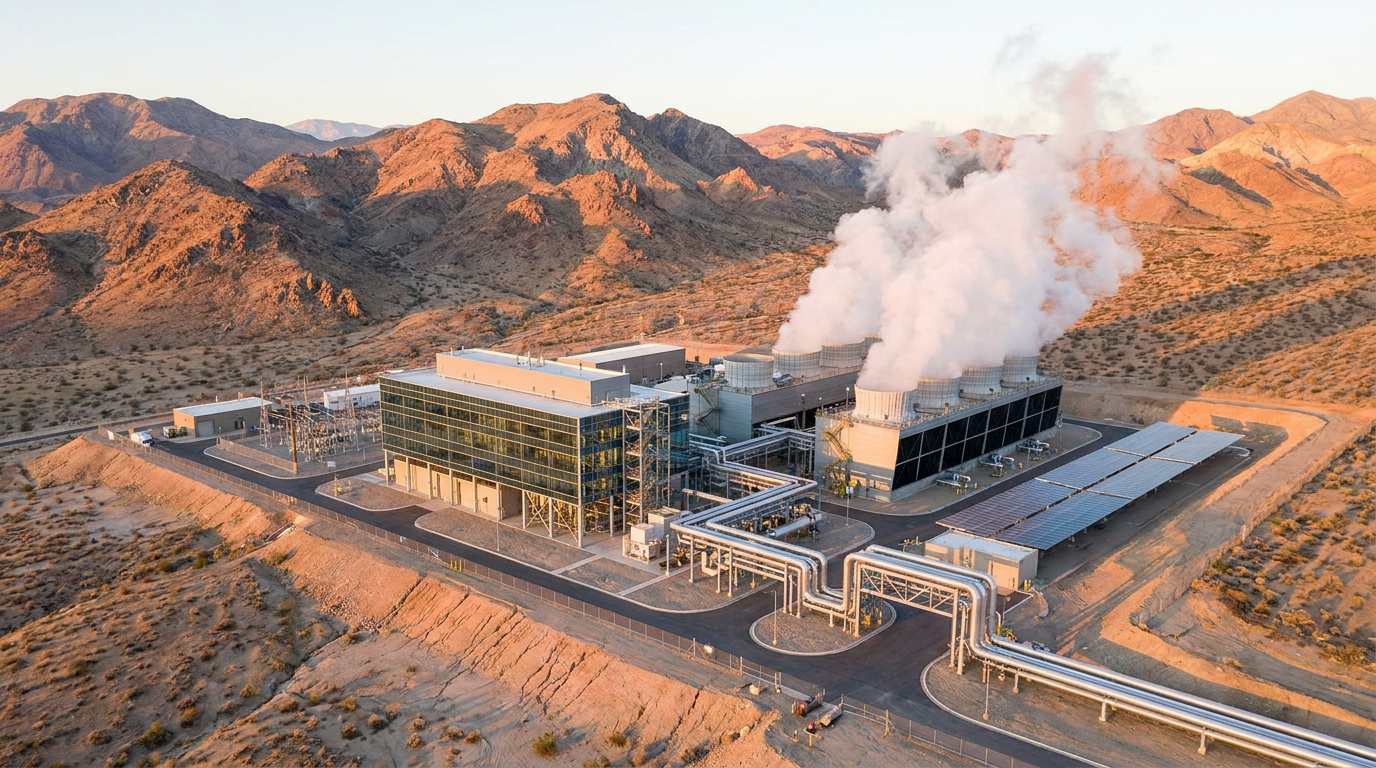
The commercial viability of this technology is no longer theoretical. In Beaver County, Utah, a Houston-based company named Fervo Energy is currently building Cape Station, the world's largest next-generation geothermal development.[1][2][5]
Cape Station serves as the ultimate proving ground for EGS bankability. In early 2026, Fervo secured $421 million in non-recourse project financing for the facility's first phase—a massive milestone indicating that conservative infrastructure lenders now view engineered geothermal as a safe, utility-scale asset.[1][2]
Cape Station serves as the ultimate proving ground for EGS bankability.
Shortly after securing this debt, Fervo went public on the Nasdaq, raising nearly $1.9 billion and achieving a market valuation exceeding $10 billion. The financial markets are betting heavily that underground heat can be reliably converted into institutional-scale power infrastructure.[2]
When Cape Station begins delivering its first power to the grid later in 2026, it will start with approximately 100 megawatts of operating capacity. By 2028, the multi-phase project is expected to scale to 500 megawatts—enough to power roughly 355,000 homes annually.[1][2]

This massive scale-up is heavily supported by power purchase agreements from major buyers, including Southern California Edison and tech giants desperate for clean, firm power to run their data centers. For companies operating massive AI infrastructure, EGS is the missing link to achieving 24/7 carbon-free energy goals.[1][6]
The rapid advancement of EGS is also driving parallel innovations in subsurface monitoring. Because injecting high-pressure fluids into fault lines carries a risk of induced seismicity—small earthquakes—precise monitoring is non-negotiable for safe operations.[4][6]
In April 2026, geophysicists from the Lawrence Berkeley National Laboratory announced a significant breakthrough at the Cape Station site. They successfully deployed a custom-built seismometer nearly 7,000 feet underground, continuously monitoring microseismic activity for seven months.[4]
The equipment operated flawlessly in extreme temperatures reaching 338 degrees Fahrenheit, marking the world's longest recorded measurement at such heat. This high-temperature monitoring allows engineers to map exactly how the rock fractures are forming in real-time, optimizing the heat extraction process while actively managing and mitigating any seismic risks before they can be felt at the surface.[4]

While EGS dominates the current commercial push, the geothermal sector is also advancing a parallel track known as Advanced Geothermal Systems (AGS). Rather than fracturing rock to circulate fluid, AGS uses sealed, closed-loop well architectures—essentially functioning as a giant underground radiator.[3][5]
In an AGS setup, a working fluid circulates entirely inside pipes embedded in the hot rock, absorbing heat through conduction. Because no fluid is injected directly into the geological formation, AGS eliminates the risk of induced seismicity and requires zero groundwater, though it generally yields lower power output than EGS.[3][5]

The implications of mastering these next-generation geothermal technologies are staggering. The U.S. Department of Energy's Geothermal Technologies Office projects that advanced geothermal could provide at least 90 gigawatts of electricity-generating capacity by 2050.[3]
That projection includes deploying geothermal power in states east of the Mississippi River, where no such generation currently exists. By decoupling geothermal energy from volcanic geography, EGS transforms the Earth's crust into a ubiquitous, inexhaustible battery.[3][6]
As the energy transition enters its most challenging phase—balancing the need for absolute reliability with the mandate for zero emissions—Enhanced Geothermal Systems offer a rare, scalable solution. The technology that once extracted carbon from the ground is now being flipped to leave it behind.[3][6][8]
How we got here
2023
Fervo Energy completes a successful 30-day flow test at a pilot site, proving the commercial viability of EGS.
July 2025
Berkeley Lab deploys a custom high-temperature seismometer 7,000 feet underground at Cape Station.
March 2026
Fervo Energy secures $421 million in non-recourse project financing for the first phase of Cape Station.
May 2026
Fervo Energy goes public on the Nasdaq, raising nearly $1.9 billion to scale geothermal infrastructure.
Viewpoints in depth
Clean Energy Developers
Argue that engineered geothermal is the only scalable, zero-carbon baseload power source capable of replacing fossil fuels.
For clean energy developers, the intermittency of wind and solar has always been the Achilles' heel of the renewable transition. They view Enhanced Geothermal Systems as the ultimate silver bullet: a technology that provides the absolute reliability of a coal or nuclear plant, but with near-zero emissions and a fraction of the land footprint. By repurposing the horizontal drilling and hydraulic fracturing techniques perfected by the oil and gas industry, developers argue they can rapidly scale EGS globally, turning the Earth's crust into a universal battery that isn't dependent on the weather.
Grid Operators & Tech Companies
View EGS as the critical missing link to provide the 24/7 firm power required for AI data centers and grid stability.
Grid operators and major technology companies are approaching geothermal from a perspective of sheer necessity. The explosion of artificial intelligence has created an insatiable appetite for electricity, and tech giants like Google and Microsoft have strict internal mandates to power their operations with 100% carbon-free energy. Because data centers cannot power down when the wind stops blowing, these stakeholders are aggressively funding and signing long-term power purchase agreements for EGS projects. They see geothermal not just as an environmental win, but as a critical infrastructure requirement to keep the modern digital economy running.
Subsurface Scientists
Focus on the technical execution of EGS, emphasizing the need for advanced high-temperature monitoring to optimize output and prevent induced seismicity.
Geophysicists and subsurface engineers are highly optimistic about EGS, but they remain focused on the immense technical challenges of operating miles underground. Their primary concern is managing 'induced seismicity'—the micro-earthquakes caused by injecting high-pressure fluids into rock formations. Scientists stress that the long-term viability of EGS depends entirely on advanced monitoring technologies, such as the high-temperature seismometers recently deployed by Berkeley Lab. By mapping fracture networks in real-time, they argue the industry can safely optimize heat extraction while ensuring that seismic events remain microscopic and undetectable at the surface.
What we don't know
- Whether EGS drilling costs can be driven down low enough to compete directly with cheap natural gas without federal subsidies.
- How local communities outside of traditional geothermal states will react to EGS drilling and the associated microseismic risks.
- The long-term thermal degradation rate of artificial EGS reservoirs over a 20-to-30-year lifespan.
Key terms
- Enhanced Geothermal Systems (EGS)
- A technology that creates artificial underground reservoirs by injecting fluid into hot, dry rock to extract heat for electricity generation.
- Baseload Power
- The minimum amount of electric power needed to be supplied to the electrical grid at any given time, requiring power plants that can run continuously 24/7.
- Hydro-shearing
- The process of injecting high-pressure fluid into deep rock formations to open and expand existing microscopic fractures, creating permeability.
- Advanced Geothermal Systems (AGS)
- A closed-loop geothermal technology where fluid circulates entirely within sealed underground pipes, absorbing heat through conduction without touching the rock.
- Induced Seismicity
- Minor earthquakes and tremors that are caused by human activity, such as fluid injection or extraction from the Earth's crust.
Frequently asked
Is Enhanced Geothermal the same as fracking?
It uses similar horizontal drilling and fluid injection techniques, but instead of extracting hydrocarbons, it circulates water to harvest heat. It uses lower pressures and avoids the toxic chemical cocktails associated with oil and gas fracking.
Can EGS power plants be built anywhere?
Theoretically, yes, if you drill deep enough. However, current commercial projects target regions where hot rock is accessible at 3 to 10 kilometers deep to keep drilling costs economically viable.
Why do tech companies care about geothermal energy?
AI data centers require massive, uninterrupted power 24/7. Because wind and solar are intermittent, geothermal provides the ideal zero-carbon baseload solution to meet their clean energy pledges.
Does engineered geothermal cause earthquakes?
Injecting fluid into rock can cause 'induced seismicity' (micro-earthquakes). However, operators use advanced fiber-optic and seismic monitoring to manage subsurface pressures and prevent events large enough to be felt at the surface.
Sources
Source coverage
8 outlets
4 viewpoints surfaced








[1]Fervo EnergyClean Energy Developers
Fervo Energy Secures $421 Million in Non-Recourse Project Financing for Cape Station
Read on Fervo Energy →[2]Utah Money WatchFinancial Markets
Houston-based Fervo Energy soared in its Nasdaq debut yesterday, but the company's most important proving ground is in Beaver County, Utah
Read on Utah Money Watch →[3]ITIFGrid Operators & Tech Companies
Advanced Geothermal Technologies: Transforming the U.S. Energy Mix
Read on ITIF →[4]Lawrence Berkeley National LaboratorySubsurface Scientists
Scientists Develop New Technology to Continuously Monitor Geothermal Energy Operations
Read on Lawrence Berkeley National Laboratory →[5]VallourecClean Energy Developers
Enhanced Geothermal Systems (EGS) Explained
Read on Vallourec →[6]World Economic ForumGrid Operators & Tech Companies
Enhanced geothermal systems: Deep decarbonization while minimizing land requirements
Read on World Economic Forum →[7]PatSnap InsightsSubsurface Scientists
Enhanced Geothermal Systems Technology Landscape 2026
Read on PatSnap Insights →[8]Factlen Editorial Team
Synthesis by Factlen editorial team
Read on Factlen Editorial Team →
Every angle. Every day.
Get energy stories with full source coverage and perspective breakdowns delivered to your inbox.