
How the 'Science of Reading' is Quietly Revolutionizing American Public Schools
More than 40 states have now mandated evidence-based reading instruction, abandoning decades of flawed methodology in favor of explicit phonics and structured literacy.
By Factlen Editorial Team
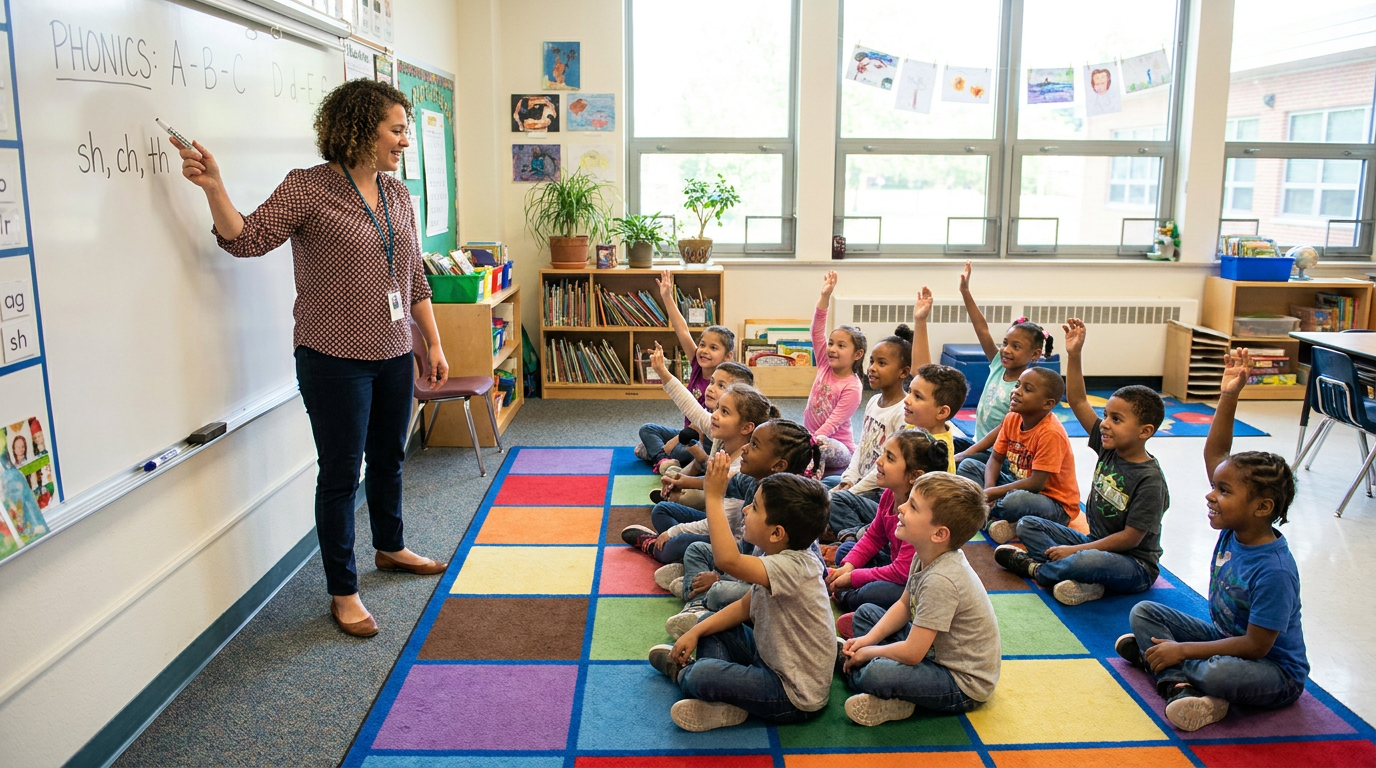
- Literacy Researchers & Cognitive Scientists
- Advocating for explicit phonics, phonemic awareness, and decoding based on brain research.
- State Policymakers
- Driving the mandate through funding, curriculum bans, and licensure changes.
- Classroom Educators
- Navigating the transition, undergoing professional development, and adapting daily instruction.
- Literacy Advocacy Groups
- Pushing for strict enforcement and tracking state-by-state legislative progress.
What's not represented
- · Publishers of legacy 'balanced literacy' curricula facing massive revenue losses
- · Parents of dyslexic students who spent years advocating for this shift
Why this matters
Reading proficiency is the foundation of all future learning and economic mobility. The nationwide shift to evidence-based literacy instruction promises to close historical achievement gaps and ensure millions of students are actually taught to read, rather than taught to guess.
Key points
- More than 40 states have now passed legislation mandating evidence-based reading instruction in public schools.
- The shift abandons 'balanced literacy' and 'three-cueing' in favor of explicit phonics and structured literacy.
- California recently committed $480 million to support the transition, marking a massive victory for literacy advocates.
- Over 80% of K-3 teachers have completed recent training in the science of reading, though some still struggle to abandon old methods.
For decades, American elementary school teachers relied on a widely accepted but fundamentally flawed assumption: that learning to read is a natural process, much like learning to speak. This belief birthed an instructional model known as "balanced literacy," which encouraged children to memorize sight words and use context clues to guess unknown text. Today, that paradigm is collapsing. In its place, a quiet but profound revolution is sweeping through the nation's K-12 public schools. Driven by decades of cognitive science and neuroscience, educators and lawmakers are rapidly adopting the "science of reading"—a comprehensive, evidence-based approach that treats reading as a skill that must be explicitly and systematically taught.[1][3]
The science of reading is not a single curriculum or a passing educational fad. Rather, it is a vast body of empirical research detailing exactly how the human brain acquires written language. At its core is a framework known as the "simple view of reading," which posits that reading comprehension is the product of two distinct capacities: decoding and language comprehension. Decoding is the mechanical ability to connect letters to sounds, while language comprehension is the ability to understand the meaning of those words in context. If a student lacks either skill, true reading comprehension cannot occur.[3][7]

This cognitive reality stands in stark contrast to the "three-cueing" method that dominated American classrooms for years. Under the cueing system, if a child encountered a difficult word, teachers were trained to ask, "What word makes sense here?" or "What does the picture show?" While this approach often produced children who appeared to be reading, it actually taught them the habits of struggling readers: guessing and skipping. Cognitive scientists have long warned that this method bypasses the brain's orthographic mapping process, which is necessary for fluent, automatic word recognition.[1][2][3]
The realization that millions of children were being taught to guess rather than read has triggered an unprecedented legislative response. By mid-2026, more than 40 states have passed laws or enacted policies requiring school districts to adopt evidence-based reading instruction. These mandates typically involve banning the three-cueing method, requiring universal dyslexia screening, and overhauling how universities train future teachers. The speed and bipartisan nature of this policy shift represent one of the most significant educational reforms in modern American history.[1][3][5]
California, the nation's largest public school system, recently marked a watershed moment in this movement. After years of resisting statewide mandates, Governor Gavin Newsom signed Assembly Bill 1454 in late 2025, requiring the state to adopt approved instructional materials for grades one through eight. To ensure the transition is successful, the state committed $480 million in its 2025-2026 budget specifically for teacher training and implementation. This massive investment signals the end of the state's decades-long experiment with whole-language reading instruction.[5]

California, the nation's largest public school system, recently marked a watershed moment in this movement.
Other states are moving with equal urgency. In New York, Governor Kathy Hochul's "Back to Basics" law required all school districts to align their curricula with the science of reading by September 2025. Meanwhile, the Massachusetts State Senate passed a sweeping early literacy bill in early 2026 by a unanimous 38-0 vote, establishing a $25 million Early Literacy Fund and mandating twice-yearly assessments for young students. In June 2026, Michigan lawmakers advanced legislation to mandate state-funded science of reading training for all K-5 educators, further cementing the regional momentum.[2][4][5]
The push for evidence-based literacy has also reached the federal level, signaling that this is a national priority rather than just a state-by-state patchwork. In March 2026, the bipartisan Science of Reading Act advanced out of the U.S. House Education and Workforce Committee with broad support. If passed, the legislation would tie federal Comprehensive Literacy State Development grants directly to science-of-reading alignment. Crucially, it would explicitly limit federal funding for any educational programs or interventions that continue to rely on the discredited three-cueing model, effectively starving outdated methods of federal tax dollars.[5][8]
While the legislative victories are clear, the reality on the ground is more complex. Changing how an entire generation of teachers delivers instruction requires a monumental logistical effort. According to a nationally representative survey conducted by the RAND Corporation and the Fordham Institute in late 2025, 82 percent of K-3 teachers reported completing at least one professional development training aligned with the science of reading in the past three years. The vast majority of these educators noted that foundational skills like phonics and phonemic awareness were a major focus of their training.[1]
However, unlearning decades of entrenched pedagogy is difficult. The same survey revealed that while most teachers now favor phonics, roughly one-third admit to still mixing in the discredited cueing methods. Educational researchers caution that this "mixed" approach can actively undermine a child's progress, as encouraging a student to guess a word contradicts the explicit decoding skills they are simultaneously being taught. Ensuring fidelity to the new methods remains the primary challenge for school administrators as they navigate this transition.[1]

Despite these implementation hurdles, the early data is highly encouraging. A recent Stanford University study examining the rollout of early literacy reforms in 66 of California's lowest-performing schools found that science-of-reading methods resulted in achievement gains equivalent to one-quarter of a school year. Crucially, these gains were achieved in chronically underperforming districts, suggesting that explicit, structured literacy instruction is one of the most effective tools available for closing the educational achievement gap and supporting students with learning differences.[3][7]
Recognizing that the literacy crisis extends beyond early childhood, policymakers are increasingly expanding their focus to older students. States like Alabama and Virginia have recently allocated millions of dollars to extend literacy support, interventionists, and specialized coaching into middle school grades. Because older students who struggle with reading often lack foundational decoding skills, these interventions are vital for ensuring they can access complex, grade-level content in subjects like science and history.[5][7]
Ultimately, the nationwide shift toward the science of reading represents a profound commitment to educational equity. For years, students from affluent families who struggled with balanced literacy could rely on private tutoring to learn phonics, while low-income students were left behind. By embedding explicit, systematic reading instruction directly into the public school curriculum, states are working to ensure that reading is no longer treated as a privilege, but as a fundamental, universally accessible civil right.[1][7]
How we got here
1990s - 2010s
The 'balanced literacy' and 'three-cueing' methods dominate U.S. reading instruction.
2019 - 2022
A wave of education journalism and cognitive science research exposes the flaws in balanced literacy, sparking a national movement.
September 2025
New York's 'Back to Basics' mandate takes effect, requiring districts to align curricula with the science of reading.
October 2025
California Governor Gavin Newsom signs AB 1454, committing $480 million to mandate evidence-based reading instruction.
March 2026
The bipartisan Science of Reading Act of 2026 advances in the U.S. House, aiming to tie federal grants to evidence-based literacy.
June 2026
Michigan passes legislation mandating state-funded science of reading training for K-5 teachers.
Viewpoints in depth
Literacy Researchers & Cognitive Scientists
Emphasize that reading is not a natural human instinct and must be explicitly taught.
This camp points to decades of fMRI brain scans and cognitive psychology studies proving that the brain must build a new neural pathway to connect visual symbols (letters) to spoken sounds (phonemes). They argue that "balanced literacy" bypassed this necessary orthographic mapping, leaving children to rely on the inefficient strategy of guessing words from context. For researchers, the shift to structured literacy is simply aligning education with established science.
State Policymakers
Focus on systemic reform through legislative mandates, funding, and accountability.
Lawmakers view the literacy crisis as an economic and civil rights emergency. Frustrated by stagnant test scores and the slow pace of change at the district level, state governments have taken the unusual step of banning specific instructional methods like "three-cueing." Their focus is on the logistics of the rollout: funding professional development, rewriting teacher licensure exams, and auditing university educator preparation programs to ensure compliance.
Classroom Educators
Focused on the practical challenges of unlearning old methods and implementing new curricula.
Teachers are on the front lines of this massive pedagogical shift. While the vast majority support the move toward phonics and have completed extensive retraining, many report feeling overwhelmed by the sheer volume of new materials. Some veteran educators also grapple with the realization that the methods they were taught in college and used for years were fundamentally flawed, making the transition both a professional and emotional undertaking.
What we don't know
- How quickly older students who were taught using balanced literacy can catch up using new middle-school phonics interventions.
- Whether university teacher-preparation programs will fully overhaul their curricula fast enough to supply schools with adequately trained new educators.
Key terms
- Science of Reading
- A comprehensive body of research from education, cognitive science, and neuroscience detailing how the human brain learns to read.
- Balanced Literacy
- An older instructional approach that attempted to balance phonics with whole-word memorization and context clues, now largely being phased out.
- Three-Cueing
- A discredited method that encourages early readers to guess unknown words using pictures or context rather than sounding them out.
- Phonemic Awareness
- The ability to identify and manipulate individual sounds (phonemes) in spoken words.
- Structured Literacy
- An explicit, systematic instructional approach that teaches decoding, spelling, and comprehension in a logical sequence.
Frequently asked
Why are schools changing how they teach reading?
Decades of cognitive research show that reading is not a natural process; it must be explicitly taught. Older methods left many students guessing words rather than actually reading them.
What happens to older students who weren't taught phonics?
Many states are now extending literacy support and interventionists into middle school grades to help older struggling readers learn foundational decoding skills.
Is the science of reading just phonics?
No. While phonics and decoding are foundational, the science of reading also heavily emphasizes vocabulary, background knowledge, and language comprehension.
How much is this transition costing?
States are investing hundreds of millions of dollars. California alone committed $480 million in its 2025-2026 budget for teacher training and new instructional materials.
Sources
Source coverage
8 outlets
4 viewpoints surfaced








[1]Education WeekClassroom Educators
How the Science of Reading Is Reshaping Teaching: What the Data Say
Read on Education Week →[2]New York FocusState Policymakers
New York School Districts' Self-Reported Alignment With Science of Reading
Read on New York Focus →[3]Stanford Graduate School of EducationLiteracy Researchers & Cognitive Scientists
How the 'science of reading' is reshaping literacy education
Read on Stanford Graduate School of Education →[4]Michigan Department of EducationState Policymakers
Michigan Children Would Benefit from Science of Reading Bills Approved Today
Read on Michigan Department of Education →[5]Phonics.orgLiteracy Advocacy Groups
States Recently Strengthening Their Approach
Read on Phonics.org →[6]Lexia LearningState Policymakers
Ohio Science of Reading Requirements: Key Highlights
Read on Lexia Learning →[7]TNTPLiteracy Researchers & Cognitive Scientists
Why does the science of reading matter?
Read on TNTP →[8]U.S. House Committee on Education and the WorkforceState Policymakers
Science of Reading Act of 2026
Read on U.S. House Committee on Education and the Workforce →

Every angle. Every day.
Get education stories with full source coverage and perspective breakdowns delivered to your inbox.