
The Science of Sleep Podcasts: How Audio Engineering and 'Cognitive Shuffling' Cure Insomnia
Millions of listeners are turning to deliberately boring stories and engineered soundscapes to fall asleep. Cognitive scientists and audio producers explain why giving the brain a 'soft place to land' is more effective than counting sheep.
By Factlen Editorial Team
- Cognitive Scientists
- Argue that sleep podcasts work by providing low-stakes stimuli that disrupt the brain's anxious thought loops.
- Audio Producers
- Focus on the craft of pacing, parasocial warmth, and acoustic engineering to create a safe auditory environment.
- Clinical Sleep Researchers
- Maintain cautious optimism, noting that while podcasts help with sleep-onset anxiety, they do not cure clinical sleep disorders.
What's not represented
- · People with severe clinical sleep apnea
- · Traditional sleep therapists
Why this matters
With nearly half of all podcast listeners using audio to help them sleep, understanding the mechanics of cognitive shuffling and acoustic masking can help you build a more effective, drug-free bedtime routine.
Key points
- Nearly half of all podcast listeners use audio to help them fall asleep.
- Sleep podcasts utilize 'cognitive shuffling' to distract the brain from anxious thought loops.
- Boring, low-stakes stories give the mind a gentle focal point without triggering alertness.
- Familiar podcast hosts provide 'parasocial' comfort, signaling safety to the nervous system.
- Audio engineers use pink and brown noise to mask disruptive environmental sounds.
- While effective for a racing mind, podcasts cannot cure clinical sleep disorders like sleep apnea.
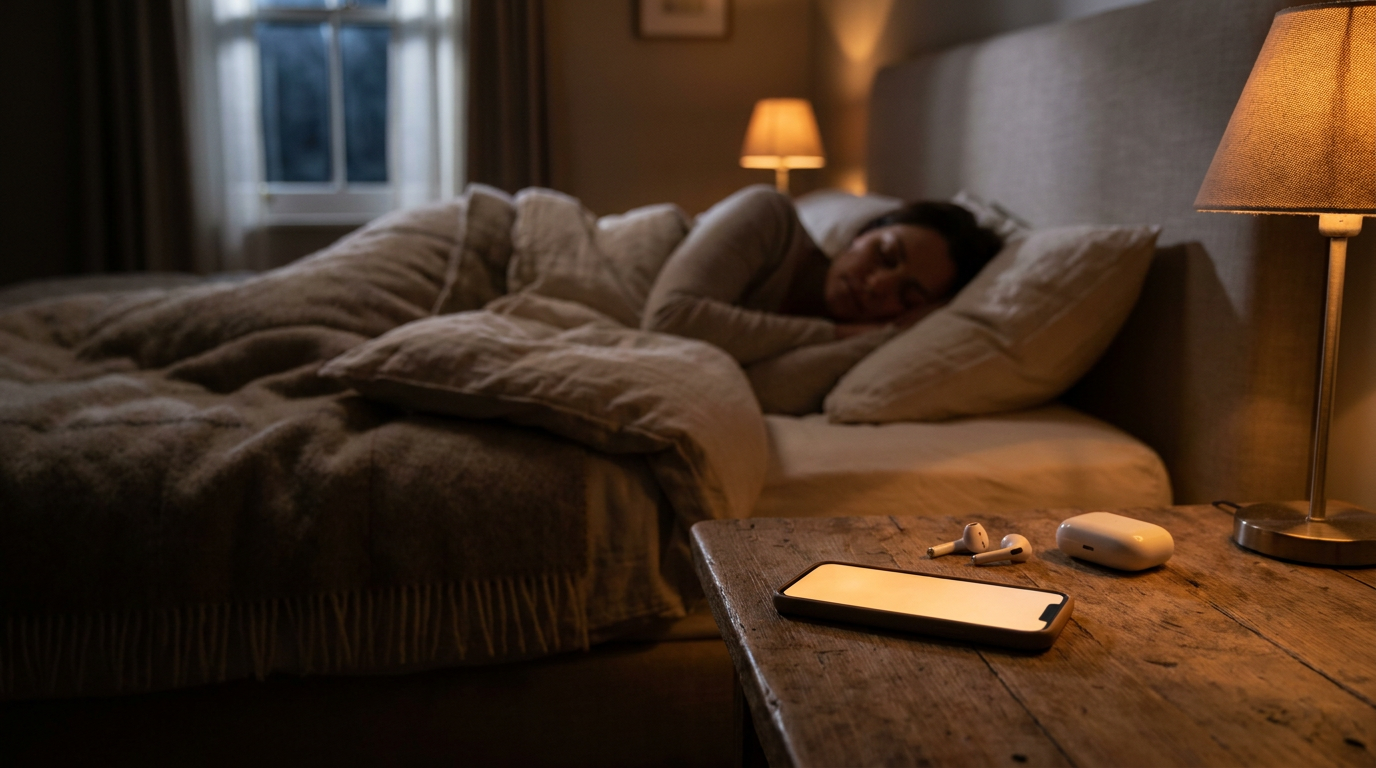
If you have ever lain awake at 2 a.m. with your mind cycling through tomorrow's to-do list or a conversation from six years ago, you understand the core problem of modern insomnia: the brain simply needs something to do.[6]
Left unstimulated in a dark room, the human mind tends to fill the silence with whatever is most unresolved or anxiety-producing. To combat this, millions of exhausted listeners are turning to an unlikely remedy: deliberately boring audio.[6]
According to recent industry data, nearly half of all podcast listeners—48 percent—now use the medium to help them fall asleep. This massive behavioral shift has spawned an entire sub-genre of audio entertainment engineered specifically to render the listener unconscious.[1]

The pioneers of this space have achieved staggering scale. Drew Ackerman, host of the long-running podcast Sleep With Me, has produced over 1,000 episodes of meandering, tangent-filled bedtime stories. His delivery is intentionally droning, designed to grab the listener's attention just enough to distract them from their own thoughts, but dull enough that the brain eventually gives up trying to follow the plot.[2]
Similarly, Kathryn Nicolai's Nothing Much Happens has amassed over 180 million streams by offering cozy narratives where the stakes are absolutely zero. A typical episode might involve a detailed description of packing a car for a trip to a cottage, or the mundane routine of a gardener. The magic lies in the architecture of the mundane.[2]
But why does boredom work so well? The answer lies in a neurological concept known as 'cognitive shuffling.' Developed by cognitive scientist Dr. Luc P. Beaudoin, the theory of Somnolent Information Processing explains how the brain transitions from wakeful alertness to sleep.[3]
When we are anxious, our brains remain locked in a state of high-arousal, logical sense-making. The threat-detection system stays online, convinced that the unresolved thoughts require immediate attention. Cognitive shuffling short-circuits this process by feeding the brain a stream of low-stakes, non-threatening, and slightly randomized imagery.[3]
By listening to a rambling story about a fictional baker or the history of metric screw threads, the listener's mind is given a gentle focal point. The narrative provides just enough cognitive load to stop the cycle of stressful thoughts, but lacks the narrative tension required to keep the brain alert.[3]

By listening to a rambling story about a fictional baker or the history of metric screw threads, the listener's mind is given a gentle focal point.
Beyond the structure of the stories, the psychological relationship between the listener and the host plays a crucial role. Media psychologists refer to this as 'parasocial interaction'—the one-sided feeling of intimacy and trust that an audience develops with a media personality.[4]
In the context of sleep podcasts, this parasocial bond is deeply comforting. Hearing the same familiar, unhurried voice every night signals safety to the nervous system. It recreates the childhood experience of being read to by a parent, lowering cortisol levels and reducing physiological arousal.[4]
Recent qualitative analysis of podcast listeners confirms that auditory immersion fosters a strong sense of perceived social presence. For people struggling with loneliness or nighttime anxiety, the asynchronous companionship of a podcast host provides tangible emotional support.[4]
Audio engineering also does heavy lifting in the quest for sleep. Producers meticulously craft the acoustic environment, often layering the host's voice over specific frequencies of ambient noise to mask disruptive environmental sounds.[2]
While 'white noise' is the most famous sleep aid, audio engineers increasingly rely on 'pink noise' and 'brown noise.' White noise contains all audible frequencies at equal intensity, which can sometimes sound harsh or static-like. Pink noise, by contrast, reduces the volume of higher frequencies, mimicking the balanced sound of steady rain or rustling leaves.[6]
Brown noise takes this a step further, heavily emphasizing low frequencies to create a deep, rumbling sound akin to a distant waterfall or the hum of an airplane cabin. These specific noise colors excel at sound-masking, drowning out sudden noises—like a passing car or a barking dog—that might otherwise jolt a sleeper awake.[6]

Some productions also experiment with binaural beats, an auditory illusion created by playing slightly different frequencies in each ear. Proponents claim this encourages the brain to synchronize its brainwaves to slower, sleep-conducive delta or theta states, though the scientific consensus on binaural beats remains mixed.[2]
Because the end goal is unconsciousness, the production ethics of sleep podcasts are uniquely strict. Producers must carefully manage volume leveling, ensuring there are no sudden spikes in laughter, sound effects, or dynamic ad insertions that could ruin a night's rest.[2]
Despite the overwhelming anecdotal success of these shows, clinical sleep researchers maintain a measured perspective. Systematic reviews of auditory stimulation for sleep have shown promising but inconsistent results when measured by objective polysomnography in a lab setting.[5]
While sleep podcasts are highly effective at reducing pre-sleep cognitive arousal—the 'racing mind' phenomenon—they are not a medical cure-all. They cannot resolve clinical sleep disorders like obstructive sleep apnea, restless leg syndrome, or severe chronic insomnia.[5]

Nevertheless, as a non-invasive, drug-free behavioral tool, the sleep podcast has proven revolutionary. By combining the ancient human tradition of storytelling with modern insights into cognitive science and acoustic engineering, creators have found a way to hack the anxious mind, offering millions a soft place to land at the end of the day.[6]
How we got here
2013
Drew Ackerman launches Sleep With Me, pioneering the 'boring bedtime story' format.
2014
Dr. Luc P. Beaudoin publishes research on Somnolent Information Processing, explaining the mechanics of sleep-onset.
2018
Nothing Much Happens debuts, proving the massive market demand for zero-stakes audio fiction.
2022
Systematic reviews in sleep medicine begin analyzing the clinical efficacy of auditory stimulation for insomnia.
2025
Industry data reveals that nearly half of all podcast listeners use the medium to help them fall asleep.
Viewpoints in depth
Cognitive Scientists
Researchers who study how the brain transitions from wakefulness to sleep.
Cognitive scientists argue that insomnia is often a problem of 'somnolent information processing.' When the brain is anxious, it remains locked in a state of high-arousal, logical sense-making. By introducing 'cognitive shuffling'—randomized, low-stakes imagery or boring narratives—the brain is tricked into abandoning its threat-detection mode. The audio provides just enough cognitive load to stop stressful thought loops, allowing the natural sleep process to take over.
Audio Producers
The creators and engineers who design sleep-inducing soundscapes.
For audio producers, putting an audience to sleep is a highly technical craft. They focus heavily on 'parasocial warmth'—ensuring the host's voice sounds like a trusted friend in the room. Furthermore, they utilize acoustic engineering, such as pink and brown noise, to mask sudden environmental sounds. Producers must also adhere to strict formatting rules, eliminating jarring volume spikes, loud sound effects, and dynamic ad insertions that could wake a listener.
Clinical Sleep Researchers
Medical professionals who study sleep disorders in laboratory settings.
While acknowledging the massive popularity of sleep podcasts, clinical researchers maintain a cautious optimism. They note that while auditory stimulation is highly effective for 'sleep-onset anxiety' (a racing mind), it is not a substitute for medical treatment. Systematic reviews show that podcasts cannot cure physiological sleep disorders like obstructive sleep apnea or restless leg syndrome, and they urge patients with chronic insomnia to seek comprehensive medical evaluations.
What we don't know
- Whether long-term reliance on sleep podcasts diminishes the brain's natural ability to fall asleep in silence.
- The exact clinical efficacy of binaural beats, which remains debated among neuroscientists.
- How the rise of AI-generated voices will impact the 'parasocial comfort' listeners currently get from human hosts.
Key terms
- Cognitive Shuffling
- A mental technique of imagining random, unrelated words or images to disrupt anxious thought loops and induce sleep.
- Parasocial Interaction
- A one-sided psychological relationship where an audience member feels a sense of intimacy and friendship with a media personality.
- Pink Noise
- A sound signal that contains all frequencies of the audible spectrum, but with more power in the lower frequencies, often compared to the sound of steady rain.
- Binaural Beats
- An auditory illusion created when two slightly different frequencies are played in each ear, which some claim encourages the brain to enter relaxed states.
- Somnolent Information Processing
- A cognitive theory explaining how the brain transitions from wakeful, logical thinking to the scattered, visual thinking that precedes sleep.
Frequently asked
What is cognitive shuffling?
It is a technique where the brain is given low-stakes, random information to process, which distracts it from anxious thoughts and signals that it is safe to fall asleep.
What is the difference between pink noise and white noise?
White noise contains all frequencies at equal intensity, which can sound harsh. Pink noise reduces higher frequencies, creating a deeper, more soothing sound like steady rain.
Can sleep podcasts cure insomnia?
They are highly effective for sleep-onset anxiety (a racing mind), but they cannot cure clinical sleep disorders like sleep apnea or restless leg syndrome.
Why do boring stories help you sleep?
They provide just enough narrative structure to hold your attention and stop you from overthinking, but lack the tension or excitement required to keep your brain alert.
Sources
Source coverage
6 outlets
3 viewpoints surfaced




[1]AcastAudio Producers
The Podcast Landscape 2025: Listener Habits and Demographics
Read on Acast →[2]PodrankerAudio Producers
The 25 Best Falling Asleep Podcasts (2026)
Read on Podranker →[3]Behaviour Research and TherapyCognitive Scientists
Somnolent information-processing: A theory of sleep-onset and insomnia
Read on Behaviour Research and Therapy →[4]National Institutes of Health (NIH)Clinical Sleep Researchers
Auditory Immersion and Perceived Social Presence in Podcast Listening
Read on National Institutes of Health (NIH) →[5]Journal of Sleep ResearchClinical Sleep Researchers
Auditory stimulation for sleep: A systematic review
Read on Journal of Sleep Research →[6]Factlen Editorial TeamAudio Producers
Synthesis by Factlen editorial team
Read on Factlen Editorial Team →


Every angle. Every day.
Get entertainment stories with full source coverage and perspective breakdowns delivered to your inbox.