
Fact-Checking the Claims: Does Ranked-Choice Voting Actually Reduce Political Polarization?
As ranked-choice voting expands across the US, a decade of empirical data reveals it significantly cools campaign rhetoric and moderates candidates, though it is not immune to deep-seated polarization.
By Factlen Editorial Team
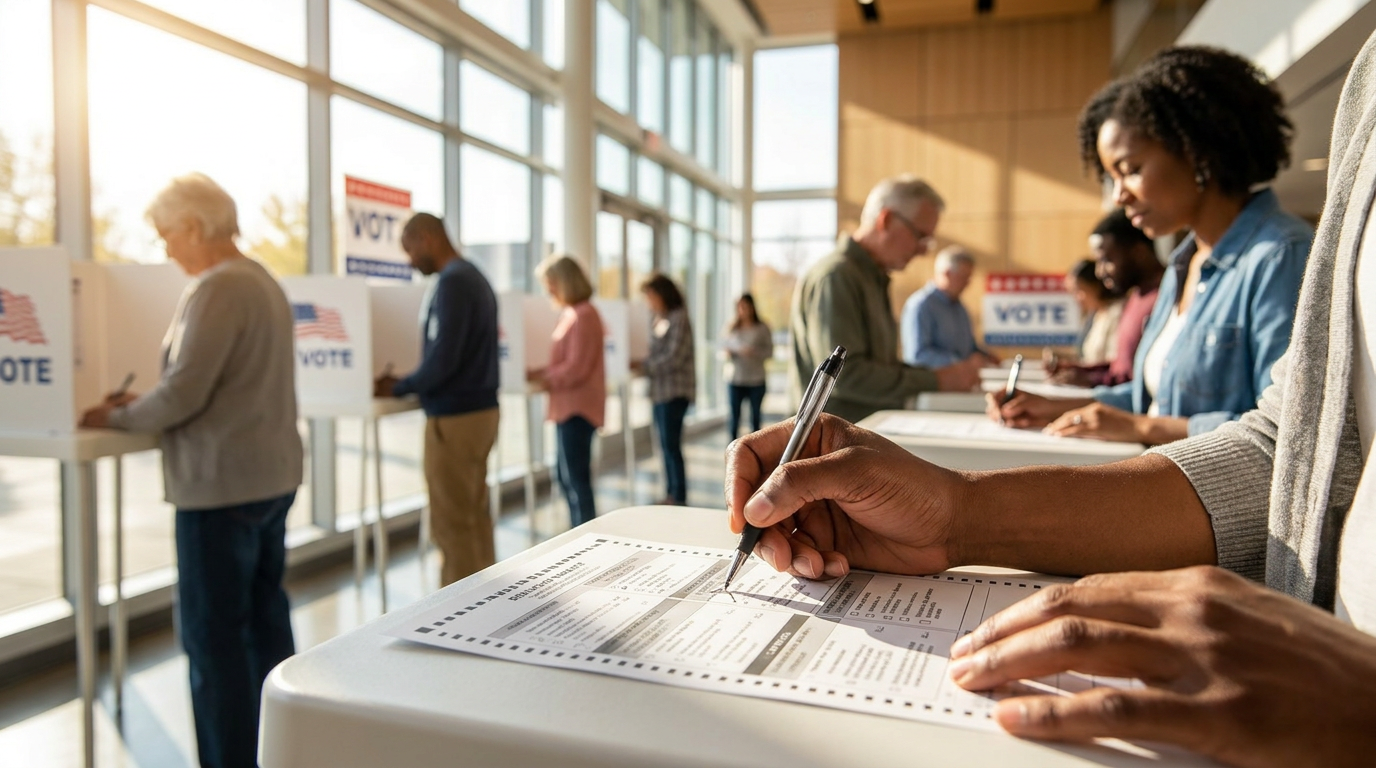
- Political Scientists
- Focus on empirical data, noting measurable improvements in civility but cautioning that success depends on candidate strategy.
- Electoral Reform Advocates
- Argue that RCV is a necessary structural change to break the two-party duopoly and incentivize consensus.
- Electoral Skeptics
- Warn that in deeply divided electorates, RCV can still eliminate moderate consensus candidates in the first round.
- Synthesis Analysts
- Evaluate the aggregate evidence to determine the real-world efficacy of voting reforms.
What's not represented
- · Local Election Administrators
- · Third-Party Candidates
Why this matters
As political polarization reaches generational highs, Ranked Choice Voting is being proposed on ballots across the country as a structural cure. Understanding what the data actually says about its impact empowers voters to make informed decisions about how their own elections should be run.
Key points
- Ranked-choice voting (RCV) requires candidates to secure a majority by earning second- and third-choice votes from rivals' supporters.
- Data shows candidates in RCV elections use significantly more positive language and engage in less negative campaigning.
- A Harvard study found a nearly 20% reduction in rhetorical extremism among congressional candidates in Maine after RCV was adopted.
- RCV eliminates the severe drop in voter turnout typically seen in traditional runoff elections.
- In highly polarized electorates, RCV can occasionally fail to elect a moderate if voters refuse to cross party lines.
The temperature of American politics has reached a boiling point, characterized by hyper-partisanship, negative campaigning, and a pervasive sense of voter exhaustion. As ideological divides widen, a growing coalition of citizens and policymakers are searching for structural solutions to repair the democratic process. In response to this strain, a reform known as Ranked Choice Voting (RCV) has rapidly transitioned from a fringe academic theory to a mainstream electoral reality. Adopted by states like Maine and Alaska, and major municipalities including New York City and Minneapolis, the system fundamentally alters the basic mechanics of how ballots are cast and counted.[7]
Instead of selecting a single candidate in a winner-take-all contest, RCV allows voters to rank their preferences—first choice, second choice, third choice, and so on. If no candidate secures an outright majority of first-place votes, the lowest-polling candidate is eliminated. The votes of those who supported the eliminated candidate are then instantly transferred to their second choices. This process of elimination and redistribution repeats until a single candidate crosses the fifty-percent threshold, ensuring a consensus winner. Advocates promise that this simple mechanical tweak can cool the political temperature and break the stranglehold of ideological extremes. But as RCV expands its footprint, political scientists are no longer relying on theory; they finally have the empirical data to grade the reform.[7]

The central, most heavily scrutinized claim regarding Ranked Choice Voting is that it forces candidates to campaign more civilly. In a traditional plurality election, candidates often win by tearing down their opponents, suppressing rival turnout, and catering exclusively to a narrow, highly motivated base. Under RCV, that strategy is mathematically perilous. Because a candidate often needs second- or third-choice votes from their rivals' supporters to win a tight race, alienating another camp's base becomes a fatal error. The structural incentive shifts from "destroy the opposition" to "become everyone's acceptable second choice."[1][6]
To determine if this theory holds up in practice, a landmark study published in the journal Politics and Governance analyzed campaign communications across both RCV and non-RCV cities. The researchers collected candidate tweets, debate transcripts, and local newspaper coverage, utilizing text-analysis software to measure the tone of the races. The data revealed a measurable and significant shift: candidates operating under Ranked Choice Voting used substantially more positive and inclusive language compared to their counterparts in traditional plurality races. Rather than ignoring or attacking their opponents, candidates in RCV jurisdictions actively engaged with rival campaigns, sometimes even cross-endorsing each other to secure backup votes.[1]
This shift in elite behavior directly impacts how the public experiences elections. Extensive survey data compiled by electoral reform organizations and academic institutions indicates that citizens in RCV jurisdictions are twice as likely to report that their local campaigns were "a lot less negative." Furthermore, voters in these cities expressed significantly higher satisfaction with the overall conduct of the election. By changing the rules of engagement, RCV successfully alters the psychological environment of the campaign trail, replacing zero-sum hostility with a degree of mutual accommodation.[4][6]
However, a polite campaign does not necessarily guarantee moderate governance. Critics often ask whether Ranked Choice Voting actually reduces ideological extremism among elected officials, or if it merely encourages extremists to use nicer language. To answer this, researchers at Harvard University conducted a comprehensive analysis of candidate platforms in Maine, which became the first state to adopt RCV for federal elections in 2018. The study sought to quantify the actual policy positions candidates were taking before and after the electoral rules changed.[2]
However, a polite campaign does not necessarily guarantee moderate governance.
By utilizing text-based analysis of campaign platforms from 2006 through 2024, the Harvard researchers uncovered striking results. The implementation of ranked ballots led to a nearly 20 percent reduction in rhetorical extremism among candidates for the U.S. House of Representatives. Faced with an electoral system that explicitly rewards broad appeal, candidates systematically moderated their policy platforms to ensure they remained palatable to the median voter. The data suggests that RCV does not just change campaign tone; it actively pulls the ideological center of gravity back toward the middle.[2]

Beyond civility and moderation, proponents argue that Ranked Choice Voting enhances democratic participation. The empirical evidence regarding voter turnout presents a nuanced but largely positive picture. While the adoption of RCV does not always trigger a massive, across-the-board surge in general election turnout, it effectively solves specific participation crises that plague traditional systems. Most notably, it eliminates the phenomenon known as "runoff drop-off," preserving the voice of the broader electorate.[4]
In traditional electoral frameworks, if no candidate wins a majority, a separate runoff election is held weeks later. These secondary elections notoriously suffer from severe voter fatigue, with turnout routinely plummeting by 30 to 50 percent. Because RCV functions as an "instant runoff," it captures maximum voter participation on Election Day. The American Bar Association notes that this mechanism ensures the final outcome is decided by the largest possible electorate, rather than a small fraction of highly partisan voters who bother to return to the polls a month later.[4]

Furthermore, the structural incentives of RCV appear to mobilize historically disengaged demographics. Research analyzing individual-level voter turnout across multiple municipal elections found that RCV specifically boosted participation among younger voters. Because candidates under RCV are forced to conduct broader, more inclusive voter outreach rather than simply turning out their most reliable base, younger voters received more direct contact and engagement. This increased outreach, combined with a less toxic campaign tone, acts as a positive mobilizing force for a demographic that traditionally reports high levels of political pessimism.[1]
Despite these measurable successes, the evidence pack also highlights critical limitations, proving that Ranked Choice Voting is not a magical cure for a deeply fractured society. A 2023 study from New York University modeled RCV in highly polarized environments and uncovered a potential structural vulnerability known as the "center squeeze." If an electorate is strictly divided into two extreme, hyper-partisan camps that refuse to rank moderate candidates, the system can backfire and fail to elect the most representative leader.[3]
In such highly polarized scenarios, a consensus candidate located at the ideological center might be everyone's second choice, but fail to secure enough first-choice votes to survive the initial elimination round. Consequently, the moderate is eliminated early, leaving the electorate to choose between the two extremes—exactly the outcome RCV was designed to prevent. This mathematical reality demonstrates that RCV cannot force consensus onto an electorate that is entirely unwilling to compromise.[3]
This vulnerability underscores a vital caveat identified by researchers at the University of Houston: Ranked Choice Voting only reduces polarization under specific conditions. The moderating effect is highly dependent on candidate strategy and voter behavior. Candidates must actively seek to maximize their second- and third-choice vote shares, and voters must be educated enough to utilize their full ballot. If voters treat an RCV ballot like a traditional plurality ballot—voting for only one candidate and leaving the rest blank—the system's consensus-building mechanisms are completely neutralized.[5]

Ultimately, the empirical data gathered over the past decade confirms that Ranked Choice Voting fundamentally alters the incentive structure of American elections. It is not a silver bullet that can instantly heal deep-seated national divisions, and it requires active participation from an informed electorate to function optimally. However, the evidence strongly supports the core claims of its advocates: RCV acts as a powerful structural cooling mechanism. By rewarding broad coalitions, penalizing toxic negative campaigning, and ensuring that winners possess genuine majority support, Ranked Choice Voting offers a data-backed pathway toward a more functional democracy.[7]
How we got here
2004
San Francisco implements RCV for municipal elections, sparking modern interest in the reform.
2018
Maine becomes the first state to use RCV for federal elections, providing a major dataset for researchers.
2020
Alaska voters approve a ballot measure adopting open primaries and RCV general elections.
2021
New York City uses RCV for its mayoral primary, marking the largest use of the system in US history.
2024-2026
Dozens of additional municipalities and several states introduce RCV ballot measures amid rising national polarization.
Viewpoints in depth
Electoral Reform Advocates' View
RCV is a necessary structural change to break the two-party duopoly and incentivize consensus.
Advocates argue that the root cause of American political dysfunction is the plurality voting system, which rewards hyper-partisanship and punishes compromise. By eliminating the 'spoiler effect,' RCV allows voters to support their true favorite candidates without fear of accidentally helping their least favorite win. Organizations like FairVote point to data showing that RCV consistently elects candidates with broader mandates, forcing politicians to govern with the whole electorate in mind rather than just a narrow, radicalized base.
Political Scientists' View
Empirical data shows measurable improvements in civility, but success depends heavily on candidate strategy.
Academic researchers take a data-driven approach, confirming that RCV does lower the temperature of campaigns and reduces rhetorical extremism. However, they caution against viewing it as a panacea. Studies from institutions like Harvard and the University of Houston emphasize that the system's benefits are conditional. If candidates refuse to campaign for second-choice votes, or if voters 'bullet vote' (selecting only one candidate), the moderating effects of RCV evaporate. The system provides the tools for consensus, but the electorate must choose to use them.
Electoral Skeptics' View
In deeply divided electorates, RCV can still eliminate moderate consensus candidates in the first round.
Skeptics and formal modelers, such as those at New York University, warn of the 'center squeeze' phenomenon. In a highly polarized environment, voters may rigidly rank only their partisan allies. A moderate candidate who is everyone's acceptable second choice might receive very few first-choice votes, leading to their elimination in the very first round. In these scenarios, RCV fails to elect the true consensus candidate, demonstrating that structural reforms cannot entirely override deep-seated cultural polarization.
What we don't know
- Whether RCV's moderating effects will hold up in highly polarized presidential general elections.
- If the increase in youth voter turnout seen in municipal RCV elections will consistently translate to federal races.
Key terms
- Instant Runoff Voting (IRV)
- The most common form of ranked-choice voting in the US, where the lowest-polling candidates are eliminated and their votes transferred until one candidate reaches a majority.
- Plurality Voting
- The traditional US election system where the candidate with the most votes wins, even if they do not secure a majority.
- Spoiler Effect
- When a third-party candidate draws votes away from a major candidate with similar views, inadvertently helping their mutual opponent win.
- Center Squeeze
- A scenario in highly polarized RCV elections where a moderate consensus candidate is eliminated early due to a lack of first-choice votes.
Frequently asked
What happens if my first choice is eliminated?
Your vote instantly transfers to your highest-ranked remaining candidate, ensuring your ballot still counts toward the final outcome.
Does ranked-choice voting favor one political party?
No. Empirical research indicates RCV favors candidates who can build broad coalitions and appeal to the median voter, regardless of their party affiliation.
Do voters find the ranked ballots confusing?
Exit polls consistently show high comprehension; in NYC's 2021 primary, over 90% of voters across all demographics found the ballot simple to complete.
Does RCV increase voter turnout?
While it doesn't always cause a massive surge in general turnout, it significantly boosts youth participation and eliminates the massive drop-off seen in traditional runoff elections.
Sources
Source coverage
7 outlets
4 viewpoints surfaced






[1]Politics and GovernancePolitical Scientists
Using Campaign Communications to Analyze Civility in Ranked Choice Voting Elections
Read on Politics and Governance →[2]Harvard UniversityPolitical Scientists
More Choices, Less Extremism: The Effect of Ranked-Choice Voting on Political Extremism in Maine
Read on Harvard University →[3]New York UniversityElectoral Skeptics
Ranked Choice Voting, Polarization, and Extremism
Read on New York University →[4]American Bar AssociationElectoral Reform Advocates
Can Ranked Choice Voting Enhance American Democracy?
Read on American Bar Association →[5]University of HoustonPolitical Scientists
When Does Ranked-Choice Voting Reduce Polarization?
Read on University of Houston →[6]FairVoteElectoral Reform Advocates
Ranked choice voting lowers polarization in politics
Read on FairVote →[7]Factlen Editorial TeamSynthesis Analysts
Synthesis by Factlen editorial team
Read on Factlen Editorial Team →
More in news politics
See all 9 stories →Cognitive Science
The Science of 'Prebunking': How Cognitive Vaccines Are Defeating Misinformation
6 sources

AI Forensics
What Actually Works for Detecting AI Content in 2026: An Evidence Pack
7 sources

US-Iran Deal
US and Iran Sign Historic Ceasefire MOU, Ending 15-Week War Amid Regional Backlash
7 sources

Labor Law
House Passes Bill Mandating Binding Arbitration for First Union Contracts
8 sources
Every angle. Every day.
Get news politics stories with full source coverage and perspective breakdowns delivered to your inbox.