
How AI and Drone Swarms Are Accelerating Global Landmine Clearance
Machine learning and multispectral imaging are transforming humanitarian demining, allowing NGOs to map post-conflict zones up to 20 times faster while drastically reducing false positives.
By Factlen Editorial Team
- Humanitarian Demining NGOs
- Focuses on the practical application of technology to increase the safety of human operators and accelerate the release of land back to communities.
- Robotics & AI Researchers
- Prioritizes the advancement of sensor fusion, algorithmic accuracy, and the eventual development of fully autonomous extraction systems.
- Global Policymakers
- Emphasizes international standardization, funding efficiency, and the macroeconomic benefits of returning agricultural land to productive use.
What's not represented
- · Local farmers in post-conflict zones
- · Hardware manufacturers building the specialized drones
Why this matters
Legacy minefields trap millions of people in poverty by rendering agricultural land unusable and unsafe. Accelerating clearance not only saves lives but immediately unlocks economic recovery and food security in post-conflict regions.
Key points
- AI and drone swarms are replacing manual prodding as the primary method for mapping minefields.
- Sensor fusion allows algorithms to detect plastic mines that traditional metal detectors miss.
- The technology reduces false-positive excavations by over 80 percent, saving time and resources.
- Faster land release directly boosts food security and economic recovery in post-conflict zones.
- Human deminers are still required for the final physical extraction and neutralization of the explosives.
For nearly a century, the process of clearing landmines has been defined by a grueling, dangerous, and painstakingly slow methodology. Human deminers, clad in heavy protective gear, inch across fields with handheld metal detectors, gently prodding the earth every time they hear a beep. Because conflict zones are littered with shrapnel, bullet casings, and metallic debris, traditional detectors yield an overwhelming number of false positives. Historically, deminers have excavated up to 1,000 pieces of harmless scrap metal for every single explosive device recovered, making the goal of a mine-free world seem mathematically impossible within our lifetimes.[2][6]
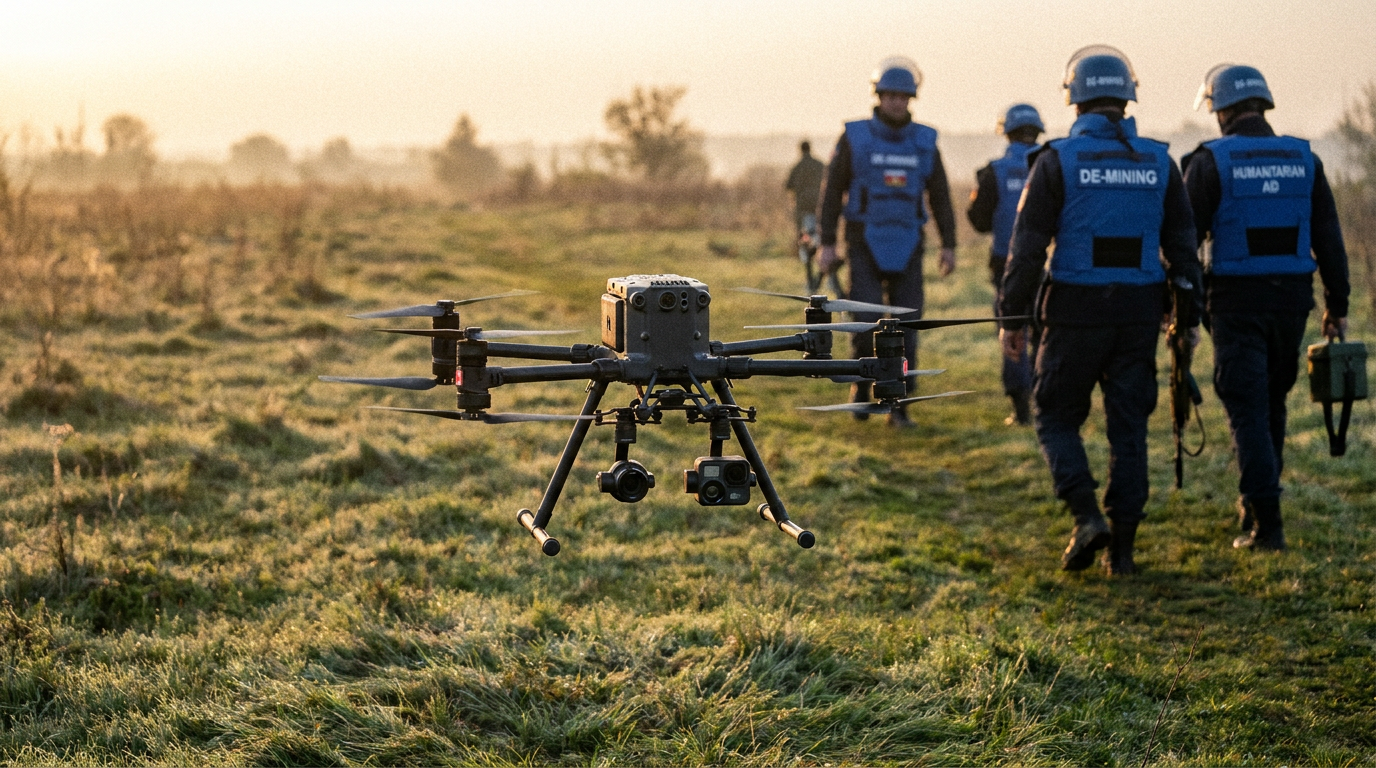
Over the past three years, however, a quiet revolution has transformed humanitarian demining from a manual crawl into a data-driven science. The integration of commercial drone swarms equipped with multispectral cameras, ground-penetrating radar (GPR), and advanced machine learning algorithms has fundamentally altered the calculus of mine clearance. By shifting the initial detection phase from the ground to the air, humanitarian organizations are mapping hazardous areas with unprecedented speed and accuracy, turning decades-long clearance projections into multi-year operational plans.[1][5]
The core of this breakthrough lies in sensor fusion and pattern recognition. Modern demining drones do not rely on a single data stream. Instead, they fly in automated grid patterns, simultaneously capturing high-resolution optical imagery, thermal signatures, and LiDAR topographical data. This multi-layered data is then fed into deep learning models trained on vast datasets of known explosive devices and environmental anomalies. The AI looks for subtle indicators that escape the human eye, such as unnatural vegetation stress caused by explosive chemicals leaching into the soil, or microscopic thermal variations where buried plastic retains heat differently than surrounding dirt.[3][5]
The empirical results of this technological shift are striking. According to the latest field evaluations published in the Journal of Field Robotics, AI-assisted drone mapping can survey a suspected hazardous area up to 20 times faster than a traditional human team. More importantly, the algorithms excel at distinguishing between a buried anti-personnel mine and a piece of rusted farm equipment. In controlled trials across varied terrains, the integration of AI analysis reduced false-positive excavation rates by over 80 percent, allowing human deminers to focus their perilous work exclusively on actual threats.[3]

The HALO Trust, one of the world's largest humanitarian demining organizations, has been at the forefront of deploying these systems in active post-conflict zones. Their recent operational reports highlight how machine learning is being used not just to find mines, but to definitively prove where mines are not. In humanitarian demining, releasing safe land back to communities is just as critical as extracting explosives. By using AI to rapidly verify that vast tracts of suspected land are entirely clear of anomalies, NGOs can return agricultural fields to farmers months or years ahead of traditional schedules.[2]
This capability has profound economic implications. In countries like Angola, Cambodia, and Colombia, legacy minefields disproportionately affect rural, agrarian communities. When a field is suspected of containing explosives, it is cordoned off, depriving families of their primary source of income and food. The United Nations Mine Action Service (UNMAS) notes that the accelerated land release facilitated by drone mapping has a direct, measurable impact on local GDP and food security, transforming idle, dangerous zones back into productive economic assets almost immediately upon certification.[1][6]
The technology is particularly effective against modern, plastic-cased mines, which have long been the bane of humanitarian clearance efforts. Because these devices contain minimal metal—sometimes just a tiny firing pin—traditional electromagnetic detectors struggle to locate them without being calibrated to a sensitivity level that triggers on every iron-rich rock. Ground-penetrating radar mounted on low-flying drones, combined with AI trained to recognize the specific dielectric signature of plastic explosives, has largely solved this decades-old engineering challenge.[3][4]

The technology is particularly effective against modern, plastic-cased mines, which have long been the bane of humanitarian clearance efforts.
Despite these massive leaps in detection capability, the Geneva International Centre for Humanitarian Demining (GICHD) stresses that AI is an augmentation tool, not a complete replacement for human expertise. The current generation of algorithms excels at mapping and probability scoring, generating highly accurate "heat maps" of a minefield. However, the physical extraction and neutralization of the devices—the "last mile" of demining—still requires the steady hands and judgment of trained human professionals. The AI tells them exactly where to dig, but it cannot dig for them.[4]
Furthermore, the technology faces distinct environmental limitations. While drone-based multispectral imaging performs exceptionally well in arid environments, open plains, and sparse vegetation, its efficacy drops significantly in dense jungle canopies where the ground is obscured. Researchers are currently attempting to bridge this gap by developing autonomous, ground-based robotic rovers that can navigate beneath the tree line, utilizing the same AI sensor fusion models to map terrain that aerial drones cannot see.[3][5]
Data sovereignty and algorithmic bias also present ongoing challenges for the sector. Machine learning models trained primarily on the soil compositions and mine types found in Eastern Europe may underperform when deployed in the distinct laterite soils of Southeast Asia or Sub-Saharan Africa. To combat this, UNMAS and partner organizations are building open-source, globally distributed training datasets, ensuring that demining algorithms are continuously fine-tuned with localized environmental data to maintain high confidence intervals regardless of geography.[1][4]
The standardization of these technologies is moving rapidly. In early 2026, the GICHD released the first comprehensive international guidelines for the use of AI in mine action. These standards establish rigorous testing protocols that any machine learning model must pass before being certified for field use, ensuring that the push for speed does not compromise the absolute safety guarantees required in humanitarian demining. The guidelines mandate transparent confidence scoring, requiring the AI to flag areas where its detection certainty falls below 99.6 percent.[4][6]

Funding dynamics within the humanitarian sector are also shifting in response to these technological breakthroughs. Historically, demining has been a capital-intensive, slow-burn philanthropic endeavor. Today, the clear, quantifiable metrics provided by AI mapping—such as exact square footage cleared per dollar spent—are attracting new waves of investment from tech philanthropies and international development banks. Donors are increasingly willing to fund clearance operations when they can see real-time, data-backed progress dashboards rather than waiting years for manual clearance reports.[2][5]
Looking ahead, the next frontier in this space is the development of fully autonomous extraction systems. Several robotics laboratories are currently field-testing heavy-duty rovers capable of receiving the AI-generated heat maps, navigating to the precise GPS coordinates of a buried anomaly, and safely detonating or excavating the device without human intervention. While these systems are still in the prototype phase and face significant regulatory hurdles, they represent the logical conclusion of the current technological trajectory.[3][6]

The psychological impact of this technological shift on the deminers themselves cannot be overstated. For decades, demining has been one of the most stressful and dangerous professions on earth, characterized by a constant, low-level dread of the unknown. By providing teams with high-fidelity maps of exactly what lies beneath the soil before they ever step foot in a field, AI has dramatically reduced the cognitive load and physical risk borne by these frontline workers, transforming a terrifying task into a highly managed, predictable engineering operation.[1][2]
Ultimately, the integration of artificial intelligence into humanitarian demining represents one of the most unambiguous triumphs of applied machine learning to date. It is a rare instance where advanced technology is being deployed not to disrupt an industry or capture attention, but to systematically undo the lethal legacy of past conflicts. As these systems become cheaper, more robust, and more widely distributed, the international community's long-stated goal of achieving a mine-free world is transitioning from a distant utopian aspiration into a scheduled, achievable reality.[5][6]
How we got here
1940s–1990s
Humanitarian demining relies almost exclusively on handheld electromagnetic metal detectors and manual prodding.
Early 2010s
Commercial drones are first introduced to visually map the perimeter of suspected hazardous areas.
2021–2023
Researchers successfully mount lightweight ground-penetrating radar and thermal cameras onto consumer-grade heavy-lift drones.
2024–2025
Deep learning models achieve breakthroughs in sensor fusion, drastically reducing false positive rates in field trials.
Early 2026
The GICHD releases the first international standards governing the use of AI algorithms in active mine clearance operations.
Viewpoints in depth
Humanitarian Operators' View
Cautious optimism, emphasizing that AI is a powerful mapping tool but not a silver bullet.
Organizations like The HALO Trust view AI primarily as a triage mechanism. By rapidly identifying which areas of a suspected field are genuinely dangerous and which are clear, they can deploy their human teams with unprecedented efficiency. However, they consistently stress that the final act of demining—physically unearthing and disarming a decaying explosive—remains a deeply human endeavor requiring judgment that algorithms cannot yet replicate. Their focus is on using tech to keep their staff safe, rather than replacing them.
Technologists' View
Pushing the boundaries of autonomy to remove humans from the minefield entirely.
Robotics researchers and AI developers see the current drone-mapping phase as merely a stepping stone. Their ultimate goal is full autonomy: a closed-loop system where an aerial drone maps the threat, and a ground-based robotic rover is automatically dispatched to neutralize it. This camp argues that as long as humans are required for the 'last mile' of extraction, the pace of global clearance will remain bottlenecked by the limits of human endurance and safety protocols.
Post-Conflict Communities' View
Prioritizing the rapid return of agricultural land over perfect technological solutions.
For the communities living adjacent to legacy minefields, the technical specifics of sensor fusion are secondary to the economic reality of land denial. A suspected minefield means lost crops, lost income, and perpetual danger for children. From this perspective, the greatest value of AI is its ability to quickly and definitively prove that a piece of land is safe, allowing life and commerce to resume without waiting decades for manual clearance teams to arrive.
What we don't know
- How long-term environmental degradation of plastic mines will affect their thermal signatures and AI detectability over the next decade.
- Whether smaller, underfunded local NGOs will be able to afford the licensing and hardware costs of these advanced drone systems.
- How autonomous extraction rovers will navigate complex legal liabilities if a machine makes an error during disarmament.
Key terms
- Humanitarian Demining
- The process of clearing landmines to make land safe for civilian use, as opposed to military demining, which only clears a narrow path for troops.
- Sensor Fusion
- The process of combining data from multiple different types of sensors (like radar, thermal, and optical cameras) to create a more accurate analysis than any single sensor could provide.
- Ground-Penetrating Radar (GPR)
- A geophysical method that uses radar pulses to image the subsurface, highly effective at detecting buried non-metallic objects like plastic mines.
- False Positive
- In demining, a false positive occurs when a detector signals a threat, but the buried object turns out to be harmless scrap metal or debris.
Frequently asked
Does the AI actually remove the landmines?
No. Current AI and drone systems are used exclusively for mapping and detection. Once a threat is identified with high confidence, trained human deminers are dispatched to safely excavate and neutralize the device.
Can this technology find plastic landmines?
Yes. Unlike traditional metal detectors, drones equipped with ground-penetrating radar and thermal imaging can detect the unique dielectric and heat signatures of plastic-cased explosives.
Does this system work in dense forests or jungles?
Aerial drones struggle when the ground is obscured by heavy tree canopy. In these environments, researchers are developing ground-based robotic rovers to carry the same AI sensors beneath the tree line.
How does this impact local communities?
By mapping suspected areas up to 20 times faster, NGOs can quickly prove which fields are safe, allowing farmers to return to their land and resume agricultural production years ahead of schedule.
Sources
Source coverage
6 outlets
3 viewpoints surfaced






[1]United Nations Mine Action Service (UNMAS)Global Policymakers
2026 Annual Report: Integrating Artificial Intelligence into Global Mine Action
Read on United Nations Mine Action Service (UNMAS) →[2]The HALO TrustHumanitarian Demining NGOs
Accelerating Clearance: The Role of Machine Learning in Post-Conflict Zones
Read on The HALO Trust →[3]Journal of Field RoboticsRobotics & AI Researchers
Evaluating the Efficacy of Multispectral Drone Imagery and Deep Learning for Scatterable Mine Detection
Read on Journal of Field Robotics →[4]Geneva International Centre for Humanitarian Demining (GICHD)Humanitarian Demining NGOs
Standards and Guidelines for Artificial Intelligence in Mine Action
Read on Geneva International Centre for Humanitarian Demining (GICHD) →[5]MIT Technology ReviewRobotics & AI Researchers
How AI is finally solving the global landmine problem
Read on MIT Technology Review →[6]Factlen Editorial TeamGlobal Policymakers
Synthesis by Factlen editorial team
Read on Factlen Editorial Team →
Every angle. Every day.
Get defense security stories with full source coverage and perspective breakdowns delivered to your inbox.