
The Evidence Pack: Did the James Webb Space Telescope Find Signs of Life on K2-18b?
Astronomers are locked in a fierce debate over whether JWST detected dimethyl sulfide—a molecule produced by marine life on Earth—in the atmosphere of a distant exoplanet.
By Factlen Editorial Team
- Data Skeptics
- Astrophysicists who argue the detection is a statistical illusion.
- Biosignature Optimists
- Researchers and science communicators who view the initial data as a historic breakthrough.
- Astrobiology Methodologists
- Scientists focused on the theoretical frameworks of alien life detection.
What's not represented
- · Engineers designing the next generation of space telescopes who must solve the 'red noise' hardware limitations.
- · Theologians and philosophers analyzing the societal implications of confirming extraterrestrial life.
Why this matters
Confirming a biosignature on another planet would be one of the most profound discoveries in human history. Understanding how scientists debate and verify these faint signals shows us exactly where the edge of human knowledge currently lies.
Key points
- Astronomers are debating whether JWST detected dimethyl sulfide (DMS) on the exoplanet K2-18b.
- On Earth, DMS is produced almost exclusively by marine life like phytoplankton.
- The initial Cambridge study claimed a 99.7 percent confidence level in the detection.
- Independent researchers argue the signal is an illusion caused by the telescope's instrumental noise.
- The planet's low density has also sparked debate over whether it has a liquid ocean or is a sterile gas giant.
- Scientists are requesting more JWST observation time to reach a definitive five-sigma conclusion.
The James Webb Space Telescope is currently peering into alien skies with unprecedented clarity, revealing atmospheric chemistry that was invisible just a decade ago. In June 2026, astronomers announced the discovery of salt clouds on the "Pink Planet" GJ504b, adding to a growing catalog of bizarre exoplanetary weather.[7]
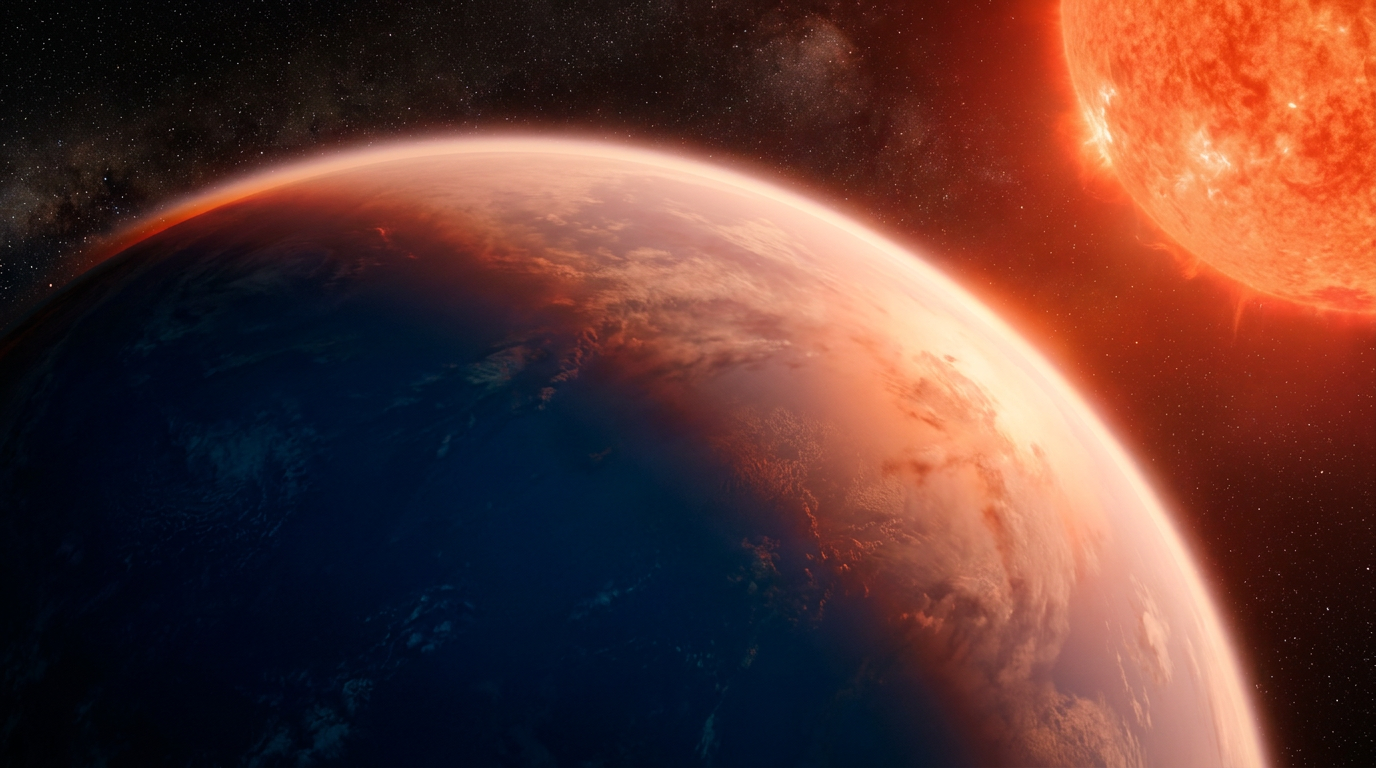
But the telescope's most profound target—and the subject of a fierce, ongoing scientific dispute—is K2-18b. Located 124 light-years away in the constellation of Leo, this sub-Neptune world has become the focal point in the search for extraterrestrial life.[6]
The core question dividing astrophysicists today is whether the space telescope has detected a biosignature, which is a chemical fingerprint of life, in the planet's atmosphere. The debate centers entirely on a molecule called dimethyl sulfide, or DMS.[3]
To understand the stakes, astronomers first examine the physical nature of K2-18b. It is roughly 8.6 times as massive as Earth and orbits within its red dwarf star's habitable zone, where temperatures could theoretically allow liquid water to pool.[6]

The research team at the University of Cambridge argues that K2-18b is a "Hycean" planet, which is a portmanteau of hydrogen and ocean. Their observations confirmed the presence of carbon-based molecules like methane and carbon dioxide, while noting a distinct lack of ammonia.[1]
In planetary modeling, this specific chemical cocktail is highly consistent with a global, liquid water ocean sitting beneath a thick, hydrogen-rich atmosphere. If true, this vast ocean could theoretically support microbial life.[1]
However, the Hycean hypothesis is heavily contested by other factions in the astronomical community. Skeptics point out that K2-18b has a low overall density of just 2.7 grams per cubic centimeter, which is less than half the density of a rocky planet like Earth.[5]
Critics argue that this low density makes K2-18b a "cold Neptune" rather than a waterworld. In this model, the planet has no solid surface or liquid ocean at all, but rather supercritical layers of gas that gradually transition into a dense fluid, rendering it entirely hostile to life as we know it.[5]

The most explosive claim in this debate emerged when the Cambridge team analyzed data from the telescope's Mid-Infrared Instrument. They reported detecting the spectral absorption lines of both dimethyl sulfide and dimethyl disulfide.[1]
The most explosive claim in this debate emerged when the Cambridge team analyzed data from the telescope's Mid-Infrared Instrument.
On Earth, dimethyl sulfide is produced almost exclusively by biological processes, primarily by marine phytoplankton and bacteria in the oceans. The Cambridge team reported their detection at a three-sigma level of statistical significance, meaning there is only a 0.3 percent probability the signal is a random fluke.[1][3]
The researchers framed this as the strongest evidence to date of possible biological activity on an exoplanet, though they carefully noted that it was not yet a definitive discovery.[1]
The pushback from the broader astronomical community has been swift and severe. Independent teams downloaded the same public telescope data and applied different data reduction and spectral retrieval methodologies.[2]
Their re-analysis concluded that the transit spectrum is highly susceptible to unresolved instrumental systematics, which is essentially red noise generated by the telescope's own sensors.[2]

When these independent researchers applied different wavelength binning schemes to the data, the chemical signal vanished. In fact, nearly 88 percent of their retrieval models found no evidence of dimethyl sulfide whatsoever. They concluded that the initial detection was an artifact of how the data was processed, not an authentic astrophysical signal.[2]
Even if the signal on K2-18b turns out to be real, astrobiologists are debating whether it constitutes definitive proof of alien life.[8]
The traditional view holds that because the molecule has no known non-living source on Earth, finding it elsewhere strongly implies biology.[3]
Astrobiologists caution against relying on any single silver-bullet biosignature gas. The chemical pathways in a hydrogen-rich atmosphere under the radiation of a red dwarf star are vastly different from those on Earth.[4][6]

Furthermore, traces of dimethyl sulfide have previously been discovered on cold, lifeless comets within our own solar system, suggesting that unknown chemical reactions can indeed produce the molecule in deep space without biology.[8]
The scientific method is currently working exactly as intended to resolve the dispute. The Cambridge team has requested up to 24 hours of additional observation time to gather more data.[1]
Their goal is to push the data past the gold-standard five-sigma threshold, which requires a 0.00006 percent probability of chance, to claim a robust scientific discovery. Until those new photons are collected and analyzed, the question of life on K2-18b remains a tantalizing, unresolved mystery at the very edge of human capability.[1][8]
How we got here
2015
The Kepler space telescope discovers K2-18b orbiting a red dwarf star 124 light-years away.
2023
Initial James Webb Space Telescope observations detect carbon-based molecules, sparking the 'Hycean' waterworld hypothesis.
April 2025
Cambridge researchers announce a 3-sigma detection of dimethyl sulfide, a potential biosignature.
August 2025
Independent teams publish re-analyses arguing the signal is an artifact of instrumental red noise.
Viewpoints in depth
Biosignature Optimists
Researchers and science communicators who view the initial data as a historic breakthrough.
This camp emphasizes that dimethyl sulfide is a highly specific molecule that, on Earth, is uniquely tied to marine life like phytoplankton. They argue that finding carbon dioxide and methane without ammonia perfectly matches the profile of a 'Hycean' waterworld. While acknowledging the need for more data, they view the 3-sigma detection as the most promising biosignature candidate in the history of astronomy, justifying the allocation of precious JWST observation hours to confirm it.
Data Skeptics
Astrophysicists who argue the detection is a statistical illusion.
Skeptics focus on the raw mechanics of how JWST's Mid-Infrared Instrument (MIRI) collects data. They point out that 'red noise'—systematic errors inherent to the telescope's sensors—can easily mimic the faint absorption lines of a gas. By running the exact same public data through different wavelength binning algorithms, they demonstrated that the dimethyl sulfide signal disappears in nearly 88 percent of scenarios. They warn that premature announcements damage the credibility of the exoplanet hunting field.
Astrobiology Methodologists
Scientists focused on the theoretical frameworks of alien life detection.
This group takes a step back from the specific K2-18b data dispute to question the underlying assumptions of biosignatures. They argue that the astronomical community is too reliant on Earth-centric biology. Because traces of dimethyl sulfide have been found on comets, they hypothesize that the extreme radiation and hydrogen-rich environment of a sub-Neptune could synthesize the molecule abiotically. They advocate for moving away from 'silver bullet' gases and instead looking for complex, multi-gas ecological imbalances.
What we don't know
- Whether K2-18b actually possesses a liquid water ocean or is composed of supercritical gas.
- If the dimethyl sulfide signal will survive further scrutiny with additional JWST observation hours.
- Whether unknown, non-biological chemical processes could produce dimethyl sulfide in a hydrogen-rich atmosphere.
Key terms
- Transit spectroscopy
- A technique where astronomers analyze the starlight passing through an exoplanet's atmosphere as it crosses in front of its host star, revealing the chemical fingerprints of the gases present.
- Sub-Neptune
- A planet that has a larger radius than Earth but is smaller than Neptune, often featuring a thick gaseous envelope.
- Three-sigma
- A statistical measure indicating a 99.7 percent confidence level that a result is not due to random chance, often considered a 'strong hint' in physics but not a definitive discovery.
- Red noise
- Systematic, non-random background errors generated by a telescope's own instruments that can mimic or obscure real astronomical signals.
- Abiotic
- Physical rather than biological; not derived from living organisms.
Frequently asked
What is a biosignature?
A biosignature is a chemical substance, isotope, or phenomenon that provides scientific evidence of past or present life. In astronomy, it usually refers to specific gases in a planet's atmosphere that are unlikely to exist without biological processes.
Why is dimethyl sulfide (DMS) important?
On Earth, DMS is produced almost exclusively by living organisms, primarily marine phytoplankton. Finding it on another planet is considered a strong indicator that a similar biological process might be occurring.
What is a Hycean world?
A Hycean world is a theoretical type of habitable exoplanet characterized by a global liquid water ocean sitting beneath a thick, hydrogen-rich atmosphere. The term is a combination of 'hydrogen' and 'ocean'.
Why do scientists disagree on the JWST data?
Extracting chemical signatures from starlight filtered through an exoplanet's atmosphere is incredibly complex. Different teams use different statistical models and data-binning techniques to filter out the telescope's background noise, which can lead to entirely different conclusions about what gases are present.
Sources
Source coverage
8 outlets
3 viewpoints surfaced








[1]University of CambridgeBiosignature Optimists
Strongest hints yet of biological activity outside the solar system
Read on University of Cambridge →[2]arXivData Skeptics
K2-18b Does Not Meet The Standards of Evidence For Life
Read on arXiv →[3]The Washington PostBiosignature Optimists
A molecule detected on a planet 124 light-years away is produced on Earth by decaying phytoplankton
Read on The Washington Post →[4]Astrobiology.comAstrobiology Methodologists
The search for signs of life in the Universe has entered a new phase
Read on Astrobiology.com →[5]Starts With A BangData Skeptics
The Evidence for Biosignatures on K2-18b Is Flimsy at Best
Read on Starts With A Bang →[6]WikipediaAstrobiology Methodologists
K2-18b
Read on Wikipedia →[7]CBS NewsAstrobiology Methodologists
Researchers studying the universe's 'Pink Planet' have discovered an unexpected feature
Read on CBS News →[8]Factlen Editorial TeamAstrobiology Methodologists
Synthesis by Factlen editorial team
Read on Factlen Editorial Team →
Every angle. Every day.
Get science stories with full source coverage and perspective breakdowns delivered to your inbox.