
How Enhanced Geothermal Systems Work—and Why They Are Finally Powering the Grid
By borrowing horizontal drilling techniques from the oil and gas industry, next-generation geothermal projects are unlocking 24/7 clean baseload power from hot, dry rock.
By Factlen Editorial Team
- Geothermal Developers
- Argue that EGS is the missing piece of the clean energy puzzle, providing the 24/7 baseload power that wind and solar cannot.
- Energy Researchers & Scientists
- Focus on the technical mechanisms, seismic monitoring breakthroughs, and long-term grid modeling that make the technology viable.
- Factlen Editorial Team
- Synthesizes the engineering breakthroughs with the economic realities of scaling a new baseload power source.
What's not represented
- · Local communities living near EGS development sites
- · Fossil fuel industry workers transitioning to geothermal drilling
Why this matters
As the world transitions away from fossil fuels, wind and solar power alone cannot keep the grid running 24/7. Enhanced geothermal technology provides a massive, reliable source of zero-carbon baseload power that could stabilize electricity prices and support the massive energy demands of modern data centers.
Key points
- Enhanced Geothermal Systems (EGS) adapt oil and gas drilling techniques to extract heat from dry underground rock.
- Fervo Energy's successful $10 billion IPO in May 2026 signals major commercial viability for the technology.
- Drilling times have dropped by 70% over two years, rapidly driving down the capital costs of geothermal plants.
- Tech giants like Google are heavily investing in EGS to secure 24/7 clean baseload power for AI data centers.
- The first 100 megawatts of commercial EGS power will come online in Utah by late 2026.
The clean energy transition has long been haunted by a simple meteorological reality: the sun sets, and the wind stops blowing. To keep the grid running 24/7 without fossil fuels, the world needs "baseload" power—energy that is always on. For decades, nuclear power and hydroelectric dams were the only viable zero-carbon options. But in 2026, a long-overlooked technology has officially crossed the threshold from experimental pilot to commercial reality: Enhanced Geothermal Systems (EGS).[3][8]
In May 2026, Houston-based Fervo Energy went public in a blockbuster IPO, achieving an implied market capitalization of roughly $10 billion. The financial milestone signaled Wall Street's recognition that next-generation geothermal is no longer a science project. By late 2026, Fervo's Cape Station facility in Beaver County, Utah, is scheduled to begin delivering its first 100 megawatts of continuous clean power to the grid, scaling up to a massive 500 megawatts by 2028.[4][7]
To understand why this is a breakthrough, it helps to look at why traditional geothermal energy stalled out. Conventional geothermal plants rely on naturally occurring hydrothermal reservoirs. They require three specific geological ingredients to exist in the exact same place: extreme underground heat, naturally occurring fluid like water or brine, and highly permeable rock that allows the fluid to circulate freely.[1]
Finding all three of those elements together is incredibly rare. It is the geological equivalent of finding a natural hot spring that is large enough to power a city. Because these natural reservoirs are mostly confined to specific tectonic regions—like The Geysers in California or the volcanic terrain of Iceland—traditional geothermal has remained a niche contributor, historically accounting for less than half a percent of U.S. electricity generation.[1][6]

Enhanced Geothermal Systems bypass this geographical lottery by engineering the missing ingredients. Deep beneath the Earth's surface, there is a virtually limitless supply of hot, dry rock. The intense heat is already there, but the water and the permeability are not. EGS operators create a human-made reservoir to tap that stranded thermal energy.[1][3]
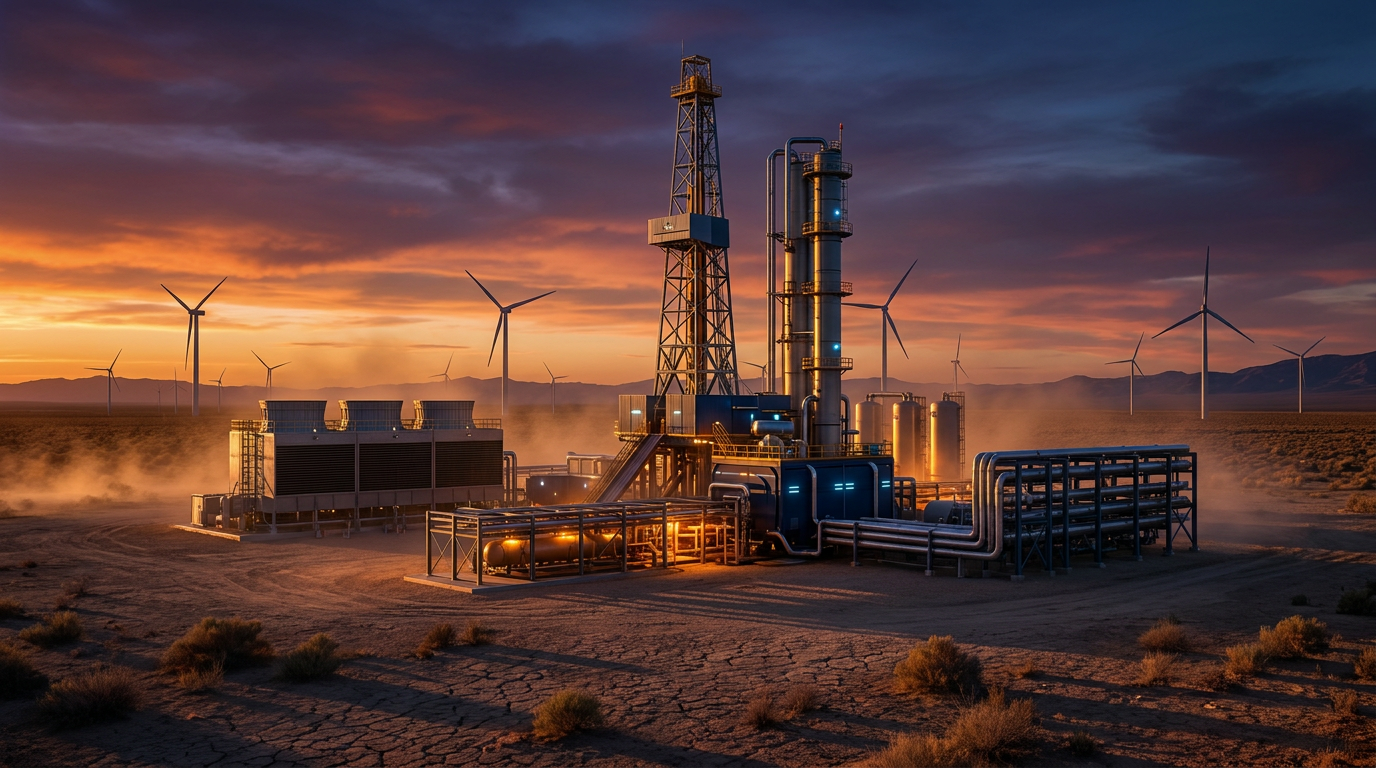
EGS solves the permeability problem by borrowing the core technologies that sparked the shale revolution in the oil and gas industry: horizontal drilling and hydraulic fracturing. Engineers drill vertical wells thousands of feet into the hot, impermeable crystalline rock, and then steer the drill bits horizontally to maximize contact with the heat source.[3]
Once the horizontal wells are established, cold water is injected at high pressure to create or reopen millimeter-thick fractures in the rock—a process known as hydro-shearing or stimulation. This creates an artificial underground radiator. Cold water is pumped down an injection well, forced through the newly created fractures where it absorbs the intense heat of the surrounding rock, and then drawn back up through a separate production well.[1][5]
At the surface, this superheated fluid—often exceeding 200 degrees Celsius—is used to flash into steam or heat a secondary working fluid, which spins a turbine to generate electricity. The cooled water is then reinjected into the ground in a continuous, closed-loop cycle, producing zero greenhouse gas emissions while running around the clock.[1][4]
The conceptual elegance of EGS has been understood for decades, but the economics of drilling through hard, hot granite were historically ruinous. Drilling costs typically account for more than half of a geothermal project's capital expenditure. If it takes months to drill a single well, the electricity produced will never be cost-competitive with natural gas, wind, or solar.[3]
The conceptual elegance of EGS has been understood for decades, but the economics of drilling through hard, hot granite were historically ruinous.
The breakthrough over the last two years has been a dramatic acceleration in drilling efficiency. By utilizing advanced drill bits and techniques refined in the shale patches of Texas and North Dakota, companies have drastically steepened the learning curve. Fervo Energy reported a staggering 70 percent reduction in drilling times between its initial pilot project in Nevada and its commercial wells at Cape Station in Utah.[3][4]

This efficiency translates directly into falling costs. Current capital expenditures for EGS are hovering around $7,000 per kilowatt of capacity, but industry analysts and developers project those costs will rapidly drop toward $3,000 per kilowatt as deployment scales. At that price point, enhanced geothermal becomes highly competitive with other forms of firm, dispatchable power.[3][4]
The demand for this 24/7 clean energy is currently being supercharged by the technology sector. The explosive growth of artificial intelligence has triggered a massive build-out of data centers, which require enormous, uninterrupted power loads that intermittent renewables cannot reliably supply on their own. In March 2026, Google Energy signed a massive framework agreement with Fervo, securing a right of first refusal on up to 3 gigawatts of future geothermal capacity.[3][4][6]
Beyond corporate buyers, major utilities are also signing on to secure grid stability. Southern California Edison recently executed two 15-year power purchase agreements totaling 320 megawatts from the Cape Station project. It stands as the largest geothermal procurement in history, sufficient to power roughly 350,000 homes with carbon-free electricity.[3]
Despite the commercial momentum, EGS still faces technical and environmental hurdles. The most prominent concern is induced seismicity. Injecting high-pressure fluid into deep rock formations can trigger micro-earthquakes. While these seismic events are typically too small to be felt at the surface, operators must carefully manage injection pressures to avoid activating larger fault lines.[3][7]
To mitigate this risk, continuous subsurface monitoring is essential. In April 2026, scientists at the Lawrence Berkeley National Laboratory announced a breakthrough in high-temperature seismic monitoring. They successfully deployed a custom seismometer nearly 7,000 feet underground at Cape Station, continuously recording data for seven months in temperatures reaching 338 degrees Fahrenheit. This real-time data allows engineers to map fracture networks safely and adjust fluid pressures before problematic seismic activity occurs.[5]

Another challenge is water usage. While the underground loop is largely closed, some fluid is inevitably lost to the surrounding rock formation over time, requiring operators to top up the system. In arid regions like the American Southwest—where the best near-surface geothermal resources are located—securing water rights for industrial use can be politically and environmentally sensitive.[3][8]
Furthermore, while the technology is advancing rapidly, the industry still relies heavily on clean energy mandates and federal subsidies to compete with legacy fossil fuels in the near term. The Department of Energy has set an aggressive "Earthshot" goal to reduce the cost of EGS to $45 per megawatt-hour by 2035, which would make it one of the cheapest forms of electricity on the grid.[3][7]
To reach that goal, the industry is increasingly turning to artificial intelligence for subsurface prospecting. Startups like Zanskar are deploying AI models to analyze geological data and identify hidden "blind" geothermal resources that show no surface signs, such as hot springs. This significantly reduces the exploration risk and the number of expensive dry holes drilled.[7]
If these cost reductions and technological advancements continue on their current trajectory, the impact on the energy transition could be profound. A recent analysis by Princeton University researchers concluded that, if EGS follows the cost-reduction curves seen in wind and solar, geothermal could supply up to 20 percent of all U.S. electricity by 2050.[2]
For an energy grid desperately seeking a reliable, clean anchor, the Earth's internal heat offers a compelling solution. By looking downward instead of upward, the energy industry is proving that the key to a zero-carbon future might just be the ground beneath our feet.[8]
How we got here
1911
The world's first commercial traditional geothermal power plant is built in Larderello, Italy.
2023
Fervo Energy completes its Project Red pilot in Nevada, proving that horizontal drilling and fracking techniques can successfully create an EGS reservoir.
Late 2025
Advanced closed-loop geothermal systems begin delivering their first commercial power.
April 2026
Berkeley Lab scientists announce a breakthrough in high-temperature seismic monitoring, deploying sensors 7,000 feet underground at the Cape Station project.
May 2026
Fervo Energy goes public in a highly successful IPO, achieving an implied market capitalization of roughly $10 billion.
Late 2026
The Cape Station project in Utah is scheduled to begin delivering its first 100 megawatts of commercial EGS power to the grid.
2035
The U.S. Department of Energy's target date to reduce the cost of EGS to $45 per megawatt-hour.
Viewpoints in depth
Geothermal Developers
Argue that EGS is the missing piece of the clean energy puzzle, providing the 24/7 baseload power that wind and solar cannot.
Industry leaders emphasize that the fundamental technology risk of EGS has been retired. By utilizing off-the-shelf horizontal drilling equipment from the oil and gas sector, developers have proven they can predictably engineer underground reservoirs. Their current focus is entirely on the learning curve: drilling faster, standardizing well designs, and driving the capital cost per kilowatt down to a level that directly competes with natural gas. They point to the massive, multi-gigawatt demand from hyperscale data centers as proof that the market is ready to pay a premium for firm, zero-carbon power.
Environmental Watchdogs
Support the zero-carbon emissions of geothermal but caution against the risks of induced seismicity and water consumption.
While broadly supportive of displacing fossil fuels, environmental groups urge caution as EGS scales from pilot projects to massive 500-megawatt facilities. Their primary concern is induced seismicity—the risk that high-pressure fluid injection could trigger damaging earthquakes if fault lines are not properly mapped. Additionally, they highlight the irony of relying on water-intensive fracturing processes in the drought-prone American Southwest, arguing that developers must prioritize closed-loop systems and strict water recycling protocols to avoid straining local aquifers.
Grid Operators & Utilities
View EGS as a critical tool for maintaining grid stability as coal and gas plants retire.
For the utilities tasked with keeping the lights on, the appeal of EGS is its dispatchability. As more intermittent wind and solar power is added to the grid, operators face severe balancing challenges when the weather changes. While massive lithium-ion battery banks can bridge short gaps, they cannot provide power for days at a time. Grid operators view enhanced geothermal as a direct, clean replacement for retiring coal and nuclear plants—a reliable anchor that can run at maximum capacity 24 hours a day, 365 days a year.
What we don't know
- Whether EGS capital costs will reliably fall to the $3,000 per kilowatt target required to compete with natural gas at scale.
- How strictly state regulators will govern water usage for geothermal injection in drought-prone western states.
- If continuous seismic monitoring can entirely prevent larger induced earthquakes as projects scale to gigawatt capacities.
Key terms
- Enhanced Geothermal Systems (EGS)
- A technology that generates electricity by injecting fluid into artificially fractured hot, dry rock deep underground to extract heat.
- Baseload Power
- The minimum amount of electric power needed to be supplied to the electrical grid at any given time, requiring energy sources that can run continuously 24/7.
- Induced Seismicity
- Minor earthquakes and tremors that are caused by human activity that alters the stresses and strains on the Earth's crust, such as high-pressure fluid injection.
- Hydro-shearing
- A technique adapted from the oil and gas industry that uses high-pressure fluid to open pre-existing, millimeter-thick fractures in underground rock.
- Power Purchase Agreement (PPA)
- A long-term contract between an electricity generator and a buyer, which guarantees a fixed price for the energy and helps secure project financing.
Frequently asked
How is enhanced geothermal different from traditional geothermal?
Traditional geothermal relies on naturally occurring underground pools of hot water. Enhanced geothermal (EGS) engineers these reservoirs by drilling into hot, dry rock and injecting water to create artificial fractures, allowing the technology to be deployed almost anywhere.
Does enhanced geothermal cause earthquakes?
The process of fracturing rock does create micro-seismic events, which are typically too small to be felt at the surface. However, operators use advanced deep-well seismometers to continuously monitor the rock and adjust fluid pressures to prevent larger, problematic earthquakes.
Why are tech companies investing in geothermal energy?
The massive energy demands of artificial intelligence data centers require 24/7 uninterrupted power. Because wind and solar are intermittent, tech companies are turning to geothermal as a reliable, zero-carbon baseload energy source.
Sources
Source coverage
8 outlets
3 viewpoints surfaced








[1]U.S. Department of EnergyEnergy Researchers & Scientists
Enhanced Geothermal Systems
Read on U.S. Department of Energy →[2]Princeton EngineeringEnergy Researchers & Scientists
Enhanced geothermal systems: An underground tech surfaces as a serious clean energy contender
Read on Princeton Engineering →[3]Information Technology and Innovation FoundationEnergy Researchers & Scientists
Advanced Geothermal Energy Is Widely Available, Clean, and Maybe Cheap Enough to Make a Big Impact
Read on Information Technology and Innovation Foundation →[4]Cleantech GroupGeothermal Developers
Fervo's IPO Establishes Enhanced Geothermal Baselines, Presents New Competition to Fission, and Adds a New LDES Class
Read on Cleantech Group →[5]Lawrence Berkeley National LaboratoryEnergy Researchers & Scientists
Scientists Develop New Technology to Continuously Monitor Geothermal Energy Operations
Read on Lawrence Berkeley National Laboratory →[6]Switchgear MagazineGeothermal Developers
Geothermal breakthrough may unlock 150 GW
Read on Switchgear Magazine →[7]The University of UtahEnergy Researchers & Scientists
Could geothermal be nation's cheapest power?
Read on The University of Utah →[8]Factlen Editorial TeamFactlen Editorial Team
Synthesis by Factlen editorial team
Read on Factlen Editorial Team →

Every angle. Every day.
Get guides stories with full source coverage and perspective breakdowns delivered to your inbox.