
The 2026 Guide to 3-Row Electric SUVs: Kia EV9 vs. Volvo EX90 vs. Rivian R1S
The electric three-row SUV market has finally matured, offering families distinct choices between ultra-fast charging, Scandinavian safety, and rugged off-road capability.
By Factlen Editorial Team
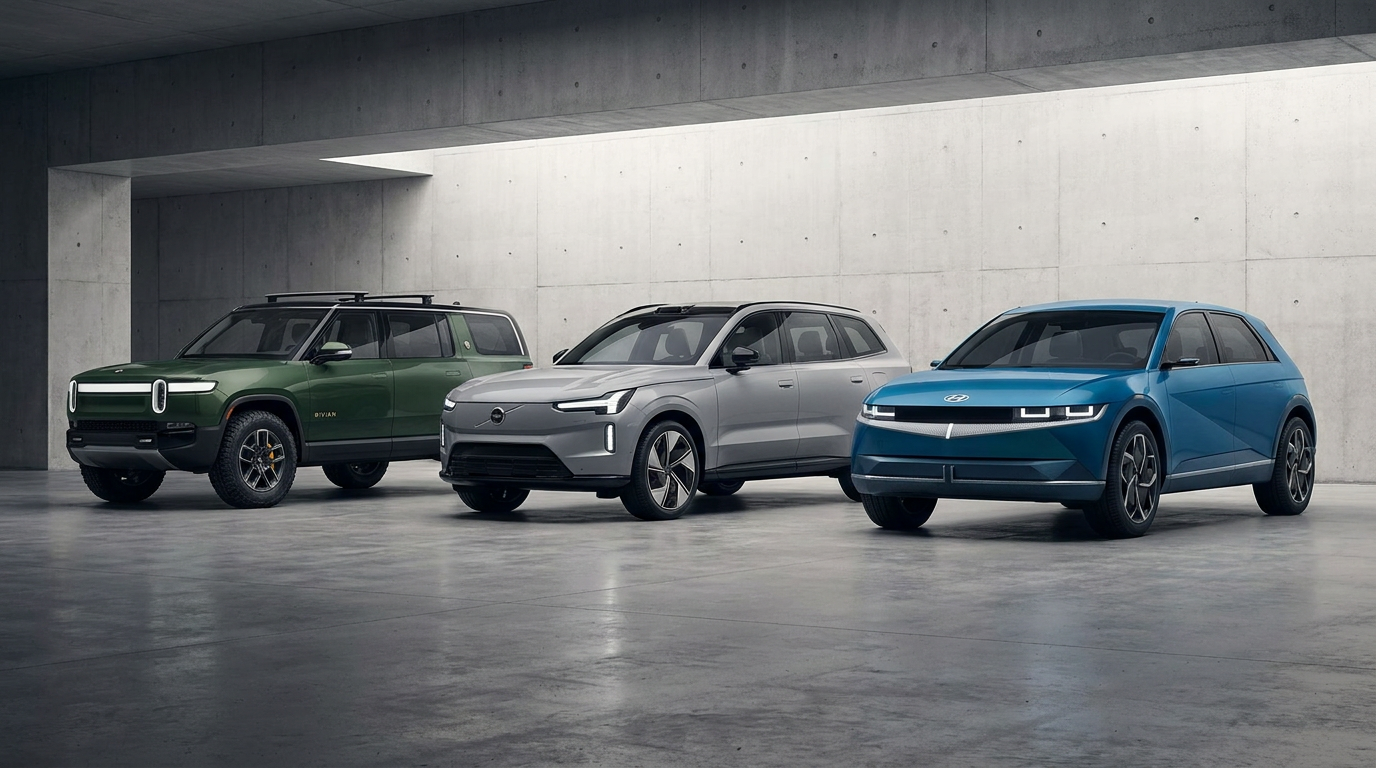
- Value & Practicality Advocates
- Focuses on charging speed, passenger volume, and accessible pricing for everyday family use.
- Safety & Luxury Traditionalists
- Prioritizes active safety tech, cabin serenity, and premium materials over raw performance.
- Adventure & Range Maximizers
- Demands maximum battery range, off-road capability, and high horsepower.
- Holistic Market Analysts
- Evaluates the entire segment to map trade-offs rather than crowning a single winner.
What's not represented
- · Minivan loyalists who prefer sliding doors
- · Buyers in rural areas with zero fast-charging infrastructure
Why this matters
For years, large families wanting to transition to electric vehicles had to compromise on space, range, or budget. The 2026 lineup of three-row EVs finally offers zero-emission solutions that can genuinely replace the traditional gas-guzzling family hauler without sacrificing road-trip capability.
Key points
- The 2026 Kia EV9 offers the best value and fastest charging, adding 100 miles in 13 minutes.
- The Volvo EX90 prioritizes safety and luxury, featuring Lidar and an interior radar system.
- The Rivian R1S Gen 2 dominates in performance, offering up to 1,025 horsepower and 410 miles of range.
- Rivian now includes a native NACS port for seamless Tesla Supercharger access.
- The Kia EV9 provides the most spacious and adult-friendly third-row seating of the group.
The three-row family SUV has long been the holy grail of the American driveway, serving as a necessary chariot for carpools, cross-country road trips, and weekend grocery runs. For years, the transition to electric vehicles left large families with few viable options, forcing buyers to compromise on passenger space, driving range, or household budgets. Early electric SUVs were either too small to comfortably seat seven or carried price tags that placed them firmly out of reach for the average consumer.
In 2026, the landscape has fundamentally shifted. The electric three-row segment has matured from a niche luxury experiment into a highly competitive and capable market. Three distinct philosophies have emerged to claim the family driveway: the pragmatic value and charging speed of the Kia EV9, the Scandinavian safety fortress of the Volvo EX90, and the rugged, go-anywhere capability of the second-generation Rivian R1S.
Factlen’s comparative analysis evaluates these three frontrunners not to crown a single, undisputed winner, but to map their specific trade-offs. Each vehicle excels under different conditions, and choosing the right one requires weighing the case for and against each model based on daily driving habits, charging infrastructure, and budget constraints.[9]
The case for the 2026 Kia EV9 rests heavily on its unparalleled blend of charging speed, interior space, and approachability. Built on Hyundai Motor Group’s advanced 800-volt architecture, the EV9 can accept a 230-kilowatt DC fast charge, allowing it to add roughly 100 miles of range in just 13 minutes. For families navigating tight schedules and impatient toddlers, this rapid turnaround makes the EV9 one of the most practical road-trip vehicles on the market.[1][4]

Inside, the Kia EV9 feels purpose-built for the chaos of family life. Reviewers consistently praise the spaciousness of the third row, noting that it comfortably accommodates adults—a rarity even among massive gas-powered SUVs. The flat floor, abundant USB-C ports, and thoughtful storage cubbies demonstrate a clear focus on everyday usability, while the GT-Line trim adds upscale touches like relaxation seats and dual moonroofs.[4][5]
The evidence against the Kia EV9 centers on its base-model range and material choices. The entry-level Light trim, while budget-friendly, offers a more modest range that may induce anxiety on longer trips. Furthermore, while the upper trims are undeniably upscale, some critics note the presence of lower-grade plastics in less visible areas, reminding buyers that this is still a mass-market brand stretching into luxury pricing territory. The EV9 fits well when a family prioritizes rapid charging, maximum interior volume, and a traditional, easy-to-use interface. It does not fit when the primary use case involves heavy off-roading or when buyers demand top-tier, bespoke luxury materials throughout the cabin.[1][4][5]
The evidence against the Kia EV9 centers on its base-model range and material choices.
Shifting to the 2026 Volvo EX90, the primary argument is rooted in uncompromising safety, serene comfort, and minimalist luxury. As the electric successor to the beloved XC90, the EX90 introduces a suite of advanced driver-assistance systems. This includes an interior radar designed to prevent children or pets from being left behind, and an optional roof-mounted Lidar system that can see hundreds of meters down a pitch-black road, creating a virtual safety shield around the vehicle.[1][2]
The EX90’s cabin is a masterclass in Scandinavian design. Featuring sustainable wool-blend upholstery, a massive panoramic glass roof, and a 24-speaker Bowers & Wilkins sound system, the interior is designed to be a calming sanctuary. The dual-motor setup delivers up to 670 horsepower in the Performance trim, providing effortless, near-silent acceleration that masks the vehicle's immense size.[1][3]

The evidence against the Volvo EX90 lies in its sheer mass and its heavy reliance on touchscreen controls. Weighing in at over 6,000 pounds, the EX90’s bulk is noticeable on winding roads, where the air suspension struggles to completely hide the vehicle's weight during spirited driving. Additionally, Volvo has moved nearly all physical buttons—including mirror and steering column adjustments—into the central touchscreen, a decision that has frustrated reviewers who prefer tactile controls. The EX90 fits well when buyers demand the highest safety standards, whisper-quiet highway cruising, and a premium, lounge-like interior. It does not fit when budget is a strict constraint or when drivers prefer physical buttons over screen-centric interfaces.[1][2][3]
For those whose weekends involve dirt roads, towing, and wilderness exploration, the case for the second-generation 2026 Rivian R1S is unmatched. Rivian has refined its flagship SUV, introducing a native NACS port for seamless access to the Tesla Supercharger network without an adapter. Furthermore, the available Max battery pack pushes the EPA-estimated range to an impressive 410 miles, effectively eliminating range anxiety for most drivers.[6][7]
The R1S is a genuine off-road powerhouse. Its adaptive air suspension can raise the vehicle to provide 15 inches of ground clearance, allowing it to ford deep water and tackle rocky trails that would leave the Kia and Volvo stranded. With power outputs ranging from a robust 533 horsepower in the Dual-Motor to a staggering 1,025 horsepower in the Quad-Motor variant, the R1S delivers sports-car acceleration in a seven-seat package.[6][7]

The arguments against the Rivian R1S focus on its premium pricing, technological walled garden, and driving dynamics. The R1S is the most expensive of the trio, with top trims easily exceeding $120,000. Furthermore, Rivian continues to omit Apple CarPlay and Android Auto, forcing users to rely on its proprietary infotainment system. Some drivers also note that the aggressive regenerative braking takes a few days to master. The R1S fits well when maximum range, off-road capability, and raw performance are non-negotiable. It does not fit when buyers require Apple CarPlay, or when the sheer size and aggressive regenerative braking feel too intimidating for simple urban commuting.[6][7][8]
When comparing cargo and utility, the differences between the three models become stark. The Rivian R1S swallows gear with up to 104.7 cubic feet of total storage and a massive 11.1-cubic-foot front trunk. The Kia EV9 counters with superior third-row passenger comfort and a highly configurable second row. The Volvo EX90 splits the difference, offering a highly refined cargo area with clever hooks and straps, though its third row is noticeably tighter than the Kia's and is best reserved for children.[2][5][6]

Ultimately, the 2026 electric three-row market proves that families no longer have to settle for a one-size-fits-all solution. The Kia EV9 democratizes the segment with ultra-fast charging and cavernous space. The Volvo EX90 elevates the daily commute into a silent, hyper-safe luxury experience. The Rivian R1S invites families to venture further off the grid without leaving anyone behind. By understanding the specific conditions where each vehicle excels, buyers can confidently transition their family fleets into the electric era.[9]
How we got here
Late 2023
Kia launches the EV9, bringing the first mainstream, relatively affordable three-row electric SUV to the market.
Mid 2024
Rivian introduces the Gen 2 updates for the R1S, overhauling the suspension and adding native NACS charging ports.
Early 2025
Volvo begins widespread deliveries of the EX90 after initial software delays, emphasizing its Lidar-equipped safety suite.
2026
The three-row EV segment reaches maturity, with all three models offering refined software, faster charging, and distinct family-focused features.
Viewpoints in depth
Value and Practicality Buyers
Prioritizes charging speed, passenger comfort, and budget over luxury badges.
This camp heavily favors the Kia EV9. They argue that for daily school runs and occasional road trips, the 800-volt charging architecture and spacious third row offer the best real-world utility. They view the higher price tags of the Volvo and Rivian as unnecessary premiums for features—like extreme off-roading or Lidar—that rarely see daily use.
Safety and Luxury Traditionalists
Values serene driving dynamics, premium materials, and cutting-edge active safety.
Buyers in this camp gravitate toward the Volvo EX90. They point to the interior radar and structural safety legacy of Volvo as non-negotiable requirements for transporting their families. For this group, the vehicle's heavy curb weight is an acceptable trade-off for the vault-like quietness and ride comfort on the highway, and they prefer the minimalist Scandinavian aesthetic over rugged styling.
Adventure and Range Maximizers
Demands maximum battery range, towing capacity, and true off-road capability.
This perspective champions the Rivian R1S. They cite the 410-mile Max battery pack and native Tesla Supercharger access as critical evidence that the R1S is the ultimate road-trip machine. This camp is willing to sacrifice Apple CarPlay and pay a higher sticker price in exchange for 15 inches of ground clearance, massive cargo volume, and sports-car acceleration that traditional SUVs cannot match.
What we don't know
- How long-term reliability and battery degradation will compare across the three distinct platforms over a 10-year lifespan.
- Whether Rivian will eventually cave to consumer pressure and add Apple CarPlay via an over-the-air update.
Key terms
- 800-volt architecture
- An advanced electrical system in some EVs that allows for significantly faster charging times and better thermal management compared to standard 400-volt systems.
- NACS port
- The North American Charging Standard, originally developed by Tesla, which is becoming the universal plug for fast charging in North America.
- Lidar
- Light Detection and Ranging; a sensor technology that uses lasers to create a highly accurate 3D map of the vehicle's surroundings for advanced safety and autonomous driving.
- Regenerative braking
- A system that captures the kinetic energy usually lost during braking and uses it to recharge the vehicle's battery, often allowing for 'one-pedal driving'.
Frequently asked
Which 3-row EV charges the fastest?
The Kia EV9 utilizes an 800-volt architecture that allows it to add 100 miles of range in just 13 minutes at a 230-kW fast charger.
Does the Rivian R1S have Apple CarPlay?
No, Rivian continues to use its own proprietary infotainment system and does not support Apple CarPlay or Android Auto.
Is the Volvo EX90's third row big enough for adults?
Reviewers note that while the EX90's third row is functional, it is tighter than the Kia EV9's and is best suited for children or smaller adults on short trips.
Can the Rivian R1S use Tesla Superchargers?
Yes, the 2026 Rivian R1S Gen 2 comes with a native NACS port, granting it seamless access to the Tesla Supercharger network without an adapter.
Sources
Source coverage
9 outlets
4 viewpoints surfaced









[1]Car and DriverValue & Practicality Advocates
2026 Volvo EX90 Review, Pricing, and Specs
Read on Car and Driver →[2]AutocarSafety & Luxury Traditionalists
Volvo EX90 review 2025
Read on Autocar →[3]Top GearSafety & Luxury Traditionalists
FIRST DRIVE: Volvo EX90 – Ultimate Eco-Conscious Family SUV?
Read on Top Gear →[4]TX GarageValue & Practicality Advocates
A Three-Row EV That Finally Fits Real Life: 2026 Kia EV9
Read on TX Garage →[5]AutoTechReviewsValue & Practicality Advocates
2026 Kia EV9 GT-Line Review
Read on AutoTechReviews →[6]Road EthosAdventure & Range Maximizers
2026 Rivian R1S Review
Read on Road Ethos →[7]EdmundsAdventure & Range Maximizers
2026 Rivian R1S EV Insights
Read on Edmunds →[8]PureWowAdventure & Range Maximizers
The Rivian R1S, Reviewed
Read on PureWow →[9]Factlen Editorial TeamHolistic Market Analysts
Synthesis by Factlen editorial team
Read on Factlen Editorial Team →

Every angle. Every day.
Get guides stories with full source coverage and perspective breakdowns delivered to your inbox.