
JWST Maps the Extreme Weather Differences Between Dawn and Dusk on an Alien World
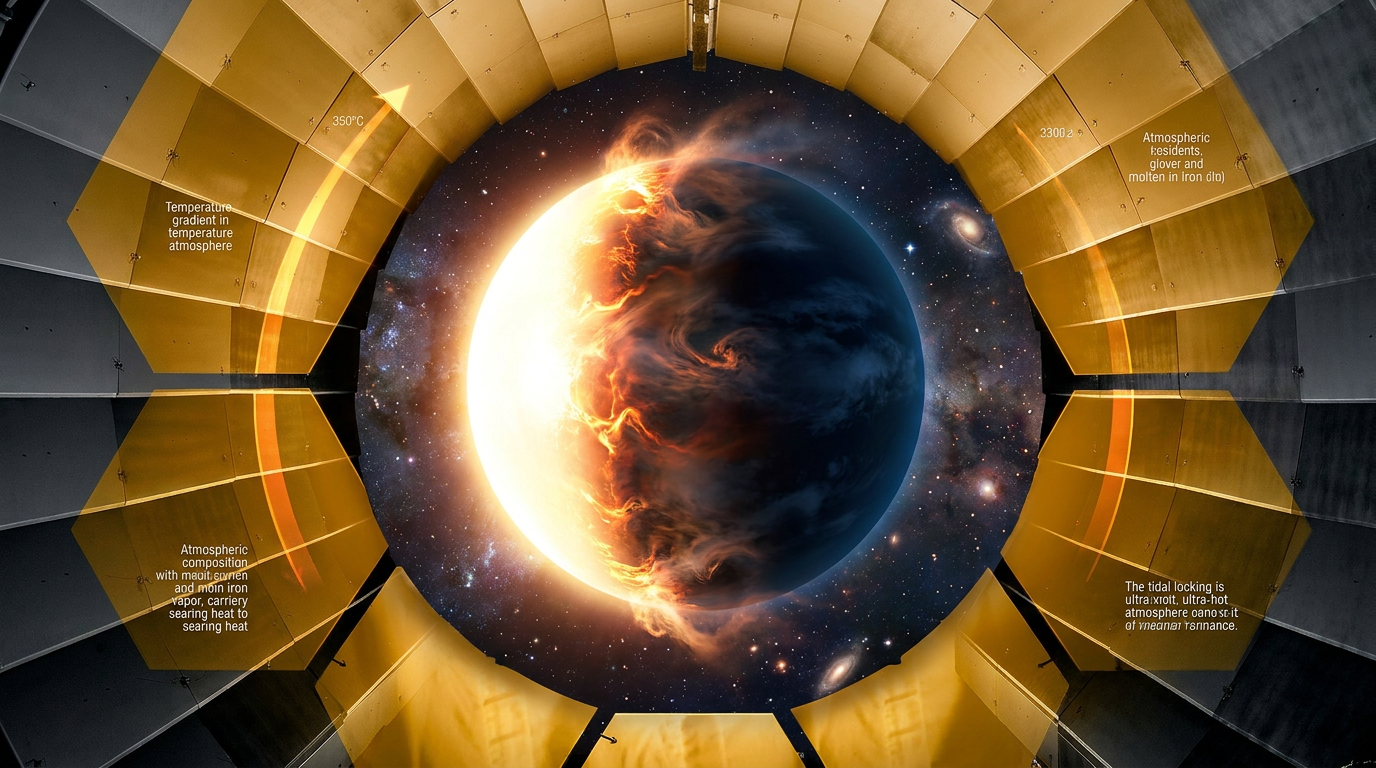
Astronomers using the James Webb Space Telescope have successfully mapped the distinct weather patterns of an ultra-hot exoplanet's sunrise and sunset, revealing a world where water is destroyed in the evening and mineral clouds condense in the morning.
By Factlen Editorial Team
- Observational Astronomers
- Focus on the unprecedented precision of JWST and the novel technique of measuring atmospheric changes across longitude during a transit.
- Planetary Meteorologists
- Focus on the physical mechanisms driving the extreme weather, such as supersonic winds, thermal dissociation, and mineral clouds.
- Exoplanet Theorists
- Focus on how these 3D atmospheric maps validate or challenge existing climate models and inform our understanding of planetary evolution.
What's not represented
- · Instrument Engineers (designers of NIRSpec/NIRISS)
- · Comparative Planetologists (studying Earth/Venus terminators)
Why this matters
For decades, astronomers could only measure the average, blended atmosphere of a distant planet. This breakthrough proves we now have the technology to map three-dimensional weather systems on worlds trillions of miles away, bringing us one step closer to understanding the complex climates of potentially habitable planets.
Key points
- JWST successfully mapped the morning and evening terminators of the ultra-hot exoplanet WASP-121 b.
- The planet's evening side is significantly hotter and more expanded than its morning side.
- Fierce 11,000 mph eastward winds carry intense dayside heat into the evening zone.
- Extreme temperatures on the evening side cause water molecules to thermally dissociate and break apart.
- The cooler morning side shows evidence of exotic mineral clouds, potentially made of silicates.
- The discovery proves JWST can resolve 3D atmospheric structures by tracking a planet's rotation during transit.
For decades, astronomers have been forced to treat distant exoplanets as uniform, one-dimensional spheres, averaging their atmospheric data into a single global signature. That era has officially ended. Using the James Webb Space Telescope (JWST), researchers have successfully mapped the distinct weather patterns of an alien world's sunrise and sunset, revealing a planet where the atmosphere fundamentally transforms between dawn and dusk. The target of this breakthrough is WASP-121 b, an "ultra-hot Jupiter" located roughly 900 light-years away in the constellation Puppis.[1][2][7]
WASP-121 b is a world defined by extremes. Orbiting its host star at a punishingly close distance, a single year on the planet lasts just 30.5 hours. Because of this proximity, the gas giant is tidally locked—meaning one hemisphere permanently faces the star in unending daylight, while the other is trapped in perpetual darkness. The dayside is roasted to an average temperature of 2,770 Kelvin (2,500°C), while the nightside cools to a relatively frigid 1,000 Kelvin (725°C).[3][4][5][7]
Between these two extremes lie the terminators: the twilight zones separating day from night. On Earth, the terminator is a gentle transition of fading light. On WASP-121 b, the morning terminator (where night turns to day) and the evening terminator (where day turns to night) are violent atmospheric battlegrounds. Theoretical models have long predicted that these two zones should exhibit drastically different climates, but proving it required an instrument capable of dissecting the edge of a planet from trillions of miles away.[1][4][5]
The foundation of this discovery rests on a novel observational technique pioneered by a team led by Cyril Gapp at the Max Planck Institute for Astronomy (MPIA). When WASP-121 b passes in front of its host star—an event known as a transit—starlight filters through the planet's atmosphere before reaching Earth. Historically, astronomers combined the data from the entire transit to boost the signal, yielding a flat, averaged atmospheric profile.[1][3][4]

The MPIA team realized that during the course of a full transit, WASP-121 b rotates by approximately 30 degrees on its axis. By utilizing JWST's Near-Infrared Spectrograph (NIRSpec) and Near-Infrared Imager and Slitless Spectrograph (NIRISS), the researchers did not average the data. Instead, they measured how the absorption of starlight changed minute by minute as progressively hotter or colder atmospheric gas rotated into the telescope's view.[4][5][8]
While the precision of JWST makes this time-series analysis possible, the technique pushes the absolute limits of current technology. The signal variations between the start and end of the transit are minuscule, requiring rigorous calibration to ensure the observed asymmetries are not instrumental artifacts. However, the independent confirmation across multiple JWST instruments provides strong confidence in the resulting data.[8]
The primary finding of the Nature Astronomy study is a stark imbalance in how infrared light is absorbed on the two sides of the planet. The data clearly indicate that the evening zone intercepts a much larger fraction of starlight than the morning zone, confirming that the two terminators are physically distinct.[1][5][8]
This asymmetric absorption profile is the physical signature of atmospheric expansion. Gases expand when heated, and the JWST transmission spectrum proves that the atmosphere at the dusk terminator is puffed up considerably higher than at the dawn terminator.[1][7]
This asymmetric absorption profile is the physical signature of atmospheric expansion.
This extreme evening expansion is driven by the planet's supersonic wind system. Fierce equatorial winds, whipping at speeds up to 11,000 miles per hour, travel eastward across the planet. These winds act as a planetary conveyor belt, dragging the blistering heat from the dayside directly into the evening terminator. By the time the winds cross the nightside and reach the morning terminator, they have cooled significantly, resulting in a more contracted dawn atmosphere.[1][3][7]

The temperature gradient between dawn and dusk is so severe that it fundamentally alters the planet's chemistry. The JWST data revealed that the two terminators do not just have different temperatures; they are composed of different molecules.[1][4][8]
As the transit progressed and the evening terminator rotated into view, the researchers observed a distinct drop in the spectral signature of water (H2O). Conversely, the absorption signal for carbon monoxide (CO) remained robust and even appeared to increase, though researchers attribute the CO signal boost to temperature effects rather than a change in absolute abundance.[1][8]
The depletion of water on the dusk side is a textbook example of thermal dissociation. At temperatures exceeding 2,500°C, the thermal energy in the atmosphere is sufficient to physically rip water molecules apart into constituent hydrogen and oxygen atoms. Because carbon monoxide is held together by one of the strongest chemical bonds in nature, it survives the eastward journey through the dayside inferno intact, while water is systematically destroyed before it reaches the evening zone.[7][8]
If the evening is defined by the destruction of molecules, the morning is defined by their condensation. As the supersonic winds traverse the dark nightside, temperatures plummet to 725°C, allowing atoms to recombine and heavier elements to condense into liquid or solid states.[3][7]
The JWST transmission data from the dawn terminator shows a muted chemical signature, a classic indicator that clouds are blocking the starlight from penetrating deeper into the atmosphere. Given the temperatures involved, these are not clouds of water vapor. Planetary meteorologists theorize they are composed of silicate minerals, or even liquid metals and condensed gems like rubies and sapphires.[1][3][6]

The evidence for specific cloud compositions remains the weakest link in the current data pack. While the presence of a cloud deck on the morning side is strongly supported by the muted spectral lines, identifying the exact mineral makeup requires more sophisticated 3D atmospheric modeling and potentially broader wavelength coverage.[3][6]
The successful mapping of WASP-121 b's terminators represents a paradigm shift in exoplanet meteorology. "With its unprecedented observational quality, JWST gives us the most detailed glimpses into distant planets to date," noted Cyril Gapp, emphasizing that astronomers can now probe alien atmospheres "longitude by longitude."[1][6]
This methodology opens a new frontier for the James Webb Space Telescope. Researchers have already identified a catalog of other ultra-hot gas giants with suitable rotation rates and transit profiles. By applying this time-series technique to a larger sample size, astrophysicists hope to build a comprehensive taxonomy of 3D planetary climates, moving beyond single-pixel approximations of distant worlds.[2][6]

Ultimately, the WASP-121 b evidence pack proves that the universe is far more dynamic than our previous instruments could perceive. The boundary between day and night on this ultra-hot Jupiter is not just a line on a map, but a chaotic engine of supersonic winds, vaporized water, and mineral storms—a weather system we are only just beginning to understand.[3][7]
How we got here
2015
WASP-121 b is first discovered using ground-based telescopes, identified as an extreme ultra-hot Jupiter.
2022
The James Webb Space Telescope conducts its initial observations of WASP-121 b during its first year of science operations.
June 2026
Researchers publish findings in Nature Astronomy revealing the distinct temperature and chemical differences between the planet's dawn and dusk terminators.
Viewpoints in depth
Observational Astronomers
Leveraging JWST's sensitivity to pioneer 3D atmospheric mapping.
For observational astronomers, the WASP-121 b data represents a triumph of instrumentation. Historically, transmission spectroscopy could only yield a one-dimensional, globally averaged profile of an exoplanet's atmosphere. By capitalizing on the planet's 30-degree rotation during its transit, researchers successfully isolated the spectral signatures of the morning and evening terminators. This time-series approach pushes the limits of the Near-Infrared Spectrograph (NIRSpec), requiring meticulous calibration to separate genuine atmospheric gradients from instrumental noise, ultimately proving that JWST can resolve longitudinal weather patterns on worlds trillions of miles away.
Planetary Meteorologists
Analyzing the extreme thermodynamics and supersonic wind systems.
Meteorologists view WASP-121 b as an extreme laboratory for fluid dynamics and atmospheric chemistry. The data confirms that 11,000 mph eastward winds act as a massive heat conveyor, dragging 2,500°C dayside temperatures into the evening zone. This intense heat physically expands the dusk atmosphere and thermally dissociates water molecules into raw hydrogen and oxygen. Conversely, the cooler morning terminator provides the necessary conditions for heavy elements to condense, supporting theories that the dawn skies are filled with exotic clouds of silicate minerals or liquid gems.
What we don't know
- The exact composition of the clouds on the morning terminator, though silicates are strongly suspected.
- Whether these extreme dawn/dusk differences exist on smaller, rocky exoplanets.
- The deep internal atmospheric circulation patterns below the observable upper atmosphere.
Key terms
- Tidal Locking
- A gravitational phenomenon where a planet's rotation matches its orbit, causing one hemisphere to permanently face its star while the other remains in perpetual darkness.
- Transmission Spectroscopy
- An observational technique that analyzes the starlight filtering through a planet's atmosphere to determine its chemical composition and temperature.
- Terminator
- The dividing line between the day side and night side of a planetary body.
- Thermal Dissociation
- A chemical process where extreme heat provides enough energy to break the bonds holding a molecule together, splitting it into individual atoms.
- Ultra-hot Jupiter
- A class of massive gas giant exoplanets that orbit extremely close to their host stars, resulting in surface temperatures exceeding 2,000 Kelvin.
Frequently asked
What is a terminator on a planet?
The terminator is the boundary line that separates the illuminated day side of a planet from the dark night side. On Earth, we experience this as dawn and dusk.
Why is WASP-121 b so hot?
WASP-121 b orbits its host star at an extremely close distance, completing a full orbit in just 30.5 hours. This proximity subjects it to intense stellar radiation and tidal forces.
How did JWST measure the different sides of the planet?
As the planet passed in front of its star, it rotated by about 30 degrees. JWST measured how the starlight filtering through the atmosphere changed minute by minute, allowing scientists to isolate the morning and evening edges.
Why is there no water on the evening side?
The evening side is so hot (driven by 11,000 mph winds carrying heat from the dayside) that water molecules are thermally dissociated, meaning they are physically ripped apart into hydrogen and oxygen atoms.
Sources
Source coverage
8 outlets
3 viewpoints surfaced








[1]Max Planck Institute for AstronomyObservational Astronomers
Ultrahot exoplanet, atmospheric differences: Researchers discovered clear differences in the atmosphere between the morning and evening sides
Read on Max Planck Institute for Astronomy →[2]ScienceDailyExoplanet Theorists
James Webb reveals two completely different twilights on an alien world
Read on ScienceDaily →[3]Space.comPlanetary Meteorologists
James Webb Space Telescope discovers extreme exoplanet being roasted by its home star
Read on Space.com →[4]SciTechDailyObservational Astronomers
James Webb Reveals Differences Between Dawn and Dusk on WASP-121 b
Read on SciTechDaily →[5]Universe MagazinePlanetary Meteorologists
James Webb observed extreme twilights and sunrises on the exoplanet WASP-121 b
Read on Universe Magazine →[6]The Cool DownExoplanet Theorists
Astronomers describe how they used JWST to analyze starlight passing through WASP-121 b's atmosphere
Read on The Cool Down →[7]ConnectSciPlanetary Meteorologists
New observations by the James Webb Space Telescope reveals distinct differences in an ultra-hot exoplanet's atmosphere
Read on ConnectSci →[8]Nature AstronomyObservational Astronomers
Chemical gradients in WASP-121 b from JWST phase-resolved transmission spectroscopy
Read on Nature Astronomy →

Every angle. Every day.
Get science stories with full source coverage and perspective breakdowns delivered to your inbox.