
The End of the Extreme Weight Cut: How Combat Sports Are Engineering a Safer Weigh-In
After decades of dangerous dehydration tactics, boxing and MMA commissions are increasingly adopting hydration testing and continuous weight monitoring to protect fighters from organ failure and brain trauma.
By Factlen Editorial Team
- Athlete Health Advocates
- Medical professionals and regulators prioritizing long-term neurological and organ health.
- Combat Sports Promoters
- League executives balancing athlete safety with the need to deliver high-quality entertainment.
- Traditionalists & Skeptics
- Coaches and sports scientists who question the reliability of current testing methods.
What's not represented
- · Amateur fighters lacking access to medical oversight
Why this matters
Extreme weight cutting has historically been the most dangerous aspect of combat sports, leading to organ failure and exacerbating brain trauma. This systemic shift toward hydration testing promises to extend athletes' careers and fundamentally change how weight classes operate.
Key points
- Extreme dehydration to make weight has historically caused organ failure and exacerbated brain trauma.
- Dehydration depletes cerebrospinal fluid, increasing the severity of concussions.
- Promotions like ONE Championship now require fighters to pass a Urine Specific Gravity (USG) test before weighing in.
- The California State Athletic Commission cancels bouts if a fighter rebounds more than 15% above their contracted weight.
- Hydrated fighters exhibit better endurance and contribute to higher finish rates.
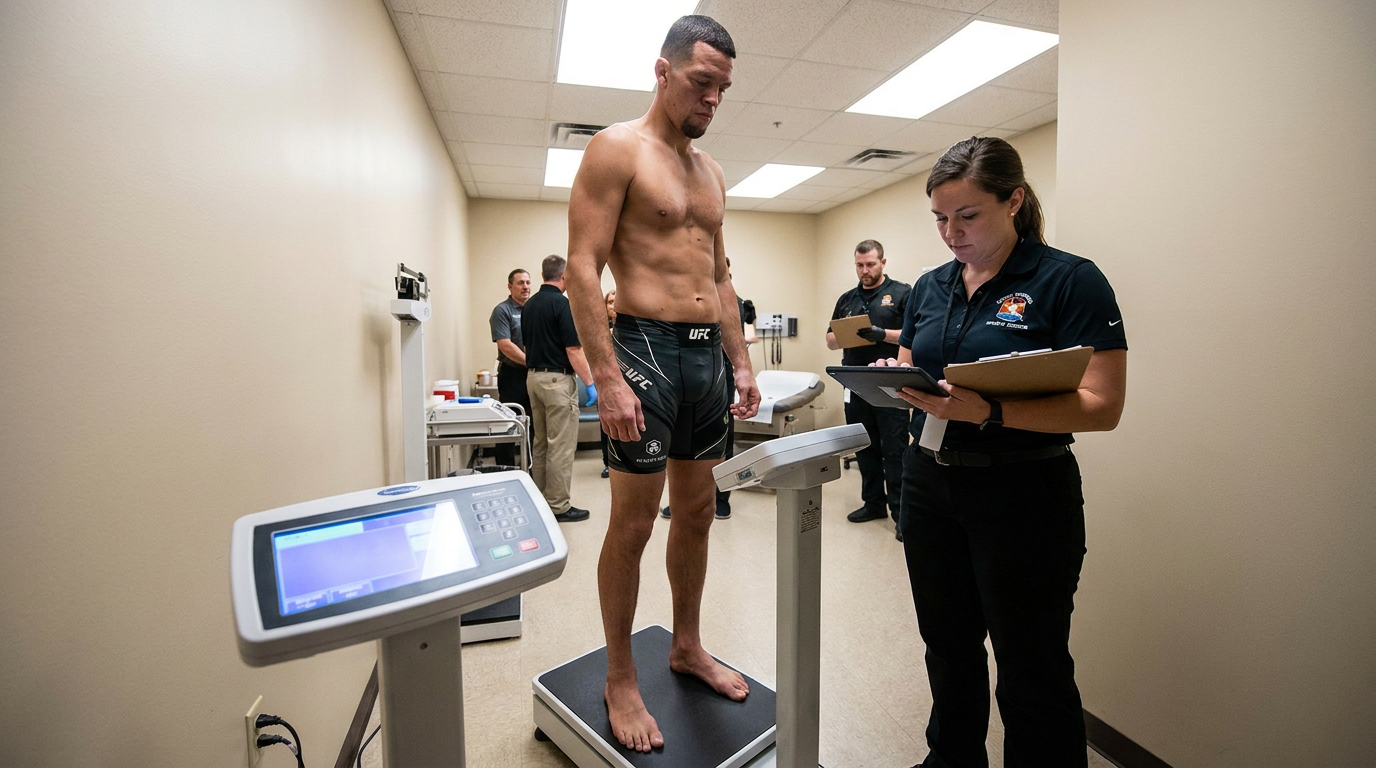
The spectacle of the combat sports weigh-in is famously grim. Fighters step onto the scale looking gaunt, their eyes sunken and skin stretched tight over their cheekbones, only to step into the ring 24 hours later looking 20 pounds heavier.[7]
For decades, this extreme cycle of dehydration and rapid rehydration has been the sport's most dangerous open secret. Athletes routinely shed 10 to 15 percent of their total body mass in the final 48 hours before a bout, starving their bodies of water to qualify for a smaller weight class.[5]
But the era of the sanctioned, near-fatal weight cut is finally closing. Driven by a string of high-profile tragedies and a growing body of medical research, major athletic commissions and global promotions are engineering a safer weigh-in process.[1][2]
The traditional weight cut relies on acute water manipulation. Because the human body is roughly 60 percent water, fighters use saunas, hot baths, rubber suits, and severe fluid restriction to sweat out pounds of essential hydration.[5]

This practice places catastrophic strain on the internal organs, particularly the kidneys and the heart. But the most insidious damage happens inside the skull.[3]
When a fighter severely dehydrates, the brain literally shrinks, and the body depletes its cerebrospinal fluid (CSF)—the vital liquid that cushions the brain inside the cranium.[3]
Without that protective fluid layer, the brain is subjected to much higher deceleration forces when a fighter takes a punch or a kick to the head. Studies have shown that dehydrated MMA athletes experience concussion severity up to 40 percent higher than their hydrated peers, dramatically increasing the risk of chronic traumatic encephalopathy (CTE).[3][5]

Without that protective fluid layer, the brain is subjected to much higher deceleration forces when a fighter takes a punch or a kick to the head.
To combat this, organizations like ONE Championship have fundamentally rewritten the rules of engagement by introducing mandatory hydration testing.[1]
Under the ONE protocol, fighters cannot simply hit a number on the scale. They must first pass a Urine Specific Gravity (USG) test, which measures the density of their urine compared to distilled water using a calibrated digital refractometer.[1]
A low specific gravity indicates well-diluted urine, while a high number signals dangerous dehydration. Fighters must register a USG of 1.025 or lower; if they fail, they are barred from officially weighing in until they can prove they are safely hydrated.[1]

Meanwhile, state regulators are attacking the problem from the other end of the timeline. The California State Athletic Commission (CSAC) has implemented strict fight-day weight monitoring to prevent the massive rebound effect.[2]
Under CSAC rules, if a fighter weighs more than 15 percent above their contracted weight class on the day of the event, the bout is immediately cancelled. This effectively destroys the incentive to undergo extreme dehydration, as fighters know they cannot legally balloon back up before the opening bell.[2]

The shift isn't just about safety; proponents argue it creates a better product. When fighters enter the cage fully hydrated rather than recovering from a traumatic physiological deficit, they exhibit better endurance, faster reaction times, and higher finish rates.[4]
However, the transition is not without friction. Recent sports science research has highlighted that USG biomarkers can sometimes be unreliable, occasionally yielding false positives if a fighter consumes a highly concentrated protein diet.[6]
Furthermore, the culture of weight cutting is deeply ingrained in martial arts as a test of discipline and psychological warfare. Some athletes still attempt to game the new systems by water-loading or manipulating their sodium intake right before a USG test.[5][6]
Despite these hurdles, the momentum is entirely in one direction. By replacing the archaic tradition of extreme dehydration with modern medical oversight, combat sports are finally protecting their athletes before the first punch is even thrown.[7]
How we got here
2015
Following the tragic death of Yang Jian Bing, ONE Championship begins overhauling its weight-cutting rules.
2017
The California State Athletic Commission (CSAC) implements a 10-point plan to combat extreme weight cuts.
2019
CSAC passes a unanimous rule to cancel bouts if a fighter rebounds more than 15% above their contracted weight.
2022
Studies reveal that concussion severity is significantly higher in dehydrated MMA athletes.
2026
Hydration testing and fight-day weight monitoring become increasingly standardized across major global promotions.
Viewpoints in depth
Athlete Health Advocates
Medical professionals and regulators prioritizing long-term neurological and organ health.
This camp, which includes athletic commissions and ringside physicians, argues that extreme weight cutting is a form of 'sanctioned cheating' that puts lives at risk. They point to the undeniable link between severe dehydration and reduced cerebrospinal fluid, which drastically increases the likelihood of traumatic brain injuries. For these advocates, strict hydration testing and fight-day weight limits are non-negotiable necessities to modernize the sport.
Combat Sports Promoters
League executives balancing athlete safety with the need to deliver high-quality entertainment.
Organizations like ONE Championship view hydration testing as both a moral imperative and a business advantage. Executives argue that fighters who don't drain their bodies of 15 pounds of water put on better, more explosive performances. While cancelled bouts due to missed hydration metrics can hurt short-term ticket sales, promoters believe that extending athletes' careers and increasing the overall finish rate is better for the sport's long-term growth.
Traditionalists & Skeptics
Coaches and sports scientists who question the reliability of current testing methods.
While few defend the most extreme cuts, many veteran coaches view weight management as an essential discipline that separates elite professionals from amateurs. Furthermore, sports scientists have raised valid concerns about the accuracy of Urine Specific Gravity (USG) tests. They note that high-protein diets or specific training loads can trigger false positives, unfairly penalizing fighters who are actually well-hydrated, and warning that athletes will always find new ways to game the system.
What we don't know
- Whether Urine Specific Gravity (USG) testing will be replaced by more accurate blood or tear biomarkers.
- How quickly smaller, regional promotions will be able to afford and implement strict medical hydration testing.
Key terms
- Urine Specific Gravity (USG)
- A metric that compares the density of urine to distilled water, used to determine an athlete's hydration level.
- Cerebrospinal Fluid (CSF)
- The clear fluid surrounding the brain and spinal cord that acts as a crucial shock absorber against head impacts.
- Catchweight
- A negotiated weight limit for a bout that does not strictly adhere to the traditional, standardized weight classes.
- Acute Weight Loss (AWL)
- The rapid shedding of body mass, primarily through water depletion, in the days immediately preceding a weigh-in.
Frequently asked
Why do fighters cut weight in the first place?
Fighters temporarily dehydrate themselves to qualify for a lighter weight class, hoping to gain a size and strength advantage when they rehydrate before the fight.
What happens if a fighter fails a hydration test?
Under rules like ONE Championship's, a fighter who fails the USG test is not allowed to officially weigh in or compete until they provide a passing, hydrated sample.
How does dehydration increase knockout risk?
Severe dehydration depletes the cerebrospinal fluid that cushions the brain. With less fluid protection, the brain sustains higher deceleration forces when the head is struck.
Sources
Source coverage
7 outlets
3 viewpoints surfaced







[1]GroundedMMACombat Sports Promoters
ONE Championship Weight-Cutting Rules (Simply Explained)
Read on GroundedMMA →[2]Boxing SceneAthlete Health Advocates
CSAC To Cancel Bouts if Fighter is 15% Over Contracted Weight
Read on Boxing Scene →[3]MMA LeechAthlete Health Advocates
How Does Weight Cutting Affect The Brain?
Read on MMA Leech →[4]SportskeedaCombat Sports Promoters
Rich Franklin explains why ONE Championship's weight and hydration tests lead to exciting fights
Read on Sportskeeda →[5]MDPITraditionalists & Skeptics
The Current State of Weight-Cutting in Combat Sports
Read on MDPI →[6]ResearchGateTraditionalists & Skeptics
Safety and Performance in Combat Sports
Read on ResearchGate →[7]Factlen Editorial Team
Synthesis by Factlen editorial team
Read on Factlen Editorial Team →
More in sports
See all 10 stories →Injury
Toronto Tempo Issue Hopeful Recovery Timelines for Brittney Sykes and Kiki Rice
6 sources
Standings
WNBA 2026 Standings: Aces Reclaim Top Spot as Expansion Teams Make Immediate Impact
6 sources
Coaching Turnaround
Green Bay Rewards Doug Gottlieb with Contract Extension After Historic Turnaround
5 sources
Tailender Evolution
Matt Fisher's Maiden Fifty Highlights the Tactical Evolution of the Test Cricket Tailender
6 sources
Every angle. Every day.
Get sports stories with full source coverage and perspective breakdowns delivered to your inbox.