
Scientists Track Individual Neurons Building Sentences in Real Time
Using high-density microelectrodes, researchers have mapped how individual brain cells plan and produce human speech during natural conversation.
By Factlen Editorial Team
- Neuroscientists
- Focus on the fundamental biological discovery of how the brain computes language.
- Clinical Technologists
- Focus on the potential to build brain-computer interfaces that restore communication for patients with severe paralysis.
- Neuroethics Advocates
- Focus on the privacy implications of technology that can decode unarticulated thoughts and semantic meaning.
What's not represented
- · Patients with communication disorders
Why this matters
Understanding language at the cellular level is the critical missing link for developing advanced brain-computer interfaces. This breakthrough paves the way for neuroprosthetics that could eventually restore natural, real-time communication for people paralyzed by stroke, ALS, or severe brain injuries.
Key points
- Researchers tracked the electrical activity of individual brain cells during natural human conversation.
- High-density Neuropixels probes recorded hundreds of neurons simultaneously in the frontotemporal cortex.
- Neurons exhibit a strict division of labor, with some processing basic word meanings and others structuring sentences.
- AI models successfully predicted the grammar and context of spoken sentences based purely on cellular data.
- The breakthrough paves the way for advanced brain-computer interfaces to restore communication for paralyzed individuals.
For decades, neuroscientists have understood which broad regions of the human brain handle language, but the exact cellular mechanics have remained a black box. Now, researchers have tracked the electrical activity of individual neurons during natural conversation, capturing how sentences are built before a single word is spoken.[1][3]
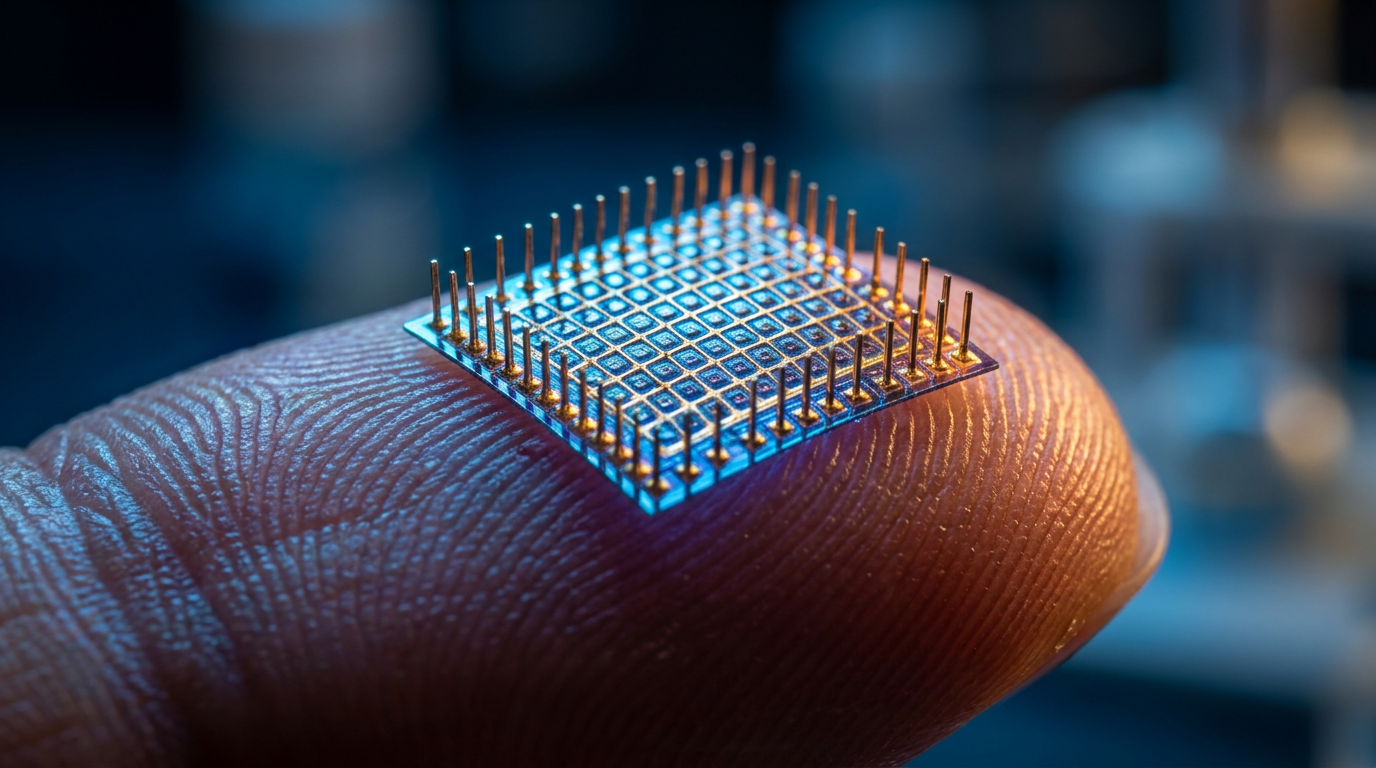
The breakthrough, led by researchers at Massachusetts General Hospital and Harvard Medical School, utilized ultrahigh-density microelectrode arrays called Neuropixels. These probes, which are smaller than the width of a human hair, pack hundreds of recording channels capable of monitoring individual cells across multiple layers of the brain's cortex.[4][5]
Because implanting these probes requires open-brain surgery, the neuronal data was gathered from eight patients who already had microelectrodes implanted for epilepsy monitoring. Scientists seized the opportunity to record the patients engaging in naturally flowing, unscripted conversations spanning a wide range of topics.[3]

The primary evidence from the study demonstrates that individual brain cells act as specialized linguistic building blocks, exhibiting a strict division of labor. Researchers detected a clear separation of duties among the examined neurons in the frontotemporal cortex, a region long associated with speech production.[1][3]
Some neurons are finely tuned to basic information, firing only when processing the specific meaning of a word or its phonetic sounds. Other neurons tackle highly complex cognitive tasks, such as grouping individual phrases together to form grammatically structured sentences in real time.[3][5]
Some neurons are finely tuned to basic information, firing only when processing the specific meaning of a word or its phonetic sounds.
Furthermore, the recordings from the prefrontal cortex showed that the brain anticipates and plans speech long before articulation. Neurons represent the specific order and structure of phonetic sequences before they are ever uttered by the mouth.[4][6]
These cells accurately predicted the syllabic and morphological components of upcoming words. As the patient prepared to speak, the cellular activity patterns transitioned seamlessly from the articulation planning phase directly into motor production, firing in a consistent, temporally ordered dynamic.[4][6]

To test the robustness of these signals, the research team applied natural language processing models to the single-cell recordings. The artificial intelligence successfully predicted the grammar, meaning, and context of the spoken sentences based purely on the cellular data.[3]
The machine-learning models could even distinguish between similar-sounding phrases, proving that the neuronal activity captured the unique semantic context of the conversation rather than just the raw audio output. Researchers noted that by recording a relatively small number of neurons, they could reliably predict the general ideas a person was comprehending.[3][5]
The data also revealed that speaking and listening share overlapping but distinct neural pathways. While both actions engage a widespread network across the frontal and temporal lobes, there are specific shifts in cellular activity when a person switches from comprehending speech to producing it. Earlier foundational work at UCSF similarly mapped how neurons in the superior temporal gyrus respond to specific consonants and vowels during listening.[4][6]

While the evidence for single-neuron language encoding is robust, the researchers acknowledge transparent limitations. The data relies on a highly invasive procedure, and the sample size is limited to eight patients with underlying neurological conditions. Scaling this research to a broader, healthy population remains technologically impossible without non-invasive tools that can match the microscopic resolution of Neuropixels.[3][7]
Translating these fundamental discoveries into functional brain-computer interfaces will require years of refinement. Current AI models can decode the recorded signals in a highly controlled setting, but building a real-time, wireless prosthetic that accurately infers speech-related thoughts for paralyzed patients involves overcoming massive engineering and biological hurdles.[3][7]
How we got here
2010s
Brain mapping relies on broad regional scans like fMRI, unable to track individual cells.
2017
Neuropixels probes are introduced, revolutionizing high-density neural recording in animal models.
Dec 2023
UCSF researchers use Neuropixels in humans to map how individual neurons process the sounds of speech during listening.
Feb 2024
Mass General researchers publish early findings on how prefrontal neurons plan the phonetic arrangement of words.
Jun 2026
AI models successfully decode grammar, meaning, and context from single-cell recordings during natural conversation.
Viewpoints in depth
Neuroscientists & Researchers
Focus on the fundamental biological discovery of how the brain computes language.
For decades, the field relied on functional MRI scans that showed broad regions of the brain lighting up during speech, treating language as a diffuse network phenomenon. Researchers view this single-cell data as a paradigm shift. By proving that individual neurons act as specialized linguistic building blocks—with some handling phonetics and others structuring grammar—they can finally map the brain's computational architecture at the microscopic level.
Neuroprosthetic Developers
Focus on the clinical applications for restoring communication in paralyzed patients.
Clinical technologists see these granular neural recordings as the necessary foundation for building next-generation brain-computer interfaces. Current assistive devices often rely on slow, eye-tracking keyboards or broad motor signals. By tapping directly into the neurons that plan and structure sentences before articulation, developers believe they can eventually build wireless prosthetics that translate a patient's neural activity into fluid, real-time, machine-generated speech.
Bioethics & Privacy Advocates
Raise concerns about the long-term implications of decoding internal speech and thoughts.
While acknowledging the immense medical benefits, ethicists warn that the ability to decode semantic meaning and unarticulated thoughts from brain activity crosses a new frontier in mental privacy. As AI models become increasingly adept at inferring context and grammar from cellular data, advocates argue that strict ethical frameworks and data protections must be established long before these technologies transition from clinical trials to commercial applications.
What we don't know
- Whether these single-cell language patterns are universal across all human languages or specific to English speakers.
- How quickly the technology can be miniaturized and made wireless for everyday clinical use.
Key terms
- Neuropixels
- Advanced microelectrode probes, smaller than a human hair, capable of recording the electrical activity of hundreds of individual neurons simultaneously.
- Frontotemporal cortex
- A region of the brain located near the front and sides, heavily involved in language production, comprehension, and executive function.
- Phoneme
- The smallest unit of sound in speech that distinguishes one word from another, such as the "d" sound in "dog."
- Brain-computer interface (BCI)
- A system that connects the brain to external devices, allowing neural signals to control computers or prosthetics.
Frequently asked
Can this technology read my mind?
No. The technology requires highly invasive open-brain surgery to implant microscopic electrodes directly into the cortex, and the AI models are currently only trained to decode specific speech-related activity in a controlled setting.
How fast does the brain process speech?
During natural conversation, the human brain plans and produces about three words per second, with individual neurons firing in a highly orchestrated sequence just milliseconds before articulation.
Will this cure speech disorders?
While it is not a cure for the underlying neurological damage, understanding speech at the cellular level is a critical step toward building advanced prosthetics that could translate a paralyzed patient's neural activity into machine-generated speech.
Sources
Source coverage
7 outlets
3 viewpoints surfaced







[1]NatureNeuroscientists
Daily briefing: The brain builds a sentence neuron by neuron
Read on Nature →[2]Neuroscience NewsClinical Technologists
Single-neuronal elements of speech production in humans
Read on Neuroscience News →[3]National Institutes of HealthClinical Technologists
With neuronal data, AI models predicted grammar, meaning, and context of spoken sentences
Read on National Institutes of Health →[4]Massachusetts General HospitalClinical Technologists
Single-Neuron Recordings Show How the Brain Plans Speech
Read on Massachusetts General Hospital →[5]Harvard UniversityNeuroscientists
Building a 'brain thesaurus'
Read on Harvard University →[6]UCSFNeuroscientists
How do individual neurons in your brain allow you to understand the sounds of speech?
Read on UCSF →[7]Factlen Editorial TeamNeuroethics Advocates
Synthesis by Factlen editorial team
Read on Factlen Editorial Team →

Every angle. Every day.
Get science stories with full source coverage and perspective breakdowns delivered to your inbox.