
Do Wearables Actually Improve Heart Health? The Science Behind the Screen
Recent clinical data reveals that smartwatches and fitness trackers successfully drive behavioral changes in heart patients, though integrating that data into long-term medical care remains a challenge.
By Factlen Editorial Team
- Clinical Cardiologists
- Value the diagnostic potential of wearables for early arrhythmia detection but remain concerned about data overload, false positives, and the lack of seamless integration into electronic health records.
- Behavioral Health Researchers
- Focus on the psychological benefits of gamification, noting that wearables successfully motivate patients to move more and overcome traditional barriers to cardiac rehabilitation.
- Health Tech Innovators
- Believe that continuous monitoring powered by AI and the Internet of Medical Things will fundamentally shift cardiology from reactive treatment to predictive, personalized prevention.
What's not represented
- · Elderly patients with low digital literacy
- · Low-income populations unable to afford premium devices
Why this matters
Millions of people rely on smartwatches to monitor their health, but understanding the gap between raw data and actual medical outcomes helps users set realistic expectations and empowers them to use these devices as genuine tools for longevity rather than just digital novelties.
Key points
- Heart patients using wearables walked nearly 1,100 more steps daily and engaged in more moderate-to-vigorous activity.
- Modern smartwatches demonstrate 84% to 95% sensitivity in detecting dangerous irregular heart rhythms like Atrial Fibrillation.
- Despite behavioral improvements, short-term wearable use did not significantly increase peak oxygen consumption (VO2 max).
- Clinical adoption is slowed by the difficulty of integrating massive amounts of consumer data into electronic health records.
- Future advancements rely on AI to filter out motion artifacts and flag only clinically relevant data for physicians.
The wearable revolution has fundamentally altered how we interact with our own biology. Millions of wrists are now adorned with glowing screens that silently track every heartbeat, step, and sleep cycle. For the average consumer, these devices offer a comforting illusion of control over their health. But for the medical community, they represent a profound shift in data collection, moving patient monitoring out of the sterile confines of the clinic and into the messy reality of daily life.[6]
The stakes for this technological shift are monumental. Cardiovascular disease remains the leading cause of death globally, claiming roughly 17.9 million lives every year. For decades, cardiologists have relied on snapshot measurements taken during brief office visits to manage these chronic conditions. Wearables promise to fill the vast blind spots between those appointments with continuous, objective data.[3]
The core question, however, has always been one of efficacy: do these devices actually move the needle on heart health, or are they simply expensive pedometers that flood users with anxiety-inducing notifications? For years, the medical consensus was cautious, viewing consumer wearables as lifestyle gadgets rather than clinical tools. But a new wave of rigorous clinical data is finally providing concrete answers.[4][6]
According to a June 2026 study published in the Journal of the American Heart Association, the behavioral impact of these devices is both measurable and clinically significant. Researchers from Penn State Health analyzed heart patients who utilized smartphone apps and wearable trackers to manage their recovery and daily activity levels.[1][2]
The findings revealed that these digital tools successfully prompted patients to walk nearly 1,100 additional steps per day compared to control groups. In the context of cardiovascular rehabilitation, where fatigue and lack of motivation are major hurdles, a sustained increase of over a thousand steps is a substantial behavioral victory.[1][2]
Furthermore, users engaged in about four extra minutes of moderate-to-vigorous physical activity daily. While four minutes may sound trivial to an athlete, Damon Swift of the American Heart Association noted that transitioning from completely inactive to even somewhat active yields outsized health benefits, significantly reducing the overall risk of mortality for those targeting the benchmark of 7,000 steps daily.[1]

The mechanism driving this change is deeply rooted in behavioral psychology. Wearables utilize continuous self-monitoring, real-time feedback loops, and gamification to encourage lifestyle modifications. Closing a digital ring or receiving a haptic vibration for hitting a step goal provides immediate positive reinforcement that traditional medical advice often lacks.[1][6]
This psychological nudge is particularly vital because many patients with cardiovascular disease face insurmountable barriers to traditional cardiac rehabilitation. Geographic distance, rigid work schedules, and financial costs often prevent patients from attending supervised clinical exercise programs. Wearables effectively democratize access to basic rehabilitation metrics, allowing patients to safely monitor their own progress from home.[1][2]
Beyond behavioral nudges, the diagnostic power of wearables has reached a level of clinical relevance that was unimaginable a decade ago. Systematic reviews published in 2025 and 2026 demonstrate that modern devices are highly adept at identifying dangerous, silent arrhythmias before they result in catastrophic events like strokes.[3][4][5]
Beyond behavioral nudges, the diagnostic power of wearables has reached a level of clinical relevance that was unimaginable a decade ago.
Devices such as the Apple Watch, Fitbit, and AliveCor KardiaMobile have demonstrated a sensitivity ranging from 84% to 95% in detecting Atrial Fibrillation (AFib). AFib is a notoriously elusive irregular heartbeat that often presents asymptomatically, making continuous wrist-based monitoring an ideal screening tool for high-risk populations.[5]
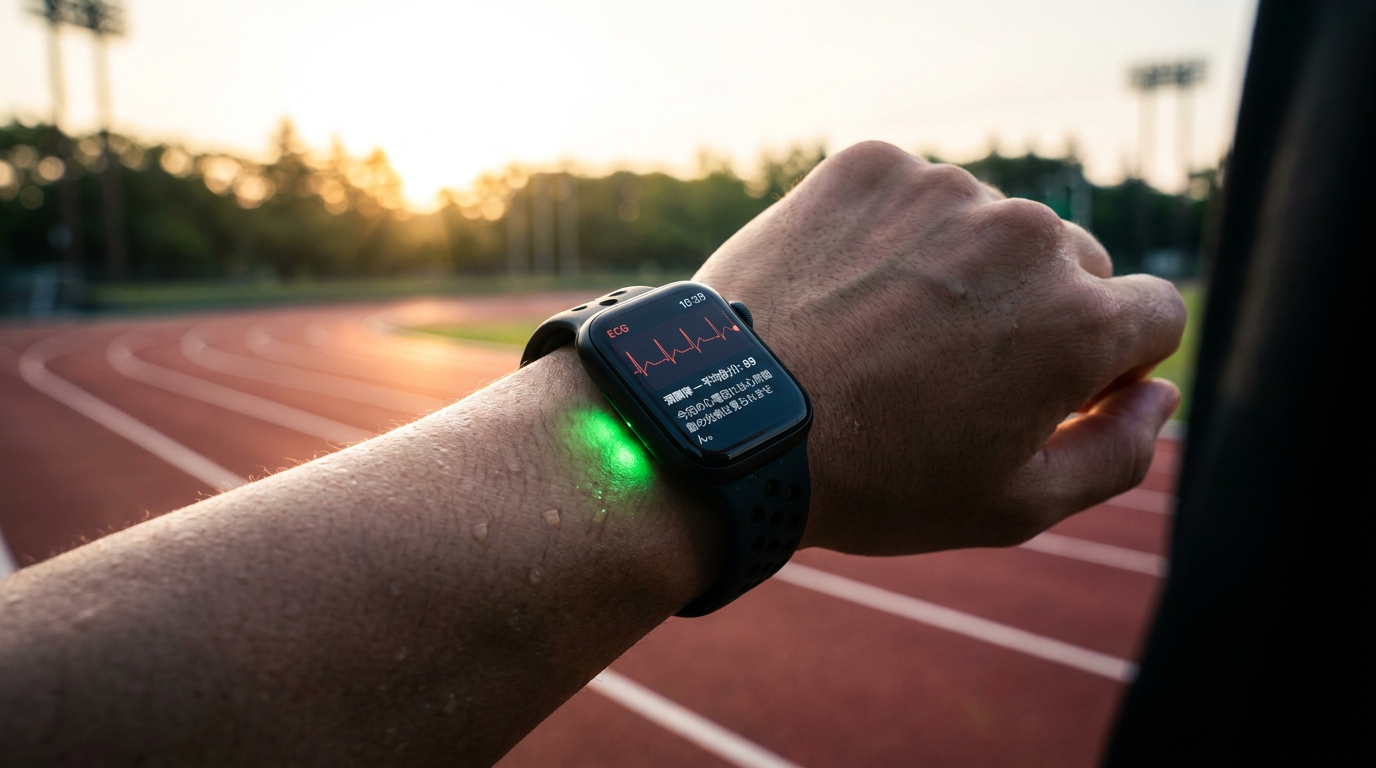
To achieve this high degree of accuracy, modern wearables rely on two primary technologies. The first is Photoplethysmography (PPG), which uses optical sensors to shine green light into the skin. By measuring the microscopic changes in light absorption as blood vessels expand and contract, the watch can continuously estimate the user's pulse rate and rhythm in the background.[3][5]
The second technology is the wearable Electrocardiogram (ECG). By placing a finger on the device's digital crown or metallic bezel, users complete a closed electrical circuit across their body. This allows the watch to record the heart's electrical signals much like a single-lead clinical ECG, providing a tracing that can be exported directly to a cardiologist for review.[5]

Despite these technological triumphs, the clinical community remains cautious about the ultimate impact on long-term physiological outcomes. While the behavioral data is overwhelmingly positive, the translation of those behaviors into deep structural heart health is still under investigation.[4][6]
Ramin Zand, senior author of the Penn State study, cautioned that while wearables successfully increased daily activity, they did not significantly improve peak oxygen consumption (VO2 max) or total walking distance capacity in the short term. This indicates that while wearables are excellent at getting patients off the couch, achieving profound cardiovascular fitness requires more intense, sustained interventions.[1][2]
There is also the formidable challenge of data integration. A 2026 review in Oxford Academic highlighted that widespread clinical adoption is severely bottlenecked by the inability to seamlessly pipe wearable data into existing Electronic Health Records (EHR). The healthcare infrastructure is simply not built to ingest terabytes of continuous consumer data.[4]
Cardiologists frequently express frustration over the resulting "data dumps." Patients often arrive at appointments with months of uncurated smartwatch alerts and raw heart rate graphs, lacking the standardized clinical workflows needed for doctors to efficiently interpret the noise without derailing a 15-minute consultation.[4][6]
False positives remain another persistent issue. Motion artifacts from everyday activities—like brushing teeth, typing aggressively, or driving over a bumpy road—can occasionally trick optical sensors into triggering irregular rhythm notifications. This can lead to unnecessary patient anxiety and costly, low-yield medical workups.[3][5]

Looking ahead, the convergence of Artificial Intelligence and the Internet of Medical Things (IoMT) promises to solve many of these friction points. Next-generation AI algorithms are currently being trained to filter out motion noise, contextualize heart rate against sleep and activity data, and flag only the most clinically relevant anomalies for physician review.[3]
Ultimately, wearables are not a silver bullet that can single-handedly cure cardiovascular disease. They cannot replace the nuanced judgment of a physician, nor can they substitute for the physiological benefits of medically supervised, high-intensity cardiac rehabilitation.[6]
However, as the technology matures from consumer novelty to medical-grade utility, wearables are undeniably transforming cardiology. By converting abstract health goals into objective, quantifiable daily metrics, they are shifting the paradigm from reactive disease treatment to a proactive, continuous partnership between patient and physician.[4][6]
How we got here
2018
The Apple Heart Study launches, enrolling over 400,000 participants to test the viability of smartwatch AFib detection at scale.
2021
Early meta-analyses begin confirming that digital health interventions significantly increase daily step counts in cardiac patients.
2025
Systematic reviews validate that modern consumer wearables achieve up to 95% sensitivity in detecting irregular heart rhythms.
June 2026
The Journal of the American Heart Association publishes data showing wearables drive measurable behavioral changes but highlights the need for longer-term outcome data.
Viewpoints in depth
Clinical Cardiologists
Physicians who value the diagnostic potential of wearables but worry about data overload and false positives.
For practicing cardiologists, wearables represent a double-edged sword. On one hand, the ability to catch asymptomatic Atrial Fibrillation before it causes a stroke is a monumental leap forward in preventive medicine. On the other hand, the clinical infrastructure is not prepared for the deluge of data these devices generate. Physicians frequently cite the lack of Electronic Health Record (EHR) integration as a major barrier, noting that sifting through months of uncurated smartwatch alerts during a 15-minute consultation is inefficient. Furthermore, false positives caused by motion artifacts often lead to unnecessary anxiety for patients and costly, low-yield medical workups that strain healthcare resources.
Behavioral Health Researchers
Experts focused on the psychological mechanisms that make wearables effective tools for lifestyle modification.
Behavioral scientists view wearables primarily as powerful engines for habit formation. Traditional cardiac rehabilitation suffers from notoriously low adherence rates due to barriers like travel time, cost, and lack of immediate feedback. Wearables bypass these hurdles by gamifying the recovery process. Researchers point to the 1,100-step daily increase observed in recent studies as proof that real-time self-monitoring, combined with haptic rewards for hitting micro-goals, provides the continuous positive reinforcement necessary to change entrenched sedentary behaviors. To this camp, the exact clinical accuracy of the step counter is less important than its ability to consistently motivate the patient to move.
Health Tech Innovators
Engineers and developers working to bridge the gap between consumer gadgets and medical-grade diagnostic tools.
The technology sector views the current friction points—such as false positives and data overload—as temporary engineering challenges rather than fundamental flaws. Innovators are heavily investing in Artificial Intelligence and the Internet of Medical Things (IoMT) to create smarter ecosystems. By training machine learning models to contextualize heart rate data against sleep patterns, respiratory rates, and accelerometer data, they aim to filter out the noise and deliver only highly curated, actionable insights to physicians. Their ultimate vision is a seamless, predictive model of cardiology where a patient's watch can forecast a cardiac event days before symptoms appear.
What we don't know
- Whether the behavioral improvements (like increased step counts) are maintained over multiple years or if user fatigue eventually sets in.
- If the use of wearables directly translates to a reduction in long-term mortality rates for cardiovascular disease patients.
- How quickly healthcare systems will be able to standardize the integration of consumer wearable data into official electronic health records.
Key terms
- Photoplethysmography (PPG)
- An optical technology used in smartwatches that shines light into the skin to measure microscopic changes in blood volume, allowing the device to estimate heart rate.
- Electrocardiogram (ECG)
- A test that measures the electrical activity of the heartbeat. Wearable versions allow users to record a single-lead tracing by completing an electrical circuit with their finger.
- Atrial Fibrillation (AFib)
- A dangerous, irregular, and often rapid heart rhythm that can lead to blood clots in the heart, significantly increasing the risk of stroke and heart failure.
- Internet of Medical Things (IoMT)
- The interconnected network of medical devices, software applications, and health systems that transmit real-time patient data to healthcare providers.
- Peak Oxygen Consumption (VO2 max)
- The maximum amount of oxygen a person's body can utilize during intense exercise, serving as a primary indicator of overall cardiovascular fitness.
Frequently asked
Do wearables replace traditional cardiac rehab?
No. While they help increase daily step counts and overcome barriers like distance and cost, they do not replace the comprehensive, medically supervised exercise and education provided by traditional cardiac rehabilitation programs.
Can my smartwatch detect a heart attack?
Currently, consumer wearables are designed to detect irregular electrical rhythms like Atrial Fibrillation (AFib). They cannot detect the arterial blockages that cause myocardial infarctions (heart attacks).
Are the step-count improvements permanent?
Long-term adherence remains a challenge in behavioral health. While studies show significant initial boosts in activity, ongoing research is needed to determine if these habits persist over multiple years.
Why do doctors sometimes dismiss wearable data?
Physicians often lack the standardized software tools needed to integrate massive amounts of continuous consumer data into their Electronic Health Records, making it difficult to efficiently interpret the data during a short clinical visit.
Sources
Source coverage
6 outlets
3 viewpoints surfaced






[1]Journal of the American Heart AssociationBehavioral Health Researchers
Digital Health Interventions and Physical Activity in Cardiovascular Disease
Read on Journal of the American Heart Association →[2]STAT NewsBehavioral Health Researchers
STAT+: Do wearables actually help people with cardiovascular disease?
Read on STAT News →[3]National Institutes of HealthHealth Tech Innovators
The Role of Wearable Technology and AI in Precision Cardiology
Read on National Institutes of Health →[4]Oxford AcademicClinical Cardiologists
Wearable devices in cardiovascular medicine: current landscape and future directions
Read on Oxford Academic →[5]International Journal of Cardiovascular ResearchClinical Cardiologists
Efficacy of Wearable Cardiovascular Monitoring Devices: A Systematic Review
Read on International Journal of Cardiovascular Research →[6]Factlen Editorial TeamHealth Tech Innovators
Synthesis by Factlen editorial team
Read on Factlen Editorial Team →


Every angle. Every day.
Get health stories with full source coverage and perspective breakdowns delivered to your inbox.