
The Era of the AI PC: How Local LLMs Are Moving Intelligence Offline in 2026
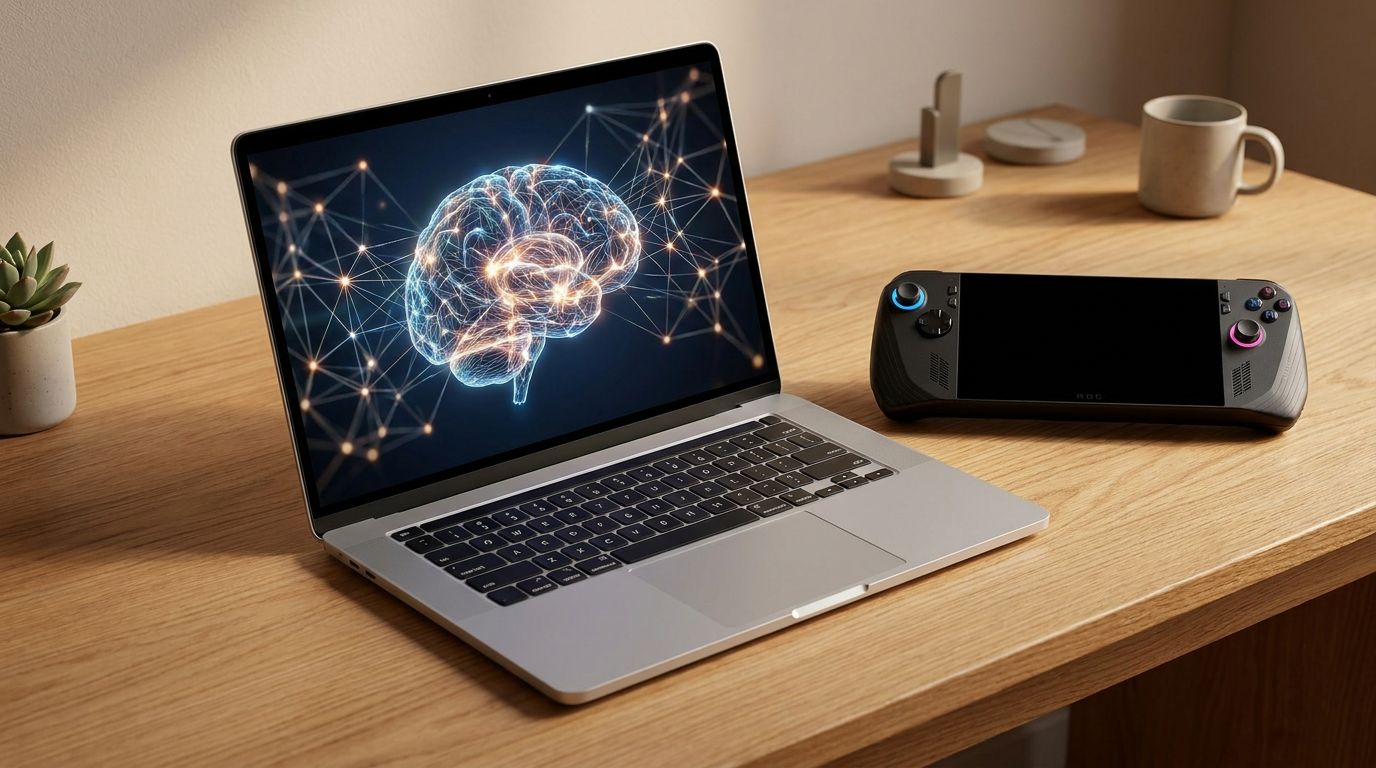
Advances in Neural Processing Units (NPUs) and highly optimized small language models are allowing everyday users to run powerful AI entirely on their own devices, ensuring absolute privacy and zero latency.
By Factlen Editorial Team
- Privacy & Security Advocates
- Argue that local AI is essential for data sovereignty and protecting sensitive information.
- Hardware Manufacturers
- View the AI PC era as a fundamental catalyst for a global hardware upgrade cycle.
- Open-Source Developers
- Champion the democratization of AI compute and freedom from subscription paywalls.
- Cloud Infrastructure Providers
- Maintain that while local AI is useful, frontier reasoning will always require centralized data centers.
What's not represented
- · Environmental analysts assessing the carbon footprint of millions of local NPUs versus centralized cloud data centers.
- · Non-technical consumers who may still find the concept of downloading and managing local AI models intimidating.
Why this matters
Running AI locally means your sensitive data—from financial spreadsheets to private journals—never leaves your computer. It also eliminates monthly subscription fees and allows powerful AI tools to work seamlessly on airplanes or during internet outages.
Key points
- Modern AI PCs feature dedicated Neural Processing Units (NPUs) that handle AI workloads without draining battery life.
- Local inference ensures absolute data privacy, as sensitive information never leaves the user's device.
- Running models offline eliminates network latency, enabling instant responses for real-time coding and voice assistants.
- Highly optimized Small Language Models (SLMs) now offer reasoning capabilities that rival recent cloud-based systems.
- The shift to local AI allows users to replace expensive monthly software subscriptions with free, on-device tools.
For the past three years, artificial intelligence has largely been a rental business. Users typed prompts into a browser, sent their private thoughts or proprietary code to a distant server farm, and waited for a response. That cloud-first model democratized access to frontier intelligence, but it came with inherent compromises: recurring subscription fees, network latency, and the uneasy reality of handing sensitive data to third-party corporations. In 2026, the paradigm is shifting rapidly. The era of the "AI PC" has moved from a marketing buzzword to a tangible hardware reality, allowing everyday users to run powerful Large Language Models (LLMs) entirely on their own devices. This transition to local, on-device inference represents one of the most significant democratizations of computing power in a decade, giving users absolute control over their data and their AI tools.[5][8]
The catalyst for this shift is a fundamental change in how computers are built. Historically, PCs relied on a Central Processing Unit (CPU) for general tasks and a Graphics Processing Unit (GPU) for rendering visuals. Today, a third pillar has become standard: the Neural Processing Unit (NPU). An NPU is a specialized piece of silicon designed specifically to handle the complex matrix math required by artificial intelligence. Unlike a CPU, which struggles to run AI efficiently, or a GPU, which consumes massive amounts of battery power and generates significant heat, an NPU processes machine learning tasks at incredibly low wattage. This allows thin-and-light laptops to run AI models continuously in the background without draining the battery or spinning up loud cooling fans.[2][4]
The hardware landscape reached a critical tipping point this year, driven largely by Microsoft's Copilot+ certification standards. To qualify, a machine must feature an NPU capable of delivering at least 40 Tera Operations Per Second (TOPS). Chipmakers have aggressively met this benchmark. Intel's Lunar Lake architecture, AMD's Ryzen AI 300 series, and Qualcomm's Snapdragon X Elite all comfortably exceed the 40 TOPS threshold. As a result, market analysts at Counterpoint Research project that "AI-Advanced PCs" will account for roughly 59 percent of all global PC shipments in 2026, up sharply from previous years. The impending end-of-support for Windows 10 has further accelerated this hardware refresh cycle, putting capable AI hardware into millions of homes and offices.[3][4]
But powerful hardware is useless without optimized software. The second half of the local AI equation has been solved by the rapid maturation of Small Language Models (SLMs) and open-weight releases. Tech giants and open-source communities alike have realized that not every task requires a trillion-parameter behemoth running in a data center. Models like Google's Gemma 4, Meta's Llama 4, and Microsoft's Phi-4 Mini have been engineered to punch far above their weight class. Through advanced training techniques and architectural refinements, these models offer reasoning capabilities that rival the cloud-based ChatGPT of just a year or two ago, yet they are small enough to fit comfortably within the 16 gigabytes of RAM that now comes standard on most modern laptops.[5][6]

The secret to fitting these models onto consumer hardware is a mathematical technique known as quantization. In simple terms, quantization reduces the precision of the numbers used within the AI model's neural network. By compressing a model from high-precision 16-bit floating-point numbers down to 4-bit or even 2-bit integers, developers can shrink the file size of a model by up to 75 percent. While this compression results in a slight degradation of the model's absolute nuance, the drop in quality is virtually imperceptible for everyday tasks like drafting emails, summarizing documents, or writing code. Quantization is the magic trick that allows a massive, highly capable AI to be downloaded as a single file and run on a standard consumer laptop.[2][7]
The most immediate and profound benefit of local AI is absolute data privacy. In sectors like healthcare, law, and finance, strict regulatory frameworks and client confidentiality agreements make it impossible to upload sensitive documents to public cloud AI services. Even for everyday consumers, the idea of feeding personal journals, financial spreadsheets, or private correspondence into a corporate server is inherently uncomfortable. With local LLMs, the data never leaves the physical device. There are no API calls, no server logs, and no third-party data processing agreements to navigate. The AI model acts as a completely private, offline assistant, ensuring that sensitive information remains strictly under the user's control.[5][6]
Beyond privacy, local inference completely eliminates network latency. When using a cloud-based AI, every prompt must travel across the internet to a data center, be processed, and travel back—a roundtrip that typically adds 200 to 800 milliseconds of delay before the first word appears on screen. While that may seem trivial for a simple chat query, it is agonizingly slow for real-time applications. For developers using AI coding assistants that suggest code as they type, or for users interacting with voice-based AI agents, that network latency breaks the illusion of seamless interaction. On-device AI responds instantly, making the technology feel like a natural extension of the user's thought process rather than a remote service.[2][5]
Beyond privacy, local inference completely eliminates network latency.
This zero-latency environment is particularly transformative for software developers. The coding landscape in 2026 has seen a massive shift toward local agentic coding. Tools like Continue.dev, paired with local models like Qwen3-Coder or DeepSeek, are replacing expensive cloud-based subscriptions like GitHub Copilot for many programmers. Because the model runs locally, it can constantly index the developer's entire private codebase in the background, offering highly contextual suggestions without ever exposing proprietary company code to the public internet. This combination of speed, context, and security has made local AI an indispensable tool in modern software engineering.[6][7]
The offline capability of local AI also unlocks entirely new use cases. Cloud AI is inherently fragile; it becomes useless the moment a user steps onto an airplane without Wi-Fi, enters a secure facility, or experiences a network outage. Local models provide absolute reliability regardless of connectivity. Field workers in remote locations, military personnel in secure environments, and disaster response teams can now rely on advanced AI diagnostics, translation, and summarization tools without needing a cell signal. This offline resilience transforms AI from a web service into a fundamental utility, as reliable as the calculator or the notepad app on a smartphone.[5][7]
The financial implications of this shift are equally compelling. The subscription fatigue associated with modern software is a real pain point for consumers and small businesses, with many paying hundreds of dollars a month for various AI tools, coding assistants, and writing aids. Running models locally represents a massive cost arbitrage. Once the hardware is purchased, the actual inference is entirely free. A user can generate thousands of images, summarize hundreds of documents, and write endless lines of code without ever hitting a rate limit or incurring an API overage charge. For power users, a capable AI PC pays for itself in saved subscription fees within a matter of months.[6][7]
Historically, the barrier to entry for local AI was steep, requiring users to navigate complex command-line interfaces, install Python dependencies, and troubleshoot driver issues. In 2026, the tooling ecosystem has matured to the point of frictionless simplicity. Desktop applications like LM Studio, Jan, and GPT4All offer polished, intuitive graphical interfaces that look and feel exactly like ChatGPT. Users simply browse a built-in directory of models, click download, and start chatting. For more technical users, frameworks like Ollama allow models to be installed and run with a single terminal command, seamlessly exposing local APIs that can be plugged into other applications.[6][7]

While NPUs are the stars of the thin-and-light laptop market, they are not the only way to run local AI. For creative professionals and power users, discrete GPUs remain the gold standard. While an NPU is perfect for background tasks and text generation, it lacks the raw compute power required for heavy creative workloads. Generating high-resolution images using models like Stable Diffusion or Flux, or processing video with AI upscaling, still demands the massive parallel processing capabilities and dedicated Video RAM (VRAM) of a discrete graphics card, such as an NVIDIA RTX 4070 or higher. The PC market has naturally segmented to accommodate both needs.[1][4]
This segmentation means buyers must be intentional about their hardware choices. A Copilot+ certified laptop with a 40 TOPS NPU is ideal for the business professional or student who wants exceptional battery life, real-time meeting transcription, and private document summarization. However, a digital artist or AI researcher will still need a heavier, more power-hungry workstation equipped with a discrete GPU. Understanding this distinction is critical, as the "AI PC" marketing label is applied broadly across both categories, even though their practical capabilities and ideal use cases are vastly different.[2][4]
The rise of local AI does not mean the death of the cloud. The smartest architecture for the foreseeable future is a hybrid approach. Local models are perfectly suited for 90 percent of daily tasks: drafting emails, summarizing text, basic coding, and organizing data. However, for the remaining 10 percent of tasks that require frontier-level reasoning, massive context windows, or complex multi-step logic, the sheer scale of cloud-based models running on massive server clusters remains unmatched. Modern operating systems and applications are increasingly designed to route simple queries to the local NPU while seamlessly escalating complex requests to the cloud, offering the best of both worlds.[5][8]

Ultimately, the normalization of on-device AI in 2026 marks a healthy rebalancing of the technology ecosystem. It pulls power away from centralized server farms and places it directly into the hands of the user. By solving the critical bottlenecks of privacy, latency, and cost, local LLMs have transformed artificial intelligence from a rented luxury into a personal, private utility. As hardware continues to improve and open-weight models become even more efficient, the default assumption will no longer be that our data must travel to the cloud to be understood. The intelligence is now built in.[5][8]
How we got here
Late 2022
Cloud-based models like ChatGPT popularize generative AI, but establish a paradigm reliant on remote servers and subscription fees.
Mid 2024
The first wave of consumer NPUs are introduced, though a lack of optimized software limits their practical utility.
Late 2025
The impending end-of-support for Windows 10 triggers a massive PC refresh cycle, pushing AI-capable hardware into the mainstream.
Early 2026
The release of highly optimized small models like Gemma 4 and Llama 4, combined with 40+ TOPS NPUs, makes local AI a viable daily tool.
Viewpoints in depth
Privacy & Security Advocates
Argue that local AI is essential for data sovereignty and protecting sensitive information.
This camp views the shift toward local LLMs as a necessary course correction after years of unchecked cloud data collection. They emphasize that professionals in healthcare, law, and finance cannot legally or ethically use cloud-based AI for client data. By running models locally, this group argues, users reclaim ownership of their digital footprint, ensuring that their private thoughts, proprietary code, and personal documents are never ingested into a corporate training dataset or exposed in a server breach.
Hardware Manufacturers
View the AI PC era as a fundamental catalyst for a global hardware upgrade cycle.
For chipmakers and PC builders, the integration of NPUs represents the most significant architectural shift since the widespread adoption of the GPU. This camp heavily promotes the 40 TOPS standard and Copilot+ certification, arguing that legacy hardware is fundamentally unequipped for modern computing. They focus on the efficiency gains—specifically how NPUs allow for continuous background AI processing without destroying laptop battery life—as the primary selling point for enterprise and consumer upgrades.
Open-Source Developers
Champion the democratization of AI compute and freedom from subscription paywalls.
This community is the driving force behind tools like Ollama, LM Studio, and highly optimized small language models. They argue that AI should be a fundamental utility, not a gated service controlled by a few massive corporations. By optimizing models to run on consumer hardware, this camp believes they are breaking the monopoly of cloud providers, allowing anyone with a standard laptop to access frontier-level coding, writing, and reasoning tools without paying exorbitant monthly API fees.
Cloud Infrastructure Providers
Maintain that while local AI is useful, frontier reasoning will always require centralized data centers.
While acknowledging the benefits of local inference for latency and privacy, this camp argues that the physical constraints of laptop hardware will always limit model capabilities. They point out that the most advanced reasoning, massive context windows, and complex multi-agent simulations require terabytes of VRAM and massive server clusters. Their vision is a hybrid future where local NPUs handle basic triage and UI tasks, but the heavy intellectual lifting is seamlessly routed back to the cloud.
What we don't know
- Whether the rapid pace of model growth will eventually outstrip the memory capacity of standard consumer laptops.
- How cloud providers will adjust their pricing models as more users migrate to free, local alternatives for daily tasks.
Key terms
- NPU (Neural Processing Unit)
- A specialized hardware chip designed specifically to accelerate artificial intelligence tasks efficiently without draining battery power.
- TOPS (Tera Operations Per Second)
- A metric used to measure the performance of an NPU, indicating how many trillions of math operations it can perform in one second.
- Quantization
- A compression technique that shrinks the file size of an AI model so it can fit into standard computer memory, with minimal loss in quality.
- Local Inference
- The process of running an artificial intelligence model directly on your own device's hardware, rather than sending data to a cloud server.
- Small Language Model (SLM)
- A highly optimized AI model designed to be compact enough to run on consumer laptops and phones while still offering strong reasoning capabilities.
Frequently asked
Do I need an internet connection to use a local LLM?
No. Once you download the model file to your device, it runs entirely offline. This makes local AI perfect for use on airplanes, in secure facilities, or during network outages.
Will running an AI model locally drain my laptop battery?
If you run heavy models on a traditional GPU, it will drain the battery quickly. However, modern "AI PCs" use a Neural Processing Unit (NPU) specifically designed to run these tasks at very low wattage, preserving battery life.
Can a local model completely replace ChatGPT Plus?
For most everyday tasks like drafting emails, summarizing documents, and basic coding, yes. However, for highly complex reasoning or tasks requiring massive amounts of context, cloud-based frontier models still hold an advantage.
What is the difference between an NPU and a GPU?
A GPU is designed for heavy, parallel processing like rendering video games, which consumes a lot of power. An NPU is a specialized chip designed strictly for the matrix math used in AI, allowing it to perform those specific tasks much more efficiently.
Sources
Source coverage
8 outlets
4 viewpoints surfaced








[1]Vision ComputersHardware Manufacturers
What Is an AI PC? Hardware Requirements for 2026
Read on Vision Computers →[2]DEV CommunityOpen-Source Developers
The current AI PC and NPU laptop market for developers
Read on DEV Community →[3]Counterpoint ResearchHardware Manufacturers
AI Advanced PCs to Surpass Half of Global Shipments in 2026
Read on Counterpoint Research →[4]NeweggHardware Manufacturers
Buying an AI PC in 2026: What You Need to Know
Read on Newegg →[5]AI MagicxPrivacy & Security Advocates
A practical guide to running AI models locally in 2026
Read on AI Magicx →[6]PinggyPrivacy & Security Advocates
Top Local LLM Tools and Models in 2026
Read on Pinggy →[7]Prompt QuorumOpen-Source Developers
Power Local LLM — Build a Private AI Stack
Read on Prompt Quorum →[8]Factlen Editorial TeamCloud Infrastructure Providers
Synthesis by Factlen editorial team
Read on Factlen Editorial Team →
Every angle. Every day.
Get ai stories with full source coverage and perspective breakdowns delivered to your inbox.