
How Next-Generation Geothermal Energy is Unlocking 24/7 Clean Power
By adapting oil and gas drilling techniques, Enhanced Geothermal Systems (EGS) are creating artificial underground reservoirs to provide firm, round-the-clock clean energy.
By Factlen Editorial Team
- Geothermal Innovators
- Argue that adapting horizontal drilling techniques from the oil and gas industry has finally made geothermal a scalable, bankable clean energy solution.
- Grid Operators & Utilities
- Value EGS primarily for its ability to provide firm, 24/7 dispatchable power to balance intermittent renewables and meet soaring data center demand.
- Environmental Risk Monitors
- Focus on the necessity of strict oversight regarding induced seismicity and water consumption during the deep-rock fracturing process.
- Energy Economists
- Cautiously optimistic but emphasize that high upfront capital costs must fall significantly for the technology to scale globally without subsidies.
What's not represented
- · Local residents near drilling sites
- · Fossil fuel workers transitioning to geothermal
Why this matters
The clean energy transition is currently bottlenecked by the intermittent nature of wind and solar power. Next-generation geothermal solves this by providing a reliable, 24/7 baseload energy source that can be deployed globally, utilizing the existing workforce and technology of the fossil fuel industry.
Key points
- Enhanced Geothermal Systems (EGS) use horizontal drilling and hydraulic fracturing to create artificial underground heat reservoirs.
- The technology provides 24/7 firm, clean baseload power, solving the intermittency problem of wind and solar energy.
- Fervo Energy's Cape Station project in Utah is set to deliver 100 MW of commercial EGS power to the grid in late 2026.
- The U.S. Department of Energy projects that next-generation geothermal could increase domestic capacity twentyfold to 90 GW by 2050.
- High upfront capital costs and the management of induced seismicity remain the primary hurdles to global scaling.
The global transition to clean energy has a massive, unresolved math problem: what happens when the sun sets and the wind stops blowing. While solar panels and wind turbines have become astonishingly cheap, they are inherently intermittent. To keep the grid stable, operators currently rely on natural gas, coal, or nuclear power to provide "baseload"—the constant, round-the-clock electricity required to power hospitals, factories, and increasingly, massive artificial intelligence data centers. Finding a clean, renewable source of baseload power that can be deployed anywhere has been the holy grail of energy economics.[3]
For decades, energy researchers have looked beneath our feet for a solution. The Earth's core is a nuclear furnace, radiating immense heat outward. Traditional geothermal energy taps into this heat by finding rare, naturally occurring underground reservoirs of hot water or steam—think of the geysers in Iceland or Northern California. But because these natural hydrothermal systems require a specific geological combination of heat, fluid, and highly permeable rock, they are geographically limited. As a result, geothermal currently provides less than half a percent of the world's electricity.[5][8]
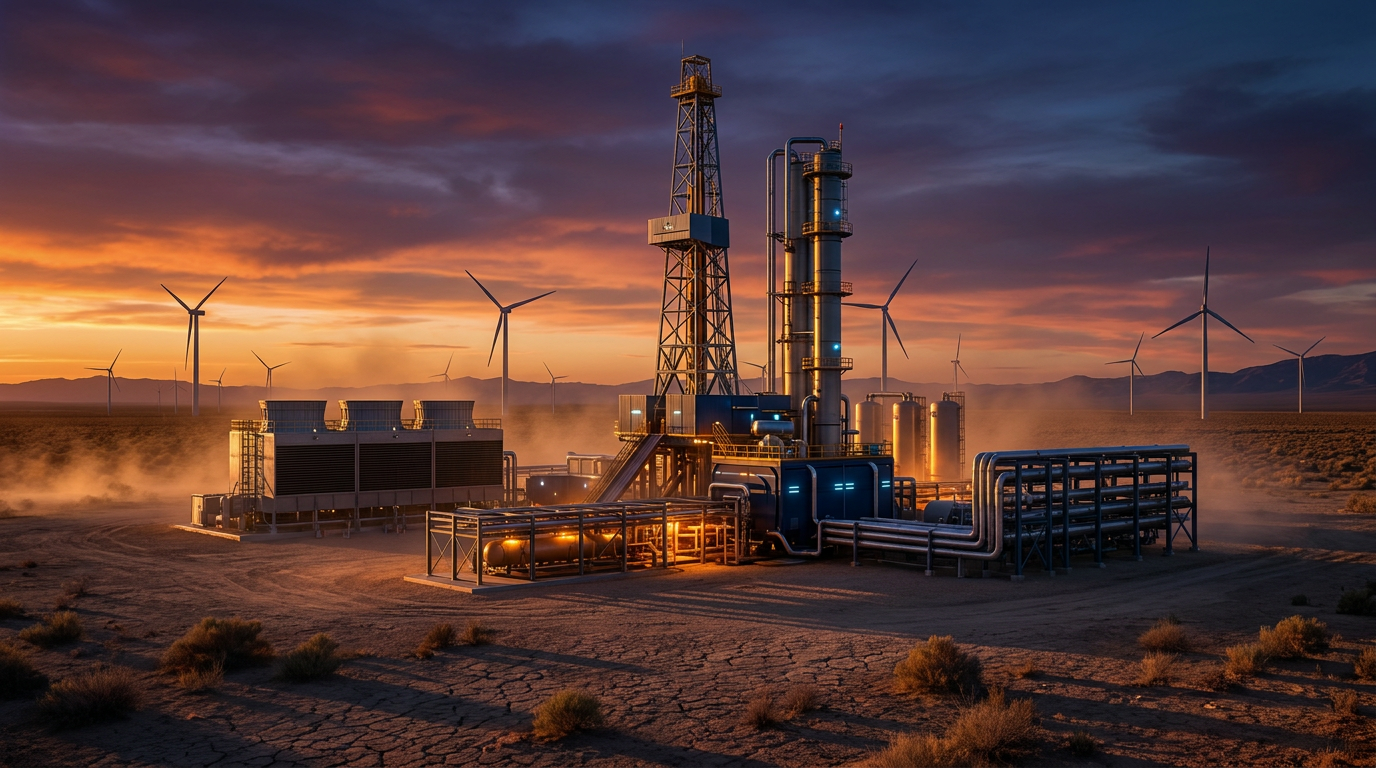
That geographic limitation is now being shattered by a technology known as Enhanced Geothermal Systems (EGS). Instead of hunting for natural hot springs, EGS engineers create their own. By drilling deep into hot, dry, impermeable rock and injecting pressurized fluid, developers can artificially fracture the stone, creating a massive subsurface radiator. Water is pumped down an injection well, heated by the deep rock, and drawn back up a production well to spin a turbine, creating a closed-loop system of zero-carbon, 24/7 power.[1][2][8]

The concept of EGS has existed since the 1970s, but it was historically plagued by high costs and technical failures. The recent breakthrough, ironically, comes directly from the fossil fuel industry. Geothermal startups have aggressively adopted the horizontal drilling and hydraulic fracturing techniques pioneered during the shale oil and gas boom of the 2010s. By drilling vertically for thousands of feet and then turning the drill bit 90 degrees to run horizontally through the hot rock, companies can expose vastly more surface area to the circulating water, drastically increasing the energy output per well.[2][3][4]
The undisputed leader in this new frontier is Fervo Energy, a Houston-based startup founded by former oil and gas engineers. In Beaver County, Utah, Fervo is currently constructing Cape Station, the world's largest EGS project. Slated to begin delivering its first 100 megawatts of power to the grid in late 2026, the facility is permitted to eventually scale up to 2 gigawatts. Cape Station represents the exact moment EGS transitions from a government-funded science experiment to a bankable, utility-scale reality.[2][4][5][6]
The economics of geothermal have traditionally been crippled by the sheer cost of drilling through hard, crystalline granite deep underground. But the application of modern oilfield technology has triggered a steep learning curve. Between 2022 and 2025, Fervo reported reducing its drilling times by 75 percent and slashing per-foot drilling costs by 70 percent. These rapid efficiency gains are the critical lever required to make EGS competitive with conventional power sources, proving that the technology can scale without breaking the bank.[3][4][6]

The U.S. Department of Energy (DOE) views these advancements as a paradigm shift for the national grid. In its recent "Liftoff" report, the DOE projected that next-generation geothermal could increase U.S. geothermal capacity from its current 2.7 gigawatts to 90 gigawatts by 2050—a staggering twentyfold expansion. Other industry estimates suggest the technology could eventually unlock up to 150 gigawatts in the American Southwest alone, fundamentally redrawing the map of where clean, firm energy can be generated.[1][5]
Department of Energy (DOE) views these advancements as a paradigm shift for the national grid.
This technological leap coincides with an unprecedented surge in electricity demand. After two decades of flat load growth, the U.S. grid is straining under the combined weight of electric vehicle adoption, domestic manufacturing, and the explosive growth of AI data centers. Tech giants like Google and Meta, which have pledged to run their operations on 24/7 carbon-free energy, have recognized that solar and batteries alone cannot power their multi-gigawatt server farms through the night or during winter storms.[3][4]
Consequently, these corporations are heavily backing EGS to secure their energy futures. Google is both an investor in and a major customer of Fervo, signing first-of-their-kind power purchase agreements (PPAs) to supply its Nevada data centers with continuous clean electricity. Utilities are also recognizing the immense value of firm clean power to balance their increasingly renewable portfolios. Southern California Edison recently signed a massive 15-year contract for 320 megawatts from the Cape Station project, marking the largest geothermal PPA in history and providing enough electricity to power 350,000 homes. This corporate and utility demand is providing the guaranteed revenue streams required to finance massive infrastructure projects.[3][4][6]

The financial markets have enthusiastically validated this momentum. In May 2026, Fervo Energy became the first next-generation geothermal company to go public, raising $1.9 billion in a highly anticipated initial public offering that valued the firm at roughly $7.7 billion. This massive influx of capital, combined with hundreds of millions in private project financing secured earlier in the year, provides the financial runway needed to transition from isolated pilot wells to massive, multi-well commercial developments across the American West. It signals to the broader energy sector that next-generation geothermal is no longer viewed as a risky venture, but as a core component of the future energy mix.[4][6]
Despite the overwhelming optimism, EGS faces significant engineering and environmental hurdles that must be managed carefully. The most prominent concern is induced seismicity. The process of injecting high-pressure water to shear deep rock inevitably creates micro-earthquakes as the stone fractures. While these events are typically of very low magnitude and rarely felt at the surface, the risk of triggering a larger, damaging seismic event remains a serious regulatory and public relations challenge for developers looking to build near populated areas.[6][7]
To mitigate this risk, developers are deploying unprecedented subsurface monitoring technology. At Cape Station, geophysicists from the Lawrence Berkeley National Laboratory recently achieved a major breakthrough by operating custom high-temperature seismometers nearly 7,000 feet underground for seven continuous months. Operating in environments where temperatures reach 338°F, this real-time data allows operators to map the fracture networks precisely and adjust injection pressures proactively to prevent dangerous fault slips, ensuring the system operates safely within strict geological limits.[7]

Water consumption is another critical variable for the industry's expansion. While EGS plants recycle the water that drives their surface turbines in a closed loop, the initial hydraulic stimulation process requires millions of gallons of fluid to create the underground reservoir. Furthermore, some water is inevitably lost to the deep rock formation over time and must be replenished. In the arid American West, where the best high-heat geothermal resources are located, securing long-term water rights can be politically and logistically complex.[6][8]
Finally, there is the ultimate hurdle of capital expenditure. While drilling costs are falling rapidly, the upfront price tag for an EGS plant remains daunting. Current capital expenditures sit at roughly $7,000 per kilowatt of capacity—competitive with advanced nuclear power, but significantly higher than natural gas or utility-scale solar. The industry's stated goal is to drive that cost down to $3,000 per kilowatt, a threshold that would allow EGS to scale globally and compete purely on economics without relying on heavy government subsidies or clean energy mandates.[3][4]
If these costs can be wrung out of the system, the implications for the climate are profound. Next-generation geothermal offers a rare and poetic convergence: it utilizes the existing workforce, drilling rigs, and heavy machinery of the fossil fuel industry to build the infrastructure of a post-carbon world. As the first commercial electrons flow from Cape Station in late 2026, Enhanced Geothermal Systems are poised to evolve from a geological theory into a foundational, round-the-clock pillar of the global clean energy grid.[2][3][9]
How we got here
1970s
Early conceptualization and initial government-funded experiments of Enhanced Geothermal Systems begin.
2010s
The shale oil and gas boom rapidly advances horizontal drilling and hydraulic fracturing technologies.
2023
Fervo Energy breaks ground on Cape Station in Utah, the world's largest commercial EGS project.
March 2024
The U.S. Department of Energy releases a report projecting that next-gen geothermal could reach 90 GW by 2050.
May 2026
Fervo Energy goes public in a $1.9 billion IPO, signaling strong financial market confidence in EGS.
Late 2026
Cape Station is scheduled to begin delivering its first 100 megawatts of commercial power to the grid.
Viewpoints in depth
Geothermal Innovators
Startups and engineers argue that adapting oil and gas technology has finally made geothermal a scalable solution.
For decades, geothermal energy was viewed as a niche resource, limited to regions with active volcanoes or natural hot springs. Innovators in the EGS space argue that by repurposing the horizontal drilling and hydraulic fracturing techniques perfected by the fossil fuel industry, they have unlocked a virtually limitless source of clean energy. They point to the rapid 70 percent reduction in drilling costs as proof that EGS can follow the same steep cost-decline curve that made solar and wind power globally dominant.
Grid Operators & Tech Giants
Utilities and data center operators view EGS as the missing piece of the clean energy puzzle.
As the demand for electricity surges due to electric vehicles and artificial intelligence, grid operators are increasingly anxious about relying solely on intermittent renewables like wind and solar. Tech giants like Google and Meta, which require massive amounts of uninterrupted power for their server farms, argue that batteries are currently too expensive to provide multi-day storage. For these stakeholders, EGS is highly attractive because it provides "firm" baseload power—electricity that is generated 24 hours a day, regardless of the weather, without producing carbon emissions.
Environmental Risk Monitors
Scientists and local communities emphasize the need for strict oversight regarding induced seismicity and water usage.
While supportive of clean energy, environmental monitors caution that EGS is not without footprint. The process of injecting high-pressure fluid to fracture deep rock inherently causes micro-earthquakes. While usually imperceptible, there is a historical precedent for poorly managed geothermal projects triggering larger, damaging seismic events. Furthermore, these groups highlight that the fracturing process requires millions of gallons of water, a significant concern in the arid regions of the American West where the most accessible high-heat rock is located. They advocate for continuous, high-resolution seismic monitoring and strict water recycling mandates.
What we don't know
- Whether the capital cost of EGS plants can be reliably reduced to the $3,000/kW target required for unsubsidized global scaling.
- How frequently induced seismicity will trigger regulatory shutdowns or community opposition as projects move closer to populated areas.
- The long-term water replenishment requirements for massive multi-gigawatt EGS reservoirs operating over decades.
Key terms
- Enhanced Geothermal Systems (EGS)
- Man-made geothermal reservoirs created by fracturing hot, dry rock deep underground to circulate water and extract heat.
- Baseload Power
- The minimum amount of electric power needed to be supplied to the electrical grid at any given time, requiring 24/7 reliability.
- Hydraulic Stimulation
- The process of injecting high-pressure fluid into underground rock formations to create or widen fractures, increasing permeability.
- Power Purchase Agreement (PPA)
- A long-term contract between an electricity generator and a buyer (like a utility or tech company) that guarantees a fixed price for power.
Frequently asked
How is EGS different from traditional geothermal energy?
Traditional geothermal relies on naturally occurring underground hot springs. EGS artificially creates these reservoirs by fracturing hot, dry rock and pumping water through it.
Does Enhanced Geothermal cause earthquakes?
The fracturing process creates micro-earthquakes that are rarely felt at the surface. However, operators use advanced seismometers to monitor the rock and prevent larger, damaging seismic events.
Can EGS power plants be built anywhere?
While EGS vastly expands where geothermal can be built, it still requires regions where high-heat rock is relatively close to the surface, such as the American West.
Why are tech companies investing in geothermal?
Companies like Google and Meta need massive amounts of 24/7 electricity for their AI data centers, and wind and solar cannot provide continuous power without expensive batteries.
Sources
Source coverage
9 outlets
4 viewpoints surfaced








[1]U.S. Department of EnergyGrid Operators & Utilities
Pathways to Commercial Liftoff: Next-Generation Geothermal Power
Read on U.S. Department of Energy →[2]PNASEnergy Economists
Next-gen geothermal could bring clean power to much more of the planet
Read on PNAS →[3]Information Technology and Innovation FoundationEnergy Economists
Advanced Geothermal Energy Is Widely Available, Clean, and Maybe Cheap Enough to Make a Big Impact
Read on Information Technology and Innovation Foundation →[4]Canary MediaGeothermal Innovators
Fervo Energy's IPO is a milestone for next-gen geothermal
Read on Canary Media →[5]Switchgear MagazineGeothermal Innovators
Geothermal breakthrough may unlock 150 GW
Read on Switchgear Magazine →[6]WTWEnergy Economists
From breakthrough to bankable: Scaling high-potential renewable technologies
Read on WTW →[7]Lawrence Berkeley National LaboratoryEnvironmental Risk Monitors
Scientists Develop New Technology to Continuously Monitor Geothermal Energy Operations
Read on Lawrence Berkeley National Laboratory →[8]MIT Climate PortalGrid Operators & Utilities
Geothermal Energy
Read on MIT Climate Portal →[9]Factlen Editorial TeamEnergy Economists
Synthesis by Factlen editorial team
Read on Factlen Editorial Team →
Every angle. Every day.
Get meta stories with full source coverage and perspective breakdowns delivered to your inbox.