
The Rise of Self-Driving Labs: How AI and Robotics Are Automating Scientific Discovery
Autonomous laboratories are combining artificial intelligence with 24/7 robotics to run the entire scientific method in a closed loop. By automating the design, synthesis, and testing of new molecules, these systems aim to compress decade-long discovery timelines into a single year.
By Factlen Editorial Team
- High-Throughput Advocates
- Prioritize speed and scale to solve urgent global challenges.
- Mechanistic Researchers
- Demand explainability and chemical understanding from AI models.
- Open-Science Proponents
- Focus on democratizing access to expensive robotic infrastructure.
- Regulatory & Ethics Watchdogs
- Focus on safety guardrails, data provenance, and preventing the synthesis of hazardous materials.
What's not represented
- · Traditional bench chemists whose daily roles will be displaced
- · Academic institutions in developing nations lacking cloud lab access
Why this matters
The traditional scientific method is too slow to solve urgent global crises like climate change and antimicrobial resistance. By handing the physical and analytical drudgery of experimentation over to AI and robotics, self-driving labs promise to compress decade-long discovery timelines into a single year, fundamentally accelerating the pace of human innovation.
Key points
- Self-driving labs combine AI and robotics to automate the entire scientific method.
- The systems operate in a continuous Design-Make-Test-Analyze loop without human intervention.
- Researchers aim to reduce the time and cost of discovering new materials by a factor of ten.
- New 'gray-box' AI models are helping scientists understand the chemical mechanisms behind discoveries.
- Cloud labs are emerging to democratize access to expensive robotic infrastructure.
For centuries, the scientific method has been a deeply human, painstakingly manual endeavor. A researcher forms a hypothesis, designs an experiment, physically mixes chemicals or cultures cells, records the results, and analyzes the data to refine the next guess. It is a process that has cured diseases and built the modern world, but it is fundamentally bottlenecked by human bandwidth and the slow pace of manual labor. In fields like materials science and drug discovery, finding a single viable compound can take a decade and cost upwards of a billion dollars, severely limiting how fast society can innovate.[5]
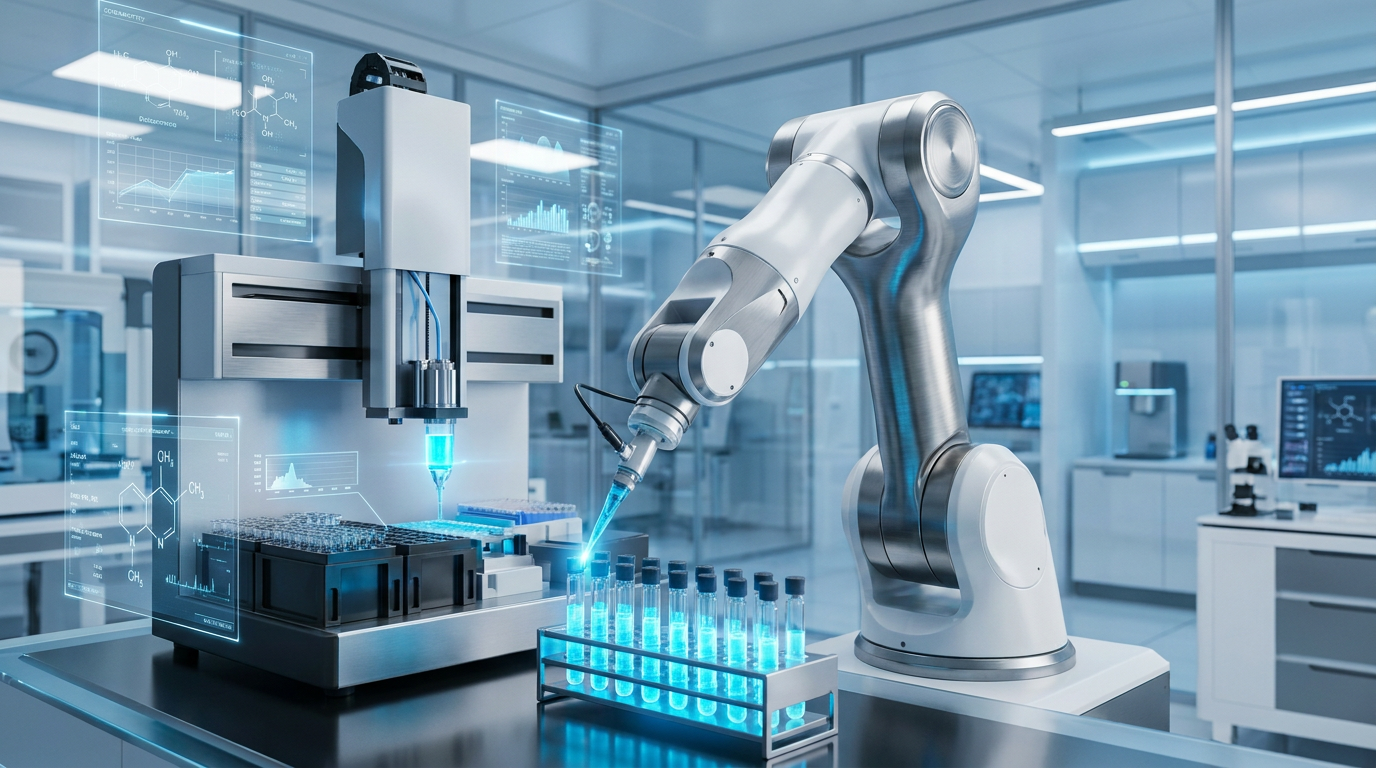
That timeline is no longer keeping pace with the world's most urgent challenges, from climate change to antimicrobial resistance. In response, a quiet revolution is taking place in research institutions across the globe. Artificial intelligence is moving beyond its role as a passive data-cruncher and stepping into the physical world. The result is the "self-driving lab" (SDL)—a fully autonomous laboratory that combines AI, robotics, and advanced computing to run the entire scientific method in a continuous, closed loop.[1][2]
These autonomous laboratories are not merely automated assembly lines executing pre-programmed instructions. They are agentic systems capable of reasoning through complex chemical spaces. Given a high-level goal—such as 'find a molecule that absorbs carbon dioxide from the atmosphere' or 'design a more efficient battery electrolyte'—the AI formulates its own hypotheses. It then directs robotic arms to synthesize the materials, tests the results, and learns from its failures to design the next experiment, entirely on its own. This marks a transition from machines that simply assist scientists to machines that actively participate in the discovery process.[7]
The mechanism powering these self-driving labs is known as the Design-Make-Test-Analyze and Learn (DMTA+L) loop. In the 'Design' phase, machine learning models, often trained on vast databases of existing scientific literature and chemical properties, predict which molecular structures might achieve the desired outcome. The system selects the most promising candidates, balancing the need to exploit known chemical pathways with the need to explore entirely new ones. This predictive capability ensures that physical experiments are not just random guesses, but highly calculated steps toward a specific scientific objective.[5][6]

Once a candidate is selected, the 'Make' phase begins. The AI orchestrates a suite of laboratory automation hardware—liquid handlers, heater-shakers, and robotic arms. These machines physically dispense reagents, control reaction temperatures, and synthesize the compound without human intervention. Because robots do not suffer from fatigue, distraction, or the need to sleep, this physical synthesis can run twenty-four hours a day, seven days a week. This continuous operation drastically increases the throughput of the laboratory, turning what used to be a slow, artisanal process into a highly efficient manufacturing pipeline for new knowledge.[5]
The newly synthesized material immediately enters the 'Test' phase, where automated characterization instruments, such as spectrometers and high-performance liquid chromatography machines, measure the physical and chemical properties of the sample. This data is instantly fed back into the AI orchestrator for the 'Analyze and Learn' phase. This final step is where the true power of the self-driving lab emerges. The AI evaluates how closely the actual results matched its predictions. Using techniques like Bayesian optimization and active learning, it updates its internal models, refining its understanding of the chemical space. Within minutes, it generates a new, smarter hypothesis, and the robotic arms begin the cycle anew. What once took a PhD student months of trial and error can now be executed in a matter of days.[5][6]
The U.S. Department of Energy has recognized this paradigm shift, launching initiatives to build interconnected 'Labs of the Future' to maintain scientific competitiveness. At Oak Ridge National Laboratory, researchers are integrating leadership-class supercomputers with cutting-edge instrumentation to create an ecosystem of self-driving labs. The goal is to accelerate the development of novel materials for next-generation computing and clean energy, moving away from sequential human workflows toward high-throughput, AI-driven discovery. By networking these autonomous systems, scientists hope to tackle combinatorially large design spaces that would be impossible to explore manually.[3][7]
Department of Energy has recognized this paradigm shift, launching initiatives to build interconnected 'Labs of the Future' to maintain scientific competitiveness.
Similar efforts are underway at Argonne National Laboratory, where an automated material laboratory is currently working to create new conductive polymer materials. Instead of following a human's step-by-step recipe, a 'boss' AI agent decides how to run the experiments, continuously optimizing the synthesis parameters to maximize the polymer's conductivity. This level of autonomy allows the system to pivot its strategy in real-time based on unexpected experimental results, uncovering novel material properties that a human researcher might have overlooked or dismissed as an anomaly.[2]
In the realm of biomedicine, the stakes are equally high, and the timelines are notoriously unforgiving. The University of Toronto's Acceleration Consortium recently partnered with the Structural Genomics Consortium to tackle the persistent bottlenecks in early-stage drug discovery. Their joint initiative, known as Target 2035, aims to discover a pharmacological modulator for every single protein in the human proteome by the year 2035. It is an incredibly ambitious goal that requires mapping the interactions of thousands of proteins, a task that traditional medicinal chemistry is simply not equipped to handle at scale.[1]
To achieve this monumental goal, the consortium is relying heavily on its Medicinal Chemistry Self-Driving Lab. Current manual workflows cannot process the rapid influx of validated chemical starting points fast enough to meet the project's deadlines. By automating the iterative synthesis and testing of potential drug compounds, the consortium hopes to drastically reduce the time and cost required to bring life-saving therapeutics to market. The ultimate vision is to compress the discovery timeline from an estimated ten years and ten million dollars down to just one year and one million dollars per novel functional material.[1]

Despite these rapid advancements, the rise of autonomous laboratories has sparked intense debate within the scientific community regarding the 'black box' nature of artificial intelligence. Critics argue that while an AI might successfully optimize a material's performance through brute-force trial and error, it rarely explains why the material works. If science is fundamentally about understanding the universe, an opaque machine that spits out a perfect catalyst without revealing the underlying chemical mechanism is only half-useful. Researchers worry that relying too heavily on uninterpretable models could lead to a crisis of scientific trust.[4]
To address this transparency gap, researchers are pioneering 'gray-box' AI approaches that prioritize explainability alongside optimization. A recent study published in ACS Catalysis, conducted by the Fritz Haber Institute and BASF, demonstrated an AI system designed to explore chemical space while simultaneously uncovering the mechanisms behind a catalyst's performance. Tested on the conversion of propane to propylene—a crucial industrial reaction for manufacturing plastics—the system proved that AI can act as an interpretable partner. It provided both high-speed optimization and deep scientific reasoning, proving that automated discovery does not have to come at the expense of human understanding.[4]
The transition to autonomous science also raises profound questions about the future role of the human scientist. As robots take over the physical drudgery of pipetting and the algorithmic heavy-lifting of parameter optimization, the day-to-day reality of laboratory work is evolving. Humans are moving up the value chain, shifting their focus away from manual execution and toward defining overarching scientific goals. Scientists will spend more time ensuring ethical oversight, designing the parameters of the AI's sandbox, and interpreting the complex, mechanistic insights generated by the machines.[5][7]
However, significant hurdles remain before self-driving labs become ubiquitous across academia and industry. The most pressing challenge is data scarcity. Unlike large language models, which are trained on the entirety of the public internet, AI copilots in the physical sciences require massive volumes of high-quality, reproducible, domain-specific data. Ironically, the very self-driving labs that need this data to function are currently the best tools for generating it. This creates a bootstrap problem that early adopters are racing to solve by running continuous, automated experiments simply to build the foundational datasets of the future.[3]

Furthermore, the sheer cost of building a fully integrated, robotic laboratory limits access to well-resourced national laboratories, elite universities, and massive pharmaceutical corporations. To prevent the monopolization of scientific discovery, a movement toward 'cloud labs' is gaining traction. These platforms offer subscription-based, remote-control access to autonomous experimental capabilities. By democratizing access to high-throughput robotics, cloud labs allow researchers anywhere in the world—regardless of their institution's hardware budget—to submit a hypothesis and have a self-driving lab execute it on their behalf.[2][6]
As these technologies mature and become more accessible, they will inevitably face intense regulatory scrutiny. Systems that autonomously design and test biologically active compounds or hazardous materials will require robust safety guardrails. Under emerging frameworks like the European Union's AI Act, any autonomous system that establishes levels of exposure to mitigate health hazards must undergo strict conformity assessments. Laboratories will need to document data provenance and provide uncertainty estimates to ensure that AI agents do not inadvertently synthesize dangerous pathogens, toxins, or environmentally harmful chemicals.[8]
Ultimately, the self-driving lab represents a profound shift in the epistemology of science. By automating the iterative loops of hypothesis, synthesis, and analysis, we are not just building faster laboratory tools; we are engineering a new kind of scientific collaborator. If successful, this synthesis of artificial intelligence and physical automation promises to unlock discoveries at a pace previously thought impossible. It stands to transform our approach to everything from clean energy and sustainable materials to human health, fundamentally rewriting the speed limit of human innovation.[8]
How we got here
1985
Early theoretical discussions begin regarding the use of artificial intelligence to design scientific experiments.
2020-2023
Initial proofs-of-concept emerge, demonstrating fully autonomous synthesis of novel organosilicon compounds.
April 2026
Researchers publish a breakthrough in 'gray-box' AI, proving autonomous labs can uncover chemical mechanisms, not just optimize performance.
June 2026
The University of Toronto and the Structural Genomics Consortium formalize a partnership to use self-driving labs for massive-scale drug discovery.
Viewpoints in depth
High-Throughput Advocates
Prioritize speed and scale to solve urgent global challenges.
This camp, largely composed of national laboratories and major research consortiums, views the traditional scientific method as dangerously slow. They argue that existential threats like climate change and antimicrobial resistance cannot wait for decade-long discovery cycles. By running automated experiments 24/7, they believe we can brute-force our way through combinatorially massive chemical spaces to find the exact molecules society needs, prioritizing functional results over perfect theoretical understanding.
Mechanistic Researchers
Demand explainability and chemical understanding from AI models.
Researchers in this camp warn against the 'black box' approach to science. They argue that simply finding a material that works is insufficient if the AI cannot explain the underlying physics or chemistry. They advocate for 'gray-box' models that simultaneously optimize performance and extract mechanistic insights, ensuring that automated discovery contributes to the foundational understanding of the universe rather than just producing uninterpretable miracles.
Open-Science Proponents
Focus on democratizing access to expensive robotic infrastructure.
This perspective highlights the massive capital required to build self-driving labs, warning that scientific discovery could become monopolized by a few elite universities and corporations. They champion the development of 'cloud labs'—remote-access robotic facilities that allow any researcher with an internet connection to run automated experiments. They argue that true acceleration will only happen when the global scientific community can share both the hardware and the resulting datasets.
What we don't know
- How quickly regulatory bodies will adapt to oversee AI systems that autonomously synthesize biologically active compounds.
- Whether the scientific community can generate enough high-quality, reproducible data to train the next generation of physical AI models.
- To what extent the high cost of robotic infrastructure will concentrate scientific power in elite institutions.
Key terms
- Self-Driving Lab (SDL)
- A fully autonomous laboratory that combines artificial intelligence and robotics to execute the entire scientific method without human intervention.
- Active Learning
- A machine learning technique where the AI actively queries the system to test specific, high-value data points, rapidly improving its own accuracy.
- Proteome
- The entire set of proteins that is, or can be, expressed by a genome, cell, tissue, or organism at a certain time.
- Gray-Box AI
- An artificial intelligence approach that combines data-driven optimization with transparent, interpretable models that explain the underlying mechanisms.
Frequently asked
Will self-driving labs replace human scientists?
No. While they automate the physical execution of experiments and routine data analysis, human scientists are still required to set high-level goals, ensure ethical oversight, and interpret complex mechanistic results.
How much faster are autonomous laboratories?
In some applications, self-driving labs aim to reduce the time required to discover a new functional material from ten years down to just one year, operating continuously 24/7 without fatigue.
What is a 'cloud lab'?
A cloud lab is a remote-controlled, automated laboratory that researchers can access via a subscription. It allows scientists to run physical experiments from anywhere in the world without needing to buy their own expensive robotics.
What is the DMTA loop?
It stands for Design-Make-Test-Analyze. It is the core closed-loop process where an AI designs an experiment, robots make and test the material, and the AI analyzes the results to learn for the next cycle.
Sources
Source coverage
8 outlets
4 viewpoints surfaced








[1]University of Toronto / Acceleration ConsortiumHigh-Throughput Advocates
AI for Discovery and Self-Driving Labs
Read on University of Toronto / Acceleration Consortium →[2]ForbesOpen-Science Proponents
Automated Science And The Future Of Discovery
Read on Forbes →[3]U.S. Department of EnergyHigh-Throughput Advocates
Achieving AI-Driven Autonomous Laboratories
Read on U.S. Department of Energy →[4]ACS CatalysisMechanistic Researchers
AI-powered self-driving labs move beyond discovery to explain catalyst performance
Read on ACS Catalysis →[5]Drug Target ReviewHigh-Throughput Advocates
How self-driving labs are changing drug development
Read on Drug Target Review →[6]Royal Society PublishingOpen-Science Proponents
Democratizing self-driving labs: advances in laboratory automation
Read on Royal Society Publishing →[7]Oak Ridge National LaboratoryHigh-Throughput Advocates
Autonomous Laboratories at Oak Ridge National Laboratory
Read on Oak Ridge National Laboratory →[8]Factlen Editorial TeamRegulatory & Ethics Watchdogs
Synthesis by Factlen editorial team
Read on Factlen Editorial Team →

Every angle. Every day.
Get ai stories with full source coverage and perspective breakdowns delivered to your inbox.