
The Classist Rulebook: Why Theatres Are Relaxing Cellphone and Noise Etiquette for Inclusivity
Theatres are dismantling 19th-century rules of absolute silence and stillness, recognizing that rigid etiquette often excludes neurodivergent audiences, younger generations, and diverse cultural traditions.
By Factlen Editorial Team
- Inclusive Arts Advocates
- Focus on dismantling barriers and welcoming neurodivergent and diverse audiences.
- Cultural Historians
- Examine how strict etiquette was engineered in the 19th century as a social gatekeeper.
- Industry Pragmatists
- Focus on the economic need to attract younger, diverse ticket-buyers to survive.
What's not represented
- · Performers and Actors on Stage
- · Front-of-House Staff and Ushers
Why this matters
As the arts sector faces declining attendance, the dismantling of rigid, 19th-century audience rules represents a massive cultural shift. For millions of neurodivergent individuals, parents, and younger patrons, these relaxed policies are the difference between being locked out of live entertainment and finally being welcomed into the auditorium.
Key points
- Theatres are moving away from strict 19th-century rules of absolute silence and stillness.
- Advocates argue traditional etiquette is classist and excludes neurodivergent and diverse audiences.
- Historically, theatre audiences were rowdy and interactive until elites engineered a shift in the 1800s.
- Silent cellphone use is being reconsidered as a necessary sensory regulation tool for some patrons.
- Theatres are adopting hybrid models, like lobby chill-out zones, to balance immersion with accessibility.
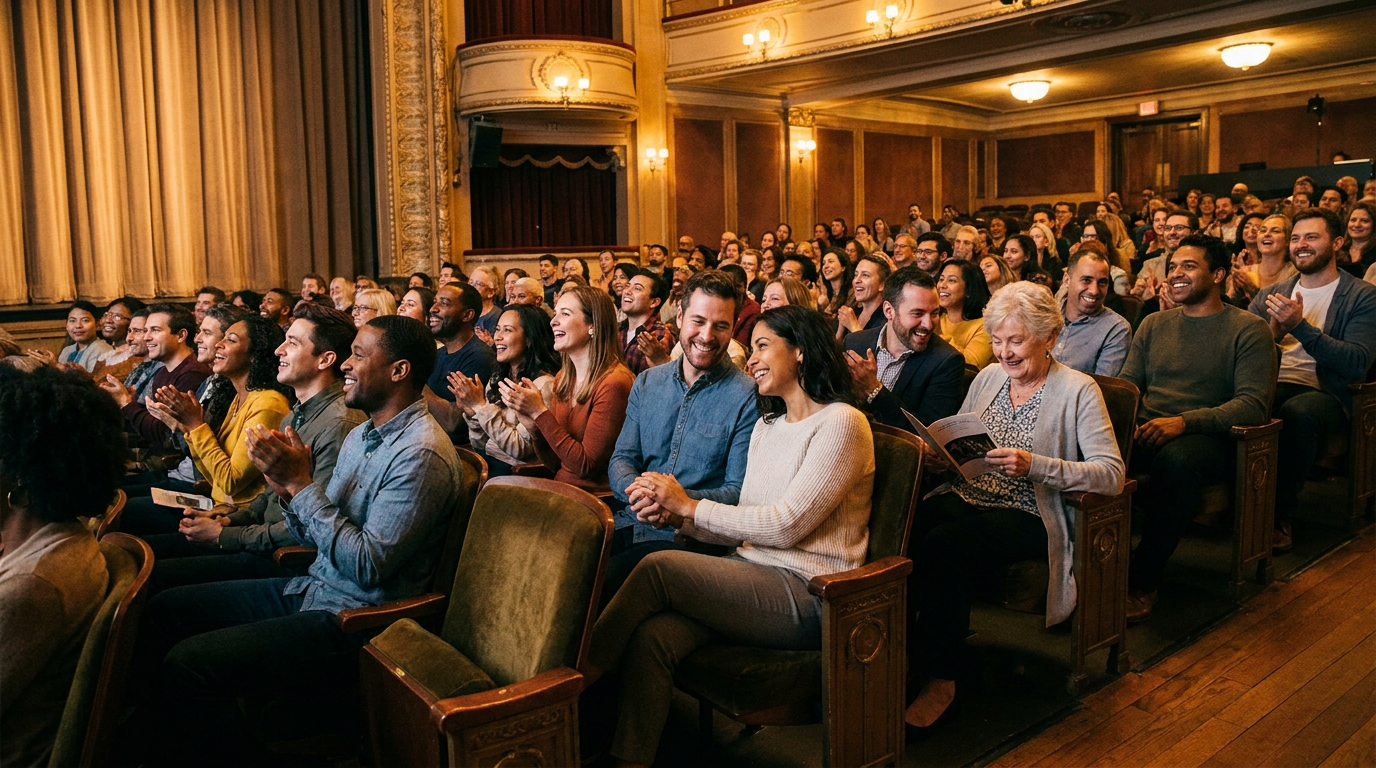
For generations, the rules of attending the theatre have been as rigidly choreographed as the performances on stage. The house lights dim to a pitch black, the audience settles into absolute stillness, and a collective, reverent silence falls over the auditorium. Any deviation—a cough, a rustling candy wrapper, a whispered comment, and certainly the glow of a cellphone—is met with swift, synchronized glaring and aggressive shushing. This behavioral contract has long been viewed as the ultimate sign of respect for the art form, a necessary sacrifice of personal comfort to maintain the immersive magic of live performance. But in 2026, a growing coalition of playwrights, directors, and accessibility advocates is fundamentally challenging this "sit still and be quiet" mandate. They argue that the traditional rulebook is not a timeless necessity of the art, but rather a manufactured, exclusionary construct that actively alienates the audiences the theatre desperately needs to survive.[6][7]
Across London’s West End, Broadway, and major regional stages, the strictest tenets of audience etiquette are quietly being dismantled. Theatres are moving beyond the occasional, segregated "relaxed performance" to question whether the baseline rules of the house are inherently discriminatory. Ushers are being retrained in de-escalation rather than strict enforcement, and pre-show announcements are shifting their tone from punitive warnings to welcoming invitations for audiences to exist comfortably in the space. This quiet revolution is driven by a realization that the rigid policing of audience behavior disproportionately targets marginalized groups, framing their natural modes of engagement or physical needs as unacceptable disruptions to the dominant cultural norm.[6]
At the heart of the debate is the argument that modern theatre etiquette is deeply classist and culturally biased. Prominent playwrights and industry critics have pointed out that the expectation of silent, passive consumption is a distinctly Western, upper-middle-class framework. In many African American, Latinx, and Indigenous cultural traditions, live performance is inherently participatory. Call-and-response, vocal affirmations, and audible reactions are signs of deep engagement and respect for the performers, not distractions. When theatres enforce absolute silence, they inadvertently signal to these demographics that their cultural expressions are invalid, effectively telling audiences of color that they are only welcome if they assimilate to the behavioral standards of a white, affluent majority.[2]
The rigid enforcement of stillness and silence also creates insurmountable barriers for neurodivergent individuals. For patrons with autism, ADHD, Tourette’s syndrome, or sensory processing disorders, sitting perfectly still in a dark, acoustically intense room for two hours can be physically painful or neurologically impossible. The pressure to suppress vocal tics, self-soothing movements (stimming), or the need to temporarily step away creates an environment of intense anxiety rather than entertainment. Qualitative studies on sensory-friendly theatre programs have consistently shown that when the fear of social policing is removed, neurodivergent individuals exhibit profound engagement with the arts, highlighting how much talent and appreciation the industry has historically locked out.[4]

Even the ultimate theatrical taboo—the cellphone—is undergoing a nuanced reappraisal. While ringing phones and loud conversations remain universally condemned, the silent use of screens is being viewed through a new lens of accessibility. For some neurodivergent patrons, silently scrolling or playing a repetitive game on a dimmed screen serves as a vital sensory regulation tool, allowing them to remain in the theatre during overwhelming moments. Furthermore, younger generations possess a "digital habitus" where dual-screening is their default mode of processing information. Some progressive venues are experimenting with designated "tweet seats" or relaxed device policies, arguing that forcing a complete digital disconnect is an arbitrary hurdle that ignores how modern audiences actually interact with the world.[7]
To understand how deeply ingrained—and how relatively recent—these rules are, historians point backward to the origins of the stage. For the vast majority of theatrical history, audiences were loud, mobile, and highly interactive. In Shakespeare’s Globe, the groundlings stood in the open air, eating, drinking, talking back to the actors, and moving around the yard. The performance was a shared, communal event where the boundary between the stage and the audience was highly porous. The idea that a play required silent reverence would have been entirely foreign to Elizabethan theatregoers, who viewed the stage as a vibrant extension of the bustling city streets.[5]
The pivot toward silence was not a natural evolution of the art form, but a deliberate social engineering project that took root in the 19th century. As industrialization created a booming, diverse urban population, theatre remained a shared popular entertainment where all classes mixed. However, as the century progressed, the upper classes sought to distinguish their cultural consumption from the "masses." Historians note that the elite began to categorize certain performances—like Shakespeare and opera—as "high art," which required a refined, educated, and critically silent mode of reception, actively separating it from the rowdier, working-class entertainments of the music halls.[1][5]
The pivot toward silence was not a natural evolution of the art form, but a deliberate social engineering project that took root in the 19th century.
This behavioral shift was cemented by architectural and technological changes, most notably championed by the composer Richard Wagner. At his Bayreuth Festspielhaus in the 1870s, Wagner introduced the concept of the "mystic gulf"—hiding the orchestra and, crucially, plunging the auditorium into complete darkness. Before this, theatres were fully lit, allowing the audience to see and interact with one another as much as the stage. By darkening the house, Wagner forced the audience into a state of isolated, passive observation. This architectural choice birthed the modern expectation of reverent silence, physically enforcing the idea that the audience's only role was to silently receive the genius of the creator.[1]
The very concept of "etiquette" was subsequently deployed as a social gatekeeper. By producing and policing arbitrary rules of behavior—when to clap, how to sit, what to wear—the upper classes could easily identify who belonged in their spaces and who did not. The rules were less about protecting the art and more about reinforcing social separation. The public reprimanding of those who stepped out of line served as a stark warning to the working classes that the theatre was no longer their domain. Today's advocates argue that when we fiercely defend traditional theatre etiquette, we are unconsciously upholding this 19th-century legacy of exclusion.[1]

The initial industry response to these access barriers was the creation of the "relaxed performance." These specific, scheduled matinees leave the house lights at a low glow, eliminate startling sound effects or strobe lights, and operate under a strict "no shushing" policy. Patrons are free to move around, vocalize, and exit the auditorium as needed. These performances have been a lifeline for families with autistic children and adults with sensory needs, providing a rare, judgment-free zone for cultural participation. Research confirms that these environments not only increase accessibility but foster a deep sense of community solidarity among attendees who usually feel marginalized in public spaces.[4]
However, the success of relaxed performances has sparked a more radical question: why should inclusivity be relegated to a single Tuesday matinee? Critics and accessibility advocates argue that segregating disabled or diverse audiences into specific time slots is a half-measure that maintains the exclusivity of the "main" performances. The push in 2026 is toward mainstreaming these concepts, asking what the theatrical landscape would look like if it were more relaxed all the time. This doesn't mean abandoning all norms, but rather shifting the baseline culture from one of hostile policing to one of mutual grace, where a quiet vocalization or a shifting body is accepted as part of the live, shared experience.[3]
Unsurprisingly, this cultural shift is meeting fierce resistance from theatrical traditionalists. For many, the theatre is one of the last remaining sanctuaries from a hyper-connected, endlessly distracting world. They argue that the immersive power of a drama relies entirely on the collective, unbroken focus of the room. From this perspective, relaxing the rules isn't an act of inclusivity, but a capitulation to shrinking attention spans and a lack of basic consideration for others. Traditionalists point out that ticket prices are exorbitant, and patrons who have paid hundreds of dollars deserve an experience free from the glow of screens and the disruption of conversational chatter.[7]
Yet, the economic realities of the 2026 theatrical landscape are forcing the hands of even the most stubborn purists. Theatres are facing an existential crisis: their traditional, affluent donor base is aging out, and subscription models are collapsing. To survive, the industry must attract younger, more diverse audiences—specifically Millennials and Gen Z. These demographics, raised on interactive digital media and highly attuned to issues of social equity, often find the rigid, punitive atmosphere of traditional theatre alienating and outdated. For producers, relaxing the rulebook is no longer just a moral imperative regarding accessibility; it is a vital commercial strategy for audience development.[6]

The solution emerging across the industry is a nuanced, hybrid approach that seeks to balance immersion with accessibility. Rather than a free-for-all, theatres are implementing structural changes: establishing sound-proofed "chill-out zones" in lobbies with live feeds of the stage, offering highly detailed content and sensory warnings so audiences can self-regulate, and creating designated seating areas where silent device use is permitted. Ushers are transitioning from enforcers of silence to accessibility hosts, trained to distinguish between a genuinely disruptive conversation and a neurodivergent patron's self-soothing vocalization.[7]
Ultimately, the dismantling of the classist rulebook is not about letting chaos reign in the stalls. It is about redefining what respect looks like in a shared cultural space. Respect no longer means demanding that every individual conform to a 19th-century standard of physical rigidity. Instead, it means acknowledging the diverse ways in which different minds and cultures process art. By relaxing its grip on absolute silence, the theatre is slowly shedding its legacy of exclusion, finally asking how it can mold its environment to welcome the audiences of the 21st century, rather than demanding the audience mold themselves to the past.[7]
How we got here
16th-17th Century
Audiences at venues like Shakespeare's Globe are rowdy, mobile, and highly interactive during performances.
Late 19th Century
Elites begin enforcing strict silence to separate 'high art' from working-class popular entertainments.
1876
Richard Wagner darkens the auditorium at Bayreuth, cementing the modern expectation of passive, isolated observation.
2010s
Theatres begin offering segregated 'relaxed performances' specifically for neurodivergent patrons and families.
2026
Major venues move to mainstream relaxed etiquette across all performances to boost inclusivity and audience numbers.
Viewpoints in depth
Inclusive Arts Advocates
Advocates argue that rigid etiquette is a tool of exclusion that must be dismantled.
This camp views the traditional rules of theatre—absolute silence, stillness, and darkness—as artifacts of 19th-century classism and white cultural dominance. They point to data showing that these rules actively lock out neurodivergent individuals, parents with young children, and audiences from cultures with participatory traditions. For these advocates, true accessibility means changing the baseline culture of the auditorium, moving away from punitive policing and toward an environment that embraces diverse physical and neurological responses to art.
Cultural Historians
Historians argue that the 'timeless' rules of theatre are actually a relatively recent 19th-century invention.
By tracing the shift from the rowdy, interactive audiences of Shakespeare's Globe to the silent, darkened auditoriums pioneered by Richard Wagner, historians demonstrate that strict etiquette was deliberately engineered. The upper classes utilized these arbitrary behavioral rules to separate 'high art' from popular entertainment, effectively using etiquette as a social gatekeeper to enforce class boundaries and exclude the working masses.
Industry Pragmatists
Producers and administrators view relaxed rules as an economic necessity for audience development.
Operating outside the purely ideological debate, theatre management and producers are focused on the bottom line. With aging donor bases and declining subscription models, the industry faces an existential threat if it cannot attract younger, more diverse ticket-buyers. This camp views the relaxation of etiquette not just as a moral accessibility issue, but as a vital commercial strategy. They advocate for hybrid solutions—like designated relaxed zones and better usher training—to modernize the theatre experience without completely alienating their traditional core audience.
What we don't know
- Whether mainstreaming relaxed rules will permanently alienate older, traditional subscription buyers.
- How performers will adapt their craft to consistently noisier and more mobile audiences.
- If the economic boost from younger, diverse audiences will offset potential losses from traditionalists.
Key terms
- Relaxed Performance
- A theatrical presentation modified to be more accessible, typically featuring adjusted lighting, lowered sound levels, and a relaxed attitude toward audience movement and noise.
- Neurodivergent
- A non-medical term describing people whose brain functions, learns, and behaves differently from what is considered 'typical,' including autism, ADHD, and Tourette's.
- Wagnerian Darkness
- The practice of completely darkening the audience seating area during a performance, popularized by composer Richard Wagner in the 19th century to force focus on the stage.
- Digital Habitus
- The ingrained habits, dispositions, and skills related to the use of digital technology, particularly among younger generations who default to dual-screening.
Frequently asked
Does this mean people can take phone calls during a play?
No. The relaxation of rules focuses on silent screen use for sensory regulation or accessibility, not disruptive phone calls or loud conversations.
Why is traditional etiquette considered classist?
Historians note that the rules of absolute silence and stillness were codified in the 19th century by upper-class patrons specifically to separate 'high art' from the rowdier, working-class popular entertainments of the era.
What is a 'tweet seat'?
A designated section in some modern theatres where patrons are permitted to silently use their phones to post about the performance or read digital programs without disturbing others.
How did theatre audiences behave historically?
For most of theatrical history, including during Shakespeare's time, audiences were highly interactive, mobile, and vocal, viewing the theatre as a shared, communal event rather than a place for silent reverence.
Sources
Source coverage
7 outlets
3 viewpoints surfaced







[1]The StageCultural Historians
Is it elitist to go on about theatre etiquette?
Read on The Stage →[2]American TheatreInclusive Arts Advocates
The Loaded Social Politics of Theatre Etiquette
Read on American Theatre →[3]The GuardianInclusive Arts Advocates
What if the theatre landscape were more relaxed all the time?
Read on The Guardian →[4]ResearchGateInclusive Arts Advocates
Sensory friendly theatre programs: dismantling barriers in social environments
Read on ResearchGate →[5]Harvard University PressCultural Historians
Highbrow/Lowbrow: The Emergence of Cultural Hierarchy in America
Read on Harvard University Press →[6]The New York TimesIndustry Pragmatists
Broadway's Quiet Revolution: Rethinking the Rules of the House
Read on The New York Times →[7]Factlen Editorial TeamIndustry Pragmatists
Synthesis by Factlen editorial team
Read on Factlen Editorial Team →
Every angle. Every day.
Get lifestyle stories with full source coverage and perspective breakdowns delivered to your inbox.