
California's AB 1777: How Police Can Now Issue Traffic Citations to Empty Robotaxis
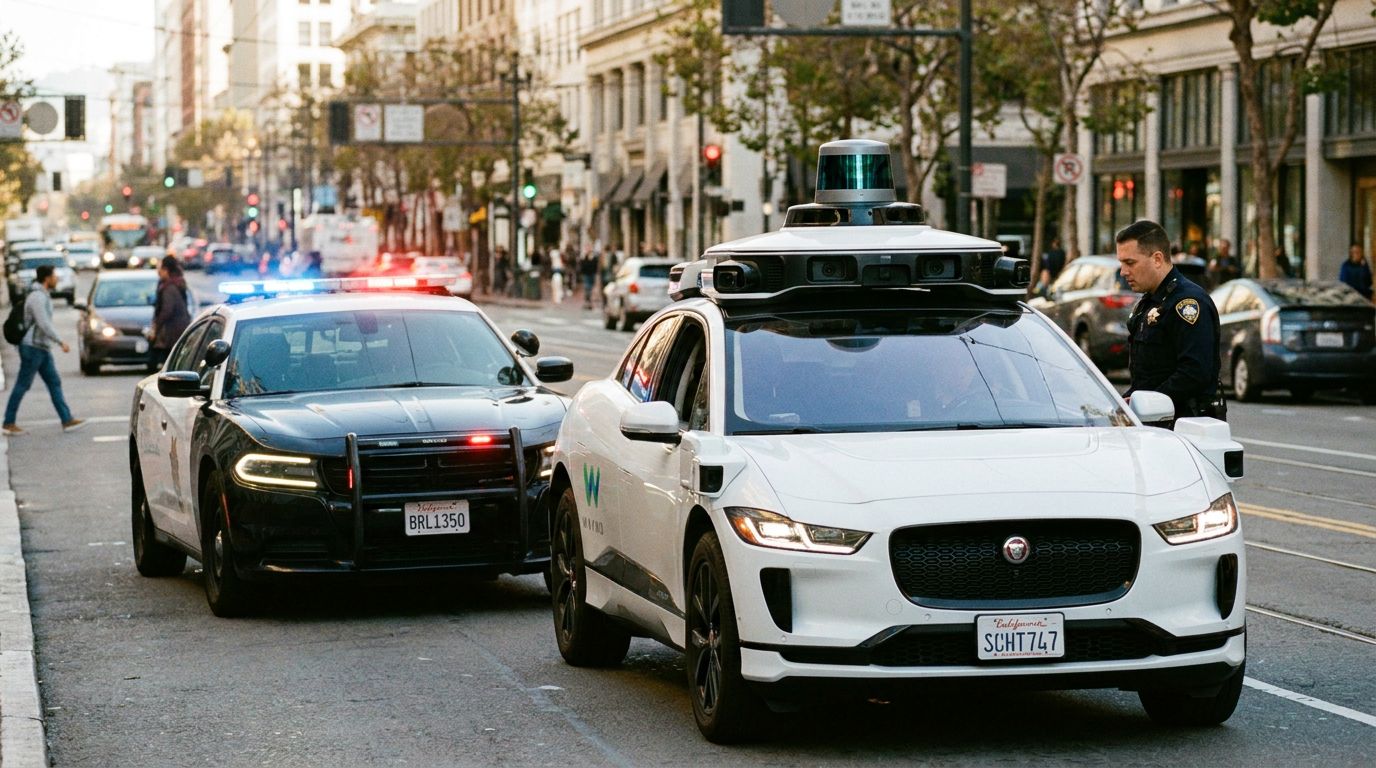
Starting July 1, 2026, a new California law closes a major legal loophole by allowing law enforcement to issue formal moving violations directly to autonomous vehicle manufacturers.
By Factlen Editorial Team
- Law Enforcement & City Officials
- Argue that police need enforceable tools to clear emergency scenes and maintain basic traffic order when AI is at the wheel.
- Autonomous Vehicle Industry
- Warns that a patchwork of local regulations could stunt innovation, though they acknowledge the need for standardized state-level reporting.
- Civil Litigators & Safety Advocates
- View the law as a crucial mechanism to pierce corporate secrecy and provide objective evidence when AVs cause injuries.
What's not represented
- · Robotaxi Passengers
- · Automotive Insurance Providers
Why this matters
For years, driverless cars that ran red lights or blocked fire trucks couldn't be ticketed because traffic laws assumed a human driver. This new law makes the AI legally accountable, giving police the power to cite manufacturers and providing crash victims with official evidence of software failures.
Key points
- California's AB 1777 allows police to issue formal moving violations directly to autonomous vehicle manufacturers.
- Companies must report all citations to the DMV within 72 hours, risking permit revocation for excessive violations.
- First responders can now issue digital geofencing directives that force robotaxis to clear emergency zones within two minutes.
- The law provides objective government documentation of AV traffic violations, aiding victims in civil injury lawsuits.
The era of the legally untouchable robotaxi is officially ending in California. Beginning July 1, 2026, a landmark piece of legislation fundamentally rewrites the rules of the road for autonomous vehicles. For the first time, law enforcement officers across the state have the explicit authority to pull over and formally cite driverless cars for moving violations, treating the artificial intelligence piloting the vehicle with the same legal scrutiny applied to human drivers.[2][3]
The shift is the result of Assembly Bill 1777, a measure designed to close a glaring loophole in the California Vehicle Code. For years, traffic laws were predicated on a simple assumption: a vehicle has a human driver. When a robotaxi ran a red light, made an illegal U-turn, or blocked an intersection, police officers were largely powerless. Because there was no human to hand a ticket to, officers could only issue parking citations, leaving moving violations completely unenforced.[3][4]
The legislative push behind the bill, authored by former Assemblymember Phil Ting of San Francisco, noted that it was reckless for autonomous vehicles to operate without any real consequences for breaking laws that humans routinely get ticketed for. The new framework acknowledges that self-driving cars are now a permanent fixture of California's transportation network, and the regulatory apparatus must evolve to match the technology.[4][5]

The catalyst for AB 1777 was a chaotic beta-testing period on the streets of San Francisco. As companies like Waymo and Cruise rapidly scaled their fleets, the city became a live laboratory for edge-case failures. Robotaxis were documented clogging intersections during power outages, driving into active crime scenes, and, in one severe incident, dragging a pedestrian. City officials and first responders found themselves frustrated by a lack of direct authority over the multi-ton computers navigating their streets.[4][6]
To solve the enforcement gap, AB 1777 introduces a new legal instrument: the Notice of Autonomous Vehicle Noncompliance (NAVN). When an officer observes a driverless car committing a vehicle code violation, they no longer need a human driver to sign a citation. Instead, the officer issues the NAVN directly to the vehicle's manufacturer or operator. The notice records the date, time, location, license plate, and confirmation that the autonomous system was engaged at the time of the infraction.[7]
The consequences of these notices extend far beyond a simple fine. Under the new law, autonomous vehicle companies are legally required to report all citations to the California Department of Motor Vehicles within 72 hours—or within 24 hours for more serious cases. This creates a centralized, state-level database of fleet behavior, shifting oversight from anecdotal social media complaints to hard, actionable data.[3]
With this data in hand, the DMV gains significant new enforcement teeth. If a specific company's fleet racks up a pattern of traffic violations or demonstrates a systemic failure to adhere to the vehicle code, the DMV can use the accumulated NAVNs as grounds to suspend or entirely revoke the company's permit to operate on public roads. The financial burden of the fines also falls squarely on the permit holder, ensuring that traffic compliance becomes a core business imperative.[3]

With this data in hand, the DMV gains significant new enforcement teeth.
Beyond routine traffic enforcement, AB 1777 mandates a sweeping overhaul of how robotaxis interact with emergency personnel. First responders previously reported instances where empty vehicles blocked fire trucks or refused to move from hazard zones, requiring police to physically cover the cars' sensors with flares or bags to trick the AI into halting.[4]
The new law requires all autonomous vehicle manufacturers to maintain a dedicated, 24/7 priority telephone line for emergency workers. When a first responder calls, the company must provide access to a human operator within 30 seconds. Furthermore, the vehicles must be equipped with two-way communication devices, allowing police and firefighters on the ground to speak directly with the remote operators managing the fleet.[1][2]
Perhaps the most futuristic provision of the law is the implementation of "emergency geofencing." If a robotaxi inadvertently approaches a disaster scene, a fire, or a cordoned-off accident, local emergency officials are now authorized to transmit a digital boundary to the fleet. Once this electronic directive is issued, the autonomous vehicle company is legally obligated to force its cars to detour or exit the restricted area within exactly two minutes.[1][2]

While the law equips police with new tools, it also quietly revolutionizes civil liability for citizens injured in autonomous vehicle crashes. Previously, victims injured by a robotaxi faced a daunting "black box" problem. Because police couldn't issue moving violations to empty cars, crash reports often lacked an official determination of fault. Injured parties were forced to rely on costly software audits and fight through corporate secrecy to prove the AI made a mistake.[7]
The NAVN system dismantles that barrier. By allowing police to formally document a driverless car's traffic violation at the scene of an accident, the state is providing objective, government-backed evidence of a system failure. Legal experts note that these notices will serve as powerful evidence of negligence in civil injury claims, eliminating the "he said, she said" disputes that have historically complicated litigation against massive technology firms.[7]
The autonomous vehicle industry has not universally welcomed the tightening regulatory net. The Autonomous Vehicle Industry Association, which represents major players in the space, has historically pushed back against efforts to increase local oversight. Industry advocates argue that regulatory certainty is crucial for deploying capital-intensive technology at scale, warning that overly punitive measures or a patchwork of local rules could stunt innovation and delay the broader safety benefits of driverless cars.[5]

However, proponents of the law argue that true scale is impossible without public trust, and public trust requires visible accountability. By creating a standardized, state-level mechanism for enforcement, AB 1777 attempts to strike a balance: allowing the technology to operate and expand, while ensuring that the algorithms are held to the exact same legal standards as the humans they share the road with.[1]
As the July 2026 implementation date arrives, cities and transportation departments across the globe will be watching California closely. The state is effectively beta-testing the legal framework for the next century of transportation. If the NAVN system and emergency geofencing protocols prove successful, AB 1777 is highly likely to become the national blueprint for how society governs artificial intelligence in the physical world.[1]
How we got here
2023–2024
San Francisco experiences a surge in robotaxi incidents, including vehicles blocking fire trucks and driving into active crime scenes.
January 2024
Assemblymember Phil Ting introduces AB 1777 to close the moving-violation loophole in the state vehicle code.
October 2024
Governor Gavin Newsom officially signs AB 1777 into law.
July 1, 2026
AB 1777 takes effect, granting law enforcement new enforcement powers over autonomous fleets.
Viewpoints in depth
Law Enforcement & City Officials
Argue that police need enforceable tools to clear emergency scenes and maintain basic traffic order when AI is at the wheel.
For years, local officials in cities like San Francisco felt they were bearing the brunt of a massive, unregulated beta test. Police and fire departments documented dozens of instances where autonomous vehicles impeded active emergency scenes, blocked intersections during power outages, or committed moving violations that officers were legally powerless to cite. From this perspective, AB 1777 is not about stifling innovation, but about establishing baseline accountability. City leaders argue that if a multi-ton vehicle is going to share public roads, it must be subject to the exact same traffic laws and emergency directives as a human driver, complete with a mechanism to force compliance when the software fails.
Autonomous Vehicle Industry
Warns that a patchwork of local regulations could stunt innovation, though they acknowledge the need for standardized state-level reporting.
The autonomous vehicle sector, represented by groups like the Autonomous Vehicle Industry Association, has consistently cautioned against regulatory overreach. While the industry generally accepts the need for state-level reporting mechanisms like the DMV citation database, they strongly oppose efforts to give individual cities the power to write their own AV laws or cap fleet sizes. Industry advocates argue that self-driving technology requires massive capital investment and regulatory certainty to scale. They warn that treating every software error as a punitive traffic violation—rather than a data point for system-wide improvement—could slow the deployment of a technology that ultimately promises to be far safer than human drivers.
Civil Litigators & Safety Advocates
View the law as a crucial mechanism to pierce corporate secrecy and provide objective evidence when AVs cause injuries.
Before AB 1777, victims injured in crashes involving driverless cars faced a steep uphill battle in civil court. Because police could not issue moving violations to empty vehicles, crash reports often lacked an official determination of fault, leaving victims to fight against proprietary "black box" algorithms and corporate legal teams. Safety advocates and personal injury lawyers view the new Notice of Autonomous Vehicle Noncompliance as a game-changer. By allowing police to formally document a system failure at the scene, the law creates an objective, government-backed record of negligence. This shifts the burden of proof and ensures that technology companies cannot hide behind software secrecy when their vehicles cause real-world harm.
What we don't know
- How aggressively the California DMV will actually use the new citation data to suspend or revoke permits for major players like Waymo and Cruise.
- Whether the Notice of Noncompliance system will face legal challenges from manufacturers disputing the officer's interpretation of the autonomous software's actions.
Key terms
- Notice of Autonomous Vehicle Noncompliance (NAVN)
- The formal citation issued by police directly to an AV manufacturer when a driverless car commits a moving violation.
- Emergency Geofencing Directive
- A digital boundary set by first responders that legally forces autonomous vehicles to detour away from an active emergency scene within two minutes.
- Dynamic Driving Task
- All the real-time operational and tactical functions required to operate a vehicle in on-road traffic, which the AI handles in a robotaxi.
Frequently asked
Can a robotaxi get a speeding ticket?
Yes. Under AB 1777, police can issue a Notice of Noncompliance to the manufacturer for moving violations, including speeding or running red lights.
Who pays the fine when a driverless car is ticketed?
The autonomous vehicle manufacturer or permit holder (such as Waymo or Cruise) is responsible for the citation, not the passengers riding inside.
Will this law ban robotaxis from California?
No, but it gives the DMV the authority to suspend or revoke a company's deployment permit if their fleet accumulates excessive traffic violations.
Sources
Source coverage
7 outlets
3 viewpoints surfaced







[1]ForbesCivil Litigators & Safety Advocates
California AB 1777: police can now ticket driverless cars
Read on Forbes →[2]Fox LALaw Enforcement & City Officials
New CA law allows police to cite driverless cars
Read on Fox LA →[3]Police MagazineLaw Enforcement & City Officials
New California Law Allows Officers to Ticket Driverless Vehicles
Read on Police Magazine →[4]The San Francisco StandardLaw Enforcement & City Officials
Robotaxi firms could be fined up to $135 million for failing to report crashes
Read on The San Francisco Standard →[5]JalopnikAutonomous Vehicle Industry
California Bills Aim To Hold Driverless Car Companies Accountable
Read on Jalopnik →[6]PatchLaw Enforcement & City Officials
New CA DMV Rules: Police To Start Ticketing Driverless Cars
Read on Patch →[7]Victims LawyerCivil Litigators & Safety Advocates
Self-Driving Car Accidents in California: Using AB 1777 to Prove Negligence
Read on Victims Lawyer →

Every angle. Every day.
Get automotive stories with full source coverage and perspective breakdowns delivered to your inbox.