
McDonald's Unveils 'NEXT' Strategy, Centering on Arch IQ AI Drive-Thru and Premium Menu Upgrades
McDonald's has launched its 'NEXT' global strategy, featuring a highly accurate, Google-powered AI ordering system called Arch IQ alongside premium menu innovations. The initiative aims to automate drive-thru ordering to reallocate human labor toward food quality and hospitality.
By Factlen Editorial Team
- Corporate Leadership
- Focuses on operational efficiency and reallocating labor to improve food quality.
- Financial Analysts
- Cautiously optimistic about long-term cash flows but wary of execution risks.
- Labor & Consumer Skeptics
- Concerned about job displacement and the loss of human interaction.
What's not represented
- · Franchisee Owners
- · Drive-Thru Employees
Why this matters
The widespread adoption of AI at McDonald's signals a permanent shift in the service industry, changing how millions of people interact with retail businesses daily. If successful, this technology will set a new standard for automated convenience while fundamentally reshaping entry-level employment and restaurant labor models.
Key points
- McDonald's announced its 'NEXT' strategy, focusing on menu upgrades, technology, marketing, and hospitality.
- The centerpiece is Arch IQ, a Google-powered AI drive-thru system currently testing in five Chicago locations.
- The new AI boasts a 90% accuracy rate, successfully handling bilingual orders and complex menu modifications.
- McDonald's previously abandoned a flawed AI ordering system in 2024 after it went viral for bizarre mistakes.
- Executives state the goal is to reallocate human labor to food preparation rather than eliminate jobs.
The drive-thru lane is undergoing its most radical transformation since the invention of the two-way speaker, signaling a massive shift in how the world orders fast food. McDonald's has officially unveiled "McDonald's > NEXT," a sweeping global strategy designed to overhaul the fast-food giant's operations, menu, and customer experience. Announced at the company's 2026 worldwide franchisee convention, the initiative aims to modernize a brand that serves millions daily. By integrating cutting-edge technology with elevated culinary offerings, McDonald's is attempting to redefine the Quick Service Restaurant (QSR) industry standard. The comprehensive plan touches every aspect of the business, from how food is prepared in the kitchen to how it is marketed on social media, reflecting a deep acknowledgment that the attention economy and digital convenience now dictate consumer behavior.[2][7]
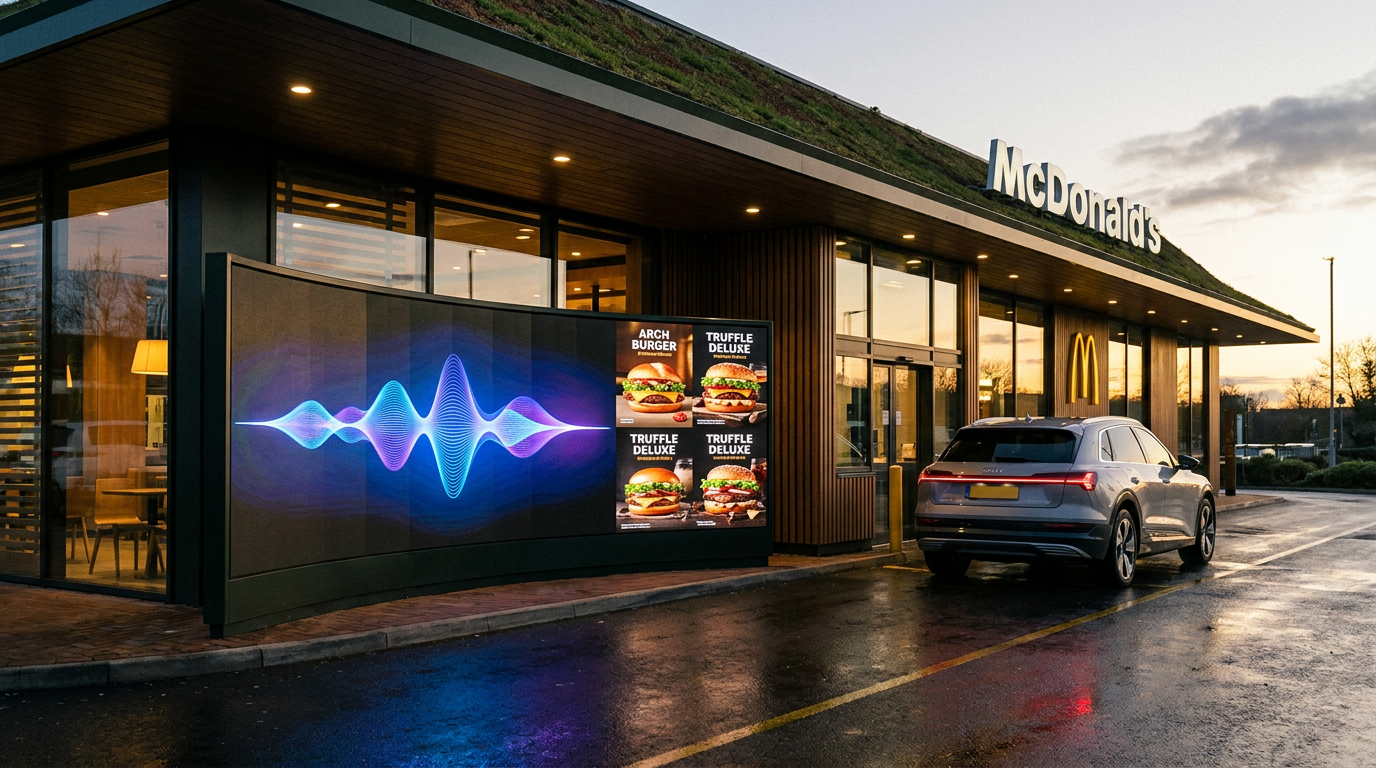
At the center of this ambitious four-pillar initiative is Arch IQ, a proprietary artificial intelligence operating system built in a high-profile partnership with Google. Nicknamed "Archie," the conversational AI is currently being actively tested at five select drive-thru locations in the Chicago area, marking McDonald's aggressive and highly anticipated return to automated ordering. Unlike standalone software patched onto existing hardware, Arch IQ is designed as a unified intelligence layer that runs across the entire restaurant. It connects the drive-thru speaker directly to point-of-sale systems and kitchen display boards, aiming to create a seamless flow of information that reduces human error and accelerates service times during peak dinner rushes.[1][5][6][7]
The rollout represents a high-stakes technological gamble for the world's largest restaurant chain. For decades, the fast-food industry has relied entirely on human workers to decipher muffled audio, heavy accents, and complex custom orders through static-filled headsets. Now, McDonald's is betting that advanced Natural Language Processing (NLP) can finally handle the unpredictable nature of human speech without the friction that has historically plagued automated phone trees and early chatbots. By deploying Google's heavy-hitting AI architecture, the company hopes to process complex orders in real-time, effectively automating one of the most stressful and bottleneck-prone roles in the modern restaurant ecosystem.[3][6]
The "NEXT" strategy, however, extends far beyond the drive-thru speaker and the implementation of artificial intelligence. The corporate initiative rests on four distinct and interconnected pillars: premium menu upgrades, aggressive influencer marketing, advanced restaurant technology, and a renewed focus on hospitality training. By treating AI as an operational spine rather than a standalone gimmick, McDonald's aims to synchronize front-of-house ordering with back-of-house kitchen operations. The strategy acknowledges that technology alone cannot drive growth; it must be paired with cultural relevance—evidenced by their massive FIFA World Cup 26 campaign—and tangible improvements to the food itself to keep value-focused diners engaged.[2][4][7]

To fully understand the significance of the Arch IQ deployment, one must look back at the company's recent and highly publicized technological missteps. In 2019, McDonald's acquired the voice AI startup Apprente, later rebranding it as McD Tech Labs, with the grand vision of deploying automated order takers across tens of thousands of locations. They launched a system designed to replace the human greeting at the speaker box, rolling it out to a limited number of test restaurants. However, the early iterations of the software struggled profoundly in real-world environments, failing to filter out background noise or parse the natural hesitations of everyday customers.[7]
By 2024, McDonald's famously abandoned that initial AI ordering technology following a wave of customer complaints and operational headaches. The system became a viral laughingstock on platforms like TikTok, where users posted videos of bizarre "AI hallucinations." In one infamous instance, the automated system stubbornly added nine sweet teas to a single order, while in others, it added items requested by passengers in neighboring drive-thru lanes. The public relations fallout forced the company to shelve the program entirely, leading many industry observers to wonder if the technology was simply too immature for the chaotic environment of a fast-food drive-thru.[3][5][6]
The primary lesson McDonald's executives took from that highly publicized retreat was the necessity of patience and strategic partnership. Rather than abandoning the dream of automation, McDonald's allowed the underlying technology to mature, shifting its approach to leverage Google's sophisticated cloud and AI infrastructure. The resulting system, Arch IQ, is fundamentally different from the rigid, clunky bots of the past. It utilizes advanced machine learning models that have been trained on vast datasets of human conversation, allowing the software to differentiate between a customer changing their mind mid-sentence and a genuine request for an obscure menu modification.[3][7]
The mechanics of Arch IQ rely heavily on real-time contextual understanding rather than simple keyword recognition. When a customer speaks, the system processes the intent behind the speech, dynamically adjusting the digital menu board to reflect the evolving order. In live demonstrations at the 2026 worldwide franchisee convention, "Archie" successfully navigated complex requests, pausing to process changes and confirming customized orders like a promotional "Tricks Meal" with specific dipping sauces. The AI demonstrated an ability to handle interruptions and corrections gracefully, mimicking the conversational flow of a highly trained human cashier without missing a beat.[3][6]

The mechanics of Arch IQ rely heavily on real-time contextual understanding rather than simple keyword recognition.
Crucially for McDonald's global ambitions, the new Arch IQ system is fully bilingual out of the box. The AI is programmed to seamlessly take and confirm orders in both English and Spanish, dynamically switching languages based on the customer's initial greeting. This feature significantly widens accessibility and speeds up service in diverse demographic markets, removing the language barriers that can often slow down drive-thru times. By accommodating a broader range of dialects and accents, the system ensures a more inclusive and frictionless ordering experience for millions of daily commuters.[3][6]
Beyond language processing, the AI is also designed to recognize and reward repeat customers through deep integration with the McDonald's digital app ecosystem. Through integrated loyalty profiles and opt-in location tracking, Arch IQ can respond to a driver simply asking, "Can I get my usual?" The system immediately queries the user's purchase history and populates the digital menu board with their historical order for quick confirmation. This level of hyper-personalization transforms the drive-thru from an anonymous transactional window into a tailored retail experience, bridging the gap between digital convenience and physical service.[6]
Early performance metrics suggest that the technological leap is paying off handsomely for the fast-food giant. According to corporate executives presenting at the convention, the current iteration of Arch IQ is operating at an impressive 90% accuracy rate during live testing environments in the Chicago area. This means that nine out of ten drive-thru orders are completed entirely by the AI without requiring a human manager to intervene, correct an error, or de-escalate a frustrated customer. Achieving this threshold of reliability is considered the holy grail for QSR automation, proving the system is finally viable for mass deployment.[3][6]
But the cutting-edge technology is only half of the "McDonald's > NEXT" equation; the automation push is inextricably linked to the strategy's menu innovation pillar. While the AI handles the logistics of ordering, the company is simultaneously rolling out higher-quality, premium items designed to elevate the brand's culinary reputation. This includes the introduction of hand-breaded chicken sandwiches and a new half-pound "Best Burger" initiative that requires more precise cooking techniques. The strategy wagers that customers will accept automated ordering if the end product they receive is noticeably hotter, fresher, and of higher quality than before.[2][4]

The operational logic tying these pillars together is straightforward: by automating the repetitive and stressful task of order-taking, McDonald's can reallocate human labor to the kitchen where it matters most. Corporate executives argue that freeing up crew members from the headset allows them to focus strictly on food assembly speed, quality control, and the newly emphasized "hospitality" training. Instead of scrambling to punch buttons on a register, employees can dedicate their attention to ensuring the fries are hot, the burgers are assembled correctly, and the final handoff at the window is accompanied by a genuine smile.[3][7]
Despite the corporate optimism and impressive technical demonstrations, the Arch IQ rollout faces significant hurdles, starting with unpredictable consumer sentiment. Early reactions on social media platforms have been notably polarized, with a vocal contingent of customers expressing a strong preference for interacting with a human being. Many diners view the streamlined, tech-forward bot as impersonal, raising concerns that the pursuit of ultimate efficiency is stripping the remaining warmth from the fast-food experience. Overcoming this psychological barrier will require flawless execution to prove the AI is actually more convenient than a human cashier.[6]
There is also the looming and highly sensitive question of labor displacement across the broader service industry. While McDonald's insists the immediate goal is to shift roles rather than eliminate jobs entirely, labor advocates and industry observers remain deeply skeptical about the long-term impact on the QSR workforce. As automation scales and becomes cheaper to deploy than human labor, there are valid fears that the total headcount required to operate a restaurant will inevitably shrink, potentially closing off a vital entry-level employment avenue for millions of young and unskilled workers.[3][6]

From a financial and investment perspective, the "NEXT" strategy introduces complex execution risks that could weigh on the company's stock. Financial analysts note that while the technology promises durable cash flows and long-term operational efficiency, it requires massive upfront capital investment. Convincing thousands of independent, cost-conscious franchisees to adopt and fund the expensive Arch IQ system will be a critical test of corporate leadership. If franchisees push back against the costs, or if the technology requires constant IT maintenance, the hoped-for operational benefits could be severely delayed.[4]
Furthermore, the broader macroeconomic environment remains challenging for the restaurant sector. With low-income consumers feeling increasingly squeezed by inflation and rising living costs, McDonald's must walk a delicate tightrope. The company has to ensure that its push toward premium, higher-priced menu items and high-tech drive-thrus does not alienate its core value-focused demographic. If the brand is perceived as becoming too expensive or too automated, it risks losing steady traffic to competitors who double down on traditional value meals and human-centric service.[4]
As the Chicago-area tests continue to gather data, the entire restaurant industry is watching the Arch IQ experiment closely. Competitors like Wendy's and Burger King are aggressively pursuing their own AI solutions, but McDonald's sheer scale means that its successes—or failures—will likely set the definitive standard for how the world orders fast food. If McDonald's can prove that AI drive-thrus are reliable, cost-effective, and accepted by the public, it will trigger an industry-wide arms race to automate the remaining friction points in the quick-service ecosystem.[3]
Ultimately, if successful, the "McDonald's > NEXT" strategy will transform the drive-thru from a simple transactional window into a highly personalized, bilingual, and predictive digital ecosystem. By marrying Google's artificial intelligence with premium menu upgrades, the company is attempting to future-proof its business model for the next decade. The era of shouting over a static-filled speaker and hoping the cashier heard your modifications may finally be coming to an end, replaced by the calm, calculated efficiency of an algorithm that already knows exactly what you want to eat.[3][6]
How we got here
2019
McDonald's acquires voice AI startup Apprente to begin developing automated drive-thru technology.
2024
The company abandons its initial AI ordering system following viral errors and customer complaints.
June 2026
McDonald's unveils the 'NEXT' strategy and begins testing the Google-powered Arch IQ system in Chicago.
Viewpoints in depth
Corporate Leadership
Focuses on operational efficiency and reallocating labor to improve food quality.
McDonald's executives view Arch IQ not as a tool for mass layoffs, but as a necessary evolution to handle the increasing complexity of modern fast food. By automating the bottleneck of order-taking, they argue that human workers can be redeployed to focus on hospitality and precise food assembly, ultimately delivering a hotter, fresher product to the consumer.
Financial Analysts
Cautiously optimistic about long-term cash flows but wary of execution risks.
Market watchers acknowledge that successful automation is the holy grail for QSR margins, but they emphasize the massive upfront capital required to deploy Google-powered AI across tens of thousands of locations. Analysts warn that convincing independent franchisees to shoulder these costs will be difficult, and any technological hiccups could alienate value-conscious consumers who are already feeling squeezed by inflation.
Labor & Consumer Skeptics
Concerned about job displacement and the loss of human interaction.
Labor advocates fear that despite corporate assurances, the ultimate endgame of scalable AI is a reduction in total headcount, threatening a vital source of entry-level employment. Meanwhile, a vocal segment of consumers expresses frustration with the increasing digitization of daily life, arguing that automated bots strip the remaining warmth and flexibility from the customer service experience.
What we don't know
- How quickly McDonald's plans to scale Arch IQ beyond the initial five test locations.
- Whether independent franchisees will push back against the financial costs of installing the new technology.
- The long-term impact on total restaurant headcount once the system is fully deployed nationwide.
Key terms
- Arch IQ
- McDonald's proprietary AI operating system, built on Google architecture, designed to manage drive-thru ordering and kitchen operations.
- Natural Language Processing (NLP)
- A branch of AI that helps computers understand and interpret human language, allowing systems to handle complex speech and hesitations.
- McDonald's > NEXT
- The fast-food chain's four-pillar 2026 growth strategy focusing on menu upgrades, influencer marketing, restaurant technology, and hospitality.
- AI Hallucination
- When an artificial intelligence system confidently generates false or nonsensical information, such as adding incorrect items to an order.
Frequently asked
Will the new AI system replace human drive-thru workers?
McDonald's executives state the goal is not to eliminate jobs, but to reallocate labor to food preparation and hospitality, though labor advocates remain skeptical.
What languages can the Arch IQ system understand?
The current iteration of the AI is fully bilingual, capable of seamlessly taking and confirming orders in both English and Spanish.
How is this different from the AI McDonald's tested before?
The previous system, abandoned in 2024, struggled with accuracy and went viral for order errors. The new system is powered by Google's advanced AI and currently boasts a 90% accuracy rate.
Sources
Source coverage
7 outlets
3 viewpoints surfaced







[1]ABC NewsLabor & Consumer Skeptics
McDonald's is testing a new AI powered drive-thru at five US locations
Read on ABC News →[2]FES MagazineCorporate Leadership
AI will play a prominent role in McDonald's NEXT initiative
Read on FES Magazine →[3]Textify.aiLabor & Consumer Skeptics
Meet 'Archie': The Brains Behind McDonald's New AI Drive-Thru
Read on Textify.ai →[4]Sahm CapitalFinancial Analysts
McDonald's Investment Narrative Recap: The NEXT Strategy
Read on Sahm Capital →[5]AL.comCorporate Leadership
McDonald's is making a major change to drive-thrus: What's changing?
Read on AL.com →[6]Mo NewsLabor & Consumer Skeptics
McDonald's tests new AI-powered drive-thru system
Read on Mo News →[7]SavorFMCorporate Leadership
McDonald's unveils 'McDonald's Next' and Arch IQ
Read on SavorFM →
Every angle. Every day.
Get food drink stories with full source coverage and perspective breakdowns delivered to your inbox.