
Travel Backpacks vs. Carry-On Rollers: The 2026 Trade-Off Analysis for One-Bag Travel
As airlines tighten carry-on enforcement and the 'one-bag' movement peaks, travelers face a definitive choice between the mobility of a travel backpack and the weightless comfort of a rolling suitcase. Here is the evidence-based breakdown of which luggage fits your itinerary.
By Factlen Editorial Team
- One-Bag Minimalists
- Travelers who prioritize absolute mobility and speed over packing capacity.
- Comfort-First Travelers
- Travelers who prioritize physical ease and professional presentation.
- Ergonomic Researchers
- Scientists studying the biomechanical impact of load carriage.
What's not represented
- · Airline Gate Agents
- · Travelers with Physical Disabilities
Why this matters
Choosing the wrong luggage can result in physical pain, ruined clothing, or forced gate-checking on strict 2026 flights. Understanding the biomechanical and logistical trade-offs ensures you buy the exact gear that matches your travel style, saving you money and transit stress.
Key points
- Airlines in 2026 are strictly enforcing carry-on limits, driving a surge in minimalist one-bag travel.
- Travel backpacks offer unmatched mobility on uneven terrain and easily avoid forced gate-checks.
- Carrying a backpack exceeding 15 percent of body mass significantly increases spinal compression and fatigue.
- Rolling suitcases provide weightless transit on smooth surfaces and keep professional clothing unwrinkled.
- Pulling a heavy two-wheel suitcase asymmetrically can cause lateral trunk flexion and shoulder strain.
- The optimal choice depends entirely on the itinerary's terrain and transit changes, not personal aesthetics.
The 2026 travel landscape has fundamentally altered how passengers pack. With airlines strictly enforcing the standard 22-by-14-by-9-inch carry-on limits and frequently forcing passengers to gate-check their bags on full flights, the luggage industry is seeing a massive shift in consumer behavior. The "one-bag" travel movement—a minimalist philosophy where travelers navigate the globe indefinitely with a single piece of luggage—has moved from a niche subculture to mainstream practice. As travelers attempt to optimize their transit experience, they are faced with a definitive choice: the wearable mobility of a travel backpack or the weightless convenience of a rolling carry-on suitcase. This decision is no longer merely about aesthetics; it is a calculated trade-off involving biomechanics, terrain friction, and airline logistics.[2][5]
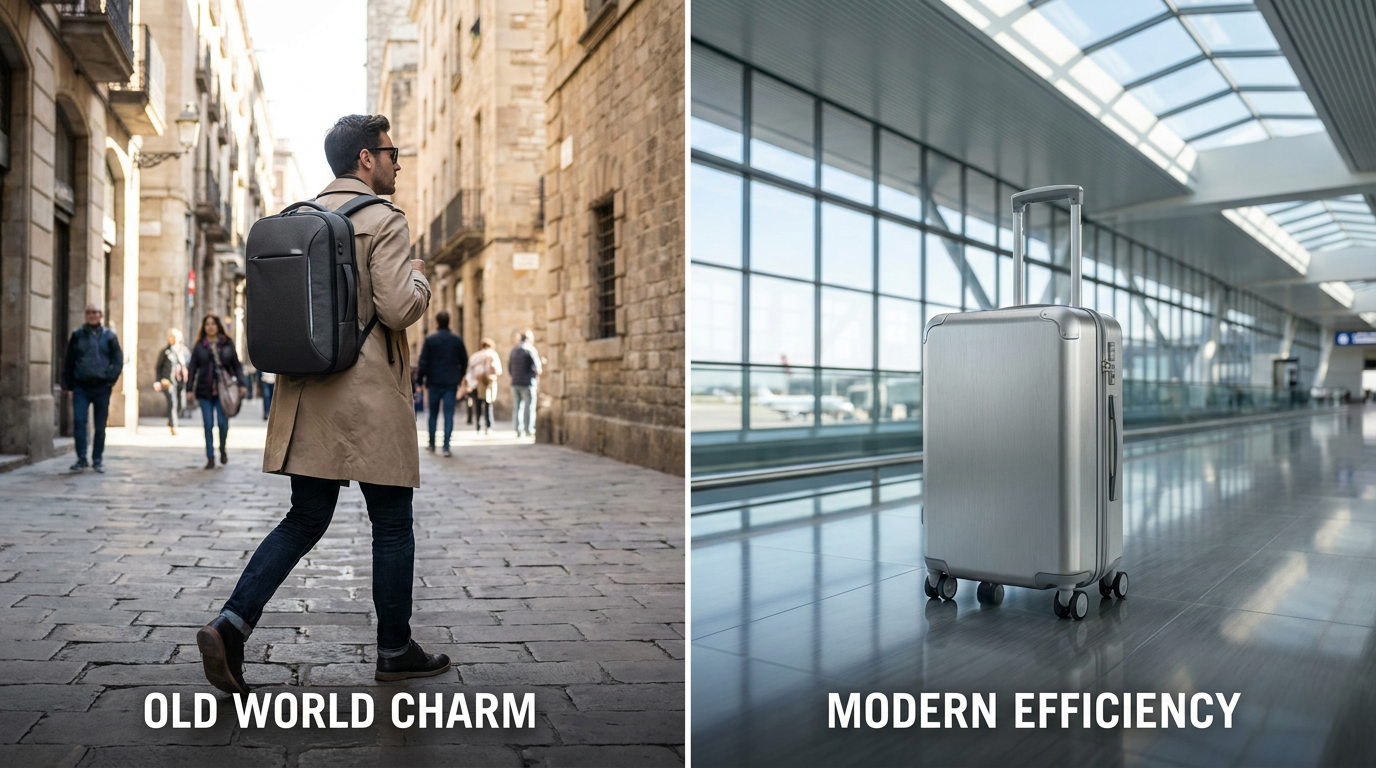
When analyzing the trade-offs between these two formats, the core debate centers on how a traveler interacts with their physical environment. The backpack requires the user to become the vehicle, bearing the entirety of the load on their skeletal structure and relying on personal stamina. In contrast, the rolling suitcase outsources that labor to the ground, relying on wheels and smooth architectural surfaces to eliminate physical exertion. Choosing between them requires evaluating the specific friction points of an upcoming itinerary, from the polished floors of an international terminal to the uneven cobblestones of a historic city center. The right choice minimizes the specific type of friction the traveler will face.[3][6]
The primary argument for the travel backpack is unmatched mobility. A backpack allows the traveler to remain entirely hands-free, making it significantly easier to present passports, navigate smartphone maps, or hold onto subway rails. When the terrain degrades—whether encountering a broken hotel elevator, a steep flight of stairs, or a crowded train carriage—the backpack wearer simply walks through the obstacle without breaking stride. This agility is the cornerstone of the one-bag philosophy, enabling rapid self-transfers between flights and seamless transitions from the airport to the city streets.[2][3]
The most compelling evidence supporting the backpack in 2026 is its near-perfect success rate in avoiding forced gate-checks. Airline gate agents are trained to target wheels and rigid handles when overhead bins fill up. Because travel backpacks lack these hard components, they can often be squeezed into the remaining gaps in an overhead bin or, in a worst-case scenario, shoved under the seat in front of the passenger. Frequent flyers report that traveling with a soft-sided backpack is currently the most reliable method for ensuring luggage remains in the cabin, completely bypassing the delays and risks associated with the baggage carousel.[6]

Conversely, the primary argument against the travel backpack is the undeniable physical strain of wearing weight. No matter how well-designed the harness system is, carrying 20 pounds of gear requires continuous muscular engagement. Furthermore, backpacks trap heat against the body. A loaded backpack combined with the stress of navigating a busy transit hub inevitably leads to back sweat, which can ruin professional attire before a business meeting. For travelers who prioritize arriving looking crisp, clean, and physically relaxed, the backpack presents a significant liability.[3][6]
Conversely, the primary argument against the travel backpack is the undeniable physical strain of wearing weight.
Biomechanical evidence strictly quantifies the limits of backpack travel. Studies published by the National Institutes of Health indicate that carrying a load exceeding 15 to 20 percent of a person's body mass significantly alters their natural gait and increases spinal compression. While a backpack provides better symmetrical balance than carrying a duffel bag, heavy loads force the trunk to tilt forward to maintain a center of gravity, increasing the rate of perceived exertion. Ergonomic researchers conclude that while backpacks are optimal for posture, they quickly become detrimental if the traveler overpacks or lacks a properly fitted hip belt to transfer weight off the shoulders.[1][7]
The argument for the rolling carry-on centers entirely on weightless transit and superior internal organization. On the smooth, polished floors of airports, train stations, and modern hotel lobbies, a four-wheel spinner suitcase requires near-zero physical effort to move. The traveler simply glides alongside their luggage, arriving at their departure gate without elevated heart rates, back sweat, or shoulder fatigue. Additionally, the rigid structure of a polycarbonate or aluminum suitcase provides unparalleled crush protection for fragile electronics and souvenirs. It also allows clothing to remain flat and unwrinkled during transit, making it the undisputed champion for business travel, formal events, and trips where presentation matters immediately upon arrival.[3][6]
However, the evidence against rolling luggage highlights its severe limitations the moment the environment becomes hostile. Suitcases are highly susceptible to terrain friction; cobblestones, dirt paths, and snow render small wheels useless, forcing the traveler to awkwardly carry a heavy, unergonomic plastic box. Furthermore, ergonomic studies warn against the biomechanical impact of pulling a traditional two-wheel suitcase. Dragging a heavy load behind the body creates an asymmetrical load that forces the trunk into lateral flexion, leading to significant shoulder and lower back strain over long distances.[1][3]

To bridge this divide, the 2026 luggage market has introduced highly engineered hybrid solutions. Modern travel backpacks now feature "clamshell" designs, unzipping fully around the perimeter to pack exactly like a suitcase, eliminating the need to dig blindly through a top-loading bag. Simultaneously, luggage manufacturers have released rolling backpacks that offer both wheels and hideaway shoulder straps. However, evidence suggests these hybrids often compromise on both fronts, adding the heavy dead weight of a wheel-and-handle mechanism to a backpack while offering less packing volume than a dedicated suitcase.[2][5][6]
Ultimately, the trade-off analysis reveals that the superior choice is dictated entirely by the specific mechanics of the trip. The travel backpack fits well when an itinerary involves multiple transit changes, public transportation, uneven city streets, and a strict requirement to avoid gate-checking at all costs. It is the optimal tool for the highly mobile traveler who values speed over capacity. Conversely, the backpack does not fit well when the traveler is packing heavy, lacks the physical conditioning to carry weight for extended periods, or must arrive at their destination in formal, unwrinkled attire.[3][7]

On the other side of the equation, the rolling carry-on fits well when the journey consists of point-to-point transit—moving directly from an airport to a taxi to an elevator-equipped hotel. It is the definitive choice for travelers prioritizing physical comfort, structured packing, and the protection of their belongings. However, the rolling suitcase does not fit well when the itinerary involves hostel hopping, navigating historic European infrastructure, or boarding aggressively overbooked flights where gate agents are actively hunting for wheeled luggage to send to the cargo hold.[6][7]
How we got here
Pre-2020
Rolling suitcases dominate the carry-on market, with backpacks largely reserved for wilderness backpacking and budget hostels.
2023
The 'one-bag' travel movement gains mainstream traction as digital nomadism rises and airlines increase checked-bag fees.
2025
Luggage brands widely adopt the 'clamshell' backpack design, allowing soft-sided bags to pack with the organization of a suitcase.
2026
Strict enforcement of the 22x14x9 carry-on rule forces travelers to optimize their gear, cementing the divide between backpack minimalists and roller loyalists.
Viewpoints in depth
One-Bag Minimalists
Travelers who prioritize absolute mobility and speed over packing capacity.
This camp argues that the freedom to navigate any terrain—from subway turnstiles to steep hostel staircases—is the ultimate travel luxury. By restricting themselves to a single 30-to-40-liter backpack, they eliminate the risk of lost luggage, bypass baggage carousels, and ensure their bag is never gate-checked. For minimalists, the physical effort of wearing their gear is a small price to pay for total independence from airline logistics.
Comfort-First Travelers
Travelers who prioritize physical ease and professional presentation.
This viewpoint contends that vacations and business trips should not double as endurance events. By utilizing four-wheel spinner suitcases, these travelers let the ground support the weight of their belongings, arriving at their destinations without shoulder strain or sweat-soaked shirts. They value the rigid protection that hard-sided luggage provides for laptops and formal wear, accepting the friction of cobblestones and stairs as a temporary inconvenience rather than a dealbreaker.
Ergonomic Researchers
Scientists studying the biomechanical impact of load carriage.
Biomechanical experts view both luggage types as physical stressors that require proper management. While backpacks promote symmetrical posture, researchers warn that exceeding 15 to 20 percent of the wearer's body mass significantly increases spinal compression and alters natural gait. Conversely, pulling a heavy rolling suitcase behind the body forces the spine into asymmetrical lateral flexion, straining the shoulder and lower back. Their consensus suggests that the healthiest choice depends entirely on the weight of the load and the distance traveled.
What we don't know
- Whether airlines will eventually begin weighing personal-item backpacks at the gate to crack down on heavy one-bag travelers.
- How the upcoming generation of ultra-lightweight hybrid roller-backpacks will perform in long-term durability tests.
Key terms
- One-Bag Travel
- A minimalist travel philosophy where a passenger travels indefinitely using only a single carry-on-sized bag.
- Clamshell Opening
- A backpack design that unzips fully around the perimeter to open flat like a suitcase, allowing for easier packing.
- Asymmetrical Load
- Carrying or pulling weight on only one side of the body, which can lead to muscle imbalances and spinal strain.
- Gate Check
- When airline staff force passengers to surrender their carry-on luggage at the boarding gate due to full overhead bins.
Frequently asked
Will my travel backpack get gate-checked?
Backpacks are rarely gate-checked because they do not have wheels or rigid handles, allowing them to fit more easily into tight overhead bins or under seats.
What size backpack equals a standard carry-on roller?
A 35-liter to 40-liter travel backpack generally holds the same amount of clothing as a standard 22-inch rolling carry-on.
Are rolling backpacks a good compromise?
Hybrid rolling backpacks offer versatility but often add significant dead weight from the wheel-and-handle mechanism, reducing overall packing capacity.
Is it bad for your back to pull a suitcase?
Pulling a heavy two-wheel suitcase asymmetrically can cause trunk lateral flexion and shoulder strain, though four-wheel spinners pushed alongside the body mitigate this issue.
Sources
Source coverage
7 outlets
3 viewpoints surfaced







[1]National Institutes of HealthErgonomic Researchers
The effects of load carriage packs on human gait biomechanics, physiology and metabolism
Read on National Institutes of Health →[2]ForbesOne-Bag Minimalists
What Is One-Bag Travel? How To Travel With Just A Carry-On
Read on Forbes →[3]CarryologyComfort-First Travelers
Backpack vs Rolling Luggage: The Performance Pros and Cons
Read on Carryology →[4]BagsmartComfort-First Travelers
Travel Backpack vs Rolling Luggage: Which Should You Choose?
Read on Bagsmart →[5]TrekariusOne-Bag Minimalists
The Complete One Bag Carry-On Travel System for 2026
Read on Trekarius →[6]Away TogetherComfort-First Travelers
Which type of Carry On Luggage is Best? A Backpack or a Rolling Suitcase?
Read on Away Together →[7]Factlen Editorial TeamErgonomic Researchers
Synthesis by Factlen editorial team
Read on Factlen Editorial Team →

Every angle. Every day.
Get shopping stories with full source coverage and perspective breakdowns delivered to your inbox.