
New Quantum Chip Turns Qubit 'Noise' Into Programmable Feature, Unlocking Fault-Tolerant Systems
Researchers have developed a novel quantum processor that intentionally introduces programmable errors, providing a crucial sandbox for testing the error-correction codes needed for large-scale quantum computing.
By Factlen Editorial Team
- Error Correction Theorists
- Argue that since noise is inevitable, the focus must be on algorithmic resilience, logical qubits, and advanced parity checks.
- Hardware Pragmatists
- Believe that physical noise reduction and material science are the most critical paths to scaling quantum computers.
- Commercial Integration Optimists
- Focus on reaching quantum advantage quickly by embracing hybrid systems and programmable noise to extract near-term value.
What's not represented
- · Cybersecurity Experts
- · Classical Supercomputing Advocates
Why this matters
For decades, the fragility of quantum bits has been the single biggest roadblock to unlocking computers capable of revolutionizing medicine, materials science, and cryptography. By transforming unpredictable environmental interference into a controlled, programmable variable, this breakthrough provides the exact testing ground needed to finally build reliable, error-proof quantum systems.
Key points
- Researchers have developed a new photonic quantum chip that intentionally introduces programmable noise to simulate signal loss.
- The chip allows scientists to test error-correction algorithms in a highly controlled environment before deploying them on larger systems.
- Current qubits have a failure rate of roughly 1 in 1,000, making error correction the largest hurdle to practical quantum computing.
- The breakthrough aligns with a broader industry shift away from noisy, intermediate-scale systems toward fully fault-tolerant architectures.
The paradox of quantum computing is that the very sensitivity making it exponentially powerful also makes it incredibly fragile. For decades, the industry's primary obsession has been shielding these delicate processors from the chaotic outside world.
Now, a breakthrough experiment has flipped that paradigm entirely. Rather than desperately trying to build an impenetrable fortress against environmental interference, researchers have developed a new quantum chip that intentionally embraces it.
By turning destructive "noise" into a highly programmable feature, this novel architecture allows scientists to introduce and study errors at will. The chip effectively transforms an invisible enemy into a highly controlled laboratory variable.[1][2]
The development marks a critical inflection point in the race toward fault-tolerant quantum computing. While classical digital bits fail roughly once in a billion operations, today's quantum bits, or qubits, suffer failure rates closer to one in a thousand.[1]

This fragility stems from decoherence, a process where microscopic disturbances—ranging from stray electromagnetic fields to minute temperature fluctuations—cause qubits to lose their quantum state.[6]
Historically, engineers have fought this by cooling processors to near absolute zero and burying them in heavily shielded cryostats. But as systems scale up to hundreds of qubits, completely eliminating noise becomes physically impossible.[3]
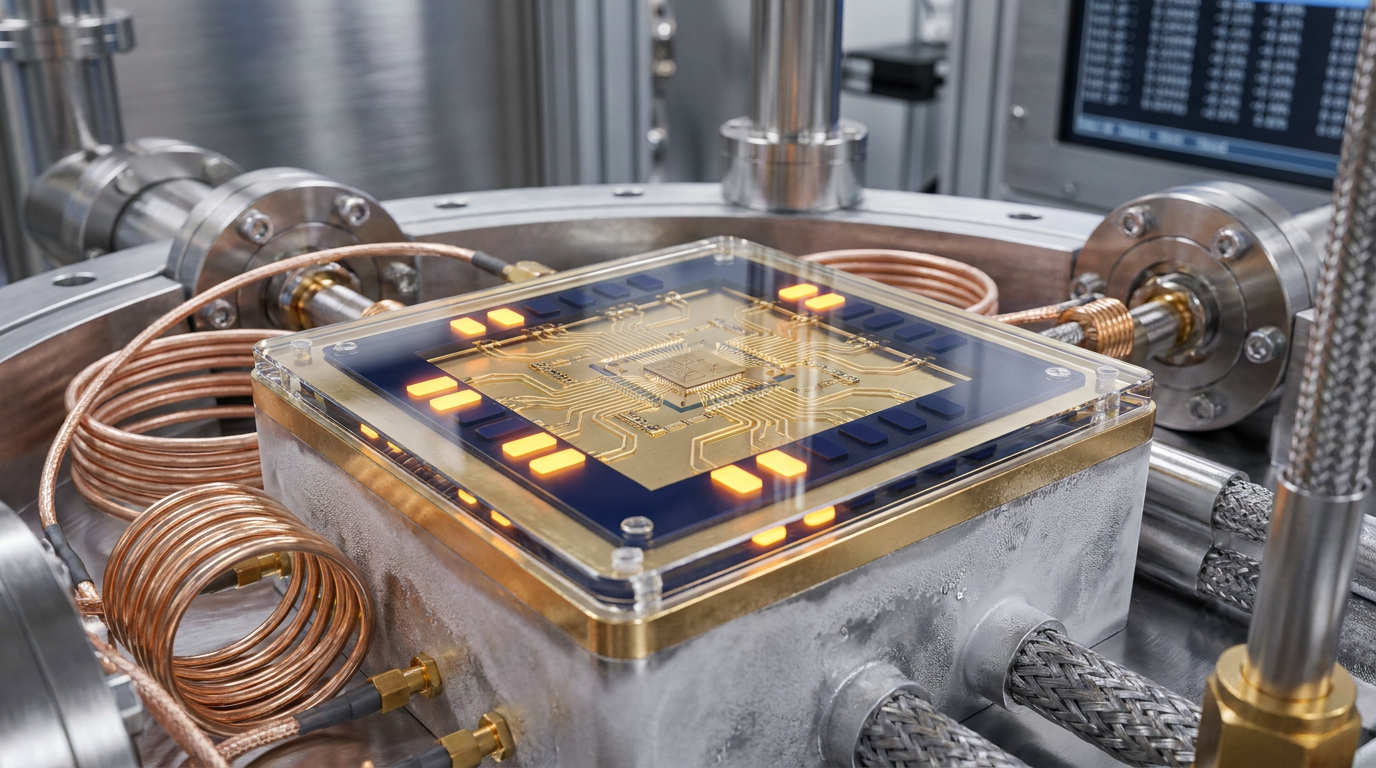
The new photonic chip, detailed in the journal Nature Communications, takes a radically different approach. It uses photons captured from laser pulses as its foundational qubits.[1][2]
Instead of isolating these photons, the chip features programmable pathways that deliberately siphon off a precise number of particles, simulating the exact types of signal loss that plague larger quantum systems.[1]
Researchers can dynamically adjust the degree of quantum superposition and entanglement, effectively dialing the "noise" up or down like a volume knob to observe exactly how the system degrades.[1][2]
This controlled environment provides a sandbox for testing quantum error correction (QEC) protocols. QEC is the holy grail of the industry, a mathematical framework designed to detect and fix errors faster than they can accumulate.[5][7]
This controlled environment provides a sandbox for testing quantum error correction (QEC) protocols.
Because the new chip can mimic the specific noise profiles of entirely different architectures—such as superconducting circuits or neutral atom arrays—it serves as a universal testing ground for these crucial algorithms.[1][8]
The timing of this programmable noise simulator aligns with a broader industry pivot from the Noisy Intermediate-Scale Quantum (NISQ) era to the dawn of true fault tolerance.[5]

Recent months have seen a flurry of parallel breakthroughs. IBM recently unveiled its Nighthawk processor and Loon testbed, explicitly designed to validate hardware components for scalable error correction.[4]
Similarly, European manufacturer IQM has introduced "barbell codes," a novel error-correcting approach that drastically reduces the number of physical qubits required to maintain a stable logical qubit.[7]
Google's Willow chip also recently demonstrated below-threshold error correction, proving that adding more physical qubits can finally reduce the overall logical error rate rather than compounding it.[5]
By providing a reliable way to stress-test these emerging QEC codes against highly specific, programmable noise, the new photonic chip accelerates the development cycle across the entire sector.[1][2]

However, significant uncertainties remain. While simulating noise in a controlled photonic environment is invaluable, translating those insights into physical hardware improvements for massive, million-qubit superconducting systems involves staggering engineering hurdles.[6][8]
Furthermore, the overhead required for robust error correction is still immense, often demanding thousands of physical qubits to sustain a single, error-free logical qubit.[7]
Despite these challenges, the ability to predictably model and manipulate quantum noise transforms a chaotic adversary into a measurable variable.
How we got here
1990s
Theoretical foundations of quantum error correction are first proposed by physicists Peter Shor and Andrew Steane.
2019
Google claims 'quantum supremacy' with its 53-qubit Sycamore processor, though the system remains highly susceptible to noise.
March 2024
Researchers demonstrate that continuous real-time noise surveillance can boost qubit performance by 700 percent.
Late 2025
Major tech firms unveil new processors and testbeds specifically designed to validate hardware components for scalable error correction.
May 2026
Scientists publish details of a new photonic chip that intentionally introduces programmable noise to simulate and study quantum errors.
June 2026
The industry marks a definitive pivot from the NISQ era toward building the first truly fault-tolerant quantum architectures.
Viewpoints in depth
Quantum Hardware Engineers
Focus on the physical limitations of scaling, arguing that fundamental improvements in qubit coherence are still the primary bottlenecks.
For hardware engineers, the physical reality of quantum systems remains the ultimate constraint. They argue that while software-based error correction is vital, it cannot entirely mask fundamentally flawed hardware. From this perspective, the programmable noise chip is a useful diagnostic tool, but the real battle is still being fought in materials science—developing better superconducting alloys, cleaner fabrication processes, and more effective cryogenic shielding to reduce the baseline noise before error correction even begins.
Error Correction Theorists
Emphasize that perfect hardware is impossible, making robust, low-overhead quantum error correction codes the only viable path to scale.
Theorists operate on the assumption that environmental noise will never be completely eliminated. Therefore, they view the new programmable chip as a monumental breakthrough because it allows them to empirically test their mathematical models. By intentionally injecting noise, they can refine 'logical qubits'—constructs where dozens or hundreds of noisy physical qubits are entangled to act as a single, perfectly reliable unit. For this camp, the software architecture of error correction is the true key to fault tolerance.
Commercial Quantum Developers
Prioritize near-term hybrid applications, arguing that even noisy systems can deliver value today if the noise can be characterized and mitigated.
Commercial developers are focused on delivering immediate return on investment. They are less concerned with achieving perfect, million-qubit fault tolerance by 2035 and more interested in what can be done with 100 noisy qubits today. From their viewpoint, turning noise into a programmable, predictable feature allows them to design 'noise-aware' algorithms. By understanding exactly how and when a system will fail, they can run hybrid classical-quantum workflows that extract useful computational advantages right now, particularly in chemistry and optimization.
What we don't know
- Whether insights gained from photonic noise simulators can be seamlessly translated to vastly different architectures like superconducting or neutral atom qubits.
- How quickly the massive physical qubit overhead required for robust error correction can be reduced to commercially viable levels.
- The exact timeline for when fully fault-tolerant, large-scale quantum computers will become available for widespread enterprise use.
Key terms
- Decoherence
- The process by which a quantum system loses its fragile quantum state due to interaction with its surrounding environment.
- Quantum Error Correction (QEC)
- A set of algorithms and physical architectures designed to protect quantum information from errors due to decoherence and other noise.
- Logical Qubit
- A highly stable, error-free qubit created by grouping together multiple noisy 'physical' qubits and applying error correction codes.
- NISQ Era
- Noisy Intermediate-Scale Quantum era; the current generation of quantum computers that have dozens to hundreds of qubits but lack robust error correction.
- Superposition
- A fundamental quantum principle where a particle can exist in multiple states or configurations at the same time until it is measured.
Frequently asked
What is a qubit?
A quantum bit, or qubit, is the basic unit of quantum information. Unlike classical bits that are strictly 0 or 1, qubits can exist in a superposition of both states simultaneously.
Why are quantum computers so prone to errors?
Qubits are highly sensitive to their environment. Minute changes in temperature, magnetic fields, or radiation can cause them to lose their quantum state, a process known as decoherence.
How does the new chip use noise as a feature?
Instead of trying to block out all interference, the chip uses programmable pathways to intentionally introduce specific amounts of signal loss and errors, allowing scientists to study and correct them in a controlled setting.
What is fault-tolerant quantum computing?
It is a theoretical stage of quantum computing where systems can detect and correct their own errors in real-time, allowing them to run complex calculations indefinitely without failing.
Sources
Source coverage
8 outlets
3 viewpoints surfaced








[1]Live ScienceCommercial Integration Optimists
A new quantum computing chip turns destructive noise into a programmable feature
Read on Live Science →[2]Nature CommunicationsError Correction Theorists
Programmable quantum noise simulation in photonic chips
Read on Nature Communications →[3]SciTechDailyHardware Pragmatists
Noise Fuels Quantum Leap, Boosting Qubit Performance by 700%
Read on SciTechDaily →[4]Tom's HardwareCommercial Integration Optimists
IBM unveils new 'Quantum Nighthawk' 120-qubit processor and software stack
Read on Tom's Hardware →[5]IEEE SpectrumCommercial Integration Optimists
Quantum Leap: 2026 Marks Turning Point in Error Correction
Read on IEEE Spectrum →[6]SpinQHardware Pragmatists
Superconducting Quantum Chip Noise Reduction: From Lab Challenge to Scalable Solution
Read on SpinQ →[7]IQM Quantum ComputersError Correction Theorists
IQM Announces Novel Quantum Error Correction Approach Toward Fault-Tolerant Quantum Computing
Read on IQM Quantum Computers →[8]arXivError Correction Theorists
Turning qubit noise into a blessing: automatic state preparation and long-time dynamics
Read on arXiv →
Every angle. Every day.
Get meta stories with full source coverage and perspective breakdowns delivered to your inbox.