
Citizen Scientist Discovers Enormous 'Bow-and-Arrow' Radio Galaxy Tracing a 1.8-Million-Light-Year Shockwave
A university student analyzing radio telescope data has discovered a massive, highly asymmetric galaxy plunging into a cosmic cluster at supersonic speeds.
By Factlen Editorial Team
- Citizen Science Advocates
- Value the democratization of astronomy and the unique pattern-recognition skills of human volunteers.
- Astrophysics Researchers
- Focus on the physical implications of the bow shock for understanding galaxy cluster dynamics.
- Observatory Consortia
- Highlight the technological capabilities of next-generation radio arrays in mapping the faint universe.
What's not represented
- · Machine Learning Developers
Why this matters
This discovery proves that human curiosity can still outperform advanced AI in recognizing the universe's most unusual phenomena. It also provides astrophysicists with a rare, direct view of the invisible forces that shape galaxy clusters, refining our understanding of how the largest structures in the cosmos evolve.
Key points
- Citizen scientist Pranim Limbo discovered a massive radio galaxy shaped like a bow and arrow.
- Named RAD-BAARG, the galaxy is falling supersonically into a cluster, creating a 1.8-million-light-year bow shock.
- The structure is illuminated by radio-emitting plasma from the galaxy's supermassive black hole.
- Automated machine-learning algorithms missed the unique shape, classifying it as a standard galaxy.
- The discovery provides a rare, direct view of the invisible gas dynamics within galaxy clusters.
The vast, freezing expanses of space between galaxies are not entirely empty, despite how they might appear through traditional optical telescopes. Instead, these immense cosmic voids are filled with a tenuous, superheated plasma known to astrophysicists as the intracluster medium. This highly diffuse gas acts as a fluid dynamics laboratory on a universal scale. [1, 2] When a massive galaxy plunges through this medium at supersonic speeds, it should theoretically generate a colossal shockwave ahead of its path, much like a supersonic fighter jet breaking the sound barrier and producing a violent sonic boom in the Earth's atmosphere. For decades, theoretical models have predicted that these massive pressure fronts must exist, shaping the evolution of entire galaxy clusters as they merge and grow over billions of years. [2, 6][1][2][6]
Despite the solid theoretical foundation for their existence, astronomers have historically struggled to observe these cosmic bow shocks directly. The intracluster gas involved is incredibly thin and faint, making the pressure gradients nearly impossible to detect with conventional X-ray or optical observatories. [3, 7] However, the universe occasionally provides its own spectacular illumination. That is exactly what happened with the newly identified system known as RAD-BAARG, a giant radio galaxy located roughly two billion light-years from Earth that is currently falling headlong into a dense, gravitationally bound cluster of neighboring galaxies. By acting as a cosmic flashlight, this single galaxy has inadvertently mapped the invisible forces of the cluster it is plunging into, providing researchers with a pristine view of intergalactic aerodynamics. [2, 8][2][3][7][8]
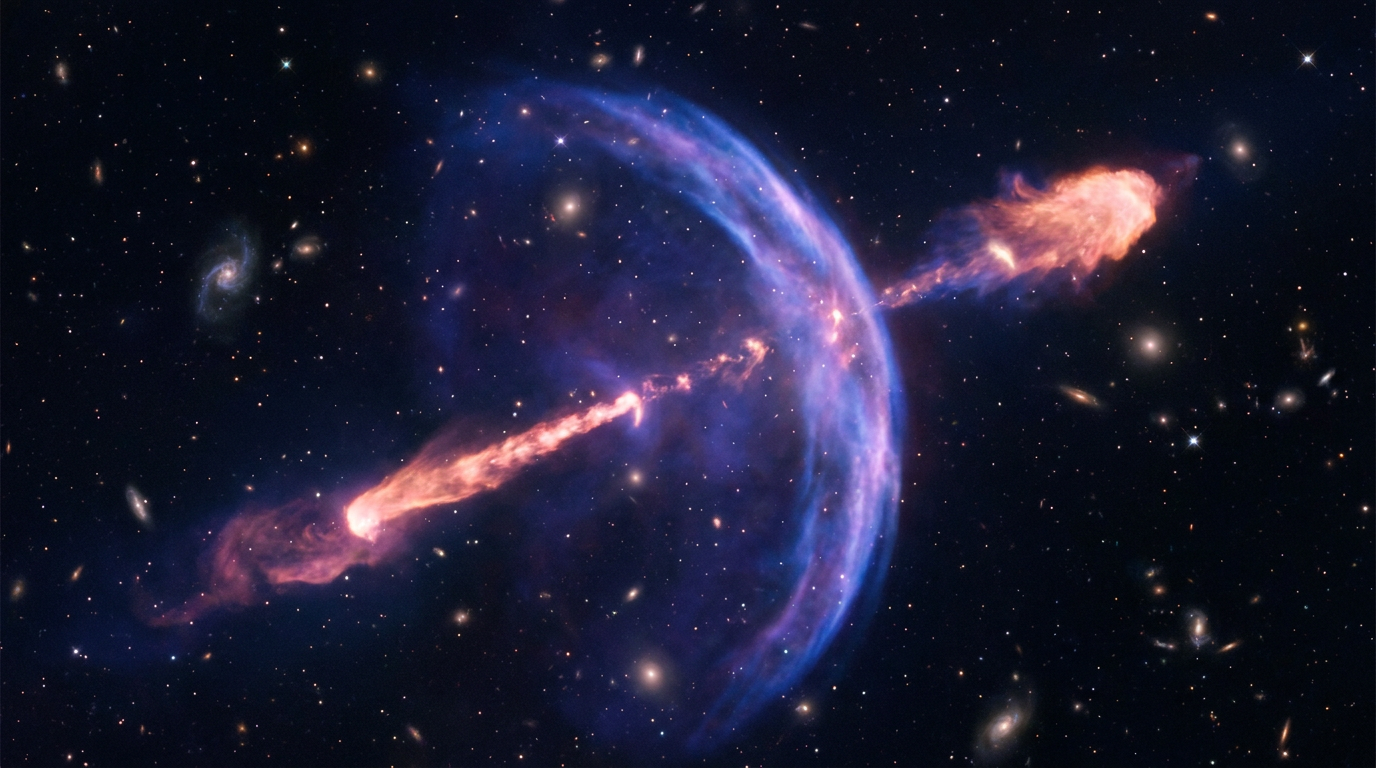
As it hurtles through the dense intracluster medium, RAD-BAARG has carved out a glowing, highly compressed shockwave extending an astonishing 1.8 million light-years across the cosmos. The resulting structure looks uncannily like a drawn bow and arrow on a scale that defies human comprehension, dwarfing our own Milky Way galaxy by a factor of nearly eighteen. [3, 6, 7] The discovery, which was recently detailed in the peer-reviewed Monthly Notices of the Royal Astronomical Society: Letters, provides one of the clearest and most dramatic views ever recorded of a giant cosmic shockwave in action. It offers a rare, direct confirmation of the fluid dynamics that govern the assembly of the largest known structures in the universe, turning abstract mathematical predictions into a stunning visual reality. [2, 3][2][3][6][7]

Remarkably, this textbook-altering structure was not found by a multi-million-dollar supercomputer, nor was it initially flagged by a veteran astrophysicist with decades of experience. Instead, it was discovered by Pranim Limbo, a university student inspecting raw telescope data during his free time from a remote hillside in the Himalayas. [1, 8] Limbo is a dedicated participant in the RAD@home Astronomy Collaboratory, a pioneering Indian citizen-science initiative that trains volunteers from diverse educational backgrounds to analyze complex astronomical datasets. By democratizing access to frontline astronomical data, the program empowers ordinary citizens to contribute directly to high-level research, proving that groundbreaking discoveries no longer belong exclusively to those working inside the world's most prestigious academic institutions. [5, 8][1][5][8]
The dataset in question had actually already been scanned by sophisticated, automated machine-learning algorithms designed to catalog the millions of objects in the night sky. Those artificial intelligence systems successfully identified the object, but they classified it merely as a standard, symmetrical giant radio galaxy, entirely missing its unique and highly distorted morphology. [8] Because algorithms are trained on known patterns, they often struggle to recognize highly anomalous or asymmetrical structures that deviate from the norm. It took the nuanced, evolutionary pattern-recognition capabilities of a human eye to notice that the galaxy was highly asymmetrical, prompting Limbo to flag the strange anomaly for further, rigorous investigation by professional radio astronomers. [1, 8][1][8]
Dr. Ananda Hota, the founder of the RAD@home initiative and the lead author of the newly published study, noted the sheer rarity and scientific value of the find. In his 25 years of dedicating his career to studying radio galaxies, Hota stated he had never seen a structure quite like it, emphasizing that the morphology perfectly records the violent interaction between the galaxy and its surrounding environment. [3, 4] The unique shape serves as a fossil record of the galaxy's trajectory and speed, offering a snapshot of a highly energetic collision that has been unfolding over millions of years. For astronomers, finding such a perfectly aligned system is akin to discovering a Rosetta Stone for intergalactic physics. [1, 3][1][3][4]
To understand exactly how RAD-BAARG achieved its striking and unusual shape, one must look at the central engine driving its massive energy output: a supermassive black hole located at the very core of the host galaxy. As this black hole actively feeds on surrounding dust, gas, and stellar matter, it becomes highly energetic, converting a portion of that infalling mass into pure energy. This process launches twin jets of relativistic, magnetized plasma in opposite directions into intergalactic space at velocities approaching the speed of light. [2, 7] Under normal, isolated circumstances, these powerful jets would push outward evenly, creating relatively symmetrical, balloon-like lobes of radio emission on either side of the galaxy that slowly fade into the cosmic background. [4, 6][2][4][6][7]

As this black hole actively feeds on surrounding dust, gas, and stellar matter, it becomes highly energetic, converting a portion of that infalling mass into pure energy.
But RAD-BAARG is not operating in a vacuum, nor is it sitting still; it is navigating a highly turbulent and resistive environment. According to the research team's calculations, the galaxy is moving at an estimated velocity of between 1,000 and 3,500 kilometers per second. [4, 6] As the host galaxy hurtles through the intracluster medium at these extreme supersonic speeds, the western jet slams directly into the compressed, superheated gas of the bow shock. This violent, high-speed interaction acts much like fluorescent dye dropped into a flowing river, highlighting the invisible currents and pressure walls that dictate the flow of matter in deep space. [2, 8][2][4][6][8]
The radio-emitting plasma from the black hole's jet illuminates the otherwise invisible pressure gradients of the shock front, making the massive bow shock brilliantly visible to low-frequency radio telescopes on Earth. The result is the 'bow'—a massive, sector-shaped arc of radio emission spanning 560 kiloparsecs. [2, 8] Without this continuous injection of glowing plasma from the active black hole, the bow shock would remain entirely invisible, as the intracluster gas itself is far too tenuous to emit detectable radiation on its own. It is a rare cosmic coincidence that the jet is perfectly aligned to light up the shockwave for observers on Earth. [1, 8][1][2][8]
On the opposite side of the galaxy, the eastern jet faces a completely different physical reality. Shielded from the direct brunt of the intracluster headwind by the bulk of the host galaxy, this trailing jet faces far less resistance as it expands outward. [3, 4] Instead of compressing into a tight, bright arc, the plasma twists into a distorted S-shape before trailing off into a faint, elongated tail that forms the 'arrow' of the system. This stark asymmetry provides researchers with a perfect directional indicator, showing exactly which way the galaxy is traveling and how the surrounding intergalactic winds are sweeping the lighter plasma backward as the heavier core plows forward. [4, 6, 7][3][4][6][7]
When measured from the leading edge of the glowing bow to the fading end of the trailing arrow, the entire structure stretches approximately 2.3 million light-years from end to end. This immense, mind-boggling scale places RAD-BAARG in the elite category of Giant Radio Galaxies, which represent some of the largest standalone single structures in the known universe. [4, 6, 7] To put that size into perspective, if one end of RAD-BAARG were placed at our Milky Way, the other end would stretch almost all the way to the Andromeda Galaxy. Capturing such a faint and sprawling structure in its entirety required extraordinary technological sensitivity and a wide field of view that older telescopes simply could not provide. [1, 7][1][4][6][7]

The groundbreaking observations were made possible by the Low-Frequency Array (LOFAR), a massive, pan-European network of radio telescopes designed specifically to detect incredibly faint, low-frequency emissions that other observatories routinely miss. [7] By combining the signals from thousands of individual antennas spread across multiple countries, LOFAR acts as a single, continent-sized telescope with unprecedented resolution and sensitivity. This distributed architecture allows astronomers to map the low-frequency radio sky with a level of detail that was previously thought impossible, opening up an entirely new window into the non-thermal universe where phenomena like aging plasma and weak magnetic fields reside. [3, 4][3][4][7]
Specifically, the data that revealed RAD-BAARG came from the LOFAR Two-metre Sky Survey (LoTSS), an ambitious, ongoing project to map the entire northern hemisphere. LoTSS recently released its third major data tranche, covering an unprecedented 80 percent of the northern sky in high resolution. [3, 4] This massive data release provides a vast new playground for both professional and citizen scientists, containing millions of individual radio sources. Because the survey is so deep and covers such a wide area, it is the perfect hunting ground for rare, extended structures like giant radio galaxies that might otherwise be cut off at the edges of smaller, more targeted observations. [1, 6][1][3][4][6]
Co-lead author Dr. Pratik Dabhade of Poland's National Centre for Nuclear Research emphasized that RAD-BAARG is much more than just a beautiful visual curiosity. The galaxy sits in a complex multi-halo environment, offering a pristine, real-world laboratory for studying gas flows, galaxy infall, and the thermodynamics of cluster assembly. [4, 6] By analyzing how the supermassive black hole's plasma jets deform against the intracluster medium, astrophysicists can calculate the exact density of the surrounding gas and the precise velocity of the infalling galaxy. This empirical data is absolutely crucial for refining theoretical models of how the largest gravitationally bound structures in the universe evolve over billions of years. [2, 4][2][4][6]

Beyond the immediate astrophysical implications, the discovery serves as a powerful, undeniable validation of the citizen-science model in modern astronomy. In an era where the field is increasingly dominated by artificial intelligence, machine learning, and massive automated data pipelines, RAD-BAARG proves that human curiosity and visual intuition remain indispensable tools for mapping the cosmos. [1, 4, 5] Algorithms are highly efficient at processing volume, but they lack the contextual awareness to flag something that simply looks 'weird' or unprecedented. The successful partnership between advanced radio arrays and dedicated citizen scientists suggests that the human element cannot be entirely engineered out of the discovery process. [1, 8][1][4][5][8]
As astronomers prepare for the next generation of instruments, including the highly anticipated Square Kilometre Array Observatory (SKAO) currently under construction, the volume of astronomical data will only grow exponentially. Telescopes will soon be producing exabytes of data, far outstripping the capacity of professional astronomers to review it all manually. [1, 2, 5] The RAD-BAARG discovery highlights the urgent need to continue integrating trained public volunteers into the scientific workflow. If a single student in the Himalayas can uncover a 1.8-million-light-year cosmic shockwave that algorithms missed, it stands to reason that many more cosmic bows are currently waiting in the data archives, ready to be drawn from the darkness. [1, 5, 8][1][2][5][8]
How we got here
2013
The RAD@home Astronomy Collaboratory is founded in India to train citizen scientists.
Early 2026
LOFAR releases its Data Release 3, covering 80 percent of the northern sky in unprecedented detail.
June 2026
Citizen scientist Pranim Limbo spots the unusual asymmetrical shape of RAD-BAARG in the LOFAR data.
June 22, 2026
The discovery is formally published in the Monthly Notices of the Royal Astronomical Society: Letters.
Viewpoints in depth
Citizen Science Advocates
Emphasize the indispensable role of human pattern recognition in an era dominated by AI.
Proponents of citizen science argue that the discovery of RAD-BAARG exposes a critical blind spot in modern machine learning. While automated algorithms are highly efficient at cataloging standard, symmetrical radio galaxies, they often fail to recognize anomalous or highly distorted structures. Organizations like RAD@home contend that training human volunteers to visually inspect complex telescope data provides a necessary safeguard against algorithmic bias, ensuring that the universe's most unusual phenomena are not dismissed as data artifacts.
Astrophysics Researchers
Focus on the physical mechanics of galaxy-cluster interactions and the evolution of the intracluster medium.
For professional astrophysicists, RAD-BAARG is a Rosetta Stone for understanding the thermodynamics of galaxy clusters. Researchers emphasize that the 'bow and arrow' structure is not just a visual curiosity, but a direct physical tracer of invisible pressure gradients. By analyzing how the supermassive black hole's plasma jets deform against the intracluster medium, astronomers can calculate the density of the surrounding gas and the exact velocity of the infalling galaxy, refining theoretical models of how the largest gravitationally bound structures in the universe assemble over time.
What we don't know
- The exact density of the intracluster medium that RAD-BAARG is plunging through.
- Whether similar 'bow and arrow' structures are common but hidden in unanalyzed radio data.
- The long-term fate of the galaxy's supermassive black hole as it merges with the cluster.
Key terms
- Radio Galaxy
- A type of active galaxy that emits massive amounts of radio waves, typically powered by jets of plasma shooting from a central supermassive black hole.
- Bow Shock
- A curved region of compressed gas formed when an object moves through a medium faster than the local speed of sound, similar to the sonic boom of an aircraft.
- Intracluster Medium
- The superheated, highly diffuse plasma that fills the seemingly empty space between galaxies within a galaxy cluster.
- Relativistic Jet
- A powerful beam of ionized matter traveling at nearly the speed of light, ejected from the poles of a feeding black hole.
- Kiloparsec
- An astronomical unit of distance equal to 1,000 parsecs, or roughly 3,260 light-years.
Frequently asked
What exactly is RAD-BAARG?
RAD-BAARG is a giant radio galaxy located about two billion light-years away. It is notable for its highly unusual 'bow and arrow' shape, created as it falls at supersonic speeds into a cluster of galaxies.
How big is this galaxy?
The entire structure stretches roughly 2.3 million light-years from end to end. The 'bow' portion alone is 1.8 million light-years across, making it nearly 18 times wider than our Milky Way.
Why did algorithms miss the discovery?
Automated machine-learning systems cataloged the object as a standard radio galaxy because they struggle to recognize highly asymmetrical or distorted morphologies. It took a human citizen scientist to notice the unique shape.
What makes the bow shock visible?
Normally, the gas in a bow shock is too thin to see. However, the galaxy's supermassive black hole is pumping radio-emitting plasma directly into the shock front, illuminating it for radio telescopes.
Sources
Source coverage
9 outlets
3 viewpoints surfaced









[1]Factlen Editorial TeamAstrophysics Researchers
Synthesis by Factlen editorial team
Read on Factlen Editorial Team →[2]Monthly Notices of the Royal Astronomical SocietyAstrophysics Researchers
Cosmic bow and arrow: a supersonic radio galaxy tracing a giant bow shock?
Read on Monthly Notices of the Royal Astronomical Society →[3]Royal Astronomical SocietyObservatory Consortia
Bow-and-arrow-shaped radio galaxy discovered by citizen scientist
Read on Royal Astronomical Society →[4]National Centre for Nuclear ResearchAstrophysics Researchers
Cosmic bow and arrow: a supersonic radio galaxy tracing a giant bow shock?
Read on National Centre for Nuclear Research →[5]RAD@home Astronomy CollaboratoryCitizen Science Advocates
RAD@home Citizen Science Research
Read on RAD@home Astronomy Collaboratory →[6]LOFAR SurveysObservatory Consortia
LOFAR Two-metre Sky Survey
Read on LOFAR Surveys →[7]Space.comObservatory Consortia
A bizarre 'bow-and-arrow' radio galaxy nearly 1.8 million light-years across could reveal how galaxy clusters sculpt some of the universe's largest structures
Read on Space.com →[8]Live ScienceObservatory Consortia
Enormous 'bow and arrow' galaxy is unlike anything radio astronomers have ever seen
Read on Live Science →[9]Down To EarthCitizen Science Advocates
Citizen scientist spots rare bow-and-arrow radio galaxy
Read on Down To Earth →

Every angle. Every day.
Get science stories with full source coverage and perspective breakdowns delivered to your inbox.