
How a 200% U.S. Tariff Threat is Rewiring the Global French Wine Trade
The U.S. has threatened a 200% tariff on French wine as geopolitical leverage, threatening to upend a €1.96 billion export market. This explainer breaks down the mechanics of the proposed border tax, its compounding effect on consumer prices, and how the global supply chain is adapting.
By Factlen Editorial Team
- French Wine Producers
- Prioritizes market diversification and structural resilience in the face of U.S. trade barriers.
- U.S. Hospitality & Importers
- Focuses on the economic damage to American restaurants, distributors, and consumers.
- Trade Policy Analysts
- Analyzes the tariffs as a geopolitical negotiating tool under U.S. trade law.
What's not represented
- · Small-scale independent French viticulturists
- · U.S. domestic wine consumers
Why this matters
A 200% tariff doesn't just double the price of a bottle of wine; due to the U.S. three-tier distribution system, it exponentially increases costs for restaurants, bars, and consumers. Understanding this trade dispute reveals how geopolitical leverage directly impacts local hospitality businesses and global agricultural supply chains.
Key points
- The U.S. has threatened a 200% tariff on French wine to pressure France on geopolitical and digital tax issues.
- Due to the U.S. three-tier distribution system, a 200% border tax would exponentially increase consumer retail prices.
- U.S. hospitality groups warn the tariffs could wipe out nearly $2 billion in domestic alcohol sales.
- French producers are exploring 'trade diversion' strategies to shift exports to Asian and Canadian markets.
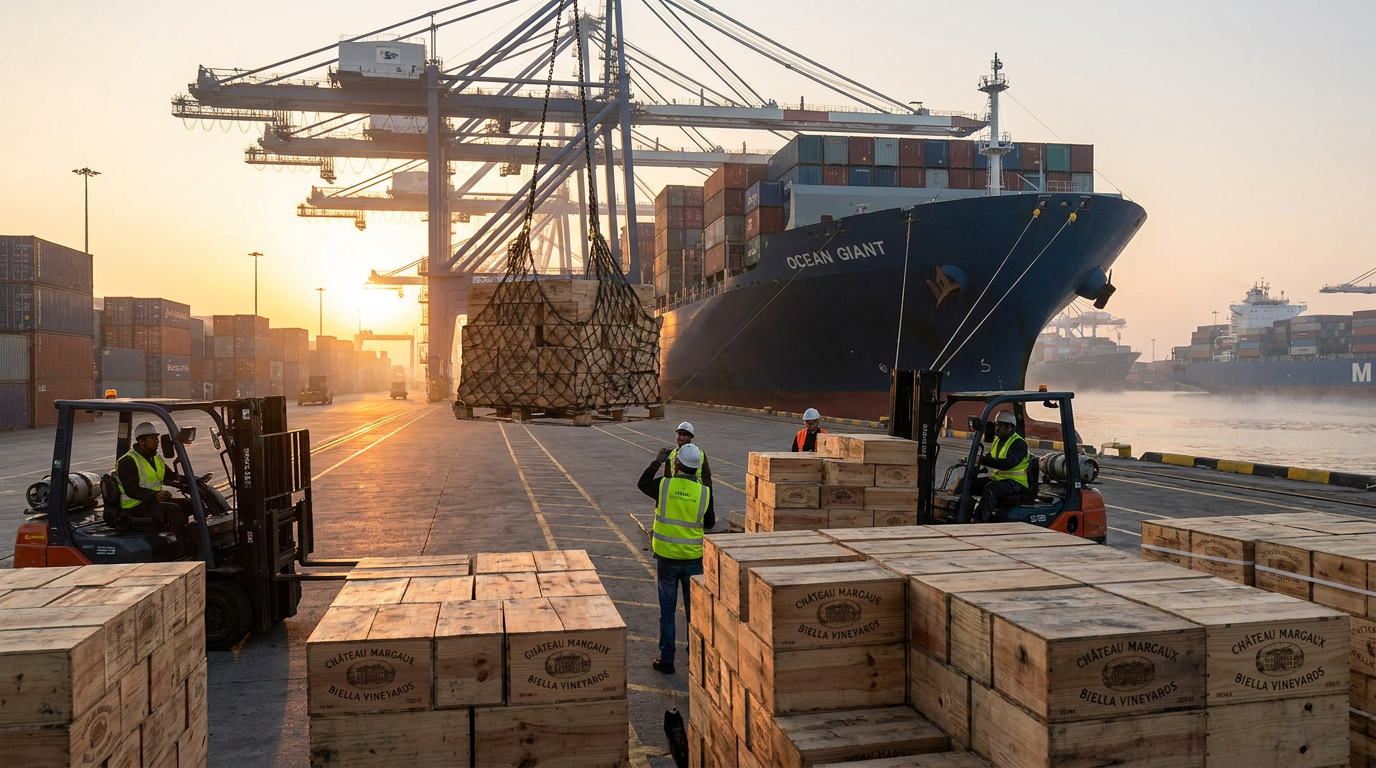
The global wine trade is bracing for a seismic disruption as the United States threatens to impose a 200% ad valorem tariff on French wine and champagne. The proposed duty, which would effectively triple the import cost of one of France's most famous luxury exports, has sent shockwaves through the transatlantic supply chain. For an industry already navigating shifting consumer habits and climate volatility, the tariff represents a sudden and severe geopolitical headwind.[1][2]
The origins of the 200% threat lie far outside the vineyards of Bordeaux or Champagne. The measure is being wielded as diplomatic leverage by the U.S. administration, primarily in response to French President Emmanuel Macron's refusal to join a U.S.-led "Board of Peace" initiative concerning the Middle East. This geopolitical friction is compounding existing economic disputes, notably Washington's ongoing frustration with France's 3% digital services tax on American technology companies.[1][4][5][7]
To understand the stakes, one must look at the mechanics of an "ad valorem" tariff. Unlike a flat tax per bottle, an ad valorem tariff is calculated as a percentage of the customs value of the imported good. A 200% tariff means that an importer bringing in a case of wine valued at $100 at the border must pay the U.S. government $200 simply to clear customs, bringing the baseline cost to $300 before it even enters the domestic supply chain.[3][5]

The financial impact of this border tax does not scale linearly for the consumer; it multiplies. The United States operates under a mandatory "Three-Tier System" for alcohol distribution, a regulatory framework dating back to the repeal of Prohibition. Under this system, producers must sell to wholesale distributors, who in turn sell to retailers and restaurants.[2]
At each tier, the business applies its standard profit margin—typically 30% to 50%. Because the 200% tariff is baked into the importer's initial cost, every subsequent markup is calculated on that artificially inflated base. Consequently, a bottle of French wine that currently retails for $30 could easily jump to $75 or $90 on a store shelf, effectively pricing it out of the everyday market.[2][7]
For the U.S. hospitality sector, the threat is acute. Restaurants and bars rely heavily on wine sales to maintain their profit margins. A coalition of U.S. alcohol producers and hospitality bodies has warned that severe tariffs could wipe nearly $2 billion off American alcohol sales and jeopardize up to 25,000 jobs. Sommeliers and beverage directors are already drafting contingency plans, preparing to rewrite menus to feature alternative regions if French imports become financially unviable.[2][3]
Across the Atlantic, the stakes are equally existential. The United States is the single largest destination for European Union alcoholic beverages. French wine exports to the U.S. are valued at roughly €1.96 billion ($2.2 billion) annually. Champagne alone accounted for over 27 million bottles shipped to the U.S. last year, representing a massive revenue stream for the region.[1][6]

The United States is the single largest destination for European Union alcoholic beverages.
A sudden closure of the U.S. market would exacerbate a structural crisis already underway in the French wine industry. Domestic consumption in France has been steadily declining for decades, and producers are grappling with a global oversupply of certain varietals. Industry leaders acknowledge that the sector is entering a three-to-five-year period of painful structural readjustment, requiring a fundamental rethink of how and where French wine is sold.[3]
In response to the tariff threat, French producers are accelerating efforts to diversify their export markets. The economic principle of "trade diversion" suggests that when a major market imposes prohibitive barriers, exporters will redirect their goods to alternative buyers, even if those secondary markets are less profitable.[3][5]
Prominent French winemakers are proposing aggressive international marketing campaigns to offset the potential U.S. losses. Initiatives like a coordinated "French Wine Month" are being pitched for top consumer countries outside the U.S., including China, Japan, Canada, and Switzerland. By mobilizing restaurants, supermarkets, and e-commerce platforms in these regions, the industry hopes to absorb the volume that would otherwise sit unsold in American warehouses.[3]

Meanwhile, the potential absence of French wine in the U.S. creates a vacuum that domestic producers are eager to fill. Vineyards in California, Oregon, and Washington stand to gain market share in the premium and super-premium categories. While domestic producers cannot legally replicate geographically protected names like Champagne or Bordeaux, they can offer high-quality sparkling wines and Cabernet blends at price points that suddenly look highly competitive.[2][7]
However, the domestic industry is not entirely insulated from the fallout. The global wine trade is deeply interconnected, and U.S. producers rely on European imports for essential supplies, including specialized oak barrels, glass bottles, and winemaking equipment. Furthermore, aggressive U.S. tariffs often invite retaliatory measures from the EU, which could target American agricultural exports, including California wine and Kentucky bourbon.[2][5]

The legal mechanism for the tariff threat falls under Section 301 of the Trade Act of 1974, which grants the U.S. president broad authority to impose trade sanctions in response to foreign practices deemed unfair or discriminatory. The Office of the U.S. Trade Representative has previously utilized Section 301 to investigate European digital services taxes, establishing a legal precedent for linking tech disputes to agricultural tariffs.[5][7]
Despite the severe rhetoric, there remains significant uncertainty about whether the 200% tariff will be fully implemented. The White House has offered little clarity on the specific enforcement mechanisms or the exact timeline for the duties. In international trade, maximum-pressure tariff threats are frequently used as negotiating tactics, designed to force concessions before the duties actually take effect.[1][2][4]
The wine industry has survived similar, albeit less severe, trade disputes in recent history. During the Airbus-Boeing subsidy dispute between 2019 and 2021, the U.S. imposed a 25% tariff on certain European wines. While painful, importers and producers absorbed some of the costs, and the trade flow eventually normalized when the tariffs were suspended.[2][5]
A 200% tariff, however, represents a different magnitude of disruption. It crosses the threshold from a painful tax to an effective embargo. As the diplomatic standoff continues, the global wine trade is operating in a state of suspended animation, preparing for a supply chain rewiring that could permanently alter the geography of luxury wine consumption.[1][3][7]
How we got here
2019
France enacts a 3% digital services tax, sparking initial U.S. tariff threats.
August 2025
The U.S. implements a baseline 15% tariff on EU wine and spirits amid broader trade disputes.
January 2026
The U.S. threatens a 200% tariff on French wine over diplomatic disagreements regarding a Gaza peace initiative.
June 2026
Tariff threats compound as the U.S. issues further warnings regarding the digital services tax, putting the transatlantic wine trade on high alert.
Viewpoints in depth
French Wine Producers
Facing a potential market shutdown, French winemakers are pivoting to alternative global markets to absorb the volume.
For the French wine industry, the U.S. tariff threat exacerbates an already painful structural crisis driven by declining domestic consumption. Rather than waiting for diplomatic resolution, industry leaders are actively planning 'trade diversion' strategies. Proposals include launching coordinated marketing blitzes in secondary markets like Japan, Switzerland, and Canada to absorb the €1.96 billion in exports that would otherwise be priced out of the American market.
U.S. Hospitality & Importers
American restaurants and distributors warn that the tariff will devastate local businesses and cost thousands of jobs.
Importers and hospitality groups argue that tariffs on European wine function as a direct tax on American small businesses. Because of the mandatory three-tier distribution system, a 200% border tax compounds at every step, turning a moderately priced bottle into an unaffordable luxury. Industry coalitions warn that this sudden price shock could wipe out nearly $2 billion in domestic alcohol sales and jeopardize up to 25,000 jobs in the restaurant and distribution sectors.
Trade Policy Analysts
Trade experts view the tariff threat as a high-stakes negotiating tactic utilizing established legal frameworks.
From a geopolitical perspective, the 200% tariff threat is a classic application of maximum-pressure diplomacy. Analysts point out that the U.S. administration is leveraging Section 301 of the Trade Act to link unrelated diplomatic disputes—such as the 'Board of Peace' initiative and digital services taxes—to agricultural trade. While the rhetoric is severe, experts note that such threats are often designed to force concessions before the tariffs are actually implemented, though the risk of a permanent supply chain rupture remains high.
What we don't know
- Whether the U.S. will actually implement the full 200% tariff or use it purely as a negotiating tactic.
- How the European Union will retaliate against U.S. agricultural exports if the tariffs take effect.
- Exactly how much of the French export volume can be successfully absorbed by secondary markets like China and Japan.
Key terms
- Ad Valorem Tariff
- A tax assessed as a percentage of the value of the imported goods, rather than a flat rate per item.
- Three-Tier System
- The U.S. regulatory framework requiring alcohol to pass from producers to distributors to retailers before reaching consumers.
- Section 301
- A provision of U.S. trade law allowing the president to impose tariffs in response to foreign practices deemed unfair to U.S. commerce.
- Trade Diversion
- The economic phenomenon where tariffs cause trade to shift from a more efficient exporter to a less efficient one, or to alternative markets.
Frequently asked
Why is the U.S. threatening a 200% tariff on French wine?
The threat is being used as geopolitical leverage, tied both to diplomatic disputes over a proposed 'Board of Peace' and retaliation against France's digital services tax on American tech companies.
How much would a 200% tariff increase the price of wine?
Because the tariff is applied at the importer level, standard retail markups mean a $30 bottle of French wine could cost $60 to $90 for the end consumer.
Will this affect wines from other European countries?
Currently, the 200% threat is specifically targeted at France, though other EU nations face separate tariff reviews over digital taxes and geopolitical disagreements.
Can U.S. winemakers replace the French supply?
Domestic producers in California and Oregon can fill some gaps, but replacing the specific volume and flavor profiles of French regions like Champagne and Bordeaux is difficult in the short term.
Sources
Source coverage
7 outlets
3 viewpoints surfaced







[1]Food Ingredients FirstU.S. Hospitality & Importers
Trump threatens 200% tariff on French wine and champagne to pressure Macron
Read on Food Ingredients First →[2]The Drinks BusinessU.S. Hospitality & Importers
Trump threatens 200% tariffs on French wine after Macron rejects Board of Peace invitation
Read on The Drinks Business →[3]Wine-SearcherFrench Wine Producers
French Wine Crisis 'Only the Start'
Read on Wine-Searcher →[4]TempoFrench Wine Producers
Trump Floats 200% Tariff on French Wine Over Perceived Snub
Read on Tempo →[5]Grant ThorntonTrade Policy Analysts
European Parliament approval upholds key parts of U.S. trade deal
Read on Grant Thornton →[6]Turkiye TodayTrade Policy Analysts
Trump threatens 200% tariffs on $2.5B French wine over Gaza board snub
Read on Turkiye Today →[7]WTVBTrade Policy Analysts
French wine exporters say Trump's latest tariff threat is bad news
Read on WTVB →
Every angle. Every day.
Get food drink stories with full source coverage and perspective breakdowns delivered to your inbox.