
The Concrete Coliseums: How the World Cup Stadium Evolved from the Centenario to the Megadome
From a hastily poured concrete bowl in 1930s Uruguay to the technologically advanced, multi-billion-dollar arenas of 2026, the evolution of the World Cup stadium mirrors the explosive commercial and cultural growth of global football.
By Factlen Editorial Team
- Football Traditionalists
- Value the historic atmosphere, acoustic intensity, and cultural legacy of older, bespoke football grounds over modern corporate amenities.
- Modern Infrastructure Advocates
- Prioritize spectator safety, technological integration, climate control, and the massive revenue potential of modern megadomes.
- Economic Pragmatists
- Argue against building new stadiums for mega-events, advocating instead for the 2026 model of utilizing existing, financially sustainable infrastructure.
What's not represented
- · Local communities displaced by historical stadium construction
- · Environmental impact analysts evaluating the carbon footprint of modern megadomes
Why this matters
Stadiums are more than just backdrops; they dictate the atmosphere, economics, and legacy of a World Cup. Understanding their evolution explains why the 2026 tournament relies entirely on existing mega-venues rather than building new ones from scratch.
Key points
- The 1930 Estadio Centenario was built in just eight months to host the inaugural tournament.
- The 1950 Maracanã holds the all-time attendance record, hosting nearly 200,000 fans before modern safety regulations.
- Mexico's Estadio Azteca set the modern blueprint in 1970 by optimizing for both massive crowds and global television broadcasting.
- Stadium disasters in the late 1980s forced a global transition to all-seater venues, reducing capacities but increasing safety.
- The 2026 tournament abandons new construction entirely, relying on existing multi-billion-dollar NFL and Liga MX megadomes.
The story of the FIFA World Cup is inextricably linked to the physical structures built to contain it. Before television rights and global sponsorships transformed the tournament into a multi-billion-dollar enterprise, the stadium was the sole mechanism for generating revenue and capturing the spectacle. As the 2026 World Cup unfolds across sixteen colossal venues in the United States, Canada, and Mexico, the contrast between today's climate-controlled megadomes and the tournament's humble architectural origins has never been starker.[1][6]
The genesis of the World Cup stadium lies in Montevideo, Uruguay. When FIFA awarded the inaugural 1930 tournament to the South American nation, the government commissioned the Estadio Centenario to commemorate the centenary of Uruguay's first constitution. Designed by architect Juan Antonio Scasso, it was an unprecedented undertaking. With only eight months to complete the project, construction crews worked around the clock in three shifts, utilizing massive floodlights to pour concrete through the night.[2][4]
The Centenario was a triumph of sheer will, though it barely met its deadline. Heavy rains delayed construction, forcing the tournament's opening matches to be played at smaller, pre-existing club grounds. When the Centenario finally opened five days into the tournament, the cement in some sections was reportedly still wet. Yet, it stood as a 90,000-capacity colossus, a physical manifestation of football's emerging global power and the first stadium explicitly built to host the world.[2][7]

If the Centenario was the birth of the World Cup stadium, the Maracanã in Rio de Janeiro was its terrifying, awe-inspiring adolescence. Built for the 1950 World Cup, the Maracanã was designed to be the undisputed largest stadium on Earth. It was a monument to Brazilian ambition, a sweeping, circular concrete bowl that prioritized raw capacity over individual comfort. In an era before strict safety regulations and individual seating, the stadium's vast terracing allowed for crowds of unimaginable density.[2][5]
The climax of the 1950 tournament—the infamous Maracanazo, where Uruguay defeated host nation Brazil—was witnessed by an official attendance of 199,854 people, though unofficial estimates suggest well over 200,000 crammed into the concrete bowl. The sheer acoustic weight of that many human beings created an atmosphere that has never been replicated in a sporting event since. The Maracanã proved that the World Cup could scale to the size of a small city, but it also represented the absolute limit of the unregulated mega-crowd.[4][5]

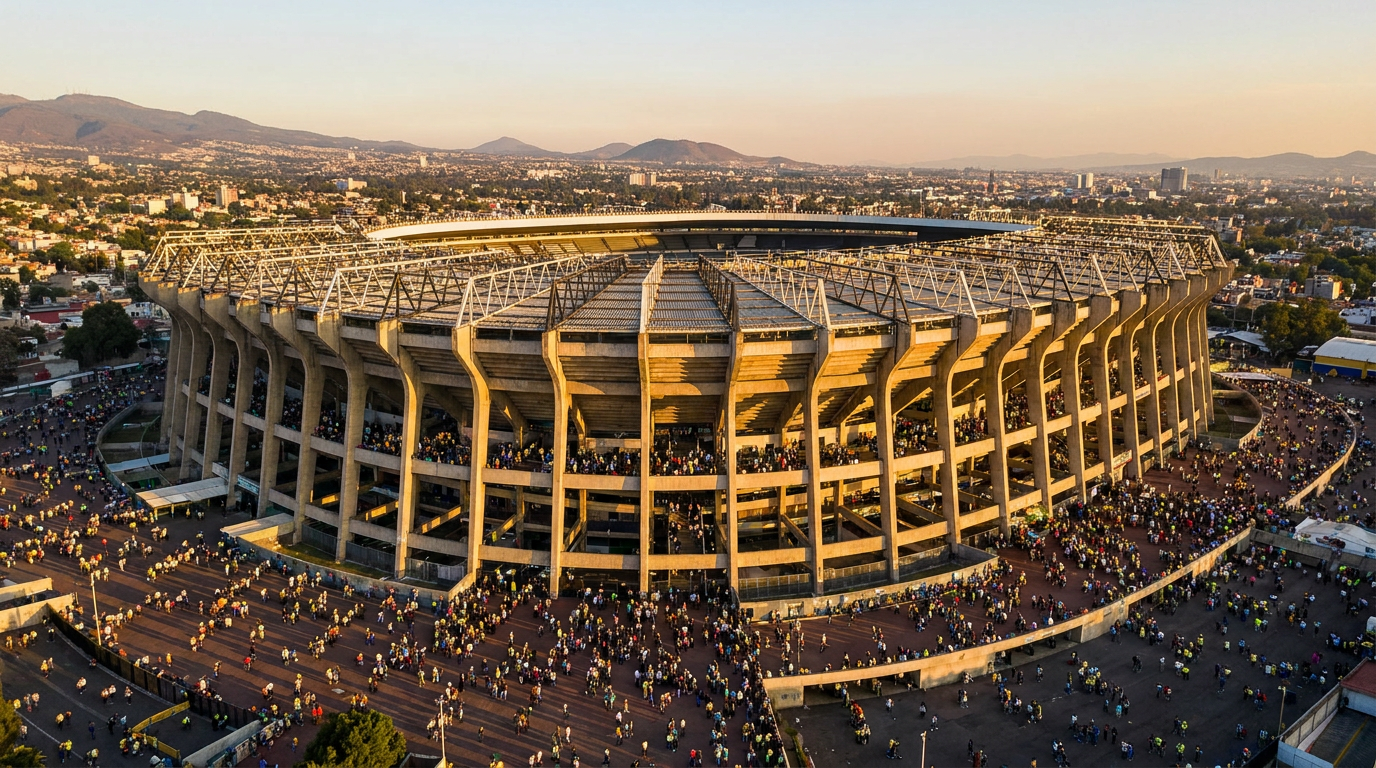
The modern era of stadium design began to take shape in the late 1960s and 1970s, driven by the advent of global color television broadcasting. The 1966 final at London's Wembley Stadium showcased the charm of historic, established grounds, but it was Mexico's Estadio Azteca in 1970 that provided the blueprint for the future. Designed by Pedro Ramírez Vázquez and Rafael Mijares Alcérreca, the Azteca was an architectural marvel, explicitly engineered to provide unobstructed sightlines for over 100,000 spectators while accommodating the massive camera gantries required for global broadcast.[3][6]
The modern era of stadium design began to take shape in the late 1960s and 1970s, driven by the advent of global color television broadcasting.
The Azteca's steep, continuous tiers trapped sound, creating a cauldron-like atmosphere that defined the 1970 and 1986 tournaments. It was the first stadium to truly balance the visceral experience of the live crowd with the sterile requirements of the television lens. As the only venue to host two World Cup finals—and slated to host matches again in 2026—the Azteca remains the bridge between the raw concrete bowls of the mid-century and the highly engineered arenas of today.[3][7]
The late 1980s and 1990s brought a forced evolution. Following a series of tragic stadium disasters in Europe, culminating in the Hillsborough disaster of 1989, the Taylor Report mandated the transition to all-seater stadiums. The era of mass terracing and 150,000-strong crowds was over. World Cup venues had to prioritize safety, ingress, egress, and individual seating, fundamentally changing the architecture and economics of the tournament. Capacities shrank, but ticket prices and corporate hospitality footprints expanded.[4][5]
This shift perfectly coincided with the 1994 World Cup in the United States. Rather than building new, bespoke football stadiums, the US utilized its massive, pre-existing inventory of college and professional American football venues. Stadiums like the Rose Bowl and the Pontiac Silverdome—the first indoor stadium to host a World Cup match—proved that existing mega-infrastructure could be temporarily retrofitted for global football. The 1994 tournament set an overall attendance record that stood for decades, proving the financial viability of the mega-stadium model.[6][7]

However, the early 21st century saw a return to bespoke, government-funded stadium construction, often with controversial results. Tournaments in Korea/Japan (2002), South Africa (2010), and Brazil (2014) featured breathtaking architectural designs, but many of these billion-dollar venues became "white elephants"—massive structures with little to no domestic use after the tournament concluded. The financial burden of building six to twelve world-class stadiums from scratch became a major political flashpoint.[3][4]
This economic reality forced a paradigm shift that defines the 2026 tournament. By expanding the World Cup to 48 teams and 104 matches, FIFA made it nearly impossible for a single developing nation to host the event without catastrophic financial risk. The solution was the North American co-hosting bid, which relies entirely on the pre-existing, hyper-commercialized infrastructure of the NFL and Liga MX. There are no new stadiums being built for 2026; instead, the tournament is leasing the most expensive, technologically advanced arenas ever constructed.[1][6]
Venues like SoFi Stadium in Los Angeles and MetLife Stadium in New Jersey represent the zenith of the modern megadome. These are multi-billion-dollar entertainment campuses featuring massive centralized video boards, climate-controlled environments, and thousands of luxury suites. They are designed not just to host a match, but to maximize revenue per square foot. The raw, terrifying noise of the 1950 Maracanã has been replaced by the curated, high-definition experience of the modern corporate cathedral.[3][7]

Yet, the core function of the stadium remains unchanged. Whether it is the wet cement of the Centenario, the sun-baked terraces of the Azteca, or the glass-and-steel facades of the 2026 venues, these structures serve as the physical anchors for global memory. They are the stages upon which national myths are forged, designed to hold the collective anxiety and elation of the world for ninety minutes at a time.[1][2]
As the 2026 World Cup unfolds across North America, the stadiums themselves tell the story of the sport's evolution. Football has grown from a regional passion project into the most lucrative entertainment property on Earth, and the buildings that house it have scaled accordingly. The concrete coliseums of the past have given way to the billion-dollar megadomes of the present, ensuring that the World Cup remains the grandest spectacle in human history.[1]
How we got here
1930
The Estadio Centenario is rapidly constructed in Montevideo to host the inaugural World Cup.
1950
The Maracanã in Rio de Janeiro hosts nearly 200,000 spectators, representing the peak of unregulated stadium capacity.
1970
The Estadio Azteca pioneers the modern, broadcast-optimized mega-stadium design.
1990
The Taylor Report accelerates the global shift toward mandatory all-seater stadiums following tragic crowd disasters.
1994
The USA proves the financial viability of hosting the tournament in massive, pre-existing domestic sports venues.
2026
The expanded 48-team tournament relies entirely on existing, multi-billion-dollar megadomes across North America.
Viewpoints in depth
Football Traditionalists
A perspective that values the historic atmosphere and cultural legacy of older, bespoke football grounds.
For traditionalists, the soul of the World Cup resides in stadiums built specifically for the sport. They argue that venues like the Maracanã, the Azteca, and Wembley possess an acoustic intensity and historical weight that cannot be replicated in modern, multi-purpose arenas. This camp often laments the transition to corporate megadomes, suggesting that the prioritization of luxury suites and VIP hospitality strips the tournament of its raw, working-class atmosphere.
Modern Infrastructure Advocates
A viewpoint prioritizing spectator safety, technological integration, and the massive revenue potential of modern megadomes.
Architects and modern organizers argue that the romanticization of mid-century stadiums ignores the very real dangers of unregulated terracing and poor crowd control. They champion the modern megadome for its unparalleled safety standards, climate-controlled environments, and advanced broadcast capabilities. From this perspective, the multi-billion-dollar venues of 2026 represent the necessary evolution of the sport, ensuring that the World Cup can safely accommodate millions of fans while generating the revenue required to sustain global football development.
Economic Pragmatists
An approach focused on financial sustainability, arguing against the construction of new stadiums for mega-events.
Economic analysts point to the devastating financial legacy of recent World Cups, where developing nations spent billions on bespoke stadiums that were abandoned shortly after the tournament. This camp strongly advocates for the 2026 model, arguing that the era of building massive infrastructure for a four-week event is over. By utilizing existing NFL and Liga MX stadiums, the North American bid eliminates the risk of 'white elephants,' proving that future mega-events must rely on cities that already possess the necessary infrastructure.
What we don't know
- Whether the massive scale of NFL stadiums will dilute the traditional, concentrated acoustic atmosphere of World Cup matches.
- How the reliance on existing mega-infrastructure will impact the ability of smaller or developing nations to host future tournaments.
Key terms
- White Elephant
- A massive, expensive stadium built specifically for a mega-event that has little to no practical or financial use once the tournament concludes.
- All-Seater Stadium
- A stadium where every spectator has a specific seat, mandated globally in the 1990s to prevent the deadly crushing incidents associated with open terracing.
- Maracanazo
- The historic 1950 World Cup match where underdog Uruguay defeated heavily favored host nation Brazil in front of nearly 200,000 fans at the Maracanã.
Frequently asked
What was the highest attendance in World Cup history?
The official attendance for the 1950 World Cup final between Uruguay and Brazil at the Maracanã was 199,854, though unofficial estimates suggest the crowd exceeded 200,000.
Why are there no new stadiums being built for 2026?
To avoid the financial burden of building 'white elephant' stadiums that go unused after the tournament, the 2026 World Cup is utilizing existing, highly advanced NFL and Liga MX venues across North America.
Why is the Estadio Azteca historically significant?
The Estadio Azteca in Mexico City was the first stadium designed specifically to accommodate both massive live crowds and modern global television broadcasting, and it is the only venue to have hosted two World Cup finals.
Sources
Source coverage
7 outlets
3 viewpoints surfaced







[1]Factlen Editorial TeamEconomic Pragmatists
Synthesis by Factlen editorial team
Read on Factlen Editorial Team →[2]FIFA Official ArchiveEconomic Pragmatists
FIFA World Cup Historic Stadiums and Attendances
Read on FIFA Official Archive →[3]ArchDailyModern Infrastructure Advocates
The Architectural Evolution of the Mega-Stadium
Read on ArchDaily →[4]The GuardianFootball Traditionalists
Monuments of mud and steel: The grounds that built the World Cup
Read on The Guardian →[5]BBC SportFootball Traditionalists
From the Maracanã to Wembley: Football's greatest stages
Read on BBC Sport →[6]The AthleticModern Infrastructure Advocates
How the 2026 World Cup venues compare to historical hosts
Read on The Athletic →[7]ESPNEconomic Pragmatists
The legacy of the World Cup's most iconic venues
Read on ESPN →

More in sports
See all 25 stories →Standings
USA and Scotland Dominate World Cup League 2 Standings as Race for Qualifier Spots Intensifies
6 sources

Injury
Marco Bezzecchi Cleared of Serious Injury Following Violent Assen Crash as Fermin Aldeguer Faces Summer Recovery
6 sources

Standings
Pato O'Ward Seizes IndyCar Championship Lead as Mid-Season Battle Tightens
6 sources

Injury
Falcons Edge Rusher Bralen Trice Cleared for 11-on-11 Drills After Missing First Two NFL Seasons
6 sources

Every angle. Every day.
Get sports stories with full source coverage and perspective breakdowns delivered to your inbox.