
Global Coalition of Artists and Managers Demands Consent and Transparency in Label AI Licensing Deals
A newly formed international coalition of musicians and managers is pushing back against major record labels' blanket AI licensing agreements, demanding explicit opt-in consent and transparent revenue sharing.
By Factlen Editorial Team
- Artist Rights Advocates
- Demands absolute sovereignty over voice and style, arguing that AI training without consent is a form of identity theft.
- Music Industry Executives
- View AI as an inevitable revenue stream and argue that collective licensing deals are the only way to monetize the tech and prevent piracy.
- Tech & AI Developers
- Seek clear, frictionless licensing frameworks to train models legally, but worry that individual opt-ins will stall innovation.
What's not represented
- · Consumers who use AI music generation tools
- · Independent AI researchers
Why this matters
As generative AI reshapes the music industry, this unified front could force a fundamental rewrite of standard recording contracts, ensuring creators maintain control over their digital likenesses and voices.
Key points
- A new global coalition of over 50,000 artists and managers is demanding a halt to blanket AI licensing deals.
- The group insists on explicit opt-in consent, transparent data usage, and proportional revenue sharing.
- Major labels argue these deals are necessary to monetize AI and protect against unregulated piracy.
- The coalition has given labels a 30-day window to respond before pursuing potential collective action.
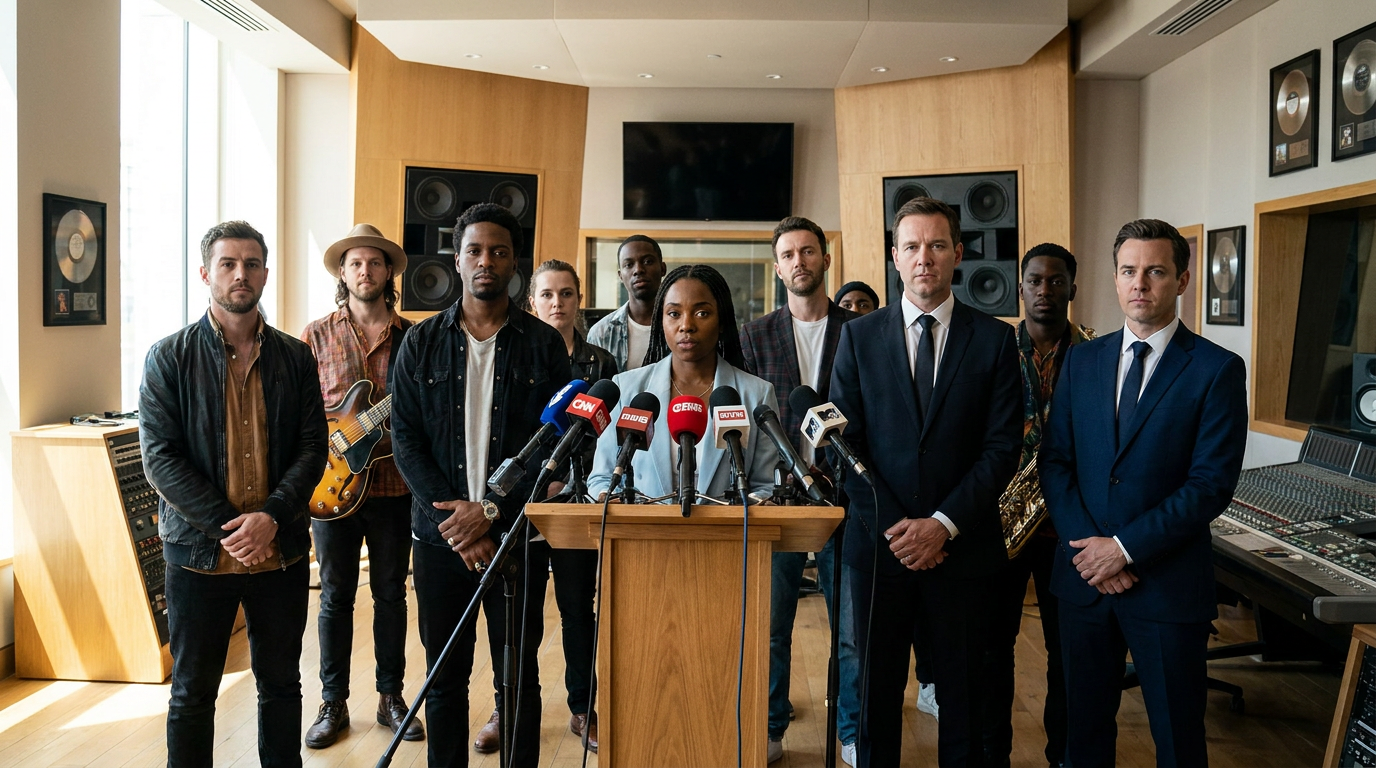
A massive coalition of over 50,000 recording artists, songwriters, and talent managers has officially drawn a line in the sand regarding artificial intelligence. In a joint open letter published Sunday, the newly formed Global Coalition of Music Creators (GCMC) issued a unified demand to the world's major record labels: halt all blanket AI licensing agreements until explicit, opt-in consent frameworks are established. The move represents the most organized labor pushback yet against the rapid commercialization of generative AI in the music sector.[1][3]
The catalyst for the coalition's formation was a recent wave of multi-million dollar deals struck between the 'Big Three' labels—Universal Music Group, Sony Music Entertainment, and Warner Music Group—and leading generative AI platforms. These pacts, estimated to be worth over $400 million collectively, grant AI companies access to vast catalogs of copyrighted music to train their models. However, artists argue these deals were negotiated behind closed doors, effectively licensing their voices, styles, and life's work without individual consultation.[2][4]
At the core of the GCMC's framework are three non-negotiable demands. First, they require absolute 'opt-in' consent, meaning no artist's work can be ingested by an AI model unless they actively agree to it, rejecting the industry's proposed 'opt-out' standard. Second, they are demanding total transparency regarding which datasets have already been licensed and how they are being used. Finally, the coalition is calling for a proportional revenue-sharing model that pays artists directly for the generation of new works based on their sonic identity.[1][5]

Major labels have defended their aggressive licensing strategy as a necessary evolution to protect the industry's ecosystem. Label executives argue that establishing authorized, paid pipelines for AI training is the only effective way to combat rampant piracy and unauthorized voice cloning. By striking these macro-level deals, the labels claim they are fulfilling their fiduciary duty to monetize new technological frontiers and secure a financial foothold for their entire rosters before unregulated platforms devalue music entirely.[6][7]
Major labels have defended their aggressive licensing strategy as a necessary evolution to protect the industry's ecosystem.
The technology sector finds itself caught in the crossfire of this internal industry dispute. Leading AI audio developers have publicly welcomed the idea of standardized, legal licensing to avoid the massive copyright infringement lawsuits that plagued the early days of generative text and image models. However, tech executives have privately expressed concern that mandating individual, track-by-track consent for millions of songs could create an insurmountable logistical bottleneck, effectively stalling the development of next-generation music creation tools.[4][8]
Independent artists and boutique labels are watching the GCMC's campaign closely, recognizing that the outcome will likely set the de facto standard for the entire global music market. Because independent creators lack the legal leverage of massive corporate entities, a standardized framework requiring explicit consent would provide a crucial safety net. Industry analysts note that if the major labels concede to the coalition's demands, independent distributors will immediately adopt identical terms to remain competitive in attracting talent.[2][9]

The coalition's demands arrive with significant political tailwinds. The push coincides with the unanimous advancement of the NO FAKES Act in the United States Senate, which seeks to establish a federal property right over voice and visual likeness, as well as the implementation of the European Union's AI Act. Legal experts suggest that these legislative moves give the GCMC immense leverage, as lawmakers are already signaling a willingness to regulate AI companies that bypass creator consent.[5][10]
The GCMC has given the major labels a 30-day window to formally respond to their proposed framework and pause ongoing negotiations with AI firms. While the coalition has not explicitly detailed its next steps if the demands are ignored, organizers have hinted at the possibility of collective action. This could range from high-profile artists withholding future releases to coordinating massive class-action litigation aimed at nullifying the existing AI training agreements.[1][3]
How we got here
Early 2024
First viral unauthorized AI voice clones spark industry panic and widespread copyright takedown notices.
Late 2024
Major labels begin suing AI startups for copyright infringement over unauthorized training data.
Mid 2025
Labels pivot to striking lucrative, closed-door licensing deals with select generative AI platforms.
June 2026
Global coalition forms to demand transparency and individual consent in all future AI licensing agreements.
Viewpoints in depth
Artist Coalition
Demands absolute sovereignty over voice and style, arguing that AI training without consent is identity theft.
For the creators driving the coalition, the issue extends beyond simple economics into fundamental rights of publicity and artistic integrity. They argue that a musician's voice and stylistic fingerprint are inextricably linked to their identity. By allowing labels to license these traits in bulk, artists fear a future where the market is flooded with synthetic imitations of their own work, diluting their brand and competing directly with their authentic output. The coalition insists that only a strict opt-in model can protect the human element of music creation.
Major Record Labels
View AI as an inevitable revenue stream and argue that collective licensing deals are the only way to monetize the tech.
Label executives maintain that the generative AI genie cannot be put back in the bottle. From their perspective, the choice is not between AI and no AI, but between monetized, authorized AI and rampant, unpaid piracy. By negotiating massive blanket licenses, labels believe they are establishing a legal framework that forces tech companies to pay for the raw materials they consume. They argue that requiring individual consent for millions of tracks would paralyze negotiations, leaving the entire industry vulnerable to tech platforms that might simply scrape the data illegally.
Generative AI Platforms
Seek clear, frictionless licensing frameworks to train models legally, but worry that individual opt-ins will stall innovation.
The technology sector is eager to legitimize its products and avoid the existential threat of multi-billion dollar copyright lawsuits. AI developers are willing to pay for high-quality, labeled training data, which the major labels can provide at scale. However, they view the coalition's demand for track-by-track, opt-in consent as a logistical nightmare. Tech leaders argue that building robust AI models requires massive, diverse datasets, and that introducing excessive friction into the licensing process will ultimately stifle the development of tools that could democratize music production for everyone.
What we don't know
- Whether major labels will agree to renegotiate existing AI contracts to include opt-in clauses.
- How exactly a proportional revenue-sharing model for AI-generated music would be calculated and distributed.
- If the coalition will actually follow through on threats to withhold new music if their demands are not met.
Key terms
- Generative AI Music
- Algorithms trained on existing audio to create new, original compositions or mimic specific voices and styles.
- Opt-In Consent
- A framework where an artist's work cannot be used unless they explicitly agree, rather than having to actively request removal.
- Blanket License
- A single agreement that covers the use of a large catalog of copyrighted works, often negotiated by labels without individual artist input.
Frequently asked
Why are artists upset if labels are getting paid?
Many artists claim they were not consulted about these deals and fear their voices and styles are being licensed without their permission or a clear breakdown of how the money is distributed.
Can AI companies just train on public music?
No, training commercial AI models on copyrighted music without permission is currently the subject of massive ongoing litigation, which is why AI companies are seeking these label deals.
What happens if the labels refuse the demands?
The coalition has threatened collective action, which could include withholding new music, public campaigns against the labels, or pursuing class-action lawsuits.
Sources
Source coverage
10 outlets
3 viewpoints surfaced










[1]BillboardMusic Industry Executives
Artists Draw a Line: New Global Coalition Demands Halt to Blanket AI Deals
Read on Billboard →[2]Music Business WorldwideMusic Industry Executives
Over 50,000 Creators Sign Open Letter Demanding 'Opt-In' AI Consent from Major Labels
Read on Music Business Worldwide →[3]Rolling StoneArtist Rights Advocates
'Our Voices Are Not Stock Assets': Musicians Unite Against Secret AI Licensing
Read on Rolling Stone →[4]VarietyMusic Industry Executives
Major Labels Face Unprecedented Pushback Over $400 Million AI Training Pacts
Read on Variety →[5]The VergeTech & AI Developers
The music industry's AI reckoning has arrived as artists demand veto power over training data
Read on The Verge →[6]ReutersTech & AI Developers
Music industry clashes internally over AI licensing frameworks and artist consent
Read on Reuters →[7]Financial TimesMusic Industry Executives
Record labels defend AI strategy as artists demand greater transparency
Read on Financial Times →[8]TechCrunchTech & AI Developers
Generative audio startups face licensing bottleneck as artists demand opt-in consent
Read on TechCrunch →[9]PitchforkArtist Rights Advocates
Independent Music Sector Rallies Behind New AI Consent Framework
Read on Pitchfork →[10]NMEArtist Rights Advocates
Global artist coalition issues 30-day ultimatum to labels over AI training deals
Read on NME →
Every angle. Every day.
Get entertainment stories with full source coverage and perspective breakdowns delivered to your inbox.