
The Mechanics of the Historic IPO: How SpaceX Raised $85.7 Billion in Its Landmark Nasdaq Debut
SpaceX has shattered global financial records with an $85.7 billion initial public offering on the Nasdaq, marking the largest public market debut in history. The massive capital injection fundamentally rewrites the economics of commercial spaceflight and deep-tech investing.
By Factlen Editorial Team
- Deep-Tech Growth Investors
- View the IPO as a rare opportunity to invest in a monopolistic utility for the modern space economy.
- Market Infrastructure Analysts
- Focus on the unprecedented mechanics and stress-testing required to execute an $85.7 billion public listing.
- Long-Horizon Strategists
- Analyze the tension between quarterly public market demands and multi-decade interplanetary goals.
What's not represented
- · Legacy Aerospace Competitors
- · Environmental Regulators
Why this matters
This historic capital raise moves the funding of interplanetary infrastructure from private venture capital to the public markets. For everyday investors, it represents the first direct opportunity to own a stake in the foundational company of the modern space economy.
Key points
- SpaceX raised $85.7 billion on the Nasdaq, shattering the previous global IPO record.
- The capital will fund the aggressive expansion of the Starship program and Starlink network.
- The S-1 filing revealed Starlink has become a massive, recurring cash-flow generator.
- The sheer volume of the debut required Nasdaq to utilize dedicated server clusters to handle the opening cross.
The bell rang on the Nasdaq this morning, but the reverberations extended far beyond Times Square. Space Exploration Technologies Corp., universally known as SpaceX, officially transitioned from a closely guarded private juggernaut to a publicly traded entity. The company raised a staggering $85.7 billion in its initial public offering, a figure that fundamentally rewrites the record books of global finance and marks a new era for deep-tech capital allocation.[1]
To understand the scale of this debut, one must look at historical precedents. Before today, the largest IPO in history belonged to Saudi Aramco, which raised $29.4 billion in 2019. Alibaba held the prior technology sector record at $25 billion in 2014. SpaceX has not just broken these records; it has nearly tripled them, signaling an unprecedented appetite for hard-technology infrastructure among public market investors.[2]
The sheer mechanics of absorbing an $85.7 billion liquidity event required months of preparation by Wall Street's largest underwriting syndicates. The offering was heavily oversubscribed, meaning institutional demand far exceeded the number of shares available, even at the absolute top of the pricing range. This immense capital influx values the aerospace manufacturer at well over $350 billion, cementing its status as a cornerstone of the modern industrial economy.[1][3]

At the heart of this historic debut is the book-building process. When a company of this magnitude goes public, investment banks act as underwriters, canvassing institutional investors—pension funds, mutual funds, and sovereign wealth portfolios—to determine their price sensitivity and demand. For SpaceX, the book-building phase revealed a market willing to price the company not just as a launch provider, but as a monopolistic utility for low-Earth orbit.[2][5]
The Form S-1 registration statement filed with the Securities and Exchange Commission provided the first truly transparent look into the company's financial engine. The document revealed that Starlink, the company's satellite internet constellation, has transitioned from a capital-intensive project into a massive cash-flow generator. This recurring subscription revenue model provided the financial bedrock necessary to justify the historic valuation to risk-averse institutional buyers.[3]
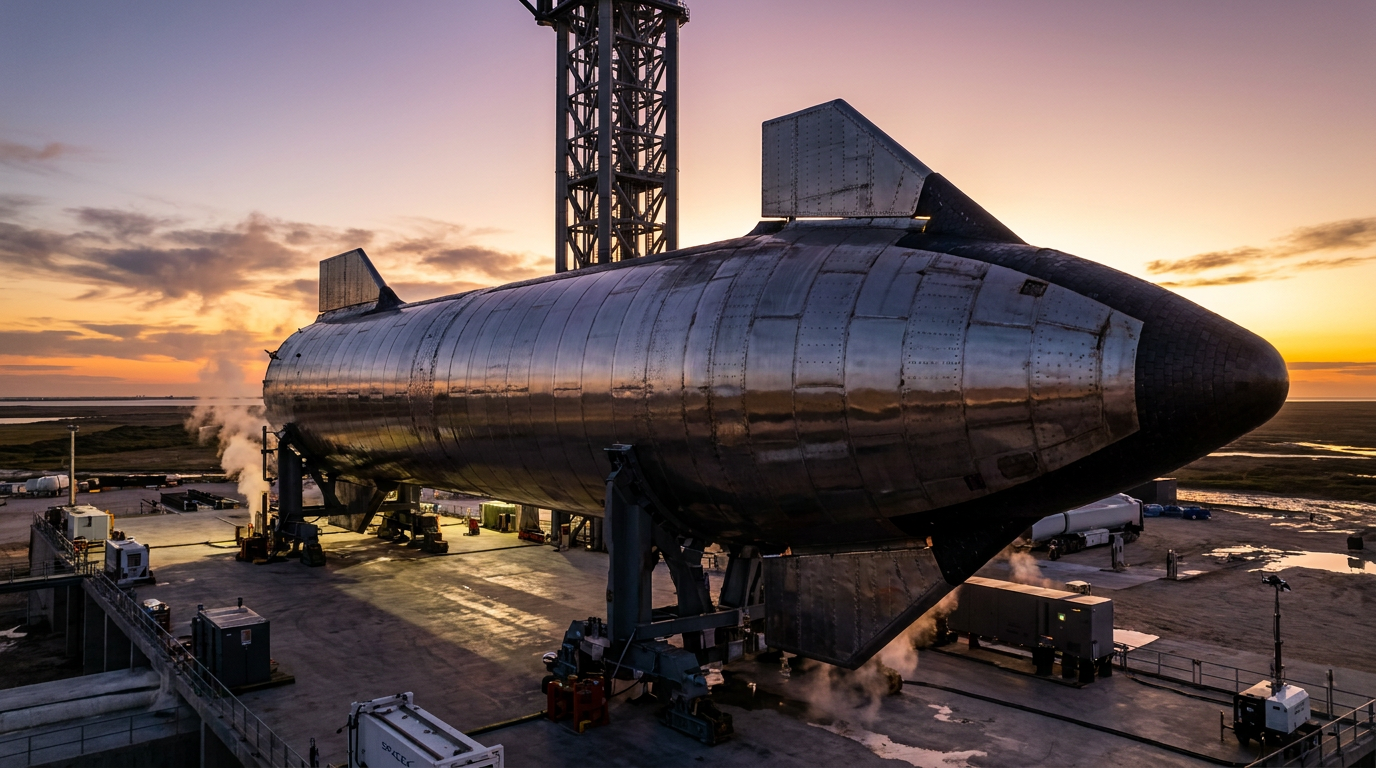
However, the $85.7 billion is not destined for a corporate treasury to sit idle. The S-1 filing outlines a highly aggressive capital expenditure roadmap. The primary beneficiary of this public capital is the Starship program, the fully reusable super-heavy lift launch vehicle designed to dramatically lower the cost of transporting mass to orbit and, eventually, to Mars. The funds will accelerate the construction of new launch pads and manufacturing facilities.[3][5]

Developing a multi-planetary transport system requires capital on a sovereign scale. Historically, projects of this magnitude—like the Apollo program or the International Space Station—were funded exclusively by the tax bases of global superpowers. By raising $85.7 billion in the public markets, SpaceX has effectively privatized the funding mechanism for interplanetary infrastructure, shifting the burden from taxpayers to willing investors.[5]
Developing a multi-planetary transport system requires capital on a sovereign scale.
The mechanics of the Nasdaq debut itself were a stress test for modern financial infrastructure. Handling the opening cross—the complex algorithmic process where buy and sell orders are matched to determine the official opening price—required Nasdaq to allocate dedicated server clusters to prevent system latency and ensure fair price discovery.[4]
On a typical IPO day, the opening cross takes a few minutes. For SpaceX, the order imbalance was so massive, driven by both institutional rebalancing and unprecedented retail enthusiasm, that the price discovery phase took over an hour. When the stock finally began trading, the volume immediately made it the most heavily traded asset on global exchanges, testing the limits of high-frequency trading networks.[1][4]
Retail investors, who have long clamored for a piece of the space pioneer, played a crucial role in the secondary market action. While institutional investors secured the bulk of the initial allocation, retail brokerages reported record-breaking buy orders the moment the stock became available to the general public. This democratization of access is a key feature of the public transition, allowing everyday portfolios to participate in the space economy.[2]
The evidence supporting SpaceX's valuation rests on its near-total dominance of the global launch market. The company currently delivers over 80% of all payload mass to orbit globally. Its Falcon 9 rocket has achieved a cadence of reusability that legacy aerospace competitors have completely failed to match, creating an economic moat that analysts describe as practically insurmountable in the near term.[2][5]

Furthermore, the integration of Starlink creates a vertically integrated ecosystem. SpaceX manufactures the satellites, launches them on its own reusable rockets, and sells the broadband service directly to consumers, enterprises, and governments. This closed-loop economic model insulates the company from third-party supply chain shocks and margin compression that plague traditional aerospace contractors.[3]
Yet, an explainer of this magnitude must also weigh the inherent uncertainties. Deep-tech investing carries risks that software companies do not. The physics of spaceflight are unforgiving, and a catastrophic failure of a crewed Starship mission could trigger severe regulatory crackdowns, freeze the company's launch cadence, and severely impact the newly minted stock price.[5]
Regulatory friction remains a significant variable. The Federal Aviation Administration and environmental agencies maintain strict oversight over launch licenses and the ecological impact of the company's massive Boca Chica facility. Public companies face a level of scrutiny and mandatory disclosure regarding these regulatory battles that private companies can often shield from public view.[3][5]
There is also the question of capital efficiency. While $85.7 billion is a historic war chest, the true cost of establishing a self-sustaining city on Mars—the company's stated ultimate goal—is entirely unknown. Skeptics argue that public market investors, who typically demand quarterly earnings growth, may eventually clash with a management team focused on multi-decade, multi-planetary timelines.[2][5]

Despite these uncertainties, the successful execution of this mega-IPO marks a paradigm shift. It proves that public markets are capable of, and willing to, fund hardware-heavy, long-horizon technological leaps. It provides a blueprint for other deep-tech unicorns in artificial intelligence, nuclear fusion, and quantum computing to access public capital without compromising their ambitious roadmaps.[1][5]
Ultimately, the mechanics of the SpaceX IPO represent more than just a financial transaction. By successfully raising $85.7 billion, the company has tethered the financial portfolios of millions of everyday investors to the future of space exploration. The success or failure of humanity's expansion into the cosmos is now, quite literally, a matter of public interest.[5]
How we got here
2002
SpaceX is founded with the long-term goal of reducing space transportation costs to enable the colonization of Mars.
2019
The first operational Starlink satellites are launched, beginning the creation of the global broadband constellation.
2024
Starship achieves consistent orbital insertion and payload delivery, proving the viability of the super-heavy lift architecture.
June 2026
SpaceX debuts on the Nasdaq, raising a record-breaking $85.7 billion in public capital.
Viewpoints in depth
Institutional Underwriters
Focused on the unprecedented scale of demand and the mechanics of pricing the offering.
For the investment banks managing the syndicate, the SpaceX IPO was an exercise in managing historic scarcity. Despite the massive $85.7 billion float, the book-building process revealed that sovereign wealth funds and major pension systems were willing to absorb the entire offering themselves. Underwriters had to carefully balance allocations to ensure a stable aftermarket, pricing the stock to reflect its near-monopoly in launch services while leaving enough upside to prevent a day-one selloff.
Retail Investors
View the IPO as the democratization of the space economy.
For over two decades, the financial upside of the commercial space revolution was locked behind private venture capital gates, accessible only to accredited investors and massive funds. Retail advocates view this IPO as a landmark moment of democratization. By listing on the Nasdaq, everyday investors can now directly allocate capital to, and potentially profit from, humanity's expansion into low-Earth orbit and beyond.
Space Economy Analysts
Analyze the impact of public market scrutiny on deep-tech innovation.
Industry analysts note that while the capital injection is transformative, it introduces a new friction: the quarterly earnings cycle. Public markets are notoriously impatient, often punishing companies for heavy capital expenditures that drag down short-term margins. Analysts are closely watching how SpaceX management will balance the fiduciary duty to deliver shareholder returns with the inherently unpredictable, multi-decade timeline of developing a self-sustaining Martian colony.
What we don't know
- How public market investors will react to the inevitable delays and hardware failures inherent in experimental spaceflight.
- The exact timeline for when the Starship program will become cash-flow positive.
- How increased regulatory scrutiny as a public company will impact the speed of operations at the Boca Chica launch facility.
Key terms
- Initial Public Offering (IPO)
- The process by which a private company offers shares to the public in a new stock issuance, allowing it to raise capital from public investors.
- Book-Building
- The process by which underwriters attempt to determine the price at which an IPO will be offered by assessing demand from institutional investors.
- Opening Cross
- The algorithmic process used by exchanges like Nasdaq to match buy and sell orders and establish the official opening price of a newly listed stock.
- Form S-1
- The initial registration form required by the SEC for U.S. companies that want to be listed on a national exchange, detailing their business model and financials.
- Capital Expenditure (CapEx)
- Funds used by a company to acquire, upgrade, and maintain physical assets such as property, industrial buildings, or equipment.
Frequently asked
How much did SpaceX raise in its IPO?
SpaceX raised $85.7 billion, making it the largest initial public offering in global financial history.
What was the previous record for an IPO?
The previous record was held by Saudi Aramco, which raised $29.4 billion in 2019.
What will SpaceX do with the $85.7 billion?
The capital is primarily earmarked for aggressive capital expenditures, specifically accelerating the development and manufacturing of the Starship launch vehicle and expanding the Starlink satellite network.
Can everyday investors buy SpaceX stock now?
Yes. Following the completion of the IPO and the opening cross on the Nasdaq, retail investors can purchase shares through standard brokerage accounts.
Sources
Source coverage
5 outlets
3 viewpoints surfaced





[1]CNBCDeep-Tech Growth Investors
SpaceX shatters records with $85.7 billion Nasdaq IPO
Read on CNBC →[2]BloombergDeep-Tech Growth Investors
Inside the SpaceX IPO: How the space venture priced its historic debut
Read on Bloomberg →[3]SECMarket Infrastructure Analysts
Space Exploration Technologies Corp. Form S-1 Registration Statement
Read on SEC →[4]NasdaqMarket Infrastructure Analysts
The Mechanics of a Mega-Listing: Handling the SpaceX Debut
Read on Nasdaq →[5]Factlen Editorial TeamLong-Horizon Strategists
Synthesis by Factlen editorial team
Read on Factlen Editorial Team →
Every angle. Every day.
Get finance stories with full source coverage and perspective breakdowns delivered to your inbox.