
DOJ and FTC Intensify Multi-Front Antitrust War on Big Tech's AI Ecosystems
Federal regulators have escalated their scrutiny of the generative AI stack, targeting Nvidia's chip dominance and Microsoft's startup investments in a coordinated effort to prevent market monopolization.
By Factlen Editorial Team
- Antitrust Enforcers
- Argue that preemptive intervention is necessary to stop tech giants from monopolizing the AI ecosystem.
- Tech Incumbents
- Argue that their market positions are earned through massive risk-taking and superior engineering, not anticompetitive behavior.
- National Security Advocates
- Warn that aggressive domestic antitrust enforcement could cede global AI leadership to geopolitical rivals.
- Open-Source Champions
- Believe regulatory intervention is necessary to prevent data moats, but fear overregulation could crush open-source innovation.
What's not represented
- · Startup Founders
- · Enterprise AI Customers
Why this matters
The outcome of these investigations will determine how the foundational technology of the next decade is built, priced, and distributed. If regulators succeed, it could force a more open, fragmented AI market; if they fail, a handful of tech giants will likely control the infrastructure of the entire AI economy.
Key points
- The DOJ and FTC have launched a coordinated antitrust offensive against the entire generative AI stack.
- The DOJ is investigating Nvidia's 80% market share in AI chips and its proprietary CUDA software ecosystem.
- The FTC is scrutinizing Microsoft's $13 billion OpenAI investment and its 'de facto' acquisition of Inflection AI.
- Regulators fear dominant tech firms are using their scale to create insurmountable data and compute moats.
- Critics warn that aggressive antitrust enforcement could undermine US national security and the CHIPS Act.
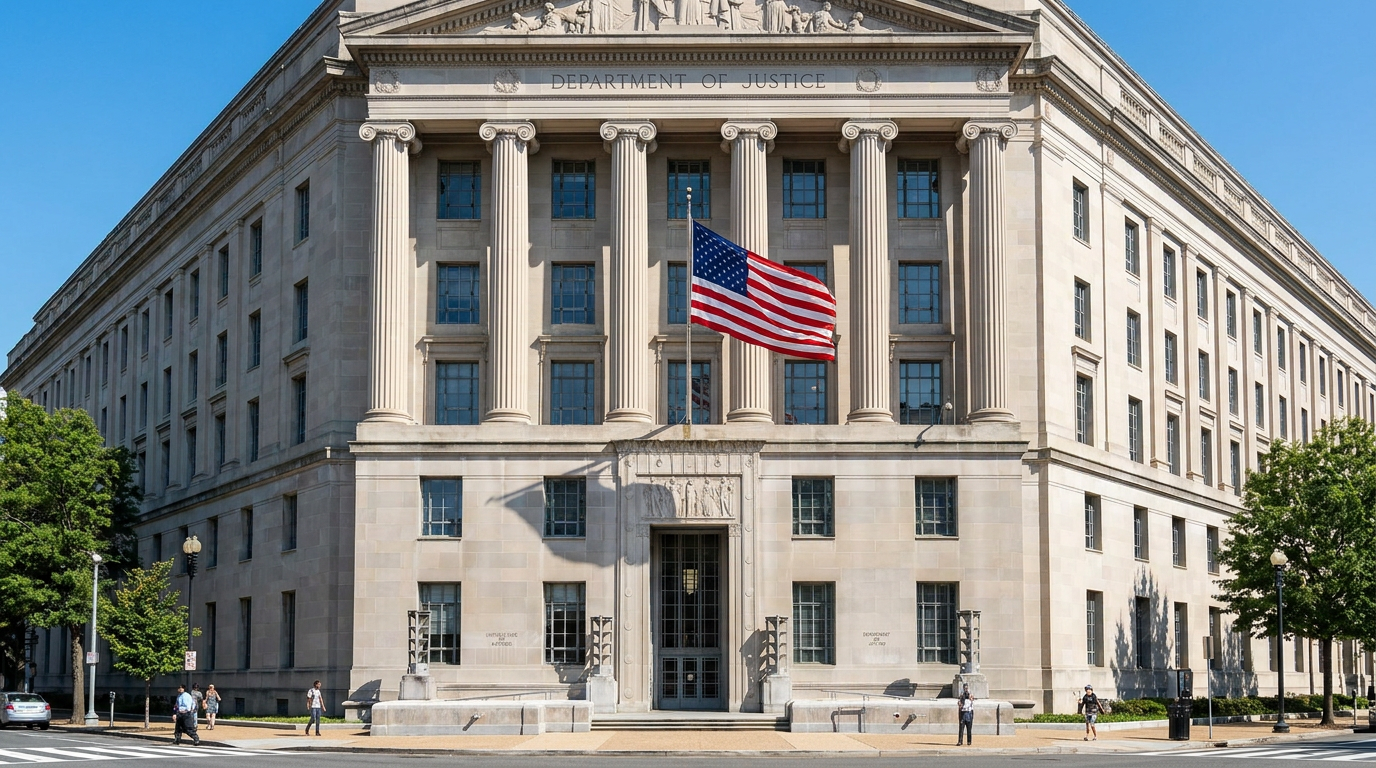
The United States government has officially turned its antitrust cannons toward the artificial intelligence boom. In a coordinated, multi-front offensive, the Department of Justice (DOJ) and the Federal Trade Commission (FTC) are aggressively targeting the "GenAI stack"—the vertical layers of hardware, models, and software that power the modern AI economy. Rather than waiting for the market to consolidate, federal regulators are attempting to preemptively dismantle what they view as emerging monopolies. The agencies have formally divided the battlefield to tackle the industry's most powerful players simultaneously. The DOJ is spearheading the probe into Nvidia, the undisputed king of AI silicon, while the FTC has trained its sights on Microsoft and its deep financial entanglements with OpenAI and other prominent startups.[1][5][6][7]
For antitrust enforcers, the mission is explicitly preventative. Regulators widely acknowledge that they missed the boat during the rise of social media and Web 2.0, allowing a handful of tech giants to consolidate unchecked power over digital advertising and communications. Now, DOJ antitrust chief Jonathan Kanter and FTC Chair Lina Khan are determined to prevent the same monopolistic "choke points" from forming in the artificial intelligence era. They argue that the sheer scale of capital and compute required to train foundational models naturally favors incumbents, making aggressive intervention necessary to protect future innovation.[4][8]
The DOJ's primary target is the physical infrastructure layer, specifically Nvidia's stranglehold on the market for advanced graphics processing units (GPUs). Nvidia currently controls an estimated 80% of the market for the specialized chips required to train large language models. The DOJ's investigation, which escalated with legally binding subpoenas, centers on how Nvidia allegedly wields this immense market power over its customers. Competitors and cloud providers have reportedly complained that Nvidia uses a carrot-and-stick approach to lock in buyers and punish those who explore alternatives.[1][2]

Specifically, the DOJ is examining whether the chipmaker charges higher prices for its essential data-center networking equipment if customers dare to purchase rival AI accelerators from competitors like AMD or Intel. Beyond the hardware itself, regulators are heavily scrutinizing Nvidia's proprietary CUDA software platform, which developers use to communicate with the GPUs. Because CUDA is deeply entrenched in the AI development ecosystem, critics argue it creates an artificial barrier to entry, making it prohibitively expensive and complex for developers to rewrite their code for competing silicon. The DOJ is also reviewing Nvidia's acquisition of Run:AI, a workload management software firm, to determine if it further entrenches this ecosystem lock-in.[2][8]
While the DOJ tackles the silicon, the FTC is dismantling the complex web of investments that tie Big Tech to the hottest AI software startups. Microsoft's $13 billion investment in OpenAI, which provides the massive computing power required for ChatGPT, is the crown jewel of this inquiry. The FTC is investigating whether these exclusive cloud-computing partnerships amount to de facto acquisitions that circumvent traditional merger review processes. By acting as the exclusive infrastructure provider, regulators fear Microsoft could exert undue influence over OpenAI's strategic direction without ever formally acquiring the company.[1][5][8]
The FTC is particularly focused on a novel corporate maneuver known as the "reverse acqui-hire." In early 2024, Microsoft hired the CEO and nearly the entire staff of the AI startup Inflection AI, while simultaneously paying the hollowed-out company a $650 million licensing fee. Regulators view the Inflection deal as a blatant attempt to bypass the Hart-Scott-Rodino Act, which requires companies to report mergers and acquisitions over $119.5 million for antitrust review. By licensing the technology and hiring the human talent without formally buying the corporate entity, Microsoft allegedly achieved the benefits of an acquisition while avoiding regulatory friction.[3][7]

The FTC is also investigating the broader strategic playbook of AI incumbents, particularly the "open first, closed later" trap. Regulators have expressed deep concern over strategies where firms release open-source models to attract developers, build a user base, and accrue massive data advantages, only to later close access and lock users into proprietary, paid ecosystems. This practice, enforcers argue, may severely undermine long-term competition by creating insurmountable data-driven moats while superficially appearing pro-competitive in the short term. The fear is that once developers are locked into a specific ecosystem, the switching costs become too high to support emerging rivals.[6][8]
The FTC is also investigating the broader strategic playbook of AI incumbents, particularly the "open first, closed later" trap.
Another emerging theory of harm focuses on the data used to train these models. Enforcers are exploring whether dominant AI companies are exercising "monopsony power"—acting as a dominant buyer—over the creators, publishers, and internet users whose content is scraped to build generative models. By controlling the primary platforms that ingest the world's data, these tech giants could effectively dictate terms to content creators, extracting immense value without providing fair compensation or viable alternatives. DOJ officials have publicly warned that AI carries the potential to create dominant companies that can exploit monopsony power at unprecedented levels, effectively becoming the sole buyer for all of the world's ideas.[4]
Beyond structural market dominance, the DOJ is also investigating the behavioral impacts of AI on broader economic competition, specifically through algorithmic pricing. Enforcers are concerned that as more industries adopt AI-driven pricing software, it could facilitate tacit collusion among competitors. If multiple companies in a sector—such as rental housing or retail—use AI tools trained on similar data or provided by the same vendor, their pricing might become implicitly coordinated without any explicit backroom agreement. This AI-driven price matching could artificially inflate costs for consumers, creating a new frontier of antitrust violations that existing laws were not designed to catch.[8]

The companies under fire vehemently deny the allegations. Nvidia maintains that its market dominance is the result of decades of visionary investment and superior engineering, arguing that it wins customers purely on merit, not coercion. The company points out that it took massive financial risks to develop AI-specific architecture long before the current generative AI boom materialized. Microsoft similarly defends its startup partnerships as vital injections of capital that accelerate innovation rather than stifle it, noting that training foundational models requires billions of dollars in compute infrastructure that only a few companies can provide. They argue that the AI market remains highly dynamic, with open-source alternatives constantly challenging proprietary models.[2][3]
The antitrust crusade has also sparked a fierce debate in Washington over national security and global competitiveness. Critics argue that aggressively hamstringing American tech champions like Nvidia and Microsoft could inadvertently cede the global AI race to geopolitical rivals, particularly China. In a technology sector where scale dictates capability, breaking up domestic ecosystems or forcing mandatory interoperability might weaken the very companies the US relies on to maintain its technological supremacy. This tension places antitrust enforcers at odds with defense and intelligence agencies, who view AI leadership as a critical national security imperative.[8]
This geopolitical lens highlights a glaring contradiction in US industrial policy. While the DOJ attempts to break Nvidia's grip on the market, the Commerce Department is simultaneously pouring billions of dollars into the domestic semiconductor industry through the CHIPS and Science Act to ensure American dominance in the exact same sector. Lawmakers have authorized massive subsidies to build domestic fabrication plants and secure the hardware supply chain, yet the government's top lawyers are simultaneously prosecuting the crown jewel of that supply chain for being too successful. Industry advocates argue that this disjointed approach creates regulatory uncertainty that could chill future investment.[8]

The outcome of this multi-front war remains highly uncertain. The DOJ and FTC are testing novel legal theories that stretch traditional antitrust frameworks, which have historically focused on immediate consumer price harm rather than innovation bottlenecks, monopsony power, or ecosystem lock-in. Proving that a company like Microsoft illegally bypassed merger rules through a licensing agreement, or that Nvidia's software ecosystem constitutes an illegal monopoly, will require convincing federal judges to adopt a much broader interpretation of antitrust law than they have in recent decades.[7][8]
Whether the federal courts will accept these new definitions of market foreclosure is the defining legal question of the decade for the technology sector. The agencies are preparing for protracted legal battles that will likely take years to resolve, outlasting current political administrations. Regardless of the final verdicts, the era of unchecked, frictionless expansion for Big Tech in the artificial intelligence space is officially over. Companies must now navigate a landscape where every investment, API change, and hardware bundle is scrutinized for its impact on the broader GenAI ecosystem.[5]
How we got here
January 2024
The FTC orders major AI players, including Microsoft and OpenAI, to provide detailed information on their investments and partnerships.
March 2024
Microsoft hires the core team of Inflection AI and pays a $650 million licensing fee, sparking intense FTC scrutiny over 'de facto' acquisitions.
June 2024
The DOJ and FTC reach a formal agreement to divide antitrust oversight of the AI industry, with the DOJ taking Nvidia and the FTC taking Microsoft/OpenAI.
September 2024
The DOJ escalates its probe by issuing legally binding subpoenas to Nvidia regarding its pricing, supply strategies, and software lock-in.
Mid-2026
The parallel investigations mature into a multi-front regulatory war, testing novel antitrust theories against the entire generative AI stack.
Viewpoints in depth
Antitrust Enforcers' view
Argues that preemptive intervention is necessary to stop tech giants from monopolizing the AI ecosystem.
This camp, led by DOJ and FTC leadership, believes that the massive capital and compute requirements of generative AI naturally favor incumbents. They argue that without aggressive antitrust enforcement, companies like Microsoft and Nvidia will use their existing dominance in cloud computing and hardware to lock up the future of AI. They point to 'de facto' acquisitions and software lock-ins as evidence that Big Tech is actively working to choke off emerging competitors before they can reach scale.
Tech Incumbents' view
Argues that their market positions are earned through massive risk-taking and superior engineering, not anticompetitive behavior.
The dominant tech firms contend that the AI market is incredibly dynamic and fiercely competitive. Nvidia argues its 80% market share is the reward for investing billions in AI architecture years before the current boom, while Microsoft defends its startup partnerships as necessary capital injections that enable, rather than stifle, innovation. They warn that punishing success will chill the massive investments required to push the boundaries of artificial intelligence.
National Security Advocates' view
Warns that aggressive domestic antitrust enforcement could cede global AI leadership to geopolitical rivals.
This perspective highlights the strategic rivalry between the United States and China. Advocates argue that AI is a critical national security technology where scale directly translates to capability. They view the DOJ and FTC's actions as dangerously disjointed from broader US industrial policy, noting the contradiction of subsidizing the semiconductor industry through the CHIPS Act while simultaneously suing its most successful domestic champion.
What we don't know
- Whether federal courts will accept novel antitrust theories regarding 'de facto' acquisitions and ecosystem lock-in.
- How the investigations will impact the pace of AI innovation and startup funding in the near term.
- Whether the DOJ will ultimately seek to break up Nvidia or simply mandate software interoperability.
Key terms
- GenAI Stack
- The vertical layers of artificial intelligence infrastructure, ranging from hardware (GPUs) and cloud computing to foundational models and end-user applications.
- Monopsony Power
- A market condition where there is only one dominant buyer, allowing them to dictate terms to suppliers—in this case, AI companies dictating terms to the creators whose data they scrape.
- Hart-Scott-Rodino Act
- A US law requiring companies to report large mergers and acquisitions (currently those over $119.5 million) to the FTC and DOJ for antitrust review before completing the deal.
- Tacit Collusion
- When competing companies implicitly coordinate their pricing or business strategies without direct communication, a risk regulators fear will increase with shared AI pricing algorithms.
Frequently asked
Why are the DOJ and FTC splitting the AI investigations?
The AI market is so large and complex that the agencies agreed to divide the workload. The DOJ is focusing on hardware and silicon (Nvidia), while the FTC is focusing on software, models, and investments (Microsoft and OpenAI).
What is a 'reverse acqui-hire' or 'de facto acquisition'?
It is a maneuver where a large company hires a startup's core team and licenses its technology without formally buying the corporate entity. Regulators allege this is done to bypass the $119.5 million threshold that triggers mandatory antitrust review.
Why is Nvidia's CUDA software under investigation?
CUDA is Nvidia's proprietary software platform used by developers to communicate with its GPUs. Because it is deeply entrenched in the industry, critics argue it creates an artificial barrier to entry, making it too expensive for developers to switch to rival chips from AMD or Intel.
How does algorithmic pricing relate to AI antitrust?
Regulators are concerned that if multiple companies in an industry use the same AI pricing software, it could lead to implicit price coordination (tacit collusion) without explicit backroom agreements, artificially inflating costs for consumers.
Sources
Source coverage
8 outlets
4 viewpoints surfaced








[1]The New York TimesAntitrust Enforcers
U.S. Clears Way for Antitrust Inquiries of Nvidia, Microsoft and OpenAI
Read on The New York Times →[2]BloombergTech Incumbents
DOJ Antitrust Division Subpoenas AI Chip Leader Nvidia
Read on Bloomberg →[3]The Wall Street JournalTech Incumbents
FTC Probes Microsoft's Deal With Inflection AI
Read on The Wall Street Journal →[4]Financial TimesAntitrust Enforcers
DOJ antitrust chief warns of AI monopoly 'choke points'
Read on Financial Times →[5]The Associated PressOpen-Source Champions
US antitrust enforcers to investigate leading AI companies Microsoft, Nvidia and OpenAI
Read on The Associated Press →[6]PoliticoAntitrust Enforcers
FTC and DOJ strike deal to divide AI antitrust probes
Read on Politico →[7]The GuardianOpen-Source Champions
DoJ and FTC poised to launch antitrust investigations into leading AI companies
Read on The Guardian →[8]George Mason University Law ReviewNational Security Advocates
Privacy and Antitrust at the Crossroads of Big Tech
Read on George Mason University Law Review →


Every angle. Every day.
Get business stories with full source coverage and perspective breakdowns delivered to your inbox.