
How China's Unprecedented Factory Robotics Boom is Rewiring Global Manufacturing
China is now installing more industrial robots annually than the rest of the world combined, fundamentally altering how goods are made. This rapid automation drive is reshaping global supply chains and pushing rival nations to accelerate their own advanced manufacturing capabilities.
By Factlen Editorial Team
- Industrial Economists
- Argue that rapid automation is a necessary and positive response to demographic decline and rising wages.
- Supply Chain Strategists
- View robotics as the critical enabler for nearshoring and building resilient, localized manufacturing networks.
- Labor Market Analysts
- Focus on the urgent need for workforce upskilling as manual roles vanish and technical maintenance roles surge.
What's not represented
- · Small-to-medium enterprise (SME) manufacturers
- · Displaced manual laborers in developing nations
Why this matters
The global economy is shifting from a model based on cheap human labor to one based on capital-intensive automation. This transition dictates where future factories will be built, what skills workers will need to secure high-paying jobs, and how resilient our supply chains will be during the next global crisis.
Key points
- China is currently installing more industrial robots annually than the rest of the world combined.
- The automation push is largely driven by a shrinking working-age population and rising manufacturing wages.
- Modern robots use AI and machine vision to adapt to new tasks quickly, making factories highly flexible.
- Western nations are subsidizing domestic automation to build resilient supply chains closer to home.
- The manufacturing workforce is shifting from manual assembly to technical roles focused on robot maintenance.
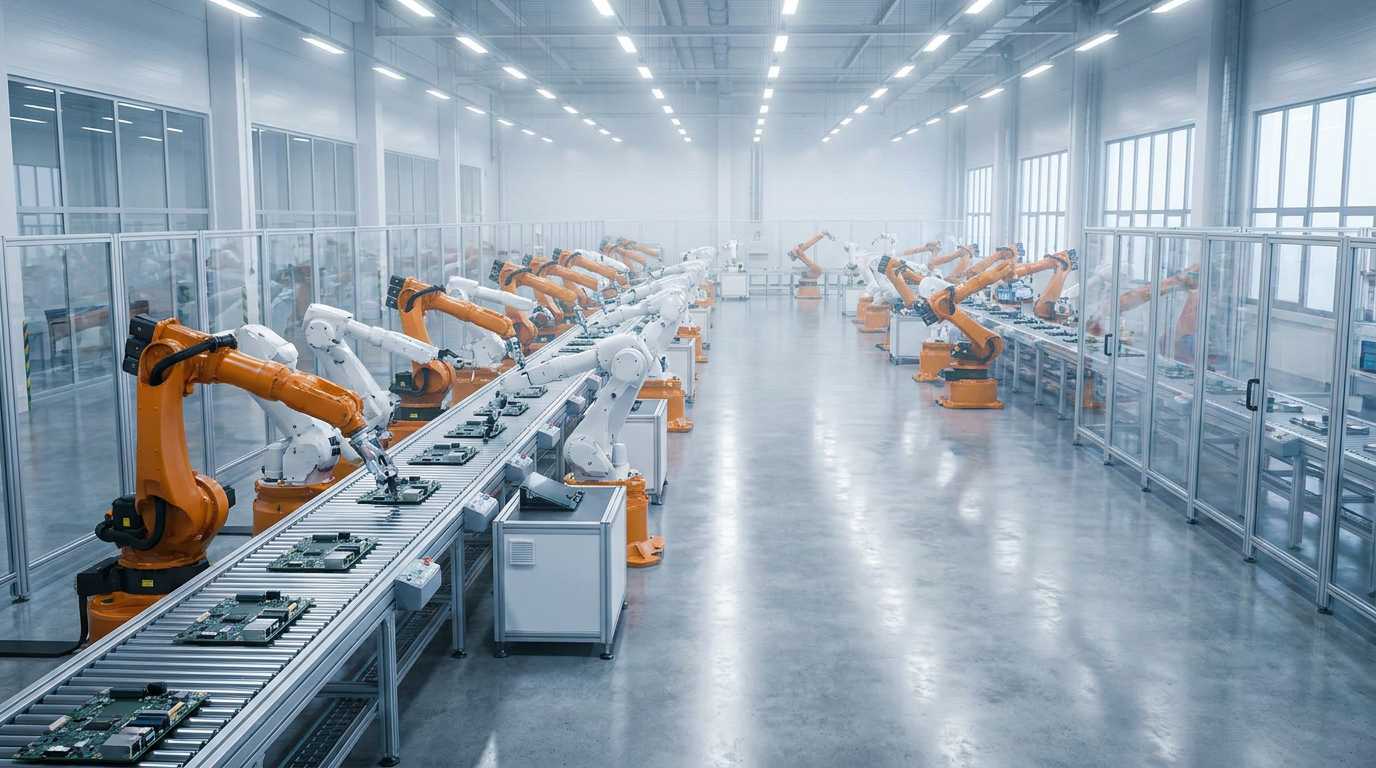
The factory floor of 2026 sounds fundamentally different than it did a decade ago. The rhythmic clanking of manual assembly and the shout of floor managers have been increasingly replaced by the high-pitched whir of servo motors and the silent, invisible processing of machine vision systems. At the center of this transformation is China, which has quietly crossed a historic threshold: it is now installing more industrial robots annually than the rest of the world combined.[1][6]
This milestone represents a profound rewiring of global manufacturing. For decades, the international supply chain relied on a simple geographic arbitrage: moving production to regions with the lowest labor costs. Today, the calculus has shifted from human headcount to robotic density, fundamentally altering how, where, and how quickly the world’s goods are produced.[2][6]
The catalyst for this unprecedented automation boom is largely demographic. China’s working-age population peaked in 2014 and has been declining since, while its manufacturing wages have steadily climbed. To maintain its position as the "world's factory" amidst these headwinds, the country had no choice but to automate at a blistering pace, replacing human hands with articulated steel arms.[3][6]

But these are not the rigid, single-task robots of the 1990s auto plants. The current generation of factory automation relies heavily on collaborative robots, or "cobots," equipped with advanced machine vision and spatial awareness. These systems can work safely alongside human technicians, adapting in real-time to variations in components rather than requiring perfectly uniform, pre-programmed environments.[2]
The integration of artificial intelligence has further accelerated this trend. Modern robotic arms can learn new tasks through demonstration and simulation, drastically reducing the time required to retool a production line. This flexibility allows factories to switch from producing electric vehicle components to consumer electronics in a matter of days rather than months, creating a highly agile industrial base.[1][2]
The International Federation of Robotics (IFR) tracks this shift through a metric called "robot density"—the number of operational industrial robots per 10,000 manufacturing employees. In just a few years, China has vaulted past traditional automation powerhouses like the United States and Germany, fundamentally changing the baseline for what constitutes a competitive industrial facility.[1]

This robotic divergence is driving a wedge into global supply chains. As Chinese factories achieve unprecedented economies of scale through automation, Western nations are realizing that traditional tariffs and trade barriers are insufficient to protect domestic manufacturing. The competition is no longer about cheap labor; it is about capital-intensive, highly automated production ecosystems.[3][4]
This robotic divergence is driving a wedge into global supply chains.
In response, the United States and the European Union have launched aggressive industrial policies aimed at subsidizing domestic automation. Initiatives like the US CHIPS and Science Act and various advanced manufacturing grants are designed to help Western companies offset the steep initial capital costs of deploying robotic assembly lines, attempting to level the playing field through technology.[4]
This dynamic is creating a "supply chain split." Rather than a single, highly integrated global network, multinational corporations are increasingly building parallel supply chains: one highly automated network based in Asia to serve Eastern markets, and a separate, increasingly automated network in North America or Europe to serve Western consumers.[3][6]
This "nearshoring" trend is entirely dependent on robotics. Bringing manufacturing back to high-wage countries like the US or Germany is economically unviable without massive automation. By deploying robots, Western factories can achieve cost parity with overseas production, trading higher capital expenditures for lower variable labor costs and significantly reduced shipping times.[4]
However, the transition is not without friction. The primary bottleneck in this global automation race is no longer the hardware, but the human talent required to deploy and maintain it. There is a severe global shortage of robotics engineers, system integrators, and maintenance technicians capable of keeping these complex, interconnected systems running smoothly.[2][5]

The labor impact is profound, but nuanced. While routine manual assembly jobs are undeniably disappearing, they are being replaced by roles that require technical literacy. The modern factory worker is less likely to hold a wrench and more likely to hold a tablet, diagnosing software faults, training AI models, and optimizing robotic workflows.[5][6]
Economists note that while automation displaces specific manual tasks, it often increases overall employment at the firm level by making the company more competitive and driving up demand for its products. The challenge lies in managing the transition for workers whose legacy skills are rendered obsolete by the new machinery.[5]

Looking ahead, the geopolitical implications of this robotics race will only intensify. The nations that control the intellectual property for advanced manufacturing—the precision servo motors, the machine vision algorithms, the robotic operating systems—will wield significant economic leverage in the coming decades.[3][4]
Ultimately, the story of this robotic boom is a preview of the global industrial future. The factory of tomorrow is a highly flexible, software-defined environment where physical goods are compiled almost like code. As this technology proliferates, the geographic distribution of global wealth and industrial power will be redrawn by those who can best orchestrate the machines.[6]
How we got here
2015
China launches its 'Made in China 2025' initiative, heavily subsidizing the domestic robotics industry.
2021
China officially surpasses the United States in industrial robot density for the first time.
2024
The integration of generative AI and advanced machine vision makes collaborative robots viable for complex, variable tasks.
2026
Data confirms China is installing more industrial robots annually than all other nations combined.
Viewpoints in depth
Industrial Economists
Argue that rapid automation is a necessary and positive response to demographic decline and rising wages.
From a macroeconomic perspective, the robotics boom is a triumph of adaptation. As populations age across East Asia and Europe, the traditional model of throwing cheap labor at manufacturing problems is mathematically broken. Economists view the aggressive deployment of industrial robots not as a job-killing menace, but as the only viable mechanism to maintain global productivity and prevent massive inflation in consumer goods. By increasing the output per worker, automation allows economies to grow even as their labor forces shrink.
Supply Chain Strategists
View robotics as the critical enabler for nearshoring and building resilient, localized manufacturing networks.
For supply chain experts, the robotics race is fundamentally about geopolitical resilience. The disruptions of the early 2020s proved that hyper-extended, single-point-of-failure supply chains are a massive liability. Strategists argue that the only way to successfully 'nearshore' production to high-wage countries in North America and Europe is through extreme automation. In this view, robots are the great equalizer, allowing Western factories to compete on price with overseas rivals by drastically reducing the labor cost per unit.
Labor Market Analysts
Focus on the urgent need for workforce upskilling as manual roles vanish and technical maintenance roles surge.
Labor experts acknowledge the productivity gains of automation but focus heavily on the friction of the human transition. They point out that while a highly automated factory might employ just as many people as a manual one, the required skill sets are entirely different. The demand for 'robot wranglers'—technicians who can code, troubleshoot, and maintain complex electromechanical systems—is vastly outstripping supply. Analysts argue that without massive investments in vocational training and technical education, the robotics boom will exacerbate inequality, leaving legacy manual laborers behind while highly paid technical roles go unfilled.
What we don't know
- Whether Western industrial subsidies will be enough to close the automation gap with Asia.
- How quickly small and medium-sized manufacturers will be able to afford advanced robotic systems.
- The long-term impact on developing nations that traditionally relied on cheap labor to industrialize.
Key terms
- Robot Density
- A metric used to measure the level of automation in a country, calculated as the number of operational industrial robots per 10,000 manufacturing employees.
- Collaborative Robot (Cobot)
- A robot designed to work safely alongside human workers in a shared workspace, often equipped with sensors that stop its movement if it bumps into a person.
- Machine Vision
- Technology that uses cameras and artificial intelligence to give robots the ability to 'see' and adapt to their environment, such as identifying parts on a conveyor belt.
- Nearshoring
- The business practice of moving manufacturing operations closer to the end consumer, often enabled by automation to offset higher local labor costs.
Frequently asked
Will robots take all manufacturing jobs?
No, but they are changing the nature of the work. Routine manual assembly jobs are declining, while demand for technicians who can program, maintain, and troubleshoot robotic systems is skyrocketing.
Why is China automating so quickly?
China faces a shrinking working-age population and rising labor costs. To maintain its status as a global manufacturing hub, it must use automation to increase productivity per worker.
Can Western countries compete in this new landscape?
Yes, but it requires heavy capital investment. By heavily automating their own factories, Western nations can offset their higher labor costs and bring manufacturing closer to home (nearshoring).
Sources
Source coverage
6 outlets
3 viewpoints surfaced






[1]International Federation of RoboticsIndustrial Economists
World Robotics Report: Global Industrial Automation Trends
Read on International Federation of Robotics →[2]MIT Center for Advanced ManufacturingIndustrial Economists
The Shifting Economics of Global Robotic Density
Read on MIT Center for Advanced Manufacturing →[3]World Economic ForumSupply Chain Strategists
The Geopolitics of the Automated Supply Chain
Read on World Economic Forum →[4]Brookings InstitutionSupply Chain Strategists
Automation, Nearshoring, and the New Industrial Policy
Read on Brookings Institution →[5]National Bureau of Economic ResearchLabor Market Analysts
Labor Market Impacts of Advanced Robotics in Manufacturing
Read on National Bureau of Economic Research →[6]Factlen Editorial TeamLabor Market Analysts
Synthesis by Factlen editorial team
Read on Factlen Editorial Team →


Every angle. Every day.
Get technology stories with full source coverage and perspective breakdowns delivered to your inbox.