
How Public Libraries Are Transforming Into Frontline Mental Health and Homelessness Hubs
As the last remaining free indoor public spaces, libraries worldwide are embedding full-time social workers to connect vulnerable patrons with housing and mental health resources.
By Factlen Editorial Team
- Whole-Person Librarianship Advocates
- Argue that libraries must adapt to serve the comprehensive needs of their patrons, integrating social services directly into the stacks.
- Municipal Health Officials
- View libraries as highly effective, non-stigmatizing access points to reach vulnerable populations who actively avoid traditional clinics.
- Frontline Library Workers
- Emphasize the need for professional social work support to alleviate the severe burnout and trauma experienced by librarians acting as de facto first responders.
- Community Traditionalists
- Express concern over mission creep, arguing that libraries should remain focused on information services rather than becoming de facto homeless shelters.
What's not represented
- · Unaccompanied minors using libraries as after-school safe havens
- · City budget directors balancing municipal resources
Why this matters
As traditional social safety nets shrink, public libraries have become the de facto waiting rooms for society's most vulnerable. Understanding this shift explains why local library budgets are increasingly tied to public health outcomes, and how communities are finding compassionate, cost-effective ways to address the homelessness crisis.
Key points
- Public libraries have become the primary indoor refuge for individuals experiencing homelessness and mental health crises.
- To prevent librarian burnout, municipalities are hiring full-time social workers to operate directly inside library branches.
- Social workers provide direct patron assistance, train library staff in de-escalation, and coordinate with city health departments.
- The model, pioneered in San Francisco in 2009, is now expanding globally as a highly effective, non-stigmatizing public health intervention.
The modern public library is undergoing a quiet but profound transformation. Long revered as quiet repositories for books, libraries have increasingly become the last remaining free, indoor "third spaces" in modern cities. As other social safety nets have frayed and digital paywalls have expanded, individuals experiencing homelessness, mental health crises, and extreme poverty have naturally gravitated toward these welcoming, climate-controlled environments.[3][5]
For years, this demographic shift placed an immense, unintended burden on frontline librarians. Staff members trained in information science suddenly found themselves acting as de facto first responders—mediating disputes, navigating behavioral crises, and trying to help patrons who had nowhere else to go. The resulting emotional dissonance and burnout forced library systems to rethink their operational models. Rather than calling security or banning vulnerable patrons, a growing number of municipalities are embracing a radically different approach: hiring full-time, licensed social workers.[2][3][7]
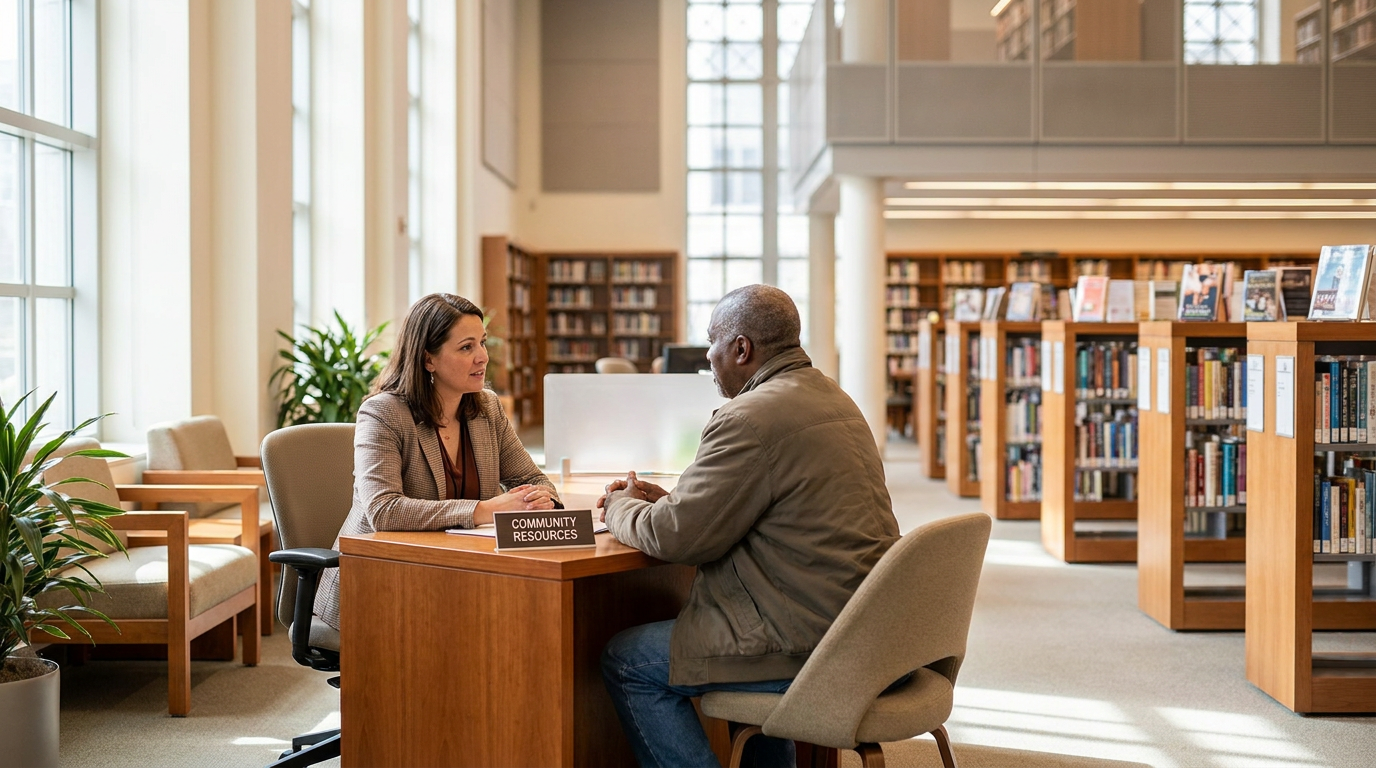
The movement, often referred to as "whole person librarianship," recognizes that a patron cannot focus on literacy or job applications if they are in the midst of a mental health crisis or freezing on the street. By embedding social workers directly into the stacks, libraries are transforming from passive reading rooms into proactive, frontline public health hubs that meet vulnerable citizens exactly where they are.[1][5][7]

The blueprint for this model was drawn in 2009 by the San Francisco Public Library (SFPL). Recognizing that up to 15 percent of its daily visitors were unhoused, the library partnered with the city's Department of Public Health to hire Leah Esguerra, the nation's first library-based psychiatric social worker. Instead of treating the unhoused population as a nuisance, Esguerra and her team approached the library as a sanctuary where people could be reached on neutral, safe territory.[6][8]
The results in San Francisco proved the concept's viability. Through library-based interventions, the SFPL outreach team has successfully placed over 150 chronically homeless individuals into permanent housing and connected hundreds more with dedicated mental health and addiction services. Today, more than 55 library systems across the United States—from Denver to Houston to Brooklyn—have followed suit, integrating social workers into their permanent staff.[2][5][6]
The mechanics of library social work operate on three distinct levels. At the "micro" level, social workers provide direct, immediate assistance to patrons. This ranges from helping individuals navigate complex government benefit applications like SNAP and Medicaid, to conducting clinical assessments and coordinating emergency shelter placements. Because the library is a non-stigmatizing environment, social workers can build trust with individuals who actively avoid traditional, clinical government offices.[1][4][5]

The mechanics of library social work operate on three distinct levels.
At the "mezzo" level, these professionals provide critical support to the library staff itself. Social workers lead training sessions in Mental Health First Aid, equipping librarians with evidence-based techniques to recognize signs of distress, de-escalate conflicts, and establish healthy professional boundaries. This internal support is vital for reducing the secondary trauma and emotional exhaustion that has increasingly plagued the library profession.[3][7]
Finally, at the "macro" level, library social workers act as systemic data gatherers and community liaisons. Because libraries see the daily, ground-level reality of a city's social crises, embedded social workers can identify systemic bottlenecks—such as a new documentation rule that is causing families to be denied shelter—and advocate for policy changes with municipal health departments.[5]
To bridge the gap between clinical staff and wary patrons, many programs employ "peer navigators" or health and safety associates. These are often individuals who have lived experience with homelessness or the shelter system. By patrolling the reading rooms and restrooms, these peers use their own stories to build empathy and connect with patrons who might distrust formal authority figures, ensuring that the library remains safe and functional for everyone.[6][8]

The success of the model is now driving international adoption. During a four-month period in 2020, a social worker embedded at the Melbourne City Library in Australia conducted over 640 patron interactions and successfully housed 17 people. Crucially, data from the Melbourne program revealed that 80 percent of the individuals assisted had no prior connection to formal support services, underscoring the library's unique power as an access point for the hardest-to-reach populations.[4]
Despite its successes, the integration of social services into libraries is not without friction. Traditionalists and some community members argue that libraries are experiencing "mission creep," expressing concerns that the presence of individuals in acute crisis disrupts the environment for children and other patrons. Balancing the library's role as a democratic sanctuary for all with the need to maintain a quiet, clean space for study remains an ongoing, delicate negotiation for branch managers.[3][6]

Sustainability also remains a hurdle. Many library social work programs were initially launched using temporary grants, leaving them vulnerable to budget cuts. However, the tide is beginning to turn as city governments recognize the cost-saving preventative power of these programs. In New York City, for example, the proposed 2027 executive budget includes $31.7 million in permanent baseline funding to stabilize library operations, acknowledging the indispensable, multi-faceted role these institutions now play in the urban safety net.[1][3]
Ultimately, the presence of social workers in the stacks represents a profound acknowledgment of what the public library has become. It is no longer just a place to check out a book; it is a vital piece of civic infrastructure that catches those who fall through the cracks. By meeting people exactly where they are, libraries are proving that compassion and community care are just as essential to a democratic society as free access to information.[4][8]
How we got here
2009
San Francisco Public Library hires the nation's first full-time library psychiatric social worker.
2014
Richland Library in South Carolina hires social workers to help patrons navigate the newly launched Affordable Care Act.
2020
The COVID-19 pandemic accelerates the trend as libraries become critical lifelines during widespread economic and social disruption.
2026
Major municipalities begin shifting library social work programs from temporary grants to permanent baseline city funding.
Viewpoints in depth
Frontline Library Staff
Librarians emphasize that they are trained in information science, not crisis intervention.
For years, library staff have absorbed the brunt of failing social safety nets, acting as de facto first responders for overdoses, mental health breakdowns, and housing crises. Frontline workers argue that without embedded social workers, they face severe emotional dissonance and burnout. They view social workers not as a luxury, but as an essential operational requirement that allows librarians to safely return to their core mission of literacy and community programming.
Public Health Advocates
Health officials view libraries as high-leverage environments for reaching the most isolated populations.
Public health experts point out that traditional government service centers are often highly stigmatized, causing vulnerable individuals to avoid them entirely. Because libraries are universally trusted, democratic spaces, they serve as the perfect "soft entry" point for social services. Advocates argue that funding social workers in libraries is a highly cost-effective preventative measure that reduces the strain on emergency rooms and police departments.
Traditional Library Patrons
Some community members express concern over the changing atmosphere of public reading rooms.
A vocal contingent of traditional library users and neighborhood groups worry about "mission creep." They argue that while compassion is necessary, libraries are fundamentally designed for study, research, and children's programming. These critics frequently raise concerns about hygiene, safety, and disruptions, suggesting that city governments should build dedicated, well-funded daytime shelters rather than forcing libraries to absorb the homelessness crisis.
What we don't know
- Whether smaller, rural library systems with limited tax bases will be able to afford full-time social workers.
- How the role of library social workers will evolve if municipal homelessness rates begin to decline.
Key terms
- Whole Person Librarianship
- A practice model that integrates social work concepts into library services to address patrons' comprehensive needs, from literacy to housing.
- Third Space
- A social environment separate from the home ("first place") and the workplace ("second place") that fosters community connection and offers safe refuge.
- Mental Health First Aid
- An evidence-based training program that teaches non-clinical professionals how to identify, understand, and respond to signs of mental distress.
- Peer Navigator
- An outreach worker, often with lived experience of homelessness or mental health challenges, who helps connect library patrons to social services.
Frequently asked
Why are libraries hiring social workers instead of security guards?
Social workers are trained to de-escalate mental health crises and connect patrons to long-term resources, addressing the root causes of disruptions rather than just temporarily removing individuals.
Do social workers replace librarians?
No. Social workers complement librarians by handling complex social service needs, allowing librarians to focus on information science, literacy, and community programming.
How are these library social work programs funded?
Historically, many started with temporary grants from foundations. However, an increasing number of cities are now writing these positions into their permanent municipal budgets as preventative public health measures.
Sources
Source coverage
8 outlets
4 viewpoints surfaced








[1]American Library AssociationWhole-Person Librarianship Advocates
Social Workers in Public Libraries
Read on American Library Association →[2]Route FiftyMunicipal Health Officials
Why more public libraries are adding social workers to their staffs
Read on Route Fifty →[3]Epicenter NYCFrontline Library Workers
Librarians shared what it takes to keep some of the last free indoor spaces in New York open
Read on Epicenter NYC →[4]International Federation of Library AssociationsWhole-Person Librarianship Advocates
Social Workers in Public Libraries: Creating Powerful Community Connections
Read on International Federation of Library Associations →[5]The Macro LensWhole-Person Librarianship Advocates
The Demographic Shift the Field Rarely Names
Read on The Macro Lens →[6]Business InsiderCommunity Traditionalists
San Francisco put a social worker for homeless people in the public library
Read on Business Insider →[7]National Institutes of HealthMunicipal Health Officials
Public Libraries' Response to Patrons Experiencing Homelessness and Mental Illness
Read on National Institutes of Health →[8]KALWCommunity Traditionalists
How San Francisco's public library became a model for homeless outreach
Read on KALW →
Every angle. Every day.
Get community stories with full source coverage and perspective breakdowns delivered to your inbox.