
Massive Deep-Sea Organism Discovery in Japan Trench 'Defies Modern Taxonomy'
An international deep-sea expedition has discovered a ghostly, slow-gliding organism nearly 10 kilometers below the surface that cannot be assigned to any known animal phylum. The breakthrough study also cataloged 108 distinct organism groups, establishing a vital new biological baseline for the ocean's deepest trenches.
By Factlen Editorial Team
- Taxonomists and Marine Biologists
- Focused on the biological mystery and the challenge of classifying an organism that breaks known taxonomic rules.
- Deep-Sea Technologists
- Emphasizing the technological leap that allowed for non-destructive, in-situ observation of fragile deep-sea life.
- Oceanic Conservationists
- Highlighting the vulnerability of deep-sea ecosystems and the alarming presence of human debris at extreme depths.
What's not represented
- · Deep-Sea Mining Industry
- · Japanese Environmental Policymakers
Why this matters
This discovery highlights how much of our own planet remains entirely unexplored, challenging foundational biological frameworks. By establishing a comprehensive visual baseline of the hadal zone, scientists are better equipped to protect these fragile, high-pressure ecosystems from the encroaching threats of deep-sea mining and global pollution.
Key points
- A 2022 expedition to the Japan, Ryukyu, and Izu-Ogasawara trenches discovered an organism that defies modern taxonomic classification.
- Designated Animalia incerta sedis, the ghostly white creature was filmed at a depth of 9,137 meters and cannot be assigned to any known phylum.
- The research team utilized crewed submersibles and baited landers to observe deep-sea life in-situ, avoiding the destructive nature of traditional trawling.
- The mission cataloged 108 distinct organism groups, including the deepest-ever recorded fish and sprawling meadows of stalked sea lilies.
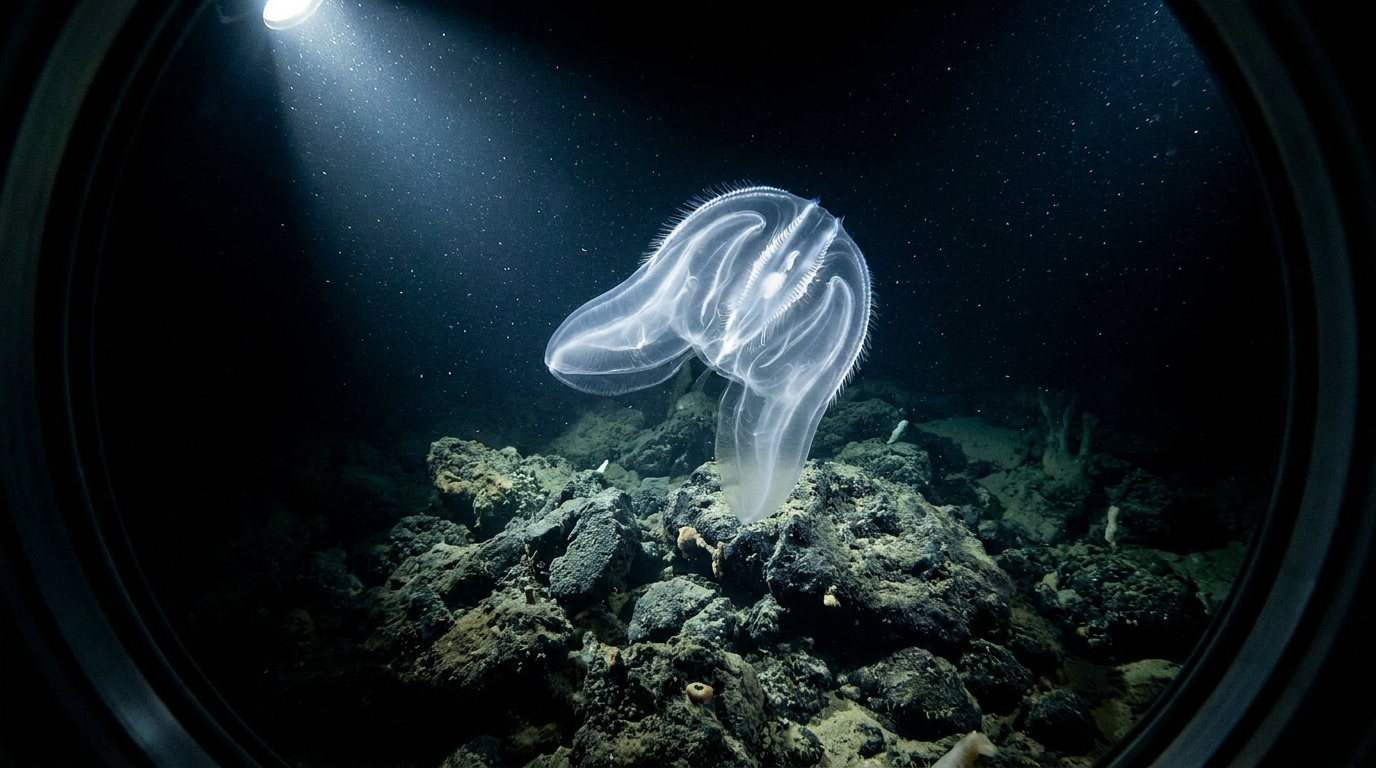
Deep beneath the surface of the western Pacific Ocean, where the pressure is nearly a thousand times greater than at sea level, the rules of biology begin to warp. In the crushing darkness of the Ryukyu Trench, an international team of marine scientists has captured footage of a slow-gliding, ghostly white organism that is actively defying modern taxonomy. Filmed at a staggering depth of 9,137 meters, the creature has left global experts entirely stumped. It is not merely a new species or a new genus; researchers cannot even confidently assign it to a known phylum, the broad taxonomic rank that separates fundamentally different body plans like arthropods from mollusks.[1][2]
The discovery, detailed in a comprehensive April 2026 study published in the Biodiversity Data Journal, serves as the capstone of a massive biological baseline effort. The findings stem from a two-month expedition conducted in 2022 by the Minderoo-UWA Deep-Sea Research Centre at the University of Western Australia and the Tokyo University of Marine Science and Technology. Funded by Caladan Oceanic LLC and the philanthropic research institution Inkfish, the mission sought to map the abyssal and hadal zones of the Japan, Ryukyu, and Izu-Ogasawara trenches. What they found was a thriving, complex ecosystem that challenges the assumption that the deepest ocean trenches are barren, isolated wastelands.[1][3][4]
The enigmatic organism, currently carrying the placeholder designation Animalia incerta sedis—Latin for 'animal of uncertain placement'—was observed twice floating near the seafloor. High-definition cameras mounted on the crewed submersible Limiting Factor captured the creature's slow, deliberate movements through the water column. Visually, it shares superficial traits with both nudibranchs, commonly known as sea slugs, and holothurians, or sea cucumbers. Yet, its structural morphology lacks the definitive anatomical markers required to place it in either category, prompting extensive and ultimately unresolved debates among global taxonomic experts.[5][6][7]
The inability to classify an organism at the phylum level is an exceedingly rare event in modern biology. The animal kingdom is divided into roughly three dozen phyla, encompassing everything from sponges to vertebrates. When a newly discovered creature cannot be slotted into one of these foundational categories, it suggests an evolutionary lineage that diverged hundreds of millions of years ago, adapting in complete isolation. For marine biologists, Animalia incerta sedis represents a tantalizing blank space on the tree of life, a reminder of how little is known about the biological architecture of the hadal zone.[1][3][4]

The success of the expedition relied heavily on a shift in deep-sea research methodology. Historically, scientists studying the ocean's deepest trenches have relied on trawling—dragging nets across the seafloor to bring specimens to the surface. However, the extreme decompression and physical trauma of the ascent often turn fragile, gelatinous deep-sea organisms into unrecognizable biological mush by the time they reach the deck of a ship. To avoid this destructive sampling, the Minderoo-UWA team deployed a dual-pronged, non-invasive approach.[2][4]
Operating from the research vessel DSSV Pressure Drop, the team utilized the Limiting Factor submersible to conduct crewed transects along the trench floors, allowing human observers to study benthic animals in their natural habitats. Simultaneously, they deployed free-falling baited landers equipped with high-resolution cameras to attract and record scavenging fauna. This combination of direct human observation and remote monitoring enabled the researchers to build the most comprehensive visual baseline of hadal megafauna ever recorded in the Northwest Pacific.[2][3][5]
Simultaneously, they deployed free-falling baited landers equipped with high-resolution cameras to attract and record scavenging fauna.
The mystery organism was far from the only revelation. Across the three trenches, the research team cataloged an astonishing 108 distinct organism groups, known as morphotaxa. The sheer density and diversity of life varied significantly depending on the local geological processes, depth, and the influx of nutrients from the surface waters above. The Japan Trench, in particular, hosted the highest number of observed morphotaxa, benefiting from nutrient-rich currents that fuel a complex deep-sea food web.[1][2][4]
One of the most visually striking discoveries occurred at the base of the Boso triple junction, a rare geological intersection where three tectonic plates meet. At a depth of 9,137 meters, the submersible traversed what the researchers described as stunning 'crinoid meadows.' These underwater fields were blanketed by over 1,500 stalked crinoids, ancient marine invertebrates often called sea lilies, anchored firmly to the rocky terraces. The dense aggregation of these filter-feeders at such extreme depths highlights the presence of strong, nutrient-carrying bottom currents that sustain large populations of stationary life.[2][3][4]

The expedition also pushed the known depth limits for several major animal groups. In the Izu-Ogasawara Trench, cameras recorded carnivorous sponges belonging to the family Cladorhizidae thriving at depths between 9,568 and 9,744 meters. Unlike shallow-water sponges that filter microscopic plankton, these deep-sea variants use hook-like spicules to ensnare small crustaceans, slowly digesting them to survive in the nutrient-poor abyss. This encounter represents the deepest in-situ observation of carnivorous sponges ever documented.[2][4]
The baited landers proved equally successful in capturing unprecedented vertebrate behavior. Footage from the landers depicted a snailfish feeding at 8,366 meters below the surface, marking the deepest in-situ observation of a fish ever recorded. Snailfish are uniquely adapted to the hadal zone, possessing specialized proteins that prevent their cells from collapsing under the immense hydrostatic pressure. The presence of an active, feeding apex predator at this depth underscores the vitality of the trench ecosystems.[1][3][4]
Scavengers also made a prominent appearance in the footage. The team spotted the massive 'supergiant' amphipod, Alicella gigantea, in all three of the surveyed trenches. These deep-sea crustaceans, which can grow up to 20 times larger than their shallow-water relatives due to a phenomenon known as abyssal gigantism, were seen swarming the baited landers alongside various other deep-dwelling fishes and invertebrates. Their widespread presence indicates a highly efficient waste-disposal system operating at the very bottom of the ocean.[1][3][4]

Yet, the expedition's findings were not entirely pristine. Amidst the breathtaking biodiversity, the researchers documented a sobering reality: the reach of human pollution extends to the deepest, most remote corners of the planet. The submersible cameras captured evidence of human-derived debris resting on the trench floors, likely transported downward by downslope currents and geological processes. The discovery shatters the illusion of deep-sea trenches as untouched wildernesses, highlighting the pervasive impact of surface-level waste on fragile hadal ecosystems.[2][5]
The implications of the Minderoo-UWA expedition extend far beyond the cataloging of new species. By establishing a robust visual baseline for the Japan, Ryukyu, and Izu-Ogasawara trenches, the researchers have created a vital reference point for future studies. As deep-sea mining and climate change threaten to alter oceanic conditions, understanding the current state of these ecosystems is critical for assessing future impacts. The hadal zone remains one of Earth's least-explored frontiers, and this baseline will be instrumental in tracking its ecological health.[1][2][3]
Ultimately, the ghostly form of Animalia incerta sedis serves as a powerful symbol of the ocean's enduring mysteries. While technological advancements have allowed humanity to peer into the abyss with unprecedented clarity, the deep sea continues to harbor life forms that defy our established scientific frameworks. As researchers continue to analyze the footage and plan future expeditions, the unidentified glider remains a testament to the vast, undiscovered biodiversity that still thrives in the dark, high-pressure world beneath the waves.[4][5][6]

How we got here
2022
The Minderoo-UWA team conducts a two-month expedition aboard the DSSV Pressure Drop to explore the Pacific trenches.
2022–2025
Researchers consult with global taxonomic experts in an attempt to classify the ghostly white organism captured on film.
April 2026
The team publishes their comprehensive findings in the Biodiversity Data Journal, officially designating the creature Animalia incerta sedis.
Viewpoints in depth
Taxonomists and Marine Biologists
Focused on the biological mystery and the challenge of classifying an organism that breaks known taxonomic rules.
For the scientific community, the inability to place Animalia incerta sedis into a known phylum is the most significant takeaway from the expedition. Phyla represent the broadest strokes of biological architecture—the fundamental difference between a vertebrate and a mollusk. When a creature cannot be assigned to any of the roughly three dozen existing phyla, it suggests an evolutionary path that diverged hundreds of millions of years ago. Taxonomists argue that this discovery highlights the massive gaps in our understanding of deep-ocean evolution, emphasizing that the hadal zone may harbor entirely distinct branches of the tree of life that have survived in extreme isolation.
Deep-Sea Technologists
Emphasizing the technological leap that allowed for non-destructive, in-situ observation of fragile deep-sea life.
Engineers and deep-sea exploration advocates view the 2022 expedition as a triumph of modern submersible technology. Historically, sampling the hadal zone required dragging nets across the seafloor, a violent process that often destroyed delicate, gelatinous organisms before they could be studied. By utilizing the crewed Limiting Factor submersible and free-falling baited landers, the team was able to record high-definition footage of creatures like the mystery glider and the deepest-known snailfish in their natural habitats. Technologists argue that this non-invasive approach is the only viable path forward for building accurate biological baselines in high-pressure environments.
Oceanic Conservationists
Highlighting the vulnerability of deep-sea ecosystems and the alarming presence of human debris at extreme depths.
While the discovery of new species is cause for celebration, conservationists are sounding the alarm over the expedition's secondary findings: human-derived debris resting nearly 10 kilometers below the surface. Environmental advocates point out that deep-sea trenches act as massive funnels, accumulating surface pollution through downslope currents. They argue that the hadal zone is not an isolated, untouched wilderness, but a fragile ecosystem already bearing the scars of human activity. For this camp, the newly established visual baseline is less about cataloging curiosities and more about measuring the encroaching impact of global pollution and potential future threats like deep-sea mining.
What we don't know
- The exact evolutionary lineage of Animalia incerta sedis and whether it represents an entirely new phylum.
- How the mystery organism feeds, reproduces, and interacts with the broader hadal ecosystem.
- The full extent of human-derived pollution accumulating in the deepest parts of the Pacific trenches.
Key terms
- Hadal Zone
- The deepest region of the ocean, lying within oceanic trenches between 6,000 and 11,000 meters below the surface.
- Phylum
- A principal taxonomic category that ranks above class and below kingdom, grouping organisms based on fundamental body plans.
- Animalia incerta sedis
- A Latin taxonomic designation meaning 'animal of uncertain placement,' used when a species cannot be confidently assigned to a known group.
- Benthic
- Relating to the bottom of a body of water, including the sediment surface and sub-surface layers.
- Morphotaxa
- Groups of organisms classified together based solely on their physical appearance and structure, often used when genetic data is unavailable.
- Crinoid
- Marine animals, often called sea lilies, that have a mouth on the top surface surrounded by feeding arms, typically attached to the sea floor by a stalk.
Frequently asked
What is the newly discovered mystery organism?
It is a slow-gliding, ghostly white creature found at a depth of 9,137 meters. Scientists have designated it 'Animalia incerta sedis' because it lacks the anatomical features needed to be classified into any known animal phylum.
Where was this deep-sea discovery made?
The organism was filmed in the Ryukyu Trench, located in the western Pacific Ocean off the coast of Japan. The expedition also explored the nearby Japan and Izu-Ogasawara trenches.
Why couldn't scientists just bring the organism to the surface?
Bringing deep-sea creatures to the surface often destroys their fragile, gelatinous bodies due to the extreme change in pressure. The team used submersibles to study the animals unharmed in their natural habitat.
Did the expedition find anything else in the trenches?
Yes, the team cataloged 108 distinct organism groups, including the deepest-ever recorded observation of a fish and dense 'meadows' of sea lilies.
Sources
Source coverage
7 outlets
3 viewpoints surfaced







[1]Biodiversity Data JournalTaxonomists and Marine Biologists
Benthic and bait-attending megafauna of the Japan, Ryukyu, and Izu-Ogasawara trenches
Read on Biodiversity Data Journal →[2]EurekAlert!Oceanic Conservationists
New study unveils rich biodiversity in Japan's deepest ocean trenches
Read on EurekAlert! →[3]Tomorrow's World TodayDeep-Sea Technologists
Deep-Sea Expedition Discovers Unidentified Species
Read on Tomorrow's World Today →[4]IFLScienceTaxonomists and Marine Biologists
Deep-Sea Expedition Reveals Bizarre Organism That Defies Classification
Read on IFLScience →[5]PetaPixelOceanic Conservationists
Deep-Sea Cameras Off Japan Film Mysterious Floating Creature Scientists Can't Identify
Read on PetaPixel →[6]The DebriefDeep-Sea Technologists
Scientists Exploring Deep Ocean Trenches Discover 'Baffling' Mystery Organism
Read on The Debrief →[7]BBC Wildlife MagazineTaxonomists and Marine Biologists
Mystery deep-sea creature baffles scientists
Read on BBC Wildlife Magazine →
Every angle. Every day.
Get environment stories with full source coverage and perspective breakdowns delivered to your inbox.