
How Hydrogen Trains Work: The Promise and Challenges of 'Hydrail'
Hydrogen-powered trains offer a zero-emission alternative to diesel on non-electrified routes, emitting only water vapor. But as record-breaking test runs clash with real-world infrastructure hurdles, the technology faces a critical proving ground.
By Factlen Editorial Team
- Hydrogen Advocates
- Proponents view hydrail as the only viable zero-emission replacement for diesel on long, remote routes.
- Battery-Electric Proponents
- Critics argue that direct electrification and battery trains are more efficient and technologically simpler.
- Pragmatic Operators
- Transit authorities focus on the immediate logistical and financial hurdles of adopting a new fuel standard.
What's not represented
- · Local Communities
- · Fossil Fuel Industry
Why this matters
Rail transport is critical for global mobility, but thousands of miles of rural tracks still rely on highly polluting diesel engines. Hydrogen trains offer a path to eliminate these emissions entirely, potentially transforming the air quality and carbon footprint of regional transit worldwide.
Key points
- Hydrogen trains use fuel cells to generate electricity onboard, emitting only water vapor.
- They are designed to replace highly polluting diesel locomotives on non-electrified regional routes.
- Stadler's FLIRT H2 recently set a world record by traveling 2,803 kilometers on a single tank.
- Hydrogen trains can refuel in 15 to 20 minutes, offering a major advantage over battery-electric trains.
- High infrastructure costs and complex supply chains remain significant hurdles to widespread adoption.
For decades, rail transport has been the poster child for sustainable travel, efficiently moving millions of passengers and tons of freight. Yet, a surprisingly large share of the world's regional rail networks still relies on diesel locomotives. In Europe and North America, thousands of miles of track remain non-electrified because installing continuous overhead wires is prohibitively expensive for low-traffic or remote routes.[4][5]
Diesel engines, however, are increasingly incompatible with global climate targets. They emit significant amounts of carbon dioxide, nitrogen oxides, and particulate matter, contributing to both global warming and local air pollution. This creates a persistent "diesel replacement" problem for transit authorities: how to decarbonize long, rural routes without spending billions on infrastructure.[4][5]
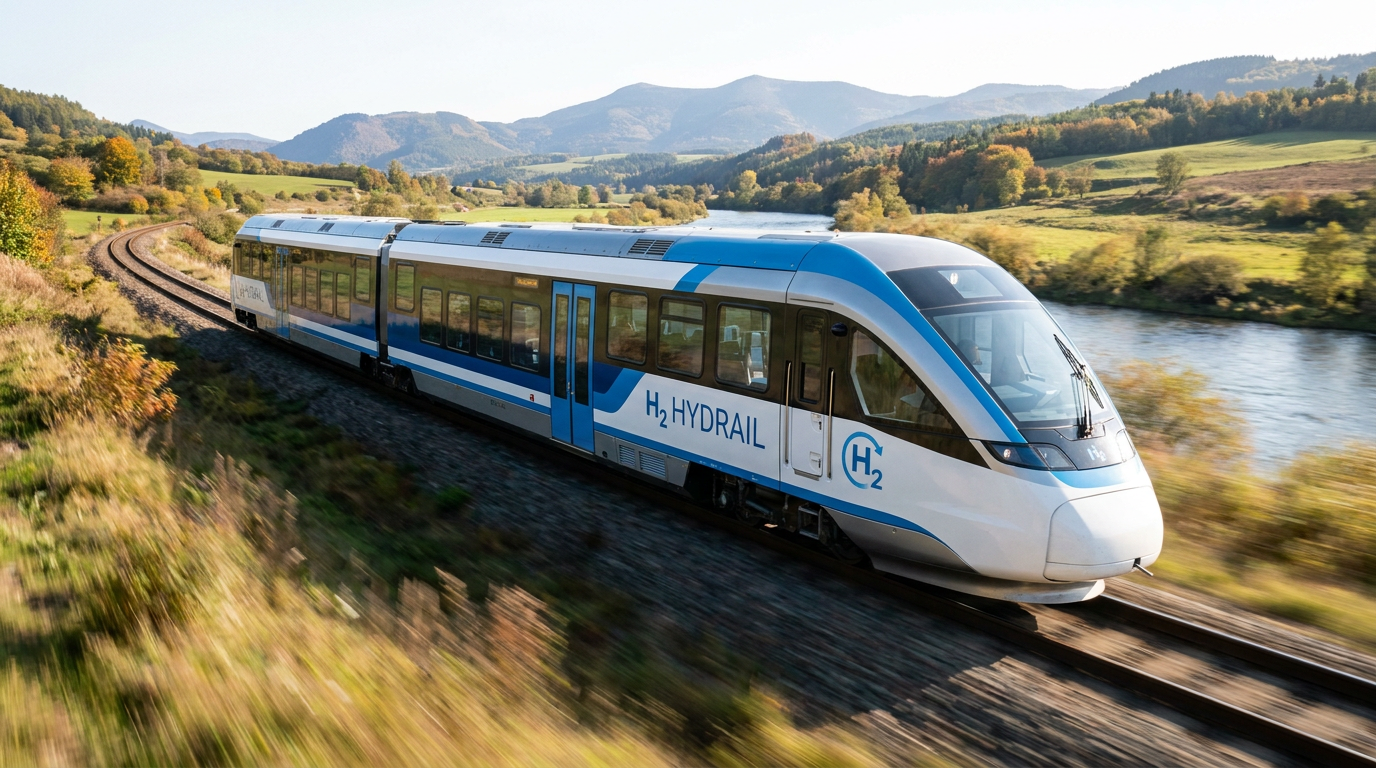
Enter "hydrail"—a growing class of trains powered by hydrogen fuel cells. Rather than burning fossil fuels or drawing power from overhead lines, these trains carry their own power plants on board. They promise the smooth, quiet performance of an electric train, but with the range and flexibility of a traditional diesel locomotive.[3][6]
The core mechanism behind a hydrogen train is the fuel cell. Inside this device, hydrogen gas stored in high-pressure onboard tanks is combined with oxygen drawn from the ambient air. This electrochemical reaction generates electricity, with the only byproducts being heat and pure water vapor. There is no combustion, no smoke, and zero direct greenhouse gas emissions at the tailpipe.[3][5]

The electricity produced by the fuel cell is fed directly into the train's electric traction motors to drive the wheels. Because fuel cells operate most efficiently at a steady output, hydrogen trains are typically designed as hybrid systems. They incorporate lithium-ion batteries or supercapacitors to manage the dynamic power demands of rail travel.[1][3]
These onboard batteries act as an energy buffer. When the train accelerates or climbs a steep gradient, the battery provides an extra surge of power. Conversely, when the train slows down, regenerative braking systems capture the kinetic energy and feed it back into the battery, maximizing the vehicle's overall efficiency.[1][5]
The passenger experience is fundamentally transformed by this technology. Without the heavy vibration and noise of a diesel combustion engine, a hydrogen train glides quietly along the tracks. For communities living near railway lines, the reduction in noise pollution and the elimination of toxic exhaust fumes represent a massive upgrade in quality of life.[5][6]
The passenger experience is fundamentally transformed by this technology.
The technology is rapidly moving from concept to reality, punctuated by impressive engineering milestones. In March 2024, Swiss manufacturer Stadler shattered expectations with its FLIRT H2 passenger train. During a rigorous test at a facility in Pueblo, Colorado, the train traveled 2,803 kilometers (1,741 miles) over 46 hours on a single tank of hydrogen.[1]
This Guinness World Record run demonstrated that hydrogen fuel cells can easily match, and even exceed, the operational range of diesel locomotives. Stadler's FLIRT H2 is now slated for deployment with the San Bernardino County Transportation Authority in California, marking a significant step for zero-emission transit in the United States.[1]

Europe has also been a vital testing ground. French manufacturer Alstom pioneered the space with its Coradia iLint, the world's first hydrogen-powered passenger train, which entered commercial service in Germany. These trains demonstrated that hydrail could seamlessly integrate into existing schedules, offering ranges of up to 1,000 kilometers and refueling times of just 15 to 20 minutes.[2][5]
That rapid refueling time is one of hydrogen's greatest advantages over pure battery-electric trains. While a battery train might need to sit idle for hours to recharge, a hydrogen train can be refilled at a depot almost as quickly as a diesel train, keeping fleet utilization high and minimizing downtime.[5]
However, the transition to hydrail is not without significant friction. The environmental benefit of a hydrogen train depends entirely on how the hydrogen is sourced. If the fuel is "green hydrogen"—produced via electrolysis using wind or solar power—the entire lifecycle is virtually carbon-neutral. But currently, much of the world's hydrogen is "grey," extracted from natural gas in a process that still releases carbon emissions.[3][4][5]
Infrastructure and supply chain logistics present an even steeper hurdle. Transporting, storing, and dispensing highly pressurized hydrogen gas requires entirely new, specialized facilities. These depots are expensive to build and technically complex to operate, requiring massive upfront investments from transit authorities.[5]

These logistical challenges have recently caused real-world setbacks. In Germany, a regional operator that replaced 15 diesel railcars with 14 hydrogen units was temporarily forced to revert to diesel operations after severe hydrogen delivery shortages left most of the fleet unable to run.[2]
Furthermore, Alstom recently paused further development of its hydrogen train programs after the French government withdrew financial support, citing that the technology was not yet fully mature. This pause highlights the financial fragility of scaling new propulsion systems without sustained public subsidies.[2][6]
Hydrogen trains also face fierce competition from rapidly improving battery technology. As lithium-ion batteries become cheaper and more energy-dense, pure battery-electric trains are increasingly viable for shorter regional routes. Battery trains are mechanically simpler and can charge directly from the existing electrical grid, avoiding the complex hydrogen supply chain entirely.[5][6]
Ultimately, the future of rail decarbonization will likely be a patchwork approach. Heavily trafficked corridors will continue to rely on overhead electrification, while battery trains will conquer shorter branch lines. But for the long, demanding, and remote routes where wires are impossible and batteries fall short, hydrogen trains remain one of the most promising tools to finally retire the diesel engine.[4][5][6]
How we got here
2016
Alstom unveils the Coradia iLint, the world's first hydrogen-powered passenger train, at the InnoTrans trade fair.
2018
The Coradia iLint enters commercial passenger service in Lower Saxony, Germany.
Dec 2023
North America's first hydrogen train demonstration successfully concludes in Quebec, Canada.
Mar 2024
Stadler's FLIRT H2 sets a Guinness World Record by traveling 2,803 kilometers on a single tank of hydrogen in Colorado.
Nov 2025
Alstom pauses further development of its hydrogen train programs following the withdrawal of French government funding.
Viewpoints in depth
Hydrogen Advocates
Proponents view hydrail as the only viable zero-emission replacement for diesel on long, remote routes.
This camp, which includes many rail manufacturers and environmental researchers, argues that hydrogen is essential for fully decarbonizing rail networks. They emphasize that while overhead electrification is the gold standard, it is economically impossible to justify on low-traffic rural lines. Because hydrogen trains can travel over 1,000 kilometers and refuel in under 20 minutes, they offer a one-to-one operational replacement for diesel locomotives without requiring massive changes to existing timetables or fleet sizes.
Battery-Electric Proponents
Critics argue that direct electrification and battery trains are more efficient and technologically simpler.
Energy analysts and battery advocates point out the inherent inefficiencies of the hydrogen cycle. Creating hydrogen, compressing it, transporting it, and converting it back into electricity results in significant energy losses compared to simply charging a battery from the grid. As lithium-ion battery costs plummet and energy density improves, this camp believes battery-electric trains will soon be capable of handling all but the most extreme regional routes, rendering the complex hydrogen supply chain unnecessary.
Pragmatic Operators
Transit authorities focus on the immediate logistical and financial hurdles of adopting a new fuel standard.
For the operators actually running the trains, the debate comes down to reliability and cost. While they welcome the environmental benefits, they are wary of the massive capital required to build specialized high-pressure hydrogen refueling depots. Recent supply chain hiccups—such as operators in Germany being forced to revert to diesel when hydrogen deliveries failed—have reinforced their cautious approach. They argue that until green hydrogen becomes cheap, abundant, and reliably transported, hydrail will remain a niche solution rather than a universal standard.
What we don't know
- How quickly the cost of producing and transporting 'green hydrogen' will fall to make it cost-competitive with diesel.
- Whether rapid advancements in solid-state batteries will eventually render hydrogen trains obsolete for all but the longest routes.
- If governments will provide the sustained subsidies required to build out a widespread hydrogen refueling infrastructure.
Key terms
- Hydrail
- A generic term for any rail vehicle that uses hydrogen fuel cells to generate electricity for traction.
- Fuel Cell
- A device that generates electricity through an electrochemical reaction between hydrogen and oxygen, without combustion.
- Green Hydrogen
- Hydrogen fuel produced by splitting water via electrolysis, powered entirely by renewable energy sources like wind or solar.
- Regenerative Braking
- A mechanism that captures the kinetic energy normally lost as heat during braking and stores it in the train's battery for later use.
- Grey Hydrogen
- Hydrogen produced from natural gas using steam methane reforming, a process that releases carbon dioxide into the atmosphere.
Frequently asked
Are hydrogen trains safe to ride?
Yes. They use highly resilient carbon-fiber storage tanks, and because hydrogen is lighter than air, any leak dissipates rapidly upward rather than pooling on the ground like liquid fuels.
Do hydrogen trains need overhead wires?
No. They generate their own electricity onboard using fuel cells, making them ideal for rural routes where installing overhead wires is too expensive.
What comes out of the exhaust?
The only byproducts of the electrochemical reaction in the fuel cell are pure water vapor and heat.
Why not just use battery-powered trains?
While battery trains are excellent for shorter routes, they are heavy and take a long time to recharge. Hydrogen trains offer much longer ranges and can refuel in just 15 minutes.
Sources
Source coverage
6 outlets
3 viewpoints surfaced






[1]Railway TechnologyHydrogen Advocates
Stadler steams into record books with hydrogen-powered trainset
Read on Railway Technology →[2]Railway PROPragmatic Operators
Alstom pauses hydrogen train development
Read on Railway PRO →[3]TWI GlobalHydrogen Advocates
What is a Hydrogen Train and How Do They Work?
Read on TWI Global →[4]University of British ColumbiaHydrogen Advocates
Sustainable & Zero-Emission Rail Technology
Read on University of British Columbia →[5]Encyclopedia.pubBattery-Electric Proponents
Advantages and Disadvantages of Hydrogen Trains
Read on Encyclopedia.pub →[6]Factlen Editorial TeamPragmatic Operators
Synthesis by Factlen editorial team
Read on Factlen Editorial Team →

More in transportation
See all 13 stories →Battery Tech
The Solid-State Battery Era Arrives: How 2026 Became the Tipping Point for EV Tech
7 sources
Maritime Tech
The High-Tech Return of Wind Power to Global Shipping
7 sources
Green Shipping
Commercial Shipping Returns to Wind Power to Slash Global Emissions
7 sources
Grid Tech
How Bidirectional Charging is Turning EVs into Mobile Power Plants
9 sources
Every angle. Every day.
Get transportation stories with full source coverage and perspective breakdowns delivered to your inbox.