
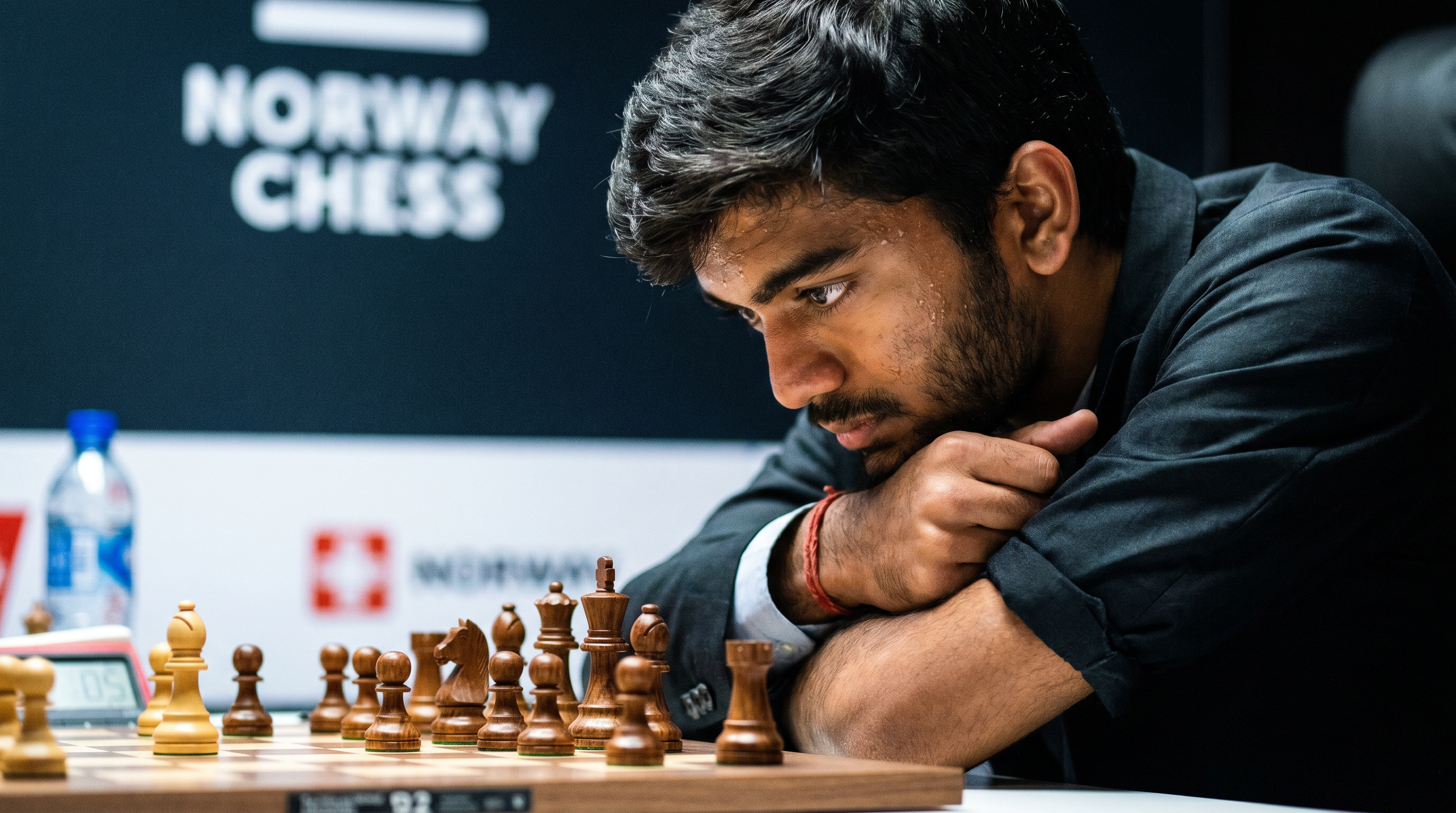
Praggnanandhaa and Assaubayeva Claim Titles at Norway Chess 2026
Indian Grandmaster Praggnanandhaa Rameshbabu secured the Norway Chess 2026 title with an astonishing four-game classical winning streak, while Kazakhstan's Bibisara Assaubayeva claimed the women's crown with a round to spare. The dual-tournament event in Oslo concluded with dramatic final-round victories that reshaped the global chess rankings.
By Factlen Editorial Team
- Global Chess Media
- Focuses on the historic nature of Praggnanandhaa's comeback and the thrilling entertainment value of the Armageddon format.
- Official & Rating Trackers
- Analyzes the mathematical impact of the tournament on the FIDE world rankings and the shifting generational hierarchy.
- Central Asian Press
- Celebrates Bibisara Assaubayeva's dominant wire-to-wire victory and her role in elevating Kazakhstan's chess profile.
What's not represented
- · Players' coaching teams
- · Tournament organizers in Oslo
Why this matters
Praggnanandhaa's unprecedented comeback from last place to tournament champion cements his status as a leading force in the game's new generation, proving he can consistently dismantle the world's absolute best. Assaubayeva's dominant victory over a field including the reigning Women's World Champion further signals a definitive shift in the sport's competitive landscape toward rising stars from India and Central Asia.
Key points
- Praggnanandhaa Rameshbabu won the Norway Chess Open Section with 18.0 points after a four-game classical winning streak.
- Bibisara Assaubayeva won the Women's Section with 16.5 points, clinching the title before the final round.
- The tournament utilized a unique scoring system where drawn classical games immediately went to an Armageddon tiebreak.
- Both champions received an identical first-place prize of 700,000 Norwegian kroner (approx. $75,000).
- World No. 1 Magnus Carlsen finished fourth after suffering four uncharacteristic classical defeats.
- The event caused significant shifts in the June 2026 FIDE ratings, with young Indian grandmasters climbing the top 10.
The Norway Chess 2026 super-tournament concluded in Oslo on Friday with a dramatic final round that crowned Indian Grandmaster Praggnanandhaa Rameshbabu and Kazakhstan's Bibisara Assaubayeva as champions. The dual-tournament event, featuring both an Open and a Women's section, brought together the world's absolute elite players for a grueling double round-robin competition that tested their endurance over ten rounds. While Assaubayeva secured her title with a round to spare after a dominant wire-to-wire performance, Praggnanandhaa required a historic, against-all-odds final-day surge to overtake the leaders and claim the prestigious trophy. The contrast between the two victories—one a masterclass in sustained front-running, the other a breathless come-from-behind sprint—provided a fitting conclusion to one of the most closely watched events on the international chess calendar.[1][2][5]
Norway Chess has long been renowned for its decisive, high-stakes scoring system, which was specifically designed by organizers to eliminate quiet draws and force fighting chess at the highest level. If a classical game ends in a draw, the players do not split a point; instead, they immediately contest an Armageddon tiebreak game. Under this system, a classical victory awards three full points, while an Armageddon win yields 1.5 points, heavily incentivizing players to take massive risks in the longer time control rather than settling for a safe tie. This unique format proved to be the defining factor in the tournament's thrilling conclusion, as the massive point swings available for classical victories allowed trailing players to rapidly close the gap on the leaders in the final days of the competition.[2][5]
Praggnanandhaa's path to the championship was nothing short of miraculous, representing one of the greatest comebacks in the history of elite round-robin tournaments. After suffering devastating consecutive losses in rounds five and six—including a crushing defeat to American Grandmaster Wesley So—the 20-year-old Indian prodigy found himself languishing in last place, trailing the tournament lead by a massive 5.5 points. At that juncture, tournament victory seemed mathematically improbable, if not entirely impossible against a field of this caliber. Praggnanandhaa later admitted in post-match interviews that he had completely written off his chances of winning the event, deciding instead to simply focus on playing good, principled chess without the burden of watching the standings or calculating complex tournament permutations.[1]
What followed was one of the most remarkable streaks in recent elite chess history, as Praggnanandhaa unlocked a level of play that left his opponents entirely defenseless. The young grandmaster strung together four consecutive classical victories against a terrifying gauntlet of the world's best players. He systematically dismantled French prodigy Alireza Firouzja, outplayed World No. 1 Magnus Carlsen, and decisively defeated reigning World Champion Gukesh Dommaraju in a highly anticipated all-Indian clash. Entering the tenth and final round half a point behind the tournament leader, Wesley So, Praggnanandhaa knew that only a classical win with the white pieces against Germany's Vincent Keymer would guarantee him the title, setting the stage for a dramatic final-day showdown.[1][2]

Under immense pressure, Praggnanandhaa executed his game plan flawlessly, converting a complex advantage against Keymer to secure the full three points and complete his historic run. Meanwhile, on the adjacent board, Wesley So was held to a tense classical draw by Firouzja. Although So subsequently won the mandatory Armageddon tiebreak to earn 1.5 points, it was not enough to hold off the surging Indian star's massive classical point haul. Praggnanandhaa finished the event with 18.0 points, exactly one point ahead of So's 17.0, while Firouzja claimed third place with 15.5 points. The final standings reflected the sheer power of the Norway Chess scoring system, rewarding Praggnanandhaa's refusal to accept draws when his back was against the wall.[2][4]
Meanwhile, on the adjacent board, Wesley So was held to a tense classical draw by Firouzja.
In the Norway Chess Women's tournament, the narrative was entirely different, characterized by the wire-to-wire dominance of Bibisara Assaubayeva. The 22-year-old Kazakh grandmaster navigated the elite six-player field with remarkable precision and tactical clarity, clinching the title on Thursday before the final round even began. Her commanding performance was highlighted by a crucial early victory over Ju Wenjun, the reigning five-time Women's World Champion, which set the tone for the rest of her campaign. Assaubayeva's ability to consistently generate winning chances in classical time controls allowed her to build an insurmountable lead, showcasing her rapid development into one of the most formidable forces in women's chess.[1][3]
Assaubayeva entered the ninth and penultimate round needing only a single point against Ukraine's Anna Muzychuk to mathematically eliminate the rest of the field and secure the championship. She achieved exactly that by drawing the classical game and pushing the match to Armageddon, securing the title and the 700,000 Norwegian kroner (approximately $75,000) first-place prize. The tournament's strict commitment to gender equality ensured that both the Open and Women's sections featured identical prize funds, a standard that Norway Chess has proudly championed in recent years. This financial parity, combined with the elite playing conditions, has made the event a premier destination for the world's top female players.[2][3]

Despite having already secured the trophy and the prize money, Assaubayeva faced a highly motivated Ju Wenjun in the final round. The Women's World Champion, eager to salvage a difficult tournament, managed to hand Assaubayeva her only classical defeat of the event, though the result did not alter the final championship standings. Elsewhere in the final round, China's Zhu Jiner finished her campaign in second place with 16.0 points after securing a vital classical victory over India's Koneru Humpy. Anna Muzychuk rounded out the podium in third place, capping off a highly competitive Women's section that featured decisive classical games across the board on the final day.[2]
For the local fans gathered in Oslo, the tournament provided a mixed and often frustrating experience regarding their hometown hero, Magnus Carlsen. The former world champion and undisputed World No. 1 endured a highly turbulent event, suffering an uncharacteristic four classical defeats—a staggering number for a player renowned for his invincibility. However, Carlsen showcased his trademark resilience in the final round, grinding out a long, complex classical victory over World Champion Gukesh Dommaraju. The win allowed the Norwegian star to finish the tournament on a positive note, climbing into fourth place with 13.0 points and avoiding a catastrophic drop in his classical rating.[1][2]
The dramatic results in Oslo have immediately reverberated through the global chess hierarchy, causing significant shifts in the competitive landscape. The June 2026 FIDE rating list reflects this volatility at the top of the sport, with major rating swings impacting tournament invitations and future seeding. While Carlsen remains the undisputed World No. 1, the gap beneath him is shifting rapidly as players jockey for position. French star Alireza Firouzja, for instance, dropped a massive 15 rating points following his uneven performance in Norway, falling out of the world's top ten entirely and highlighting the severe rating penalties associated with classical defeats at this level.[6][7]

Conversely, the younger generation continues its relentless climb up the global rankings, signaling a permanent shift in the sport's power dynamics. Alongside Praggnanandhaa's triumphant performance in Oslo, his compatriot Arjun Erigaisi recently jumped to World No. 8 after a stellar shared first-place finish at the TePe Sigeman tournament in Sweden. The Norway Chess 2026 results cement a growing consensus in the international chess community: the new wave of grandmasters from India and Central Asia are no longer just future challengers waiting in the wings—they have arrived, they are winning super-tournaments, and they are actively taking the crown from the established elite.[1][3][6]
How we got here
May 25, 2026
Norway Chess 2026 begins in Oslo with a double round-robin format.
May 31, 2026
Praggnanandhaa loses to Wesley So in Round 6, falling to last place in the standings.
June 1-4, 2026
Praggnanandhaa wins three consecutive classical games against Firouzja, Carlsen, and Gukesh.
June 4, 2026
Bibisara Assaubayeva clinches the Women's Section title with a round to spare.
June 5, 2026
Praggnanandhaa defeats Vincent Keymer in the final round to leapfrog Wesley So and win the Open title.
Viewpoints in depth
Global Chess Media
Focuses on the historic nature of Praggnanandhaa's comeback and the thrilling entertainment value of the Armageddon format.
International outlets emphasized the sheer improbability of Praggnanandhaa's victory. By highlighting his four-game classical winning streak against the world's absolute best, commentators framed this not just as a tournament win, but as a definitive statement of arrival. The coverage also praised the Norway Chess format for forcing decisive results and preventing the 'draw death' that often plagues elite round-robin events.
Central Asian Press
Celebrates Bibisara Assaubayeva's dominant wire-to-wire victory and her role in elevating Kazakhstan's chess profile.
Regional media focused heavily on Assaubayeva's commanding performance, noting that she mathematically eliminated the field before the final day. Her victory over reigning World Champion Ju Wenjun was highlighted as a passing-of-the-torch moment. The coverage also emphasized the financial parity of the tournament, celebrating the 700,000 NOK prize as a major milestone for women's chess.
Official & Rating Trackers
Analyzes the mathematical impact of the tournament on the FIDE world rankings and the shifting generational hierarchy.
Statistical platforms and official federation reports took a more clinical view, tracking the massive rating swings caused by the event's decisive games. Analysts noted Alireza Firouzja's steep 15-point drop and the simultaneous rise of Indian stars like Praggnanandhaa and Arjun Erigaisi. For these observers, Norway Chess 2026 served as a brutal stress test that reshuffled the top 10 and solidified Magnus Carlsen's vulnerability in classical time controls.
What we don't know
- Whether Magnus Carlsen will adjust his classical repertoire after suffering multiple defeats to the younger generation in Oslo.
- How the massive rating shifts from Norway Chess will impact invitations for the upcoming World Championship cycle events.
Key terms
- Classical chess
- The traditional format of chess with long time controls, allowing players hours to complete a game.
- Armageddon
- A tiebreak game where White has more time on the clock but must win, while Black has less time but wins the match if the game ends in a draw.
- FIDE
- The International Chess Federation, the governing body of international chess competition.
- Grandmaster (GM)
- The highest title a chess player can attain, awarded by FIDE based on rating and tournament performance.
Frequently asked
How does the scoring system work at Norway Chess?
Players earn 3 points for a classical win. If a classical game is drawn, they play an Armageddon tiebreak, where the winner earns 1.5 points and the loser earns 1 point.
How far behind was Praggnanandhaa before his comeback?
After round six, he was in last place, trailing the tournament leader by 5.5 points before winning four consecutive classical games.
Did the men and women receive the same prize money?
Yes, Norway Chess 2026 featured equal prize funds, with both champions receiving 700,000 Norwegian kroner (about $75,000).
Sources
Source coverage
7 outlets
3 viewpoints surfaced







[1]Chess.comGlobal Chess Media
Praggnanandhaa Wins Norway Chess With Stunning 4-Game Winning Streak
Read on Chess.com →[2]International Chess Federation (FIDE)Official & Rating Trackers
Norway Chess 2026: Praggnanandhaa R and Bibisara Assaubayeva win titles
Read on International Chess Federation (FIDE) →[3]The Astana TimesCentral Asian Press
Kazakhstan's Bibisara Assaubayeva Wins Norway Chess 2026 Title
Read on The Astana Times →[4]ChessWorld.netGlobal Chess Media
Norway Chess 2026 Final Standings: Praggnanandhaa Wins
Read on ChessWorld.net →[5]WikipediaOfficial & Rating Trackers
Norway Chess 2026
Read on Wikipedia →[6]Kingdom of ChessOfficial & Rating Trackers
FIDE Ratings June 2026
Read on Kingdom of Chess →[7]ChessBaseOfficial & Rating Trackers
FIDE ratings - June 2026
Read on ChessBase →

More in sports
See all 408 stories →Franchise Valuations
How Women's Sports Franchises Became a Billion-Dollar Asset Class
7 sources
Athlete Longevity
How NCAA Gymnastics and NIL Transformed the Lifespan of an Elite Gymnast
6 sources
Track Tech
The Dual Revolution Rewriting the Track and Field Record Books
6 sources

Crystal Palace
Crystal Palace to Appoint Pierre Sage as New Manager Following Lens Success
6 sources

Every angle. Every day.
Get sports stories with full source coverage and perspective breakdowns delivered to your inbox.