
The 2026 'Third Place' Revival: How Communities Are Reclaiming Physical Spaces to Combat Loneliness
Driven by a desire for genuine connection, a cultural shift is reviving 'third places'—from modernized public libraries to grassroots micro-communities—as essential infrastructure against the modern loneliness epidemic.
By Factlen Editorial Team
- Public Space Advocates
- Argue that true third places must be radically inclusive and entirely free of financial barriers.
- Commercial Innovators
- Believe that private enterprise and specialized retail can effectively fill the modern demand for social connection.
- Gen Z Community Builders
- Focus on grassroots, low-barrier 'micro-communities' that prioritize recurring physical presence over digital curation.
What's not represented
- · Rural community organizers
- · Elderly care advocates addressing senior isolation
Why this matters
As digital fatigue peaks and remote work isolates millions, the resurgence of physical gathering spaces offers a tangible, accessible blueprint for improving mental health and rebuilding local civic bonds.
Key points
- Sociologists define 'third places' as informal, neutral gathering spots distinct from home and work.
- Chronic social isolation is increasingly recognized as a severe public health crisis.
- Younger demographics are actively trading digital-only interactions for recurring, in-person 'micro-communities.'
- Public libraries are transforming into dynamic social hubs that offer radical inclusivity without financial barriers.
- Urban planners are prioritizing 15-minute city designs to encourage passive, trust-building neighborhood encounters.
For much of the last decade, modern life has felt increasingly optimized but undeniably isolated. The pandemic accelerated a retreat into the domestic sphere, while remote work blurred the boundaries between the office and the living room. As digital connectivity replaced physical proximity, a quiet crisis emerged: the erosion of the spaces where people simply gather. Now, in 2026, a powerful cultural counter-current is taking hold. Driven largely by younger demographics exhausted by screen time, communities are actively reclaiming and reinventing the physical world to combat the modern loneliness epidemic.[1][3]
At the center of this cultural shift is the revival of the "third place." Coined by American urban sociologist Ray Oldenburg in his 1989 book The Great Good Place, the term describes the informal social environments distinct from the home (the "first place") and the workplace or school (the "second place"). Classic examples include neighborhood diners, barbershops, public parks, and local pubs. According to Oldenburg, true third places share specific characteristics: they are highly accessible, unpretentious, inexpensive or free, and centered around spontaneous conversation. They are the communal living rooms of society, where people can relax in public and encounter familiar faces without the pressures of domestic or professional obligations.[1][9]
For years, these vital community anchors were quietly disappearing. Urban sprawl, the privatization of public spaces, and the rise of digital entertainment chipped away at local gathering spots. The COVID-19 lockdowns dealt a severe blow, forcing the closure of countless physical venues and pushing social interaction almost entirely onto digital platforms like Discord, group chats, and social media. However, as the novelty of online-only existence wore thin, the limitations of digital connection became glaringly apparent.[2][3]
The stakes of this spatial deficit are profoundly physical. Research consistently links chronic social isolation to severe health consequences, with some studies suggesting it can be as harmful to long-term health as smoking 15 cigarettes a day. Humans are biologically wired for intimacy and village-scale interaction, often framed around "Dunbar's number"—the cognitive limit of roughly 150 stable relationships a person can maintain. When urban environments lack the infrastructure for casual, repeated encounters, that social glue dissolves, leaving residents surrounded by millions of people yet entirely isolated.[8][9]

In response, 2026 has seen a surge in intentional, offline community building, heavily championed by Generation Z. Valuing real-world experiences over digital curation, younger adults are trading endless content streams for genuine community connection. This demographic, despite being the most digitally native, reports the highest need for physical third places, demonstrating a willingness to sacrifice online conveniences for authentic, in-person belonging.[3][5]
This desire has birthed the "micro-community" trend. Rather than seeking one monolithic friend group, people are joining small, recurring circles built around low-stakes activities. Run clubs, listening bars, community gardens, and even "errand clubs"—where groups tackle weekend chores together before getting coffee—have proliferated. The psychological mechanism driving these groups is proximity and consistency. By meeting weekly or biweekly, these spaces remove the friction of planning and allow trust to build naturally over time through shared routines.[3][8]
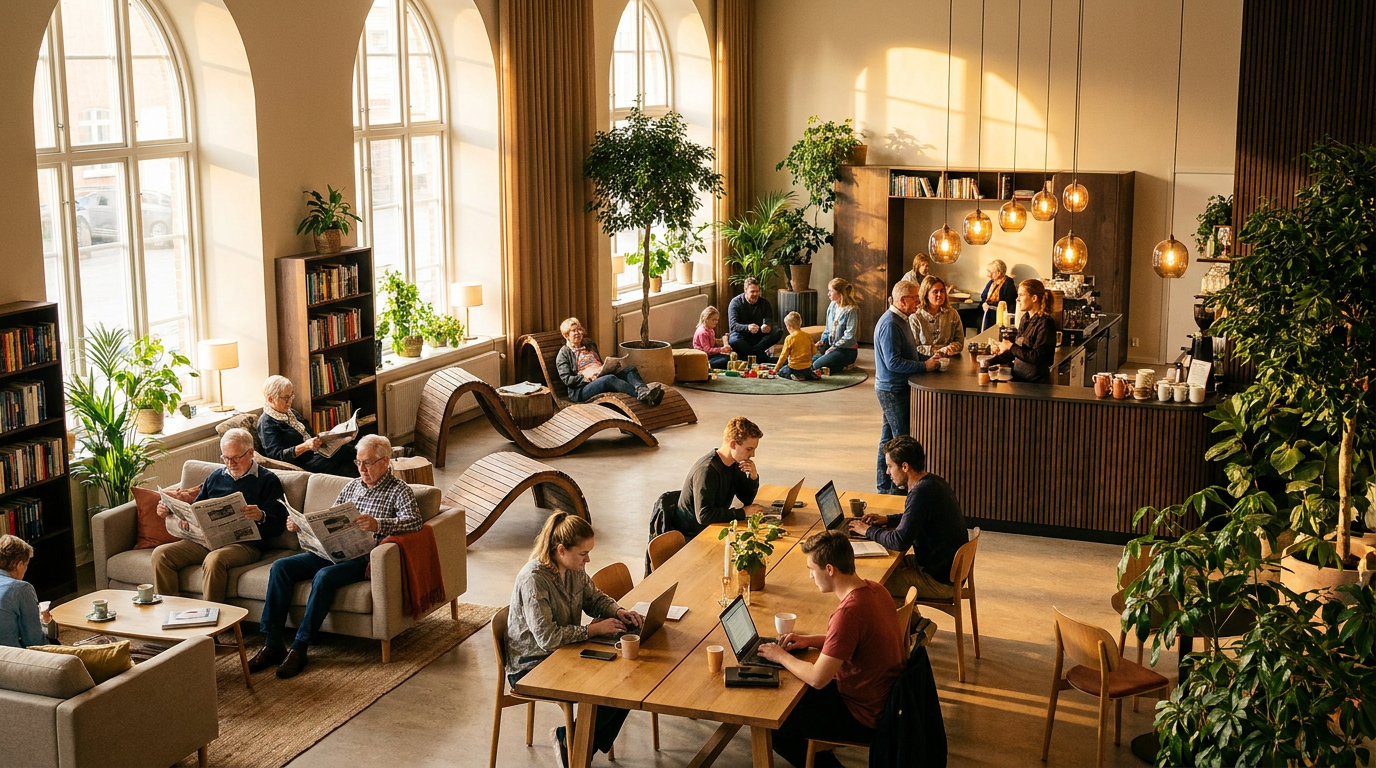
Perhaps the most striking evolution in the third-place landscape is the renaissance of the public library. Long stereotyped as silent, austere repositories for books, modern libraries have quietly transformed into some of the most successful and dynamic community hubs in the urban landscape. Recognizing the need for social infrastructure, libraries have redesigned their interiors to include collaborative workspaces, maker labs, language learning groups, and even integrated cafes.[4][6]
Perhaps the most striking evolution in the third-place landscape is the renaissance of the public library.
The superpower of the modern library is its radical inclusivity. In an era where most public seating requires a transaction—often termed the "pay-to-participate" economy—libraries remain one of the few indoor spaces where a person can exist indefinitely without the expectation of spending money. They offer free Wi-Fi, climate-controlled comfort, and programs tailored to diverse populations, from neurodivergent-friendly design spaces to language classes for recent immigrants. This neutral ground allows individuals across different socioeconomic backgrounds to share space, fostering a sense of civic equality.[4][6]

Urban planners and architects are also rethinking the physical layout of neighborhoods to support this revival. The concept of the "15-minute city"—where essential services and leisure spaces are accessible within a short walk or bike ride—relies heavily on the integration of third places. Proximity is crucial; when gathering spots are close to where people live, they encourage the "passive encounters" that build neighborhood trust. Bumping into the same person at the local bakery or chatting on a well-designed park bench creates a web of natural accountability and mutual care.[8][9]
Parks and green spaces remain the most resilient outdoor third places. They act as natural equalizers, offering a refuge for physical activity and casual gatherings without financial barriers. Cities that invest heavily in their park systems provide vital social infrastructure for residents who may not have access to traditional indoor venues, proving that thoughtful landscape design can directly combat urban loneliness.[5][8]
However, the revival of the third place is not without tension, particularly regarding commercialization. As the demand for social spaces grows, private entities have eagerly stepped in to fill the void. The rise of "influencer cafes" and highly curated retail experiences caters to the desire for connection, but often at a steep premium. When a casual bowling date or a trip to a specialized hobby space costs upwards of $100, these commercial venues risk excluding lower-income residents, creating niche communities rather than broadly inclusive ones.[2][3]

This commercial shift reflects a broader debate about the nature of modern community. Traditional third places served geographic communities, where diversity occurred naturally through neighborhood proximity. Today's commercialized spaces increasingly serve "communities of interest," gathering like-minded individuals who share specific hobbies or aesthetics. While this strengthens bonds within specific subcultures, sociologists warn it may reduce the cross-cultural, cross-class interactions that Oldenburg viewed as essential for a healthy democracy.[2][9]
Despite these challenges, innovative hybrid models are emerging globally. In Brazil, the Serviço Social do Comércio (SESC) centers offer a compelling blueprint. Funded by a payroll tax on commerce and tourism, these repurposed industrial spaces provide cultural, recreational, and dining amenities designed explicitly for community rather than profit. Similarly, in the UK, the resurgence of community ballrooms and dedicated music clubs demonstrates how shared cultural movements can revitalize physical spaces.[7][9]

Ultimately, the 2026 third-place revival is a testament to the enduring human need for physical presence. Digital networks can transmit information, but they cannot replicate the oxytocin release of shared laughter, the comfort of being recognized by a local barista, or the serendipity of a spontaneous conversation.[3][8]
Rebuilding this social infrastructure requires intentionality from both city planners and citizens. It demands zoning laws that protect community spaces, public funding for parks and libraries, and a personal commitment to log off and show up. By actively participating in the humble, everyday spaces of local life, communities are proving that the most effective antidote to modern isolation is simply finding a place to be together.[1][8]
How we got here
1989
Sociologist Ray Oldenburg coins the term 'third place' in his book The Great Good Place.
2020–2022
Pandemic lockdowns force the widespread closure of physical gathering spaces, accelerating digital isolation.
2023
The U.S. Surgeon General officially declares a national epidemic of loneliness and isolation.
2025–2026
A youth-led cultural shift sparks a massive revival of offline micro-communities and modernized public spaces.
Viewpoints in depth
Public Space Advocates
Argue that true third places must be radically inclusive and entirely free of financial barriers.
This camp, heavily represented by urban planners and library advocates, emphasizes that the core value of a third place is its accessibility to all socioeconomic classes. They argue that when gathering spaces require a purchase—such as a $6 coffee or a $30 fitness class—they cease to be true community equalizers. Instead, they champion the expansion of public libraries, municipal parks, and community centers as the only sustainable infrastructure for combating loneliness, noting that these spaces allow for 'radical inclusivity' where people can simply exist without a transactional agenda.
Commercial Innovators
Believe that private enterprise and specialized retail can effectively fill the modern demand for social connection.
Retail strategists and hospitality entrepreneurs argue that commercial spaces are adapting to meet the specific desires of modern consumers. They point to the rise of 'influencer cafes,' boutique run clubs, and specialized hobby spaces as evidence that people are willing to pay for highly curated, aesthetically pleasing environments that foster connection. This perspective suggests that while these spaces may not be free, they successfully build 'communities of interest' that resonate deeply with younger demographics seeking shared passions and high-quality experiences.
Gen Z Community Builders
Focus on grassroots, low-barrier 'micro-communities' that prioritize recurring physical presence over digital curation.
For this demographic, the revival of the third place is less about physical architecture and more about intentional, recurring routines. Exhausted by the performative nature of social media, these community builders organize informal, low-cost gatherings like weekend 'errand clubs,' local park meetups, and neighborhood walking groups. They argue that the most effective antidote to digital isolation isn't a heavily funded municipal project or a pricey cafe, but rather the simple, consistent act of showing up in the same physical space with the same group of people week after week.
What we don't know
- Whether commercialized third places can successfully bridge socioeconomic divides or if they will remain exclusive to higher-income brackets.
- How long-term municipal funding will adapt to support the expanded social roles of public libraries and parks.
Key terms
- Third Place
- A sociological term for an informal, neutral public space where people gather to socialize, distinct from the home and the workplace.
- Dunbar's Number
- A cognitive limit, estimated at roughly 150, to the number of stable social relationships a human can comfortably maintain.
- Micro-community
- A small, recurring group of individuals who meet regularly around a shared, low-stakes activity to build social bonds.
- Radical Inclusivity
- The principle of designing spaces that are welcoming and accessible to everyone, regardless of socioeconomic status or background.
- Passive Encounter
- A brief, unplanned social interaction—such as nodding to a neighbor—that gradually builds trust within a community.
Frequently asked
What exactly is a third place?
It is a neutral, accessible social environment separate from your home (first place) and workplace (second place), such as a park, library, or cafe.
Why did third places start disappearing?
Urban sprawl, the privatization of public spaces, the rise of digital entertainment, and the COVID-19 pandemic all contributed to their decline.
How are modern libraries changing?
They are evolving from silent book repositories into dynamic community living rooms, offering cafes, maker spaces, and collaborative areas without requiring visitors to spend money.
What is an 'errand club'?
It is a type of micro-community where small groups of friends or neighbors complete weekend chores together, turning isolated tasks into social time.
Sources
Source coverage
9 outlets
3 viewpoints surfaced









[1]Washington MonthlyGen Z Community Builders
The Shrinking Space Between Home and Work
Read on Washington Monthly →[2]ArchDailyCommercial Innovators
Third Places in the United States: Commercialized or Community-Centered?
Read on ArchDaily →[3]Young HollywoodGen Z Community Builders
Gen Z's Third Place Revival: Community Over Content
Read on Young Hollywood →[4]EveryLibraryPublic Space Advocates
Why the Public Library Is the Best Third Place
Read on EveryLibrary →[5]Citizen RelationsCommercial Innovators
Building Social Connection Through Third Places
Read on Citizen Relations →[6]HSE IlluminatedPublic Space Advocates
Libraries as the Third Place
Read on HSE Illuminated →[7]Longboard Architectural Products
Third Places: Fostering Community Beyond Home and Work
Read on Longboard Architectural Products →[8]Furnitubes
Third Places & Community Design: How Urban Spaces Combat Social Isolation
Read on Furnitubes →[9]Factlen Editorial Team
Synthesis by Factlen editorial team
Read on Factlen Editorial Team →

More in lifestyle
See all 46 stories →Modern Romance
The Science of 'Slow Dating': Why Intentional Matchmaking is Replacing Swipe Culture
8 sources

Relationship Science
Why How You Celebrate Good News Matters More Than How You Fight
7 sources
Workplace Culture
How the 4-Day Workweek Actually Works in 2026
6 sources
Minimalism Evolution
The 2026 Minimalism Recalibration: How 'Underconsumption Core' and Analog Buffers Replaced the Sterile Aesthetic
6 sources
Every angle. Every day.
Get lifestyle stories with full source coverage and perspective breakdowns delivered to your inbox.