
The Global Rise of Astrotourism: How Dark Sky Sanctuaries are Redefining Remote Travel
As light pollution obscures the stars for billions of people, a booming travel sector is turning pristine night skies into a protected, highly sought-after natural resource.
By Factlen Editorial Team
- Conservationists & Astronomers
- Argues that astrotourism is a vital tool for incentivizing local governments to enact strict lighting ordinances and protect nocturnal ecosystems.
- Rural Economic Developers
- Views astrotourism as a low-cost, high-yield economic engine that creates jobs, manages seasonality, and sustains remote communities.
- Travel Industry Operators
- Capitalizes on the booming consumer demand for unique, unplugged experiences and celestial events to drive premium bookings.
What's not represented
- · Indigenous communities whose ancestral lands host these sanctuaries
- · Urban planners struggling to balance safety lighting with dark sky compliance
Why this matters
Astrotourism offers a sustainable economic lifeline for rural communities while incentivizing the global conservation of natural darkness, proving that protecting the night sky can be more profitable than lighting it up.
Key points
- Astrotourism has evolved into a mainstream travel trend, driven by a desire to escape urban light pollution and witness celestial events.
- DarkSky International certifies remote locations as Sanctuaries, Parks, or Reserves based on their strict adherence to responsible lighting policies.
- The astrotourism sector provides a massive economic boost to rural communities, requiring minimal infrastructure while creating thousands of local jobs.
- To maintain their certified status, destinations must continuously monitor sky quality and prevent new developments from introducing light pollution.
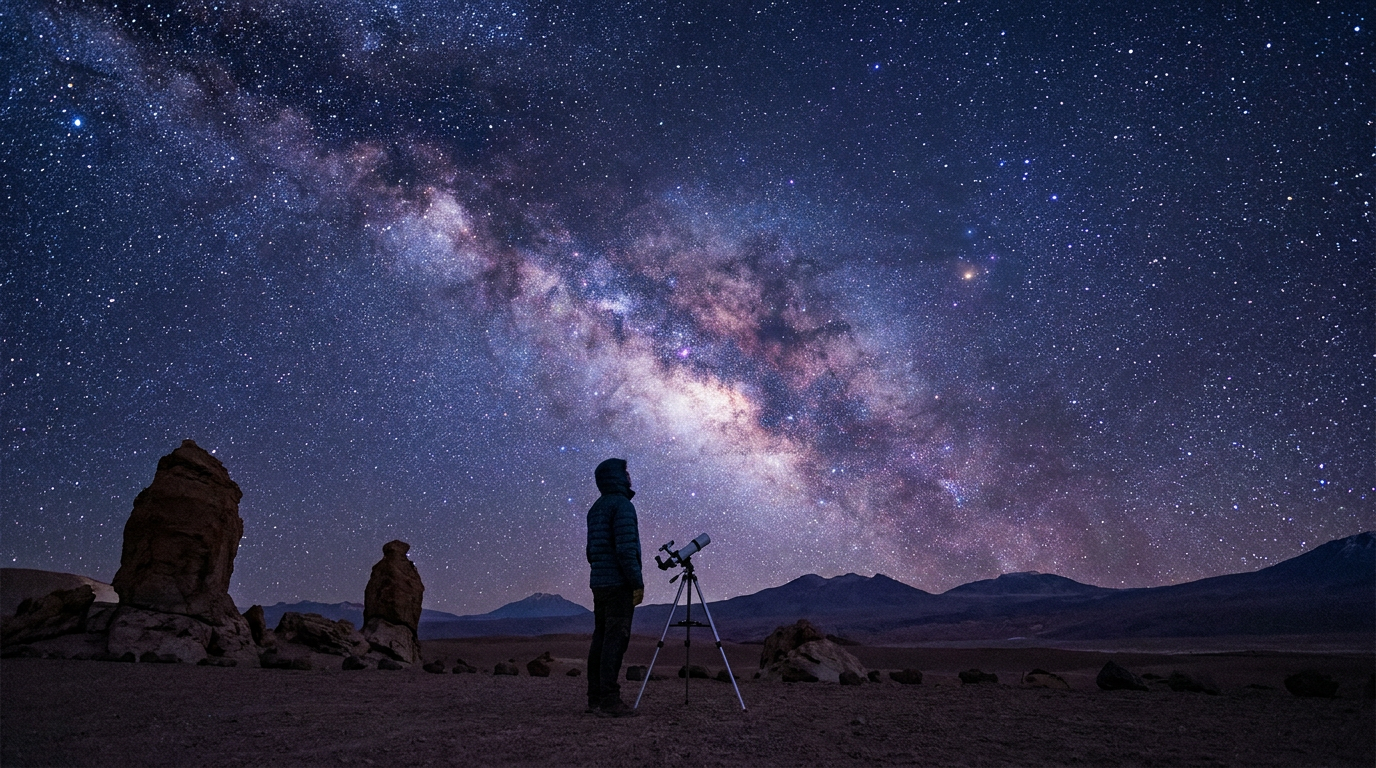
The modern urbanite’s sky is increasingly empty. Today, over eighty percent of the United States population—and a similarly staggering percentage of the global public—lives under a persistent veil of artificial light that completely obscures the cosmos. For generations, humanity’s connection to the stars was a shared, universal experience, but the rapid expansion of urban infrastructure and unshielded lighting has transformed natural darkness into an endangered environmental state. However, as the glow of cities expands, a profound shift in global travel behavior is accelerating in response. Travelers are no longer just seeking out pristine beaches or untouched forests; they are actively hunting for the absence of light. This pursuit has birthed a booming sector that is reshaping the map of remote travel, turning the simple act of looking up into a highly sought-after commodity.[6]
Often referred to as noctourism, astrotourism has rapidly evolved from a niche hobby reserved for amateur astronomers into a mainstream, high-demand travel trend. Driven by a collective desire to unplug from hyper-connected lives and reconnect with the raw scale of the natural world, travelers are increasingly charting courses to the darkest, most isolated corners of the planet. Tour operators and luxury travel networks report massive year-over-year increases in enrollment for astronomy-focused programs, with a majority of surveyed travelers indicating plans to visit dark-sky destinations in the coming years. This shift represents a fundamental evolution in ecotourism, where the primary attraction is not located on the ground, but rather suspended millions of light-years above it.[1]
The timing of this travel boom is entirely celestial. The Earth is currently navigating a period of solar maximum, a phase in the sun's magnetic cycle that produces spectacular, highly active auroral displays. These northern and southern lights are currently visible much further toward the equator than usual, drawing millions of travelers to high-latitude destinations. Combined with highly anticipated celestial events—such as the European Total Solar Eclipse slated for August 2026—the travel industry has effectively dubbed this era the golden age of stargazing. From budget backpackers pitching tents in the desert to affluent tourists booking private glass igloos, the demographic of the astrotourist is expanding rapidly, united by the pursuit of a pristine cosmic view.[1]
Before travelers pack their bags and telescopes, they must first understand the fundamental metric that governs this new frontier of exploration: the Bortle Scale. Created in 2001 by amateur astronomer John E. Bortle, this nine-level numeric scale measures the brightness of the night sky and the observability of celestial objects in a specific location. It provides a standardized language for astrotourists to evaluate exactly what they will be able to see before they book a flight. The scale ranges from Class 1, representing an exceptionally dark, pristine sky, all the way up to Class 9, which denotes a heavily light-polluted inner-city sky where only the moon and a few bright planets can pierce the glare.[6]

Most modern city dwellers live their entire lives under a Bortle 8 or 9 sky, entirely disconnected from the galactic phenomena that defined ancient navigation and mythology. True astrotourism targets environments that rank as Bortle 1 or 2. In these exceptionally rare locations, the Milky Way is not just a faint smudge, but a highly detailed, structured band of light that is bright enough to cast distinct shadows on the ground. Thousands of stars blanket the horizon, and phenomena like the zodiacal light—a faint, triangular glow of sunlight scattered by interplanetary dust—become clearly visible to the naked eye. Finding and protecting these Class 1 skies has become the central mission of the astrotourism movement.[6]
Locating these pristine skies requires rigorous, third-party verification to ensure travelers are getting the experience they expect. Enter DarkSky International, a pioneering nonprofit organization that has become the de facto global authority on light pollution and night sky conservation. Through its International Dark Sky Places program, the organization evaluates and certifies locations around the world that meet incredibly strict criteria for natural darkness. This certification process is modeled heavily on other major conservation and environmental designation programs, such as the UNESCO World Heritage Sites and Biosphere Reserves, lending it significant international credibility.[3]
As of early 2026, there are over two hundred and fifty certified Dark Sky Places worldwide, scattered across dozens of countries and every continent except Antarctica. The organization divides these locations into several distinct categories based on their size, management, and proximity to populated areas. International Dark Sky Parks are protected public lands with exceptional night skies, while International Dark Sky Reserves consist of a dark core zone surrounded by populated peripheral areas that have agreed to strict lighting policies. There are also certifications for communities and urban places that, while not perfectly dark, demonstrate a profound commitment to responsible lighting.[3]
The most prestigious and fragile category within this framework is the International Dark Sky Sanctuary. A sanctuary differs from a park or reserve in that it is typically situated in a profoundly remote location with few, if any, nearby threats to the quality of its dark night skies. Places like the Aotea Great Barrier Island in New Zealand or the Gabriela Mistral Dark Sky Sanctuary in Chile represent the absolute gold standard of natural darkness. These sanctuaries are often geographically isolated, requiring significant effort to reach, which inherently limits mass tourism and helps preserve the delicate nocturnal ecosystems that thrive in the absence of artificial light.[3]
Achieving any of these DarkSky certifications is not merely a matter of being located far from a major city; it requires an active, legally binding commitment to responsible lighting policies. Certified places must undergo comprehensive audits of their existing infrastructure and commit to retrofitting non-compliant fixtures. This means installing energy-efficient, fully shielded lighting that points directly downward, utilizing warm-amber LEDs rather than harsh blue-white lights, and ensuring that illumination is only used when and where it is strictly necessary. These measures drastically minimize skyglow and prevent artificial light from scattering into the atmosphere.[3]

Certified places must undergo comprehensive audits of their existing infrastructure and commit to retrofitting non-compliant fixtures.
The economic incentives for rural municipalities to pursue these rigorous certifications are staggering. Unlike traditional forms of tourism, which often require massive, capital-intensive infrastructure investments in the form of mega-resorts, theme parks, or expansive transit systems, astrotourism relies on a natural resource these remote communities already possess in abundance: the dark. By simply protecting their night skies, rural destinations can attract a highly motivated, high-spending demographic of travelers without fundamentally altering the character or landscape of their towns.[2]
The financial impact of this low-impact tourism model is already being quantified with impressive results. A landmark economic study conducted by researchers at Missouri State University analyzed the potential impact of dark sky tourism on the Colorado Plateau—a vast, rugged region spanning parts of Arizona, Colorado, New Mexico, and Utah that boasts a high concentration of certified parks. The study forecasted that non-local astrotourists visiting the region specifically for its dark skies will spend an estimated $5.8 billion over a ten-year period, representing a massive injection of outside capital into local economies.[2]
This influx of astrotourism spending is projected to generate $2.4 billion in wages and create more than ten thousand additional jobs each year across the Colorado Plateau region alone. Furthermore, because optimal stargazing conditions—characterized by longer nights and crisper, less humid air—are often found during the colder, non-summer months, astrotourism provides a crucial tool for managing tourism seasonality. It allows destinations to attract visitors year-round, stabilizing local employment and providing a reliable revenue stream for hotels, restaurants, and guide services during traditional off-seasons.[2]

The socio-economic benefits of the astrotourism boom extend far beyond the borders of North America, proving particularly transformative in developing nations. In the remote, arid region of Sutherland, South Africa, the establishment of major astronomical observatories, including the Southern African Large Telescope, has fundamentally altered the trajectory of the local economy. What was once a struggling agricultural town has been revitalized by a steady stream of domestic and international visitors drawn to the pristine, unpolluted skies of the Karoo desert.[4][5]
According to extensive research and field studies conducted by the Office of Astronomy for Development, astrotourism initiatives in Sutherland have directly catalyzed the creation of local jobs and spurred a dramatic increase in the number of tourist accommodations. This sustainable revenue stream has been credited with combating severe unemployment and the associated social issues that often plague isolated rural communities. By training locals as astronomy guides and establishing community development centers, the region has successfully leveraged its dark skies to raise the overall quality of life for its residents.[4][5]
Similarly, the Dark Sky Alqueva reserve, which spans multiple municipalities across the borders of Portugal and Spain, made history by becoming the world’s first Transboundary Starlight Destination. This massive protected area has cultivated a highly specialized network of rural tourism operators who have adapted their entire business models to the nocturnal schedule of astrotourists. Local businesses now offer late-night dinners, midnight horseback riding, nighttime canoeing, and guided telescope tours, proving that an entire regional economy can successfully pivot to operate under the stars.[6]
However, the rapid acceleration of astrotourism is not without its inherent paradoxes and challenges. The sudden influx of thousands of visitors to fragile, remote ecosystems brings the very real risk of introducing the exact pollution they are traveling to escape. Increased vehicular traffic means more headlights sweeping across the landscape, and the construction of new accommodations to house these tourists can easily introduce new, unregulated light sources if local zoning laws are not strictly enforced. Managing this carrying capacity is the primary hurdle for newly certified destinations.[5]

To combat this threat, DarkSky International ensures that its certifications are never awarded in perpetuity. Certified sites are subject to rigorous, ongoing reviews and must submit annual reports detailing their sky quality measurements and community outreach efforts. A destination can, and will, have its certification revoked if it fails to maintain the minimum program requirements. Disqualifying actions include permitting new commercial development with non-compliant lighting, failing to conduct regular night sky monitoring, or neglecting the educational programs that justify the sanctuary's existence.[3]
Furthermore, academic researchers analyzing the global astrotourism market have noted that the economic benefits do not always distribute evenly. In some highly sought-after regions, the financial windfall disproportionately favors wealthy, non-local developers who have the capital to build luxury eco-lodges and private observatories. This dynamic can leave indigenous populations or long-standing rural residents with only indirect benefits, such as low-wage service jobs, rather than true ownership of the tourism infrastructure that is monetizing their ancestral skies.[5]
To address these inequities, organizations like the Starlight Foundation and the Office of Astronomy for Development strongly advocate for community-based tourism models. These frameworks prioritize grassroots involvement, ensuring that local populations are intimately involved in the planning and execution of astrotourism initiatives. By focusing on capacity building, technology transfer, and funding local entrepreneurs to start their own guide services, these organizations aim to democratize the benefits of astronomy-based tourism and ensure the wealth remains within the rural communities that steward the land.[4]
Ultimately, the global rise of astrotourism represents a rare, highly successful alignment of ecological conservation and sustainable economic development. By attaching a tangible, lucrative dollar value to natural darkness, this movement provides the ultimate financial incentive for municipalities to turn off the lights. As more travelers seek out the humbling, infinite expanse of a pristine Milky Way, astrotourism is quietly proving that protecting the night sky is not just an environmental imperative, but a highly profitable enterprise that restores humanity’s oldest connection to the cosmos.[6]
How we got here
2001
The Bortle Scale is created to standardize the measurement of night sky brightness, and the first International Dark Sky Places are certified.
2011
The Dark Sky Alqueva reserve in Portugal and Spain becomes the world's first certified Transboundary Starlight Destination.
2019
A landmark economic study forecasts that astrotourism will generate $5.8 billion over a decade in the Colorado Plateau region.
2024-2026
A period of solar maximum and highly anticipated solar eclipses drives astrotourism into a mainstream, high-demand travel trend.
Viewpoints in depth
Conservationists & Astronomers
Focuses on preserving the night sky and protecting nocturnal habitats from light pollution.
For organizations like DarkSky International, astrotourism serves as a Trojan horse for environmental protection. By attaching a tangible dollar value to natural darkness, they can successfully incentivize local municipalities to enact strict lighting ordinances that would otherwise be ignored. Their primary concern moving forward is ensuring that the tourism boom doesn't inadvertently introduce new light pollution through unregulated hotel developments or increased vehicular traffic in fragile nocturnal habitats.
Rural Economic Developers
Views the dark sky as an untapped natural resource capable of reversing rural economic decline.
For remote municipalities and NGOs, astrotourism represents a rare economic lifeline that requires almost zero hard infrastructure to monetize. Researchers emphasize that this low-impact tourism model can reverse rural brain drain and provide crucial year-round income. However, they caution that the financial benefits must be actively democratized—through community-based training and local ownership—to prevent the windfall from flowing exclusively to outside luxury developers.
Travel Industry Operators
Sees astrotourism as the ultimate premium experience for a burned-out, hyper-connected populace.
Tour operators and luxury travel networks are rapidly scaling up their astrotourism offerings to meet explosive consumer demand. From budget-friendly telescope tours to VIP glass igloos, the industry is heavily marketing the opportunity to unplug under the stars. Operators are strategically timing their packages around solar maximums, eclipses, and meteor showers, viewing the night sky not just as a conservation target, but as a highly lucrative, infinitely renewable attraction.
What we don't know
- How effectively remote destinations will manage the carrying capacity of increased tourist traffic without degrading the fragile nocturnal ecosystems they are trying to protect.
- Whether the economic benefits of astrotourism will be equitably distributed to local and indigenous populations, rather than being monopolized by outside luxury developers.
Key terms
- Astrotourism
- A form of sustainable travel focused on visiting remote destinations with minimal light pollution to observe celestial phenomena.
- Bortle Scale
- A nine-level numeric scale used by astronomers to measure the brightness of the night sky and the observability of stars.
- Skyglow
- The brightening of the night sky over inhabited areas, caused by artificial light scattering in the atmosphere.
- Dark Sky Sanctuary
- The most remote and fragile category of certified dark sky places, possessing exceptional starry nights and minimal nearby light threats.
- Light Pollution
- The inappropriate or excessive use of artificial light, which disrupts ecosystems and obscures the natural night sky.
Frequently asked
What is a Dark Sky Sanctuary?
A Dark Sky Sanctuary is a highly remote public or private land possessing exceptional starry nights. It is legally protected for its scientific and natural value and is situated far from any nearby light pollution threats.
How does a destination get certified?
Locations must submit a rigorous application to DarkSky International. The process requires implementing strict, responsible lighting policies, conducting public education, and regularly monitoring night sky quality.
What is the Bortle Scale?
The Bortle Scale is a nine-level numeric system used to measure the brightness of the night sky. Class 1 represents an exceptionally dark, pristine sky, while Class 9 denotes a heavily light-polluted inner-city sky.
Why is astrotourism economically beneficial?
It relies on an existing natural resource—the dark sky—requiring minimal new infrastructure. It also attracts visitors during colder, off-peak seasons, providing year-round revenue for rural communities.
Sources
Source coverage
6 outlets
3 viewpoints surfaced






[1]VirtuosoTravel Industry Operators
The Darker the Sky, the Better: Astrotourism Trends
Read on Virtuoso →[2]Miles PartnershipRural Economic Developers
Studying Dark Sky Tourism's Potential Economic Impacts
Read on Miles Partnership →[3]DarkSky InternationalConservationists & Astronomers
International Dark Sky Places Program
Read on DarkSky International →[4]Astronomy for DevelopmentRural Economic Developers
Empowering Rural Communities through Astrotourism
Read on Astronomy for Development →[5]arXivRural Economic Developers
The Socio-Economic Impact of Astrotourism in Rural Areas
Read on arXiv →[6]Factlen Editorial TeamTravel Industry Operators
Synthesis by Factlen editorial team
Read on Factlen Editorial Team →
More in travel
See all 48 stories →Sustainable Travel
The Definitive Guide to Kyoto's 'Hands-Free Travel' and Sustainable Tourism Rules in 2026
7 sources

Astrotourism
The Rise of Astrotourism: How the Search for Dark Skies is Reshaping Travel
7 sources
Biometric Security
How Biometric Airport Security Actually Works (and Protects Your Data)
6 sources
EV Tech
The 2026 Guide to Planning an EV Road Trip
8 sources

Every angle. Every day.
Get travel stories with full source coverage and perspective breakdowns delivered to your inbox.