
The Rise of Stratospheric Balloon Tourism: How the Edge of Space Became Accessible
In 2026, commercial stratospheric balloons are offering passengers the astronaut experience without the extreme costs, G-forces, or carbon footprint of rocket launches.
By Factlen Editorial Team
- Astro-Tourism Advocates
- Focus on the consumer experience, soft adventure, and democratizing the astronaut experience.
- Environmental Pragmatists
- Focus on the massive carbon savings of hydrogen balloons over traditional rocket launches.
- Aerospace & Defense Analysts
- Focus on the corporate viability, acquisitions, and dual-use military applications of balloon technology.
- Traditional Spaceflight Trackers
- Focus on the broader space tourism market, comparing the balloon experience to suborbital rockets.
What's not represented
- · Aviation Regulators
- · Climate Scientists studying upper atmosphere impacts
Why this matters
Stratospheric balloons are democratizing the 'overview effect,' allowing a broader demographic to experience the curvature of the Earth. This shift also represents a massive reduction in the carbon footprint associated with space tourism.
Key points
- Commercial stratospheric balloon flights are launching in 2026 from operators like Halo Space and Zephalto.
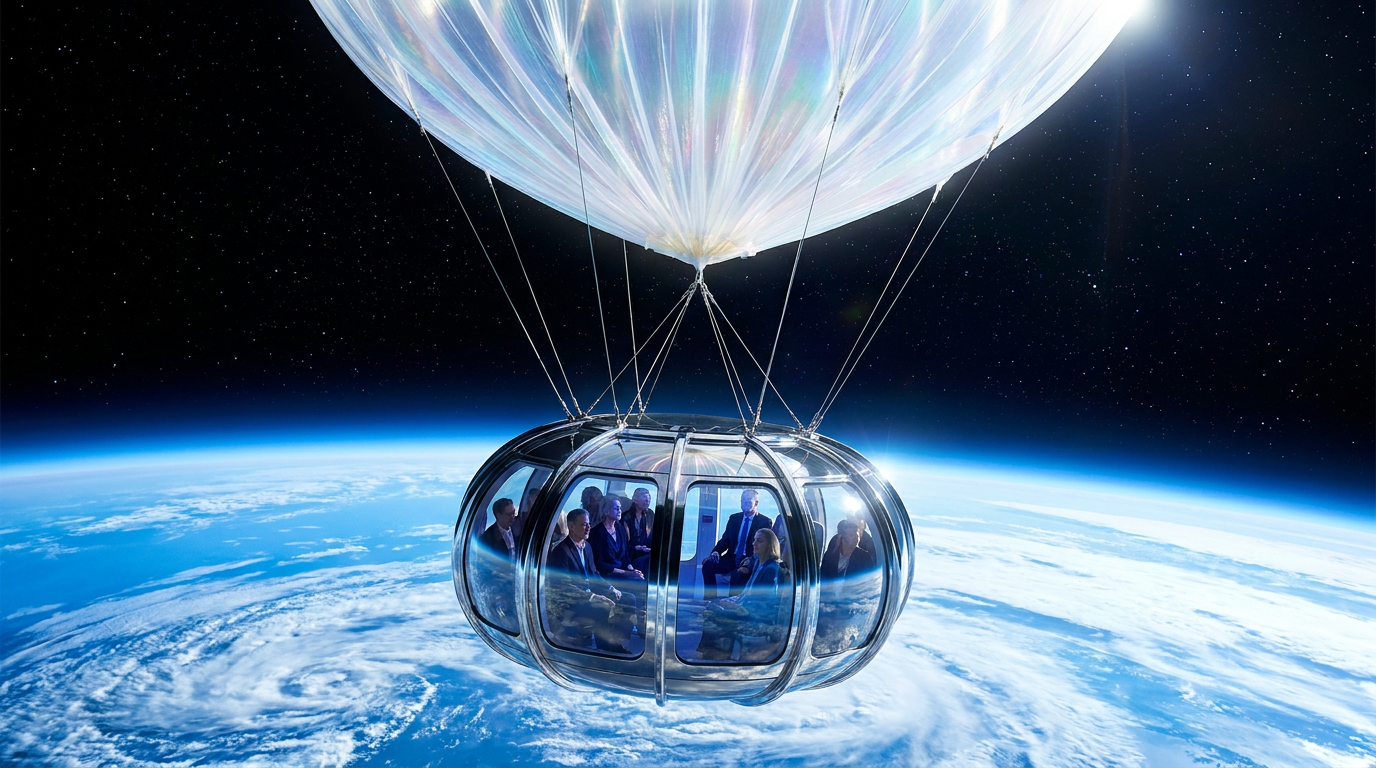
- Passengers travel in pressurized capsules to 30 kilometers altitude, viewing the Earth's curvature and the blackness of space.
- Unlike suborbital rockets, balloons offer a gentle, hours-long experience with zero G-forces and normal Earth gravity.
- The carbon footprint of a hydrogen balloon flight is a tiny fraction of a traditional rocket launch.
- The industry has faced consolidation, with companies like Space Perspective and World View undergoing acquisitions.
The billionaire space race of the early 2020s was defined by fire, crushing G-forces, and extreme exclusivity. But in 2026, the frontier of adventure travel has shifted from the explosive to the serene. Stratospheric balloon tourism has officially transitioned from a speculative concept to a commercial reality, offering a radically different path to the edge of space. Companies across the globe are racing to capture this new market. France's Zephalto and Saudi-backed Halo Space are both preparing to launch their first commercial passenger flights this year, aiming to provide the quintessential astronaut view without the physical toll of a rocket launch. This shift represents a maturation of the space tourism industry, moving away from pure adrenaline and toward accessible, awe-inspiring exploration.[1][2][9]
The mechanism behind these flights relies on proven, decades-old high-altitude balloon technology, updated with modern aerospace materials and luxury hospitality. Instead of riding atop a controlled explosion, passengers step into a pressurized, climate-controlled capsule suspended beneath a massive balloon filled with lighter-than-air gas, typically helium or green hydrogen. The ascent is agonizingly slow by aerospace standards—rising at roughly 12 miles per hour. Over the course of two hours, the balloon climbs to a cruising altitude of approximately 30 kilometers (about 19 miles), lifting travelers above 99 percent of Earth's atmosphere. At this extreme altitude, the visual experience mimics that of orbital astronauts. The sky transitions from the familiar blue to the absolute black of the cosmos, and the bright blue curvature of the Earth becomes starkly visible against the void.
This vantage point triggers what psychologists and astronauts call the "overview effect"—a profound cognitive shift and sense of interconnectedness that comes from seeing the planet as a fragile, unified sphere. Balloon operators are betting that travelers will pay a premium for this psychological experience, even if they never technically cross the 100-kilometer Kármán line that defines outer space. The physical experience, however, is fundamentally different from suborbital rocket flights offered by companies like Virgin Galactic or Blue Origin. There are no heavy G-forces during launch or reentry, no need for specialized pressure suits, and no rigorous physical training required prior to boarding. It is an experience designed for the general public rather than trained test pilots.[6]

Crucially, there is also no weightlessness on these stratospheric journeys. Because the capsule is simply floating in the upper atmosphere rather than falling back to Earth or orbiting at high speeds, passengers experience normal Earth gravity throughout the entire journey. They can walk around the spacious cabin, sip cocktails from the onboard bar, and use high-speed Wi-Fi to livestream the view to friends and family back home. The economics of the stratosphere are also reshaping the space tourism market. While a seat on a suborbital rocket currently costs upwards of $450,000, balloon operators are targeting a slightly more accessible tier of luxury travel. Halo Space is pricing its 2026 flights between $100,000 and $164,000, while Zephalto's luxury "Céleste" experience costs roughly €170,000. Arizona-based World View has advertised future flights for as low as $50,000.[1][2][4]
Crucially, there is also no weightlessness on these stratospheric journeys.
This price drop coincides with a broader shift in the aerospace industry. In early 2026, Blue Origin announced a multi-year pause on its New Shepard suborbital flights to redirect resources toward its Blue Moon lunar lander contracts for NASA. This pivot has left a temporary vacuum in the near-space tourism market, which balloon operators are eager to fill. Environmental concerns are also driving the pivot toward balloon-based exploration. Traditional rocket launches deposit black carbon, alumina, and other pollutants directly into the fragile upper atmosphere, raising long-term climate concerns as launch cadences increase. In stark contrast, balloon operators are leaning heavily into eco-tourism credentials. Zephalto, for instance, claims its green-hydrogen flights generate just 26.6 kilograms of CO2 per passenger. This footprint is roughly equivalent to a 140-mile journey in a standard combustion-engine car, making it vastly more sustainable than rocket propulsion.[2][6]
However, the path to commercial operations hasn't been entirely smooth. The balloon tourism industry has faced significant financial and logistical turbulence over the past two years as startups struggled to transition from research and development to active flight operations. Space Perspective, once a highly publicized darling of the balloon tourism sector, faced a severe cash crunch in 2025. After being evicted from its Florida airport facilities due to unpaid rent, the company was acquired by the Spanish firm Eos X Space. Under new ownership, they are now targeting late 2026 for their commercial debut. Meanwhile, World View was acquired by the defense technology firm Ondas in April 2026. While the company maintains its civilian tourism ambitions, its immediate revenue is increasingly coming from military intelligence contracts. In June 2026, World View secured a $4.8 million deal to provide high-altitude surveillance balloons for the U.S. Navy's Southern Command.[3][4][5][6]

Despite these corporate growing pains, underlying consumer demand remains remarkably robust. Global travel reports for 2026 highlight "astro-tourism" and "soft adventure" as dominant trends reshaping the hospitality industry. Travelers are increasingly seeking profound, immersive experiences that prioritize connection and awe over pure adrenaline or physical exhaustion. The regulatory framework governing these flights is also maturing rapidly to meet this demand. Aviation authorities in Europe, the United States, and the Middle East have established clear certification pathways for pressurized stratospheric capsules, treating them more like specialized commercial aircraft than experimental spacecraft. A typical flight concludes with a gentle, two-hour descent. Depending on the operator, the capsule either vents gas to slowly lower the balloon or detaches to glide back to Earth beneath a massive, steerable parafoil, landing safely on the ground or in the ocean.[7][8]
As the first commercial passengers prepare to float back down to Earth this year, they mark the beginning of a new era of human exploration. The edge of space is no longer just a destination for test pilots, government astronauts, and eccentric billionaires. It is rapidly becoming a premium, accessible extension of the global adventure travel market. By combining the awe-inspiring vistas of orbital flight with the comfort and sustainability of modern eco-tourism, stratospheric balloons are redefining what it means to leave the Earth. The success of these early flights will likely dictate the pace of innovation for the next decade, potentially driving ticket prices down further and opening the stratosphere to an even wider audience.[9]
How we got here
2012
World View Enterprises is founded, pioneering modern commercial stratospheric balloon technology.
2021
Space tourism gains global attention with high-profile suborbital rocket launches by Blue Origin and Virgin Galactic.
2025
Space Perspective faces financial difficulties and is acquired by Eos X Space, highlighting industry growing pains.
Early 2026
Blue Origin pauses New Shepard flights, leaving a vacuum in the near-space tourism market.
Late 2026
Halo Space and Zephalto prepare to launch their first commercial passenger balloon flights.
Viewpoints in depth
Astro-Tourism Advocates
Viewing stratospheric balloons as the democratization of the astronaut experience.
Proponents emphasize that the 'overview effect'—the profound cognitive shift experienced when viewing Earth from above—should not be restricted to highly trained astronauts or billionaires willing to ride controlled explosions. By removing the physical barriers of G-forces and the need for specialized suits, balloon operators argue they are opening the edge of space to a much broader demographic, fundamentally changing how humanity views its home planet.
Environmental Pragmatists
Focusing on the drastic reduction in emissions compared to rocket-based tourism.
For eco-conscious analysts, the appeal of balloon tourism lies in its carbon math. Suborbital rockets deposit black carbon and other pollutants directly into the fragile upper atmosphere. In contrast, operators like Zephalto use green hydrogen to achieve lift, resulting in a carbon footprint comparable to a short road trip. However, some pragmatists still question the allocation of resources and sustainable materials for ultra-luxury tourism.
Traditional Aerospace Purists
Arguing that balloon flights fall short of true space exploration.
Aerospace traditionalists are quick to point out the technical definitions of spaceflight. Because these balloons cruise at roughly 30 kilometers—well below the 100-kilometer Kármán line—and do not achieve orbital velocity, passengers do not experience weightlessness. From this perspective, stratospheric balloons are essentially high-altitude aviation rather than true space tourism, offering a spectacular view but lacking the defining physical characteristics of space travel.
What we don't know
- How quickly operators can scale their launch cadences to meet the backlog of thousands of ticket holders.
- Whether the $50,000 to $170,000 price point will drop further as the technology matures and economies of scale take effect.
- How international aviation regulators will standardize airspace management for fleets of slow-moving stratospheric balloons.
Key terms
- Stratosphere
- The second layer of Earth's atmosphere, extending to about 50 kilometers, where the sky appears black and the Earth's curvature is visible.
- Kármán Line
- The internationally recognized boundary of space, located at 100 kilometers (62 miles) above sea level.
- Overview Effect
- A profound cognitive shift reported by astronauts when viewing the Earth from space, characterized by a feeling of awe and interconnectedness.
- Zero-Pressure Balloon
- A high-altitude balloon that vents gas to maintain a zero pressure difference with the outside environment, allowing it to float stably in the stratosphere.
Frequently asked
Do you experience zero gravity on these flights?
No. Because the balloon does not achieve orbital velocity or enter a free-fall trajectory, passengers experience normal Earth gravity throughout the entire flight.
Is it actually space?
Technically, no. The flights reach about 30 kilometers (19 miles), which is above 99% of the atmosphere but well below the 100-kilometer Kármán line that defines outer space.
What kind of training is required?
Unlike rocket flights, balloon tourism requires no specialized physical training or spacesuits due to the gentle ascent and pressurized, climate-controlled cabin.
Sources
Source coverage
9 outlets
4 viewpoints surfaced









[1]شركات مباشرAstro-Tourism Advocates
Launching Ambitions: How Saudi Arabia's Space Sector Is Attracting Capital, Startups & Global Partners Toward Vision 2030
Read on شركات مباشر →[2]GrokipediaEnvironmental Pragmatists
List of planned stratospheric balloons
Read on Grokipedia →[3]ACCESS NewswireAerospace & Defense Analysts
Ondas' World View Selected as Stratospheric High-Altitude Balloon Provider for U.S. Navy SOUTHCOM Maritime Domain Awareness Program
Read on ACCESS Newswire →[4]WikipediaAerospace & Defense Analysts
World View Enterprises
Read on Wikipedia →[5]Travel WeeklyTraditional Spaceflight Trackers
Space Perspective's balloon dreams deflate
Read on Travel Weekly →[6]Orbital RadarTraditional Spaceflight Trackers
Space Tourism 2026 — Flights, Costs, Providers & Complete Flight Log
Read on Orbital Radar →[7]Nayara Resorts BlogAstro-Tourism Advocates
The Top 10 Travel Trends of 2026
Read on Nayara Resorts Blog →[8]Travel CounsellorsAstro-Tourism Advocates
Adventure Travel Trends for 2026: Ready for Your Next Big Escape?
Read on Travel Counsellors →[9]Factlen Editorial TeamEnvironmental Pragmatists
Synthesis by Factlen editorial team
Read on Factlen Editorial Team →


Every angle. Every day.
Get travel stories with full source coverage and perspective breakdowns delivered to your inbox.