
The Iron Path: How Via Ferratas Democratized the Vertical World
Originally built for soldiers during World War I, via ferratas have evolved into a booming global outdoor sport. Here is the history, physics, and gear that make scaling sheer cliffs safely accessible to hikers.
By Factlen Editorial Team
- Outdoor Tourism Advocates
- This camp views via ferratas as a powerful tool for rural economic development and accessible recreation.
- Alpine Safety Experts
- This group focuses on the unique physics of via ferrata falls and the absolute necessity of specialized gear.
- Mountain Guides & Purists
- This perspective prioritizes historical preservation, accurate grading, and respect for the alpine environment.
What's not represented
- · Traditional rock climbers concerned about overcrowding and the bolting of natural rock faces.
Why this matters
As outdoor recreation booms, millions of hikers are venturing onto high-altitude iron paths. Understanding the unique physics of via ferrata gear is critical—using standard climbing equipment on these routes can be a fatal mistake.
Key points
- Via ferratas are mountain routes equipped with fixed steel cables, ladders, and rungs, allowing hikers to safely navigate vertical cliffs.
- The original 'iron paths' were constructed in the Italian Dolomites during World War I to move troops and artillery across high alpine ridges.
- Standard rock climbing gear is highly dangerous on a via ferrata due to extreme 'fall factors' that generate massive impact forces.
- Climbers must use a specialized via ferrata set equipped with an Energy Absorbing System (EAS) that tears open to cushion a fall.
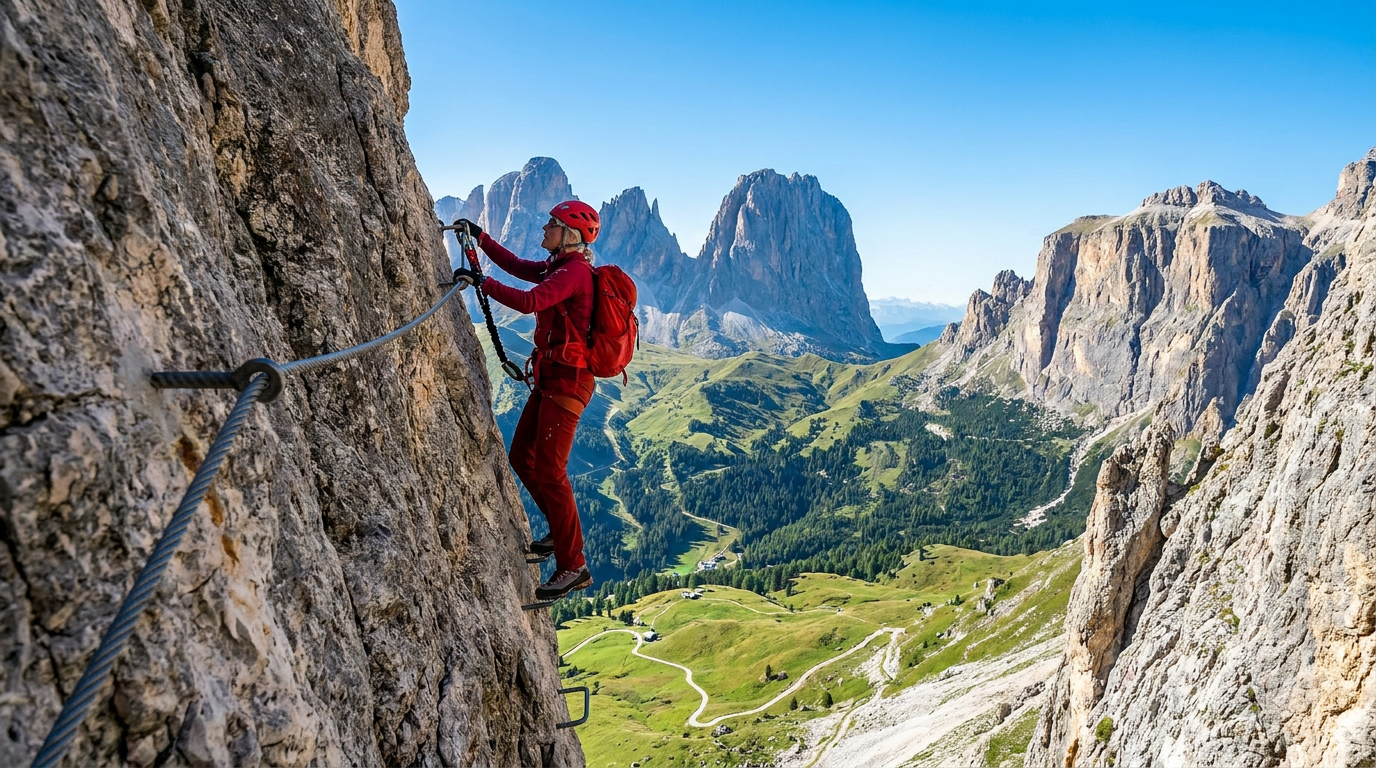
Hanging hundreds of feet above a sweeping alpine valley, a hiker steps onto a small iron rung driven into a sheer limestone cliff. To their left is a breathtaking view of jagged peaks; to their right, a continuous steel cable bolted directly into the mountain. They are not a professional rock climber, nor are they relying on a complex system of ropes and belay partners. They are traversing a via ferrata—an "iron path" that bridges the gap between a strenuous hike and technical mountaineering.
Over the past decade, and particularly following the post-pandemic surge in outdoor recreation, via ferratas have exploded in popularity. What was once a niche European alpine curiosity has rapidly evolved into a global hybrid sport. Recent academic reviews note a massive expansion of these structured climbing systems across North America, while tourism boards in China report that via ferrata installations are drawing record crowds and revitalizing rural economies. The appeal is straightforward: it offers the visceral thrill of vertical exposure without requiring years of technical climbing training.[2][5]
The origins of these iron paths, however, are rooted in survival rather than recreation. During the First World War, the jagged peaks of the Italian Dolomites became a brutal, high-altitude battleground. Between 1914 and 1917, Italian Alpini troops and Austro-Hungarian Kaiserjäger fought a ferocious war of attrition along a 230-mile front, battling not only each other but extreme cold, avalanches, and treacherous terrain.[1]
To move troops, artillery, and supplies across these impassable ridges, military engineers constructed a vast network of fixed lines. They drove iron pitons into the rock, strung thick ropes across chasms, and bolted wooden ladders up vertical faces. This "vertical front" allowed soldiers to navigate the high alpine environment in all conditions, though the rudimentary infrastructure offered little in the way of modern safety.[1]

After the war, the military abandoned the routes, leaving the ropes to rot and the wood to splinter. It wasn't until the 1930s, and more systematically after the Second World War, that organizations like the Italian Alpine Club began restoring them. They replaced the decaying wartime infrastructure with thick steel cables and sturdy iron rungs, transforming the battlefields into accessible historical monuments and laying the groundwork for modern adventure tourism.[1]
Today, the fundamental mechanism of a via ferrata remains the same: a continuous steel lifeline bolted to the rock face every few meters. Climbers use this cable both as a handhold for upward progression and as a fail-safe anchor. But while the mountain infrastructure is simple, the personal safety equipment required to navigate it is a marvel of modern engineering, designed to solve a unique and deadly physics problem.[3]
A climber navigates the iron path using a specialized via ferrata set attached to a standard climbing harness. This set consists of two elasticized lanyards, each ending in an auto-locking carabiner, and a central Energy Absorbing System (EAS). As the climber ascends, they clip both carabiners to the steel cable. When they reach an anchor point where the cable is bolted to the rock, they unclip and re-clip the carabiners one at a time, ensuring they are never fully detached from the mountain.[3]
A climber navigates the iron path using a specialized via ferrata set attached to a standard climbing harness.
The critical component of this setup is the EAS, which addresses the severe danger of "fall factors" in climbing. In traditional rock climbing, a long, dynamic rope stretches to absorb the kinetic energy of a falling climber. On a via ferrata, a climber might be attached to the cable by a lanyard that is only one meter long. If they slip just before reaching the next anchor point, they could slide several meters down the cable before their carabiners slam into the bolt below.[4]
This scenario creates a massive fall factor—the ratio of the fall distance to the length of the arresting material. A five-meter fall on a one-meter static lanyard generates an impact force so violent that it would almost certainly snap the carabiners, tear the harness, or cause catastrophic spinal injuries to the climber. A standard static sling or rope is entirely useless, and highly dangerous, in this environment.[4]
To survive such a fall, the kinetic energy must be dissipated. The EAS achieves this through a progressive tearing mechanism. Housed in a small pouch near the harness, the EAS consists of a long length of webbing stitched together with specialized binding yarns. In the event of a high-impact fall, these stitches are engineered to intentionally rip apart. As the webbing unspools and tears—deploying up to 2.2 meters under current European safety standards—it acts as a shock absorber, cushioning the climber's deceleration and keeping the impact force within survivable limits.[3][4]

Because the EAS is a single-use emergency deployment system, a via ferrata set must be retired immediately if it ever sustains a major fall. The gear is designed to save a life, not to facilitate repeated drops. Consequently, the golden rule of via ferrata climbing is simple: do not fall. The equipment is a last resort, and climbers must rely on their physical strength, technique, and the iron rungs to maintain steady, controlled upward progress.[3]
To help climbers choose routes that match their physical abilities, various grading systems have been developed. Because via ferratas bridge the gap between hiking and climbing, these scales must account for a unique blend of factors, including the steepness of the rock, the distance between artificial holds, the length of the route, and the sheer psychological exposure of hanging over a void.[6]
In Switzerland and Germany, the Hüsler scale is widely used, grading routes from K1 (easy, well-secured paths) to K6 (extremely difficult, overhanging rock requiring immense arm strength). Austria utilizes a similar alphabetical scale ranging from A to F. These systems provide a quick shorthand for climbers to assess whether a route will be a scenic scramble or a grueling upper-body workout.[6]

In the Dolomites, the historic home of the sport, the grading is often more nuanced. The Italian system frequently employs a dual-rating approach, combining the Fletcher/Smith scale for overall terrain difficulty with the Hofler/Werner scale for technical climbing requirements. This ensures that a climber understands both the physical exertion required and the level of mountaineering experience necessary to navigate the high alpine environment safely.[7]
As the sport continues to grow, the challenge for land managers and alpine clubs is balancing accessibility with safety and environmental stewardship. The iron paths offer a profound way to experience the vertical world, democratizing views once reserved for elite alpinists. By respecting the history of the routes, understanding the physics of the gear, and adhering to strict safety standards, a new generation of adventurers can safely explore the mountains from the inside out.[2][8]
How we got here
1914–1917
Italian and Austro-Hungarian troops build the first extensive iron paths in the Dolomites during WWI.
1930s
The Italian Alpine Club begins restoring wartime routes for civilian tourism.
1990s
Commercial development accelerates, spreading routes beyond Italy to Switzerland, France, and Austria.
2017
European safety standards (EN 958:2017) are updated to require longer, more robust energy absorbers for via ferrata sets.
2020s
A post-pandemic outdoor recreation boom drives rapid via ferrata expansion in North America and Asia.
Viewpoints in depth
Outdoor Tourism Advocates
This camp views via ferratas as a powerful tool for rural economic development and accessible recreation.
Tourism boards and local municipalities argue that via ferratas provide a sustainable economic engine for remote mountain towns. By offering a thrilling but managed experience, these routes attract a broader demographic than traditional technical climbing, boosting local hospitality and guiding services. Proponents emphasize that structured paths concentrate human impact into specific corridors, which can be more environmentally sustainable than off-trail scrambling.
Alpine Safety Experts
This group focuses on the unique physics of via ferrata falls and the absolute necessity of specialized gear.
Equipment manufacturers and alpine rescue teams constantly battle the misconception that a via ferrata is just a steep hike. They emphasize that the 'fall factor' on a fixed cable is far more severe than in dynamic rock climbing. Their primary focus is educating the public that improvised gear—like a static sling or a standard rope—will catastrophically fail in a fall, making certified Energy Absorbing Systems (EAS) a non-negotiable requirement for survival.
Mountain Guides & Purists
This perspective prioritizes historical preservation, accurate grading, and respect for the alpine environment.
Traditional alpine clubs and local guides serve as the stewards of the iron paths. They are concerned with maintaining the historical integrity of the original World War I routes in the Dolomites, ensuring they don't become overly commercialized 'amusement parks.' This camp advocates for rigorous, standardized grading systems so climbers don't underestimate routes, and they stress the importance of proper etiquette and environmental respect in fragile high-altitude ecosystems.
What we don't know
- How the rapid expansion of via ferratas in emerging markets like China and North America will impact local alpine ecosystems over the long term.
- Whether international climbing organizations will eventually unify the fragmented regional grading systems into a single global standard.
Key terms
- Via Ferrata
- Italian for 'iron path,' a mountain route equipped with fixed steel cables, ladders, and rungs to aid climbers.
- Fall Factor
- The ratio of the length of a fall to the length of the rope or lanyard arresting it; a key metric for determining impact force.
- Energy Absorbing System (EAS)
- A stitched webbing device on a via ferrata lanyard designed to tear open progressively to cushion a fall.
- Carabiner
- A specialized metal loop with a spring-loaded gate used to connect the climber's harness to the steel cable.
Frequently asked
Do I need to be a rock climber to do a via ferrata?
No. While some advanced routes require significant upper-body strength, many beginner routes are accessible to anyone with good fitness, a head for heights, and the proper safety gear.
Can I use regular rock climbing gear instead of a via ferrata set?
Absolutely not. Using a static sling or regular climbing rope without an Energy Absorbing System (EAS) can result in catastrophic gear failure or severe spinal injury during a fall.
Where are the best via ferratas located?
The Italian Dolomites are the historic birthplace and remain the most famous destination, but routes are now widespread across the Alps, North America, and increasingly in China.
Sources
Source coverage
8 outlets
3 viewpoints surfaced








[1]UIAAAlpine Safety Experts
Via Ferrata: History and Current Situation
Read on UIAA →[2]University of Eastern FinlandOutdoor Tourism Advocates
Via Ferrata's global rise prompts call for industry collaboration
Read on University of Eastern Finland →[3]Black Diamond EquipmentAlpine Safety Experts
QC Lab: Via Ferrata
Read on Black Diamond Equipment →[4]BarrabesAlpine Safety Experts
Via Ferrata: Gear, Safety, and Fall Factors
Read on Barrabes →[5]Global TimesOutdoor Tourism Advocates
Via Ferrata becomes a rising trend, boosting tourism
Read on Global Times →[6]Swiss Alpine ClubMountain Guides & Purists
Via Ferrata Grading Systems
Read on Swiss Alpine Club →[7]Guide DolomitiMountain Guides & Purists
Via Ferrata Grading Scales
Read on Guide Dolomiti →[8]Factlen Editorial Team
Synthesis by Factlen editorial team
Read on Factlen Editorial Team →
Every angle. Every day.
Get travel stories with full source coverage and perspective breakdowns delivered to your inbox.