
How Adaptive Technology is Transforming Competitive Esports
A new wave of modular controllers, AI-assisted inputs, and standardized handicap systems is dismantling physical barriers in competitive gaming. In 2026, esports is shifting from accessibility as an afterthought to fully inclusive tournament infrastructure.
By Factlen Editorial Team
- Accessibility Advocates
- Nonprofits pushing for systemic inclusion and the removal of digital barriers.
- Hardware Innovators
- Engineers focused on creating adaptable, low-latency input methods.
- Tournament Organizers
- League operators standardizing rules and grading for fair competition.
What's not represented
- · Able-bodied professional esports players adapting to mixed-ability tournaments.
- · Game developers tasked with coding deep accessibility features into legacy titles.
Why this matters
For decades, competitive gaming inadvertently sidelined millions of players with physical disabilities due to rigid hardware requirements. The standardization of adaptive technology means skill and strategy—not physical dexterity—are becoming the true metrics of esports talent.
Key points
- The esports industry is shifting to treat accessibility as a core competitive infrastructure rather than a casual bonus.
- Modular hubs allow players to map in-game commands to foot pedals, eye-trackers, and sip-and-puff devices.
- Tournaments in 2026 are adopting official disability grading systems to ensure fair play across different physical abilities.
- Grassroots hackathons are driving innovation in affordable, open-source adaptive controller designs.
- South Korea's Kakao Games has successfully matched nearly 100 disabled players with over 600 customized devices.
The traditional image of an esports athlete—executing hundreds of actions per minute on a standard mouse and keyboard—is undergoing a radical, inclusive redesign in 2026. For decades, competitive gaming inadvertently sidelined players with physical disabilities due to rigid hardware requirements that demanded specific hand mobility. Now, a convergence of modular hardware, AI-assisted software, and dedicated tournament infrastructure is dismantling those barriers.[6]
This shift was highly visible at the CES 2026 "Gaming for All" panel in Las Vegas, where industry leaders framed accessibility not as a charitable bonus, but as a core design expectation. The focus has moved from simply allowing disabled gamers to play casually, to equipping them to compete at the highest levels of professional esports.[1]
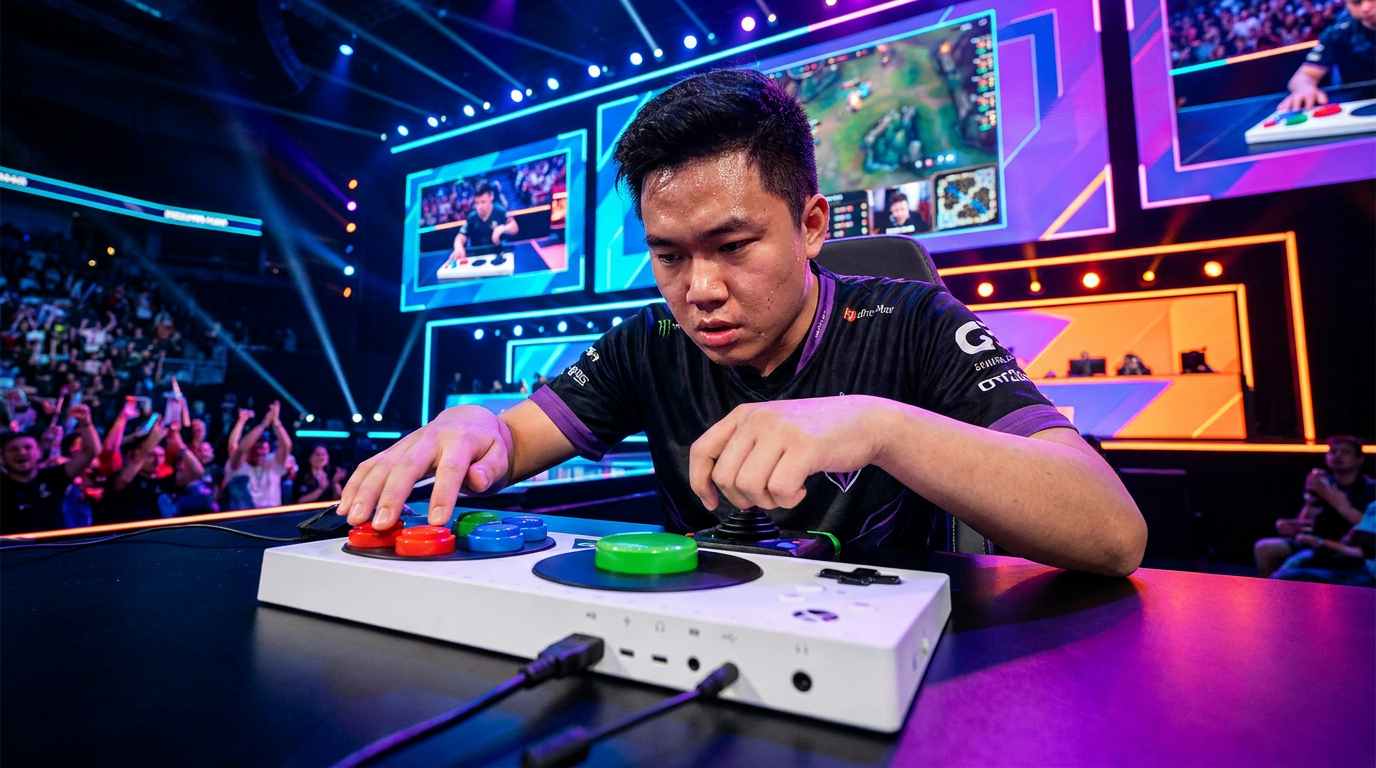
The foundation of this revolution is modular hardware. Devices like the Xbox Adaptive Controller and Sony's PlayStation Access Controller serve as unified digital hubs. Instead of forcing a player's hands to conform to a standard gamepad, these hubs allow players to plug in an array of external switches, buttons, and joysticks, mapping them to whatever physical movements the player can comfortably make.[5]
But the technology extends far beyond oversized buttons. For players with limited arm function, devices like the QuadStick—a mouth-operated joystick equipped with sip-and-puff sensors—translate breath and lip movements into complex in-game commands. Meanwhile, eye-tracking technology, such as the Tobii Eye Tracker 5, allows players to aim or navigate menus simply by looking at specific sectors of the screen.[1][5]

In South Korea, Kakao Games' "Play Buddy Together" program has been instrumental in matching disabled players with these highly customized setups. By early 2026, the initiative had successfully paired nearly a hundred players with over 600 specialized devices, proving that the primary barrier to entry is often just access to the right hardware.[1]
As the hardware matures, the next frontier is standardizing competitive play. How do tournament organizers ensure a level playing field when every competitor might be using a completely different input method? The answer lies in structured grading and handicap systems, similar to those used in the Paralympic Games.[6]
The 2026 Gippsland Esports Competition in regional Victoria, Australia, provides a blueprint for this integration. Hosted by the Australian Esports League, the June event integrates official Disability Sport Australia grading systems directly into its core competitive titles.[2]
The 2026 Gippsland Esports Competition in regional Victoria, Australia, provides a blueprint for this integration.
For example, in their premier racing competition using EA Sports F1 25, the tournament utilizes graded handicap tiers. The game's extensive driving assists—such as automatic braking and steering support—are calibrated alongside Xbox Adaptive Controllers to reduce cognitive and physical load, ensuring that advanced players and adaptive players can race side-by-side fairly.[2]

This integration requires significant logistical support. Tournament stations must be fully equipped with adaptive technology, and dedicated accessibility staff are required on-site to help players calibrate their custom layouts before a match begins. It represents a vital shift from a "bring your own device" mentality to fully supported, inclusive infrastructure.[2]
The momentum is global. In July 2026, South Africa will host the Konke Gamers Adaptive Esports Tournament (KGAET26) in Durban. Billed as the first adaptive esports tournament in Africa and created in partnership with AbleGamers, the event features specialized gaming setups and assistive input systems specifically tuned for competitive play.[3]
Beyond the competition itself, events like KGAET26 serve a crucial educational purpose. Live demonstrations and hands-on experiences with adaptive technology help demystify these tools for the broader public, showcasing how accessibility solutions are fundamentally transforming the digital landscape.[3]
Yet, hardware limitations still exist, prompting a wave of grassroots engineering. In March 2026, the Georgia Tech Esports Club partnered with the Center for Inclusive Design and Innovation to host Tech[HACK] Valley, a hackathon specifically focused on adaptive controller design.[4]
![Engineering students at Georgia Tech's Tech[HACK] Valley developed custom, affordable input methods for disabled gamers.](https://storage.googleapis.com/site-media-origin-public/factlen/news/09798-how-adaptive-technology-is-transforming-competitive-esports-image-3.png)
Engineering and computer science students were challenged to look beyond conventional joysticks. They explored alternative input methods like electromyography (EMG) sensors—which detect muscle electrical activity—and adaptable mounting systems, aiming to create affordable, open-source designs that could work seamlessly across multiple gaming platforms.[4]
The business case for this inclusive push is also becoming undeniable. The disabled gaming community represents millions of potential customers. Furthermore, as disability nonprofit Easterseals has noted, accessible game design functions much like curb cuts on sidewalks: features built for disabled users, such as remappable controls and comprehensive subtitles, ultimately improve the experience for all players.[1][5]
Virtual worlds offer a unique opportunity to erase the physical and transportation barriers that disabled individuals often face in offline spaces. By standardizing adaptive esports, the industry is not just expanding its talent pool; it is creating a space where skill and strategy are the only metrics that matter, regardless of how a player inputs their commands.[1][6]
How we got here
2018
Microsoft releases the Xbox Adaptive Controller, establishing a mainstream hub for accessible gaming.
March 2023
Kakao Games launches 'Play Buddy Together' in South Korea to provide custom assistive devices to players.
January 2026
The CES 'Gaming for All' panel highlights AI and adaptive tech as core industry expectations.
March 2026
Georgia Tech hosts Tech[HACK] Valley, focusing entirely on adaptive controller engineering.
June 2026
The Gippsland Esports Competition in Australia integrates official Disability Sport Australia grading.
July 2026
South Africa hosts the Konke Gamers Adaptive Esports Tournament, the first of its kind in Africa.
Viewpoints in depth
Accessibility Advocates
Nonprofits and community leaders pushing for systemic inclusion.
Organizations like AbleGamers and Easterseals argue that virtual worlds offer a unique opportunity to erase the physical and transportation barriers that disabled individuals face in offline spaces. They view accessible game design as a fundamental right rather than a charitable bonus, comparing digital accessibility features to 'curb cuts' on physical sidewalks—innovations that ultimately benefit everyone.
Hardware Innovators
Engineers and developers creating the physical tools for inclusion.
For hardware developers and university engineering programs, the challenge lies in modularity and affordability. Traditional controllers assume a specific range of hand mobility. Innovators are focused on bypassing the hands entirely, utilizing electromyography (EMG) sensors, eye-tracking, and sip-and-puff pneumatics to translate alternative physical actions into instantaneous digital commands with zero latency.
Tournament Organizers
League operators tasked with standardizing competitive play.
Esports leagues face the complex logistical challenge of integrating diverse hardware into a standardized competitive format. Organizers are adopting official disability sports grading systems and utilizing in-game handicap tiers—such as automatic braking in racing simulators—to ensure that matches between able-bodied and disabled players remain balanced, fair, and highly competitive.
What we don't know
- How major tier-1 esports titles will officially codify adaptive hardware rules for their world championships.
- Whether the cost of highly specialized, custom-built adaptive controllers will decrease enough for widespread global adoption.
- How anti-cheat software will evolve to differentiate between legitimate adaptive input macros and unfair automated scripts.
Key terms
- Adaptive Controller
- A modular gaming device designed to connect with external switches, buttons, and joysticks to accommodate players with limited mobility.
- Sip-and-Puff
- An assistive technology that allows users to send commands to a device using their breath, often used by individuals with limited arm function.
- Electromyography (EMG) Sensors
- Devices that detect the electrical activity produced by skeletal muscles, which can be translated into digital inputs.
- Curb Cut Effect
- The phenomenon where accessibility features designed for people with disabilities end up benefiting a much larger group of users.
Frequently asked
What is an adaptive controller?
It is a customizable hub that replaces a standard gamepad. Players can plug in various external buttons, foot pedals, or joysticks that suit their specific physical mobility.
How do disabled players compete fairly against able-bodied players?
Tournaments use official disability grading systems and in-game handicap tiers, such as cognitive or physical load assists, to ensure a level playing field.
Are these devices expensive?
While base hubs are relatively affordable, highly specialized custom inputs can be costly. Grassroots hackathons and nonprofit programs are actively working to create cheaper, open-source alternatives.
Sources
Source coverage
6 outlets
3 viewpoints surfaced






[1]Thompson TribuneAccessibility Advocates
Adaptive gaming interfaces multiplied across 2026
Read on Thompson Tribune →[2]Australian Esports LeagueTournament Organizers
2026 Gippsland Esports Competition
Read on Australian Esports League →[3]Rolling InspirationTournament Organizers
Konke Gamers Adaptive Esports Tournament 2026
Read on Rolling Inspiration →[4]Georgia TechHardware Innovators
Leveling the Playing Field: GT Esports and Tools for Life Hack Accessibility
Read on Georgia Tech →[5]Taiwan Accessibility GuideAccessibility Advocates
Complete guide to gaming accessibility in Taiwan
Read on Taiwan Accessibility Guide →[6]Factlen Editorial Team
Synthesis by Factlen editorial team
Read on Factlen Editorial Team →



Every angle. Every day.
Get sports stories with full source coverage and perspective breakdowns delivered to your inbox.