
OLED vs. Mini-LED in 2026: The Ultimate TV Technology Comparison
As Tandem OLEDs get brighter and RGB Mini-LEDs achieve unprecedented contrast, the 2026 television market offers two exceptional paths to the perfect picture. We break down the trade-offs, evidence, and ideal use cases for both technologies.
By Factlen Editorial Team
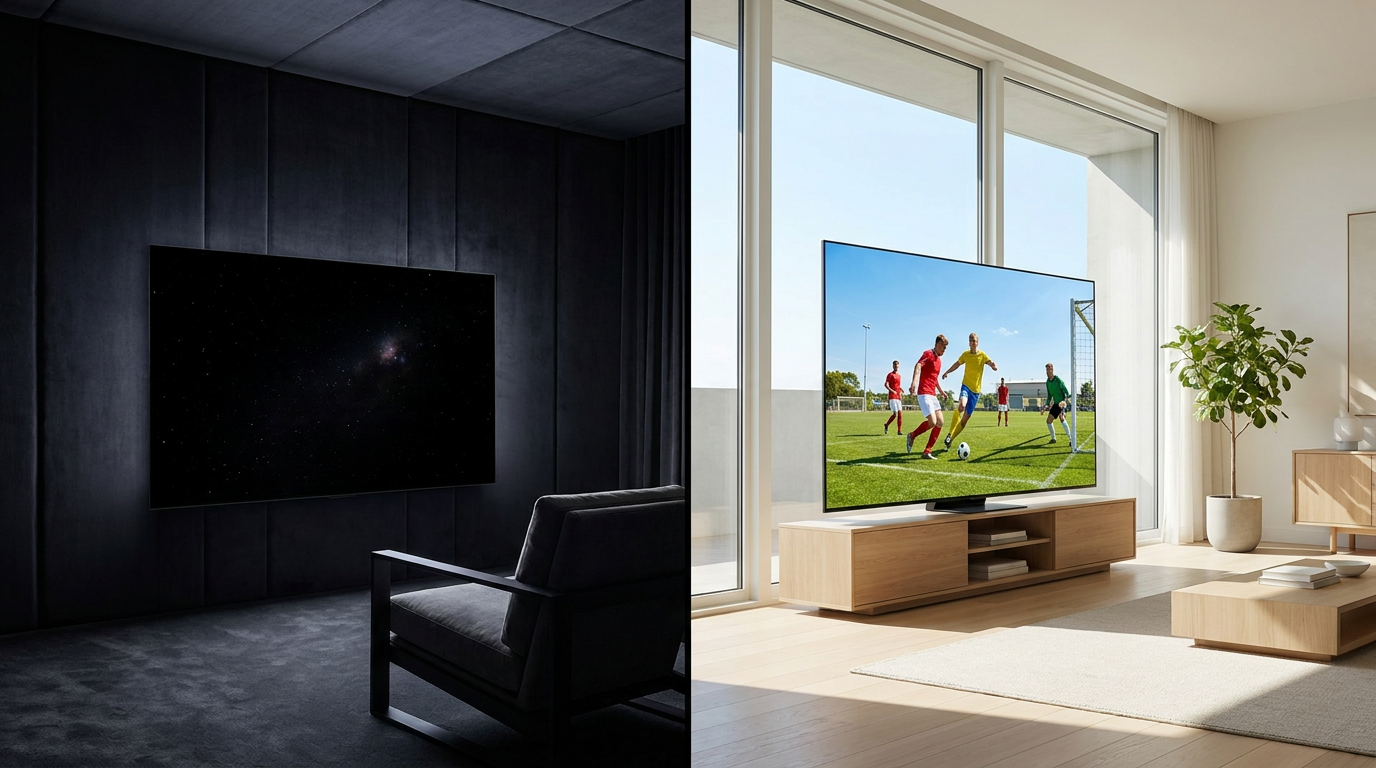
- Home Theater Purists
- Value perfect black levels, infinite contrast, and the preservation of cinematic intent in dark rooms.
- Bright-Room Viewers
- Prioritize high full-screen brightness and glare reduction for daytime sports and casual viewing.
- Competitive Gamers
- Focus on instantaneous pixel response times and motion clarity for fast-paced gameplay.
- Value-Conscious Upsizers
- Seek the largest possible screen real estate (85 inches or more) without paying ultra-premium prices.
What's not represented
- · Projector Enthusiasts
- · MicroLED Early Adopters
Why this matters
Televisions are significant multi-year investments that dictate how you experience movies, sports, and gaming. Choosing the wrong panel technology for your room's lighting conditions can result in frustrating daytime glare or distracting visual artifacts in the dark.
Key points
- Tandem OLED technology has significantly boosted peak brightness, though full-screen brightness remains limited by heat constraints.
- RGB Mini-LEDs now offer thousands of dimming zones, drastically reducing but not entirely eliminating blooming artifacts.
- OLED remains the undisputed champion for dark-room cinematic viewing and competitive gaming response times.
- Mini-LED is the superior choice for sunlit living rooms, static PC monitor use, and budget-conscious 85-inch buyers.
The 2026 television market has reached a fascinating inflection point, characterized by what industry analysts are calling the great convergence. For years, the divide was simple: OLED televisions offered perfect contrast for dark rooms, while LED televisions provided the brightness necessary for sunlit spaces. Today, those traditional boundaries have blurred significantly. The introduction of Tandem OLED architecture has dramatically increased the brightness of self-lit panels, while the deployment of RGB Mini-LED backlighting has given LCD televisions unprecedented control over dark scenes. Consumers are no longer choosing between a good picture and a bad one; they are navigating a highly competitive landscape where two distinct engineering philosophies are fighting for dominance in the living room.[2][3]
To understand the trade-offs, it is essential to grasp how these two technologies generate an image. OLED, or Organic Light-Emitting Diode, is an emissive technology. This means that every single one of the 8.3 million pixels on a 4K display generates its own light and color independently. When a pixel needs to display black, it simply turns off completely. In contrast, Mini-LED is a transmissive technology built on a traditional LCD foundation. The pixels themselves do not generate light; instead, they are illuminated by a backlight composed of thousands of microscopic LEDs. These LEDs are grouped into dimming zones that can brighten or darken independently, allowing the television to control contrast across different areas of the screen simultaneously.[8]
When evaluating the emissive approach, the argument for OLED centers entirely on absolute pixel-level precision and infinite contrast. Because each pixel operates independently, an OLED television can place a blindingly bright pinpoint of light—such as a star in a night sky—directly next to a pitch-black pixel without any light bleeding over. This creates a sense of depth and three-dimensionality that remains the gold standard for cinematic viewing. Furthermore, because there is no backlight shuttering involved, OLED panels boast near-instantaneous pixel response times, virtually eliminating motion blur during fast-paced action scenes or competitive gaming. For purists building a dedicated home theater, this level of precision is historically unmatched.[1][4]
However, the argument against OLED involves its full-screen brightness limitations and the lingering, albeit reduced, risk of permanent image retention. To protect the organic compounds from overheating and degrading, OLED televisions employ an Automatic Brightness Limiter (ABL). While a small explosion on screen might be dazzlingly bright, a scene where the entire screen is white—such as a hockey game or a snowy landscape—will be aggressively dimmed by the television's software. Additionally, while 2026 mitigation software is excellent, displaying static elements like news tickers, sports scores, or video game HUDs for thousands of hours can still theoretically cause permanent burn-in, making OLED a stressful choice for households that leave the television on a single channel all day.[7]

The evidence from 2026 benchmark testing clearly illustrates these exact boundaries. According to laboratory measurements, flagship Tandem OLED models like the LG G5 and Samsung S95F can now achieve a remarkable 2,500 nits of peak brightness in small, 10-percent window highlights. This represents a massive leap over previous generations. Yet, when measuring full-screen sustained brightness, these same premium panels still hover between 400 and 500 nits. Furthermore, long-term stress tests confirm that while modern pixel-shifting and logo-dimming algorithms have made burn-in exceedingly rare under normal mixed usage, the underlying organic chemistry still degrades faster than traditional LED backlights when subjected to extreme, repetitive static content.[1][2][7]
Conversely, the argument for Mini-LED is rooted in sheer brute-force luminance, long-term durability, and cost-effectiveness at massive screen sizes. By utilizing a robust backlight system, Mini-LED televisions can sustain massive brightness across the entire screen simultaneously, easily overpowering the glare in a sun-drenched living room. Because the technology relies on inorganic LEDs, there is absolutely zero risk of permanent burn-in, offering complete peace of mind for users who watch news networks all day or use their television as a giant PC monitor. Furthermore, the manufacturing process for LCD panels is highly mature, meaning that consumers can purchase an 85-inch or 98-inch Mini-LED television for a fraction of the cost of an equivalently sized OLED.[3][6]
Conversely, the argument for Mini-LED is rooted in sheer brute-force luminance, long-term durability, and cost-effectiveness at massive screen sizes.
The argument against Mini-LED focuses on blooming artifacts and inferior off-angle viewing. Because the backlight is divided into zones rather than individual pixels, a Mini-LED television cannot perfectly isolate light. When a bright object is displayed against a dark background—such as white subtitles on a black letterbox bar—the light from the active zone inevitably spills into the surrounding dark zones, creating a visible halo or bloom. Additionally, the liquid crystal layer used in these televisions inherently restricts the viewing angle. If you are sitting off to the side of the room rather than dead center, the colors on a Mini-LED screen will begin to wash out, and the blooming artifacts will become significantly more pronounced.[1][4]

The evidence supporting the Mini-LED value proposition is heavily quantified in this year's retail and performance data. Flagship 2026 models, such as the Sony Bravia 9 and the TCL QM8K, routinely measure between 3,000 and 4,000 nits of sustained full-screen brightness, completely outclassing OLED in bright-room visibility. However, uniformity heatmaps confirm that even with advanced RGB Mini-LED algorithms controlling up to 5,000 independent dimming zones, minor haloing remains detectable in pitch-black testing environments. On the economic front, market analysis shows that an 85-inch premium Mini-LED currently retails for roughly half the price of an 83-inch OLED, cementing its status as the undisputed king of large-format value.[1][4][6][8]
When analyzing the gaming sector, the trade-offs become a matter of genre preference. The argument for OLED in gaming is its 0.1-millisecond response time, which provides flawless motion clarity for fast-paced shooters and fighting games. The argument against OLED for gaming is the burn-in risk associated with static health bars and minimaps during marathon sessions. Conversely, the argument for Mini-LED gaming is the eye-searing HDR punch it brings to vibrant, open-world adventures, alongside total immunity to HUD burn-in. Benchmark data shows that while both technologies now universally support 144Hz refresh rates and Variable Refresh Rate (VRR), competitive esports players overwhelmingly favor OLED's motion handling, while casual console gamers often prefer Mini-LED's vibrant daylight performance.[5][7]
Synthesizing these technical realities leads to clear purchasing guidelines. OLED technology fits well when the television is placed in a light-controlled environment, such as a basement home theater or a bedroom with blackout curtains. It is the definitive choice for cinephiles who prioritize perfect black levels and shadow detail in HDR movies. It also fits perfectly for competitive gamers who demand zero motion blur, and for living rooms with wide, U-shaped seating arrangements where guests will be viewing the screen from extreme side angles. In these specific scenarios, the pixel-level precision of an emissive display simply cannot be replicated by a backlight.[1][2]

However, OLED does not fit when the primary viewing environment is a sun-drenched living room with multiple unshaded windows. The aggressive Automatic Brightness Limiter will make daytime sports viewing feel dim compared to an LCD alternative. It also does not fit well for households that use the television as ambient background noise, leaving it tuned to a single news channel with static banners for eight hours a day. Finally, it does not fit the needs of budget-conscious consumers who are determined to upgrade to a massive 85-inch or larger screen, as the manufacturing costs for OLED panels at those dimensions remain prohibitively expensive for the average buyer.[3][7]
On the other side of the aisle, Mini-LED fits well when the television must compete with heavy ambient light. It is the ultimate choice for bright, open-concept living rooms, daytime sports viewing, and environments where glare is a constant battle. It fits perfectly for users who want a massive 85-inch cinematic experience without taking out a second mortgage. It is also the safest and most reliable choice for PC gamers, remote workers using the screen as a monitor, and anyone who experiences anxiety over the concept of permanent image retention. For these users, the brute-force brightness and durability of Mini-LED provide unmatched utility.[3][6]

Conversely, Mini-LED does not fit when the primary use case is watching letterboxed movies in a pitch-black room, as the blooming around subtitles and bright highlights will inevitably distract purists. It does not fit well in rooms where the primary seating is positioned at a sharp angle to the screen, as the color shifting and contrast degradation will compromise the viewing experience for anyone not sitting in the center sweet spot. Ultimately, the 2026 television landscape offers no single perfect display, but rather two exceptional technologies that, when matched correctly to their environment, deliver the best home entertainment experiences in the history of the medium.[1][4]
How we got here
2013
The first commercial OLED TVs hit the market, establishing a new standard for contrast but struggling with low brightness.
2019
Mini-LED technology is introduced to the consumer market, offering a high-brightness alternative with improved local dimming.
2022
QD-OLED (Quantum Dot OLED) launches, significantly improving the color volume and brightness of emissive displays.
2026
Tandem OLED and RGB Mini-LED architectures converge, closing the historical performance gaps between the two technologies.
Viewpoints in depth
Home Theater Purists
Advocates for preserving the director's exact cinematic intent in light-controlled rooms.
For cinephiles and home theater purists, the conversation begins and ends with contrast. This camp argues that the foundation of a good image is a perfect black level, as it provides the canvas upon which all other colors are painted. They point out that even the most advanced Mini-LED algorithms cannot prevent blooming around complex starfields or stark white subtitles on a black background. For this group, the pixel-level precision of OLED is non-negotiable, and they are willing to control their room lighting with blackout curtains to accommodate the technology's lower full-screen brightness.
Bright-Room Viewers
Advocates for practical, everyday usability in open-concept, sunlit living spaces.
This perspective prioritizes real-world living conditions over laboratory perfection. Bright-room viewers argue that perfect black levels are entirely irrelevant if the screen acts as a mirror reflecting the living room windows during a Sunday afternoon football game. They value the brute-force luminance of Mini-LED, which can push 3,000 to 4,000 nits to cut through daytime glare. For this camp, a television is an appliance that needs to perform in all lighting conditions, not just in a pitch-black basement.
Competitive Gamers
Advocates for motion clarity, input lag reduction, and instantaneous pixel response.
Gamers evaluate displays through the lens of motion handling and responsiveness. Because OLED pixels change state almost instantaneously (0.1 milliseconds), there is virtually zero motion blur when panning a camera quickly in a first-person shooter. This camp argues that LCD-based Mini-LEDs, regardless of their refresh rate, still suffer from inherent smearing due to the physical limitations of liquid crystals changing state. While they acknowledge the burn-in risks associated with static HUDs, competitive players view OLED's motion clarity as a tangible in-game advantage.
Value-Conscious Upsizers
Advocates for maximizing screen real estate and overall impact per dollar spent.
This camp argues that size is the most important factor in creating an immersive viewing experience. They point to the steep price curve of OLED manufacturing, where an 83-inch or 97-inch panel costs exponentially more than a 65-inch model. Value-conscious upsizers advocate for Mini-LED because it allows consumers to purchase a massive 85-inch screen for the same price as a much smaller OLED. They argue that the sheer scale of a larger screen provides a more impactful upgrade than the nuanced contrast benefits of an emissive display.
What we don't know
- How quickly Tandem OLED panels will degrade over a 10-year lifespan compared to traditional single-layer OLEDs.
- Whether MicroLED technology will become affordable enough to replace both OLED and Mini-LED before 2030.
Key terms
- OLED
- Organic Light-Emitting Diode; a display technology where each pixel generates its own light, allowing for perfect black levels.
- Mini-LED
- An advanced LCD backlight technology that uses thousands of tiny LEDs grouped into dimming zones to improve contrast.
- Blooming
- A visual artifact on LED TVs where light from a bright object spills into surrounding dark areas of the screen, creating a halo effect.
- Nits
- A standard unit of measurement used to quantify the luminance or peak brightness of a display.
- ABL
- Automatic Brightness Limiter; a software feature in OLED TVs that dims the screen when a large portion of the image is bright white to prevent overheating.
Frequently asked
What is the main difference between OLED and Mini-LED?
OLED pixels generate their own light, allowing them to turn off completely for perfect blacks. Mini-LED uses a traditional LCD panel illuminated by thousands of tiny backlight zones.
Will an OLED TV get permanent burn-in?
Modern OLEDs have strong mitigation features that make burn-in rare for varied viewing. However, permanent image retention is still possible if static images (like news tickers) are displayed for thousands of hours.
Which TV is better for a bright living room?
Mini-LED is significantly better for bright rooms due to its high full-screen brightness, which easily cuts through daytime glare and window reflections.
Why are 85-inch OLED TVs so much more expensive?
Manufacturing large, continuous sheets of organic material without defects is highly complex, which drives up production costs exponentially at larger screen sizes compared to LCD manufacturing.
Sources
Source coverage
8 outlets
4 viewpoints surfaced








[1]RTINGSHome Theater Purists
OLED vs Mini LED: 2026 Test Results and Uniformity Benchmarks
Read on RTINGS →[2]CNETBright-Room Viewers
The 2026 TV Buyer's Guide: Tandem OLED vs RGB Mini-LED
Read on CNET →[3]The VergeBright-Room Viewers
Why Mini-LED is Winning the Bright Living Room
Read on The Verge →[4]Tom's GuideHome Theater Purists
LG G5 vs Sony Bravia 9: The Ultimate 2026 TV Showdown
Read on Tom's Guide →[5]TechRadarCompetitive Gamers
Gaming on OLED vs Mini-LED: Response Times and HDR Punch
Read on TechRadar →[6]WIREDValue-Conscious Upsizers
The Economics of 85-Inch TVs: How Mini-LED Took Over
Read on WIRED →[7]Digital TrendsCompetitive Gamers
Burn-in Anxiety: Is it Still a Problem for 2026 OLEDs?
Read on Digital Trends →[8]Display DailyValue-Conscious Upsizers
RGB Mini-LED and Tandem OLED Architecture Explained
Read on Display Daily →

Every angle. Every day.
Get shopping stories with full source coverage and perspective breakdowns delivered to your inbox.