
Explainer: How the U.S. Constitution Can Actually Be Amended
Article V of the U.S. Constitution outlines a rigorous two-step process for amendments, balancing the need for adaptability with a high bar for national consensus.
By Factlen Editorial Team
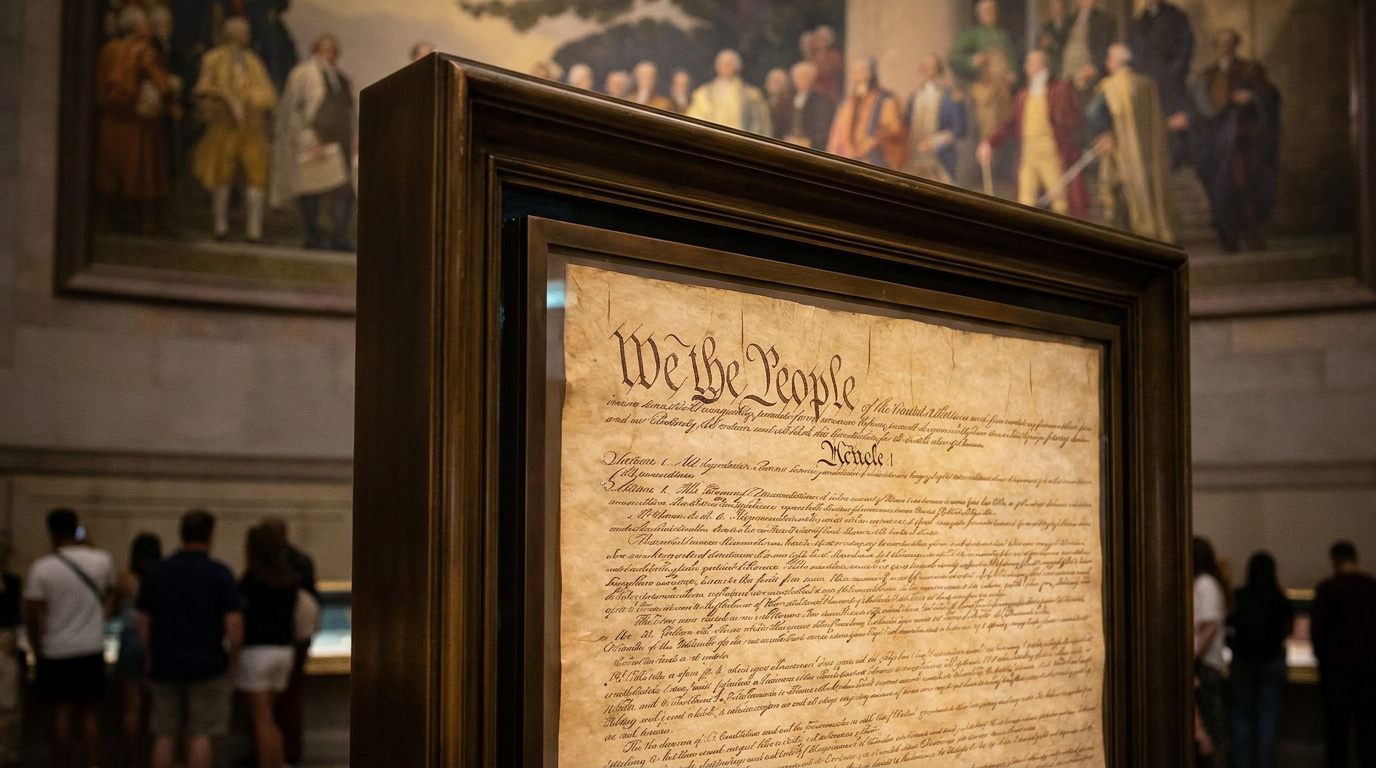
- Congressional Proposal Advocates
- Believe the traditional route through Congress ensures stability and national consensus before altering the Constitution.
- Convention Advocates
- Argue the state-led convention is a necessary check on federal power, designed for when Congress refuses to act on popular reforms.
- Convention Skeptics
- Warn that a modern constitutional convention could become a runaway assembly that rewrites fundamental rights.
What's not represented
- · Grassroots Organizers
- · State Legislators
Why this matters
Understanding the amendment process demystifies how fundamental rights and government structures can be changed. It highlights the immense power everyday citizens and state legislatures hold to force structural reforms when the federal government is deadlocked.
Key points
- Article V of the U.S. Constitution requires a strict two-step process of proposal and ratification for any amendment.
- Amendments can be proposed by a two-thirds vote in Congress or by a national convention called by two-thirds of the states.
- All 27 current amendments were proposed by Congress; the state-led convention method has never been successfully triggered.
- Ratification requires approval from three-fourths of the states (38 states), ensuring broad national consensus.
- The President has no formal role in the amendment process and cannot veto a proposed amendment.
The United States Constitution is the world's oldest surviving written national charter, a remarkable feat of political endurance. However, its longevity is not merely an accident of history or a product of blind reverence. The framers who gathered in Philadelphia in the summer of 1787 knew they were entirely incapable of foreseeing every crisis, technological shift, or moral awakening of the centuries to come. They recognized that a rigid, unyielding document would eventually break under the immense pressure of a rapidly changing and expanding society.[1][3]
To ensure the document could evolve without requiring a violent revolution or a total collapse of the government, they embedded a specific, highly engineered mechanism for change: Article V. This critical provision outlines the exact legal pathways required to alter the nation's fundamental law. It was designed to balance the urgent need for adaptability with a deliberate, rigorous structure intended to prevent fleeting political majorities from hastily rewriting the rules to suit their immediate interests.[1][6]
The result is a constitutional system that demands overwhelming, distributed national consensus before a single word can be added or removed. In the more than two centuries since its ratification, the Constitution has been amended only 27 times, despite thousands of proposals being introduced in Congress. This scarcity is a direct testament to the intentionally high hurdles Article V places in front of any proposed change, ensuring that only the most widely supported ideas become permanent law.[1][2]
Article V establishes a strict, sequential two-step process for any constitutional amendment: proposal and ratification. These two phases are entirely distinct, and an amendment must successfully clear the first hurdle before it can even be considered for the second. For an amendment to be officially proposed and sent to the states, it must navigate one of two distinct constitutional pathways, one controlled by the federal government and the other controlled by the states.[2][3]

The first and most familiar pathway is the congressional method. If two-thirds of both the House of Representatives and the Senate deem it necessary, Congress can officially propose an amendment. This supermajority requirement ensures that a proposal cannot advance on a straight party-line vote in a closely divided government; it requires substantial bipartisan agreement. Once the two-thirds threshold is met in both chambers, the proposed amendment is immediately sent to the states.[1][3]
This congressional route is the only method that has ever been successfully utilized in American history. All 27 current amendments originated in the halls of Congress. This includes the foundational Bill of Rights, the Reconstruction Amendments that abolished slavery and guaranteed equal protection, and the 19th Amendment that secured women's suffrage. The historical dominance of this pathway has made it the default mechanism for constitutional change in the minds of most Americans.[1][2]
However, the framers deeply distrusted centralized power and anticipated a scenario where the federal government might become tyrannical, unresponsive, or hopelessly deadlocked. They worried that Congress might refuse to propose necessary structural reforms that would limit its own authority. To prevent federal lawmakers from holding an absolute monopoly on constitutional change, George Mason and other delegates at the 1787 convention insisted on a second, alternative pathway.[2][6]
This alternative route directly empowers the states to bypass Washington entirely. If the legislatures of two-thirds of the states—currently 34 out of 50—submit formal applications to Congress, the federal legislature is constitutionally obligated to call a "Convention for proposing Amendments." In this scenario, Congress has no discretionary power to block the convention; its role is purely administrative, fulfilling a mandatory duty triggered by the states.[2][3]
This state-led convention method has never been successfully triggered, though it has come remarkably close on several occasions. In the early 20th century, a massive grassroots campaign for the direct election of senators nearly reached the required two-thirds threshold of state applications. The looming threat of a state-led convention, which Congress could not control, actually forced reluctant federal lawmakers to preemptively propose the 17th Amendment themselves to retain control of the process.[2][6]

This state-led convention method has never been successfully triggered, though it has come remarkably close on several occasions.
Today, the Article V convention mechanism remains a highly active area of political organizing. Various movements across the political spectrum are currently pushing state legislatures to submit applications. Conservative groups frequently advocate for a convention to propose a balanced budget amendment or congressional term limits, while some progressive organizations have explored the mechanism to propose campaign finance reform. The convention threat remains a potent tool for states to pressure the federal government.[2][6]
Once an amendment is successfully proposed by either Congress or a national convention, it moves to the second, even more rigorous phase: ratification. Here, the mathematical bar is raised significantly higher. A proposed amendment must be formally ratified by three-fourths of the states—currently 38 states—before it officially becomes part of the Constitution. This massive supermajority ensures that a proposal has deep, widespread geographic and ideological support.[1][3]
Article V gives Congress the exclusive authority to choose between two distinct methods of state ratification. The first and most common method is ratification by state legislatures. Twenty-six of the 27 amendments were approved this way, requiring a majority vote in 38 separate state capitols across the country. This method relies on the existing elected representatives of each state to evaluate and approve the proposed changes to the national charter.[1][2]
The second ratification method bypasses state legislatures entirely, relying instead on state ratifying conventions. In this scenario, voters in each state elect delegates specifically for the single purpose of deciding on the amendment. This method has been utilized only once in American history: to pass the 21st Amendment, which repealed Prohibition in 1933. Congress deliberately chose this route to bypass state lawmakers who were heavily influenced by entrenched temperance lobbies.[1][2]

While the congressional proposal method is well-understood and historically tested, the Article V convention mechanism remains shrouded in deep legal uncertainty. Because a convention has never been called since the original gathering in 1787, scholars, lawmakers, and constitutional experts fiercely debate how a modern convention would actually operate. There are no established legal precedents governing delegate selection, voting rules, or the ultimate scope of the convention's authority.[4][5]
The central dispute revolves around the "runaway convention" theory. Convention skeptics, including prominent legal scholars, warn that once an Article V convention is convened, it might not legally be limited to the single issue that triggered it. They argue that delegates could theoretically ignore their original mandate and propose sweeping, unintended changes to the Bill of Rights, much like the original 1787 convention discarded the Articles of Confederation entirely.[4][6]
Conversely, convention advocates argue this fear is overblown and historically inaccurate. They point out that the plain text of Article V specifies a convention "for proposing Amendments," and argue that state legislatures can legally bind their delegates to a specific topic through their application petitions. They maintain that a convention is a limited-purpose body, not a sovereign assembly with the power to rewrite the entire Constitution from scratch.[5][6]
Furthermore, advocates note that any rogue or radical proposals emerging from a runaway convention would still face the ultimate constitutional safeguard: the requirement that 38 states ratify the changes. This massive supermajority threshold ensures that only highly popular, consensus-driven reforms could ever survive the process and become law. A radical proposal that alienates even 13 states would be dead on arrival, making the threat of a runaway convention practically moot.[2][5]

Interestingly, while Article V allows almost any part of the Constitution to be changed, it explicitly protects one specific provision from the amendment process. The final clause of Article V dictates that "no State, without its Consent, shall be deprived of its equal Suffrage in the Senate." This deeply entrenched clause means that the fundamental structure of the U.S. Senate cannot be altered through the normal amendment process unless the affected state voluntarily agrees to give up its power.[1][3]
Another unique aspect of the Article V process is the complete absence of the executive branch. The President of the United States has no formal constitutional role in proposing or ratifying amendments. A proposed amendment does not go to the White House for a signature, and the President cannot veto it. The Supreme Court has also clarified that Congress has the power to set reasonable time limits on ratification, typically seven years, ensuring that proposals do not linger indefinitely.[2][6]
Ultimately, Article V stands as a testament to the framers' foresight and their deep understanding of human nature. By requiring broad, distributed consensus across both the federal government and the states, the amendment process protects minority rights from fleeting passions while leaving the door open for enduring, generational progress. It ensures that when a vast majority of the country agrees that the foundational rules need updating, the Constitution can bend without breaking.[1][6]
How we got here
1787
The framers draft Article V at the Constitutional Convention, establishing the dual pathways for amending the document.
1791
The Bill of Rights, comprising the first ten amendments, is ratified by the states after being proposed by the first Congress.
1913
The 17th Amendment is ratified, preempting a growing state-led movement that was nearing the threshold to call an Article V convention.
1933
The 21st Amendment is ratified via state conventions—the only time this method has been used—to repeal Prohibition.
1992
The 27th Amendment, originally proposed in 1789 alongside the Bill of Rights, is finally ratified after a 202-year delay.
Viewpoints in depth
The Traditionalists' View
Emphasizes the stability of the congressional proposal method.
This perspective highlights that all 27 successful amendments have originated in Congress. Proponents argue that the rigorous debate within the House and Senate acts as a necessary filter, ensuring that only highly refined, widely supported ideas are sent to the states. They view the high bar of a two-thirds congressional vote as a feature, not a bug, protecting the nation's foundational laws from partisan whims.
The Convention Advocates' View
Views the state-led convention as a vital constitutional emergency valve.
Advocates for an Article V convention argue that the framers intentionally gave states the power to bypass Washington. They point out that Congress will rarely, if ever, propose amendments that limit its own power—such as term limits or balanced budget requirements. By utilizing the convention mechanism, they believe state legislatures can force necessary structural reforms that the federal government refuses to address.
The Skeptics' View
Warns of the unpredictable nature of an untested constitutional convention.
Legal scholars in this camp focus on the "runaway convention" risk. Because an Article V convention has not been held since 1787, there is no established legal precedent governing its rules, delegate selection, or scope. Skeptics fear that a convention called for a specific purpose could be hijacked by well-funded interest groups to propose radical alterations to the Bill of Rights or the fundamental structure of the federal government.
What we don't know
- How delegate selection and voting rules would legally function in a modern Article V convention, as one has never been held.
- Whether the Supreme Court would intervene if an Article V convention attempted to propose amendments outside its original mandated scope.
Key terms
- Article V
- The section of the U.S. Constitution that outlines the specific procedures for proposing and ratifying amendments.
- Ratification
- The formal approval process required by three-fourths of the states to officially adopt a proposed constitutional amendment.
- Article V Convention
- A national gathering called by Congress at the request of two-thirds of state legislatures specifically to propose constitutional amendments.
- Runaway Convention
- A theoretical scenario where an Article V convention ignores its original mandate and proposes sweeping, unintended changes to the Constitution.
- Supermajority
- A requirement for a proposal to gain a specified level of support significantly greater than a simple majority, such as two-thirds or three-fourths.
Frequently asked
Can the President veto a constitutional amendment?
No. The President has no formal constitutional role in the amendment process; amendments do not require a presidential signature and cannot be vetoed.
Is there a time limit for states to ratify an amendment?
The Constitution does not set a time limit, but the Supreme Court has ruled that Congress can impose reasonable deadlines (typically seven years) within the proposing resolution.
Has a state-led Article V convention ever happened?
No. While states have submitted hundreds of applications over the centuries, the threshold of 34 active applications for a single topic has never been reached simultaneously.
Can an amendment be unconstitutional?
Generally no, because an amendment becomes part of the Constitution itself. However, Article V explicitly forbids any amendment that deprives a state of its equal suffrage in the Senate without its consent.
Sources
Source coverage
6 outlets
3 viewpoints surfaced



[1]National Constitution CenterCongressional Proposal Advocates
Interpretation: Article V
Read on National Constitution Center →[2]Congressional Research ServiceConvention Skeptics
The Article V Convention for Proposing Constitutional Amendments: Historical Perspectives for Congress
Read on Congressional Research Service →[3]National ArchivesCongressional Proposal Advocates
Article V, U.S. Constitution
Read on National Archives →[4]Yale Law JournalConvention Skeptics
The Recurring Question of the 'Limited' Constitutional Convention
Read on Yale Law Journal →[5]Harvard Journal of Law and Public PolicyConvention Advocates
Amending the Constitution by Convention
Read on Harvard Journal of Law and Public Policy →[6]Factlen Editorial TeamConvention Advocates
Synthesis by Factlen editorial team
Read on Factlen Editorial Team →

Every angle. Every day.
Get law justice stories with full source coverage and perspective breakdowns delivered to your inbox.