
The US AI Regulation Showdown: Analyzing the Evidence Behind the Push for Federal Preemption
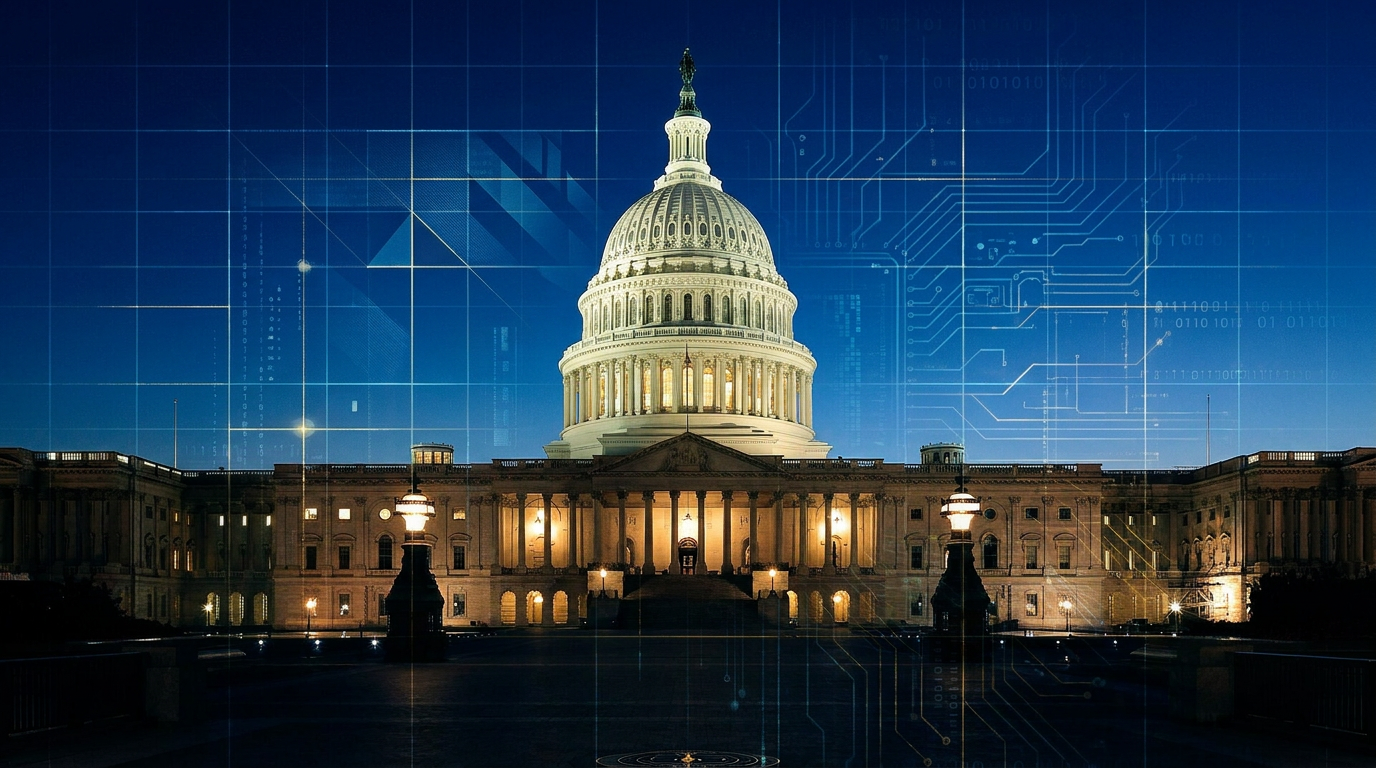
As state legislatures pass hundreds of AI laws, Congress and the Executive Branch are moving to establish a unified federal standard. This evidence pack analyzes the claims, draft legislation, and legal mechanisms driving the battle over US AI governance.
By Factlen Editorial Team
- National Standardization Advocates
- Argue that a single federal AI law is essential for innovation and compliance.
- State & Consumer Protection Defenders
- Argue that federal preemption weakens necessary safeguards and algorithmic accountability.
- Compliance & Legal Analysts
- Focus on the practical realities and legal uncertainties of the overlapping jurisdictions.
What's not represented
- · Open-source AI developers who fall below the $500M revenue threshold but may still be impacted by state-level deployment rules.
- · International regulators observing the US domestic policy vacuum.
Why this matters
The outcome of this legislative clash will determine how artificial intelligence is built and deployed in the US. If federal preemption succeeds, tech giants will face a single national standard; if it fails, companies will have to navigate 50 different state laws, fundamentally altering the speed and cost of AI innovation.
Key points
- State lawmakers have introduced over 1,500 AI-related bills in 2026, creating a fragmented compliance landscape.
- The proposed Great American AI Act aims to establish a federal floor by preempting state development laws for three years.
- Federal legislation targets companies with over $500 million in revenue, exempting smaller startups.
- Civil society groups argue that federal preemption will override stringent state-level consumer protections.
- The Executive Branch has established a DOJ task force to challenge state AI laws in federal court.
The United States is currently navigating a constitutional and regulatory showdown over the governance of artificial intelligence. As of June 2026, the absence of a comprehensive federal statute has created a policy vacuum, prompting individual states to aggressively legislate AI development and deployment. This evidence pack examines the primary claims, legislative drafts, and legal mechanisms driving the clash between state regulators, Congress, and the Executive Branch.[7]
The first major claim in this regulatory debate is that state-level fragmentation is accelerating at an unprecedented pace. The evidence for this claim is robust and quantifiable. According to legislative tracking data, state lawmakers introduced 1,561 AI-related bills across 45 states by March 2026 alone, significantly surpassing the 1,208 bills introduced in all of 2025.[3][6]
This legislative surge has already materialized into binding law. On January 1, 2026, multiple state frameworks took effect, including California's Transparency in Frontier AI Act and Texas's Responsible AI Governance Act. These laws impose strict, and sometimes conflicting, mandates on developers, ranging from mandatory risk frameworks to categorical bans on AI systems designed for behavioral manipulation.[4]

The second major claim is that the newly proposed Great American AI Act of 2026 would establish a unified federal floor by preempting these state laws. Released as a bipartisan discussion draft on June 4, 2026, the bill represents the most significant congressional effort to date to centralize AI governance.[1]
Primary document analysis of the draft reveals a targeted scope. The legislation creates binding federal obligations specifically for large frontier developers, which the bill defines as companies generating over $500 million in annual revenue that have trained a frontier model. This financial threshold effectively captures industry leaders such as OpenAI, Anthropic, Google, and Meta, while exempting smaller startups.[1]
The core mechanism of the bill is a preemption clause designed to override state laws that specifically regulate the development of AI models, enforcing a three-year sunset period on local legislation. However, the evidence suggests this preemption is narrower than industry advocates initially hoped, as it explicitly preserves state laws of general applicability and maintains state authority over activities occurring after a model is deployed.[1]
A third critical claim, raised primarily by civil society organizations, is that federal preemption will inherently weaken consumer protections. The evidence supporting this claim relies on the comparative strictness of state versus federal proposals. Groups including Public Citizen and the AFL-CIO argue that the federal draft lacks the stringent algorithmic accountability measures found in state laws like Colorado's Automated Decision-Making Technology Act.[1]
A third critical claim, raised primarily by civil society organizations, is that federal preemption will inherently weaken consumer protections.
Legal analysts note that while the Great American AI Act mandates independent auditing and critical safety incident reporting, it relies heavily on third-party verification organizations embedded within the tech companies themselves. Critics argue this structure risks becoming a self-certification regime, diluting the hard enforcement powers currently held by state attorneys general.[1][5]

The fourth major claim involves the Executive Branch, which is utilizing litigation and funding levers to unilaterally block state AI laws. The evidence for this administrative strategy is documented in the December 2025 Executive Order, Ensuring a National Policy Framework for Artificial Intelligence.[2]
The directive establishes a Department of Justice AI Litigation Task Force explicitly tasked with challenging state AI laws that the administration deems inconsistent with federal policy. The primary legal arguments being prepared center on the unconstitutional regulation of interstate commerce and the doctrine of federal preemption.[4]
Furthermore, the administration is leveraging federal funding to force compliance. The executive branch is currently tying broadband and infrastructure grants to a state's willingness to avoid what the White House categorizes as onerous AI regulations, effectively using the federal purse to discourage local lawmaking.[4]
Despite these aggressive maneuvers, there is significant uncertainty in the evidence regarding the legal viability of the Executive Branch's strategy. Legal experts emphasize that the December 2025 Executive Order does not inherently create federal AI standards; it merely establishes mechanisms to push back against states.[4][7]
Without a comprehensive federal statute passed by Congress, federal courts may be hesitant to strike down state laws based solely on an executive directive. Existing state AI laws remain fully in effect unless successfully challenged in court, creating a high-risk, unpredictable compliance environment for developers.[4][5]

Additionally, both the proposed federal legislation and the executive order contain significant carve-outs that complicate the preemption narrative. Areas such as child safety in AI contexts, AI compute infrastructure, and state government procurement are generally exempt from federal override.[4]
This indicates that even if the Great American AI Act passes, the concept of a single, unified federal AI rulebook is likely an illusion. Companies deploying AI in healthcare, education, or local government will continue to navigate a complex, multi-jurisdictional web of compliance.[4][7]
Ultimately, the evidence points to a protracted legal and legislative battle. While the push for federalization has gained significant momentum in mid-2026, the entrenched nature of state laws ensures that the United States AI regulatory landscape will remain fragmented and highly contested in the near term.[5][7]
How we got here
Aug 2024
The EU AI Act enters into force, setting a global regulatory benchmark.
Dec 2025
The Trump administration signs an Executive Order establishing an AI Litigation Task Force to challenge state laws.
Jan 2026
Major state AI laws, including California's SB 53 and Texas's TRAIGA, officially take effect.
Mar 2026
State lawmakers surpass 1,500 introduced AI bills for the legislative session.
Jun 2026
Bipartisan lawmakers introduce the discussion draft of the Great American AI Act of 2026.
Viewpoints in depth
Federal Preemption Advocates
Industry groups and federal lawmakers arguing for a unified national AI standard.
Proponents of the Great American AI Act, including the Business Software Alliance and the Information Technology Industry Council, argue that a patchwork of 50 different state laws makes compliance impossible for AI startups. They assert that a unified federal framework is a matter of national security and economic competitiveness, ensuring the US remains the global leader in frontier model development without being bogged down by conflicting local mandates.
State-Level Regulators & Consumer Advocates
Civil society organizations and state lawmakers defending local AI governance.
Groups like Public Citizen, the AFL-CIO, and various state attorneys general argue that Congress moves too slowly to regulate rapidly evolving technology. They view federal preemption as a corporate loophole designed to override stringent consumer protections, such as California's SB 53 and Colorado's automated decision-making laws. From this perspective, states serve as necessary laboratories of democracy that provide immediate safeguards against algorithmic bias and AI-generated fraud.
The Executive Branch
The administration's push to deregulate and block state interference via executive action.
The Trump administration's approach, codified in the December 2025 Executive Order, treats state AI laws as an unconstitutional burden on interstate commerce. By establishing a DOJ AI Litigation Task Force and tying federal broadband grants to deregulation, the executive branch is attempting to force a national standard through legal and financial pressure, even before Congress passes a comprehensive bill.
What we don't know
- Whether the DOJ AI Litigation Task Force will successfully strike down state laws in federal court.
- If the Great American AI Act can secure enough bipartisan support to pass the Senate before the end of the legislative session.
- How the EU AI Act's August 2026 enforcement deadline will force US companies to adopt European standards regardless of domestic law.
Key terms
- Frontier Model
- Highly capable foundation models that could possess dangerous capabilities, typically trained using massive computational power.
- Preemption
- A legal doctrine where federal law supersedes and invalidates conflicting state laws.
- Automated Decision-Making Technology (ADMT)
- Systems that use algorithms to make or assist in decisions affecting consumers, such as hiring, lending, or housing.
- Red Teaming
- A structured testing process where independent auditors attempt to find flaws, biases, or vulnerabilities in an AI system before release.
Frequently asked
Is there currently a federal AI law in the US?
No. As of June 2026, the US relies on a patchwork of state laws, executive orders, and existing agency regulations, though the Great American AI Act is currently being debated in Congress.
What happens to state AI laws if the federal bill passes?
The current draft of the Great American AI Act would preempt state laws that specifically regulate the development of AI models for three years, though it preserves state authority over how models are deployed.
Who does the Great American AI Act apply to?
The bill primarily targets 'large frontier developers,' defined as companies with over $500 million in annual revenue that train advanced AI models.
Why is the Executive Branch suing states over AI?
The administration argues that a patchwork of state AI laws unconstitutionally regulates interstate commerce and harms US technological competitiveness.
Sources
Source coverage
7 outlets
3 viewpoints surfaced






[1]Tech Policy PressNational Standardization Advocates
Reps. Obernolte and Trahan Release Great American AI Act Discussion Draft
Read on Tech Policy Press →[2]The White HouseNational Standardization Advocates
Ensuring a National Policy Framework for Artificial Intelligence
Read on The White House →[3]MultiStateState & Consumer Protection Defenders
Tracking State AI Legislation Across All 50 States in 2026
Read on MultiState →[4]VerifyWiseCompliance & Legal Analysts
State of AI governance regulations in the United States
Read on VerifyWise →[5]Goodwin ProcterCompliance & Legal Analysts
Goodwin on AI: States are taking the lead in regulating AI
Read on Goodwin Procter →[6]Brennan Center for JusticeState & Consumer Protection Defenders
Artificial Intelligence Legislation Tracker
Read on Brennan Center for Justice →[7]Factlen Editorial TeamCompliance & Legal Analysts
Synthesis by Factlen editorial team
Read on Factlen Editorial Team →

More in ai
See all 6 stories →AI Drug Discovery
Open-Source AI Discovers Three New Classes of Antibiotics to Combat Drug-Resistant Superbugs
6 sources

Edge AI
How Local AI Models Work on Consumer Hardware in 2026
8 sources

Scientific Discovery
The Rise of Self-Driving Labs: How AI and Robotics Are Automating Scientific Discovery
8 sources

Medical AI
Autonomous AI Agents Match Human Physicians in End-to-End Patient Care Simulations
7 sources

Every angle. Every day.
Get ai stories with full source coverage and perspective breakdowns delivered to your inbox.