
High-Tech Sails Return to the Oceans as Shipping Industry Embraces Wind Power
Driven by strict new carbon regulations, the global maritime industry is rapidly retrofitting cargo ships with towering rigid wings and rotor sails, achieving double-digit fuel savings.
By Factlen Editorial Team
- Shipowners & Operators
- Focused on the immediate financial return on investment and regulatory compliance.
- Maritime Engineers
- Focused on aerodynamic optimization, sensor integration, and automated control systems.
- Environmental Regulators
- Focused on meeting the International Maritime Organization's emission reduction targets.
- Industry Analysts
- Focused on market growth, retrofit economics, and the broader shift in global logistics.
What's not represented
- · Port Authorities managing the infrastructure for taller, sail-equipped vessels
- · Seafarers unions adapting to new automated deck technologies
Why this matters
Global shipping accounts for nearly 3% of all human-made greenhouse gas emissions. By harnessing free wind energy, the industry can immediately slash the carbon footprint of the goods you buy without waiting decades for alternative fuels to scale.
Key points
- The maritime industry is rapidly adopting high-tech wind propulsion to meet strict new carbon regulations.
- Rigid wings and rotor sails are fully automated and can fold flat during severe weather.
- Real-world trials show wind-assist can reduce a cargo ship's fuel consumption by up to 11 tonnes per day.
- Over 130 large commercial vessels are currently being built or retrofitted with wind technology.
- Fully wind-optimized ships will drastically cut emissions but may extend transit times by several days.
The maritime industry is returning to its roots. After a century of relying almost exclusively on heavy fuel oil to power the arteries of global trade, the wind is back. But this modern renaissance looks nothing like the canvas sails and complex rigging of the past. Today's iteration of wind power involves towering steel and composite structures that resemble airplane wings standing upright on the decks of massive cargo ships. Wind-Assisted Ship Propulsion (WASP) is rapidly transitioning from a fringe environmental concept to a commercial necessity, driven by a sudden convergence of technological maturity and inescapable regulatory pressure.[8]
The sheer scale of the shift is becoming clear in 2026. The global WASP market, valued at $7.8 billion last year, is expanding at a breakneck pace. According to industry tracking, over 130 large commercial vessels are currently under construction or undergoing retrofits to harness the wind, representing a transformational shift in how ships are designed and operated. The primary catalyst for this acceleration is regulatory. In 2025, the European Union's FuelEU Maritime initiative took effect, alongside new International Maritime Organization (IMO) carbon pricing mechanisms that fundamentally altered the mathematics of global shipping.[5][6][7]

Under these new frameworks, inefficiency carries a steep and escalating financial penalty. Shipowners are scrambling to reduce their fleet's carbon intensity, and wind offers an inexhaustible, zero-cost energy source that can be tapped immediately, without waiting for the global supply chains of alternative green fuels to mature. The most compelling evidence for the viability of modern wind propulsion comes from recent, rigorous real-world trials. The Pyxis Ocean, a massive Kamsarmax bulk carrier chartered by agricultural giant Cargill, was retrofitted with two 37.5-meter-tall "WindWings" developed by the UK-based engineering firm BAR Technologies.[1][2][6]
Over a six-month global voyage that traversed the Indian, Pacific, and Atlantic oceans, the results were definitive. The vessel saved an average of three tonnes of fuel per day. In optimal wind conditions, those savings spiked to 11 tonnes per day, translating to a 37% reduction in greenhouse gas emissions. Independent verification by the maritime classification society DNV confirmed the breakthrough. Their analysis found that the rigid wings reduced the main engine's energy consumption by 32% per nautical mile under favorable conditions, proving that the aerodynamic models translate flawlessly to the open ocean.[1][2][3]

Over a six-month global voyage that traversed the Indian, Pacific, and Atlantic oceans, the results were definitive.
The mechanics of these systems are designed for the realities of modern, lean-crewed shipping. These are not sails that require sailors to climb rigging or manually adjust canvas. Instead, the rigid wings operate autonomously, functioning much like the wing of an aircraft to generate forward thrust from crosswinds. The operation is entirely automated and sensor-driven. Onboard systems, increasingly augmented by advanced Lidar technology that reads wind speed and direction miles ahead of the ship, constantly adjust the angle and camber of the wings to maximize aerodynamic efficiency without any human intervention.[2][7][8]
When the ship needs to enter a crowded port, navigate under a bridge, or weather a severe storm, the massive structures fold flat onto the deck at the push of a button, guided by a simple traffic-light interface on the captain's bridge. While rigid wings are capturing headlines, the industry is deploying a diverse array of technologies. Rotor sails—tall, spinning cylinders that harness the Magnus effect to pull the ship forward—currently hold the largest market share, alongside emerging designs featuring suction sails and massive automated kites that fly high above the vessel.[1][2][5]

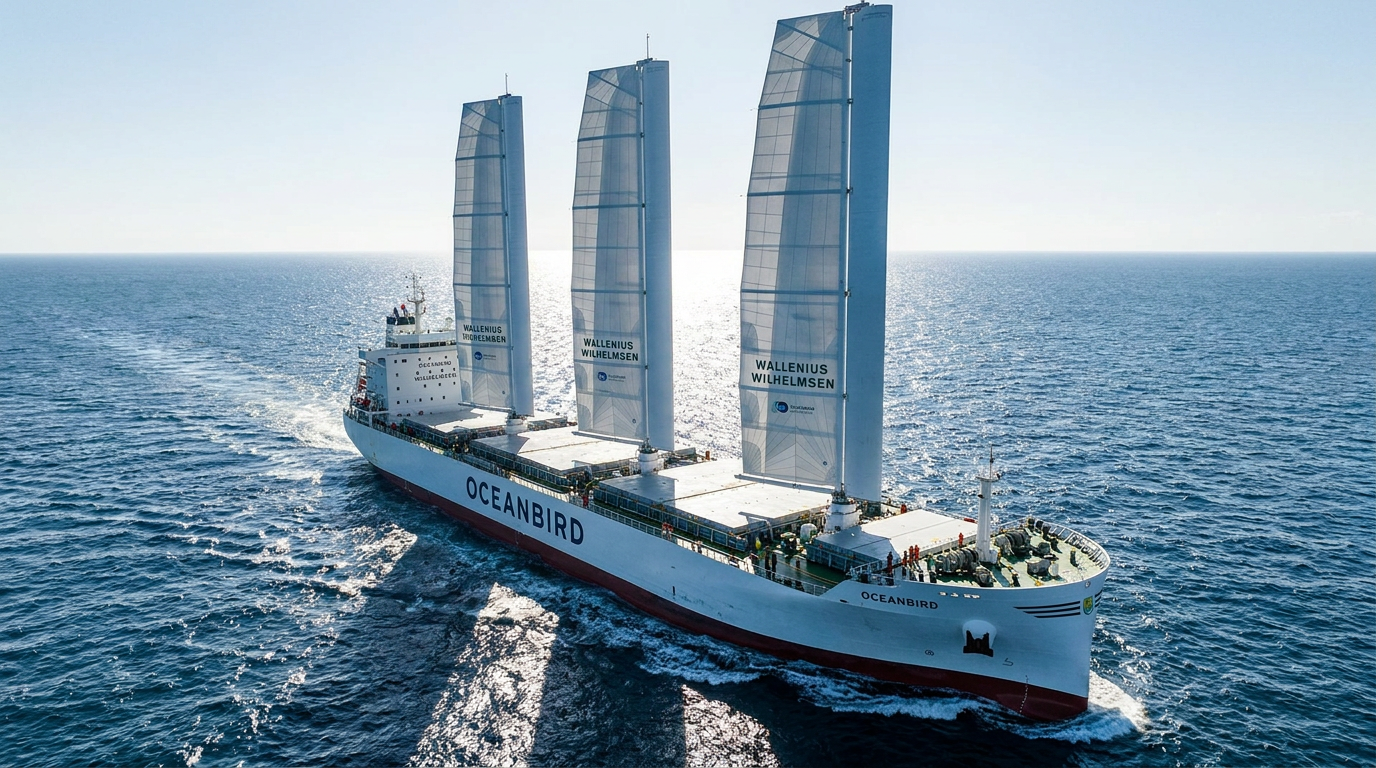
Because the global merchant fleet consists of over 100,000 existing vessels, the retrofit market is dominating the transition, accounting for over 60% of installations. Bolt-on wind technologies allow shipowners to extend the compliant, profitable lifespan of their older, fossil-fuel-burning ships. However, fully wind-optimized newbuilds are also on the horizon. The Swedish joint venture Oceanbird is preparing to launch a 7,000-car carrier in early 2026 that integrates rigid sails into the core architecture of the hull, aiming to reduce total emissions by up to 90%.[4][5]
This extreme efficiency comes with a deliberate trade-off in speed. The Oceanbird is designed to cross the Atlantic in 12 days, compared to the seven or eight days expected of conventional car carriers, forcing supply chains to adapt to a slightly slower, but vastly cleaner, rhythm. Ultimately, wind propulsion is not a silver bullet that will single-handedly decarbonize global trade. Instead, it is the most immediate, proven, and cost-effective bridge to the future, buying the maritime industry crucial time while next-generation fuels like green methanol and ammonia scale up to meet global demand.[4][8]

The broader implications for global trade are profound. As more vessels adopt wind-assisted propulsion, the visual landscape of the world's oceans and major ports will fundamentally change, echoing the maritime silhouettes of the 19th century but driven by 21st-century data. For consumers, this transition means that the carbon footprint of imported goods—from electronics to agricultural commodities—will begin to shrink long before zero-emission engines become the global standard. Wind has returned to the center of maritime strategy, proving that sometimes the most innovative solutions involve looking backward through the lens of modern engineering.[8]
How we got here
2023
The Pyxis Ocean, retrofitted with BAR Technologies' WindWings, begins its six-month global sea trial.
March 2024
Cargill releases the Pyxis Ocean trial results, proving average fuel savings of 3 tonnes per day.
2025
The EU's FuelEU Maritime regulation takes effect, financially penalizing ships with high carbon intensity.
Early 2026
The Oceanbird project plans to launch its first fully wind-optimized 7,000-car carrier.
Viewpoints in depth
Shipowners & Operators
Focused on the immediate financial return on investment and regulatory compliance.
For the companies actually moving global freight, wind propulsion is a math equation. With the European Union's FuelEU Maritime regulations imposing steep financial penalties for carbon intensity, shipowners view bolt-on wind technologies as the fastest way to keep older vessels legally compliant and profitable. The fuel savings—up to 11 tonnes per day in optimal conditions—provide a clear, measurable return on investment that alternative fuels currently cannot match.
Maritime Engineers
Focused on aerodynamic optimization, sensor integration, and automated control systems.
Naval architects and technology providers view the current era as a renaissance in fluid dynamics. Their focus is on removing the human element from sail management. By integrating advanced Lidar sensors that read upstream wind conditions and automated hydraulic systems that adjust wing camber in real-time, engineers are transforming ships into highly sophisticated, self-optimizing aerodynamic platforms.
Global Supply Chain Customers
Focused on the trade-offs between zero-emission logistics and transit times.
For the automotive manufacturers and retailers whose goods fill these ships, wind propulsion introduces a new variable into just-in-time logistics. Fully wind-optimized vessels like the upcoming Oceanbird will take 12 days to cross the Atlantic instead of seven. Supply chain managers are currently weighing whether the marketing and environmental benefits of "zero-emission shipping" justify the slower, less predictable transit times.
What we don't know
- Whether global port infrastructure can adapt quickly enough to accommodate the increased height and width of wind-assisted vessels.
- How the long-term maintenance costs of complex hydraulic wings will compare to the fuel savings over a ship's 25-year lifespan.
Key terms
- Wind-Assisted Ship Propulsion (WASP)
- The integration of modern aerodynamic technologies, such as rigid sails or spinning rotors, to supplement a ship's engine power.
- Rotor Sail
- A tall, spinning cylinder installed on a ship's deck that uses the Magnus effect to generate forward thrust from crosswinds.
- Well-to-Wake Emissions
- The total greenhouse gas emissions produced throughout a marine fuel's entire lifecycle, from extraction to combustion.
- FuelEU Maritime
- A European Union regulation that mandates progressive reductions in the greenhouse gas intensity of energy used by ships.
- Kamsarmax
- A class of bulk carrier ships built to the maximum length capable of entering the port of Kamsar in the Republic of Guinea.
Frequently asked
Do these ships rely entirely on the wind?
No. Most current designs use wind as an 'assist' to supplement traditional diesel or dual-fuel engines, reducing fuel consumption rather than replacing it entirely.
What happens during a severe storm at sea?
The rigid sails and rotors are designed to fold flat onto the deck or retract telescopically, ensuring the ship's safety and allowing it to pass under bridges.
Will wind-powered ships delay global shipping?
Retrofits maintain normal speeds while burning less fuel. However, fully wind-optimized newbuilds will travel slightly slower, extending a transatlantic crossing from seven days to 12 days.
Sources
Source coverage
8 outlets
4 viewpoints surfaced








[1]Riviera Maritime MediaShipowners & Operators
Results of a six-month test on board bulk carrier Pyxis Ocean
Read on Riviera Maritime Media →[2]gCaptainShipowners & Operators
Cargill Reveals Promising Results from Wind-Assisted Propulsion Trial
Read on gCaptain →[3]Offshore EnergyMaritime Engineers
WindWings on Pyxis Ocean cut energy consumption of main engine by 32% per NM, DNV confirms
Read on Offshore Energy →[4]WikipediaIndustry Analysts
Oceanbird
Read on Wikipedia →[5]Data InteloIndustry Analysts
Wind-Assisted Ship Propulsion Market Outlook 2025-2034
Read on Data Intelo →[6]Caponnetto HueberEnvironmental Regulators
Wind Assisted Ship Propulsion for Maritime Decarbonisation
Read on Caponnetto Hueber →[7]VaisalaMaritime Engineers
The wind-assisted ship propulsion (WASP) market is entering an exciting phase
Read on Vaisala →[8]Factlen Editorial TeamIndustry Analysts
Synthesis by Factlen editorial team
Read on Factlen Editorial Team →
Every angle. Every day.
Get transportation stories with full source coverage and perspective breakdowns delivered to your inbox.