
The 'Net-Zero' Remodel: Why Home Electrification is 2026's Biggest Renovation Trend
Homeowners are moving away from cosmetic flips in favor of 'deep energy retrofits,' replacing gas appliances with high-efficiency heat pumps and induction stoves to future-proof their properties.
By Factlen Editorial Team
- Electrification Advocates
- Policy groups and environmental organizations focused on the macroeconomic and climate benefits of transitioning away from fossil fuels.
- Pragmatic Homeowners
- Everyday consumers balancing the desire for modern, efficient homes with the realities of upfront costs and renovation disruptions.
- Building & HVAC Industry
- Contractors, manufacturers, and tradespeople tasked with implementing the electrification transition on the ground.
What's not represented
- · Natural Gas Utility Companies facing declining residential demand
- · Renters who lack the authority to upgrade their building's infrastructure
Why this matters
Transitioning a home from fossil fuels to electric systems can drastically lower monthly utility bills, improve indoor air quality, and increase property value. As new building codes and federal rebates take effect in 2026, understanding this transition is crucial for anyone planning a home renovation.
Key points
- Homeowners are increasingly choosing deep energy retrofits over cosmetic remodels to future-proof their properties.
- Heat pumps and induction stoves are replacing gas appliances due to superior efficiency and health benefits.
- A full home electrification retrofit can cost between $10,000 and $40,000 before incentives.
- Treating homes as energy infrastructure could save households an average of $26,000 over a lifetime.
- New 2026 building codes in states like California are accelerating the shift toward all-electric homes.
The era of the purely cosmetic kitchen flip is ending. In 2026, the smartest money in home remodeling is going behind the drywall. Homeowners are increasingly prioritizing "deep energy retrofits" and whole-home electrification over superficial aesthetic upgrades, fundamentally changing how residential properties operate.[5][7]
This shift is driven by a convergence of volatile fossil fuel prices, growing awareness of indoor air pollution, and a wave of new building codes. For example, California's 2025 Energy Code, which took full effect in January 2026, mandates electric readiness and expands heat pump adoption for new building permit applications.[3][7]
But what exactly is home electrification? At its core, it is the deliberate process of transitioning a household's energy consumption away from natural gas, oil, or propane, and replacing those systems with highly efficient electric alternatives.[4][7]
This is not simply about plugging more appliances into the wall; it is a paradigm shift in how a house operates. A true deep energy retrofit takes a systems-level approach, combining improved insulation and air-sealing with advanced electric machinery to drastically reduce the home's overall energy demand.[4][7]

The vanguard of this transition is the electric heat pump. Unlike traditional gas furnaces that burn fuel to generate heat, heat pumps work by moving heat from one place to another. In the winter, they extract ambient heat from the outside air and pump it indoors; in the summer, they reverse the process to act as an air conditioner.[3][6]
Because they move heat rather than create it, modern inverter heat pumps are three to seven times more efficient than their gas counterparts. While the upfront cost of a whole-home ducted heat pump installation in 2026 typically ranges from $9,500 to $17,000, it effectively replaces both an aging furnace and a central AC unit with a single, highly efficient system.[3][6]

The second major pillar of electrification is the heat pump water heater. Water heating is traditionally one of the largest energy drains in a home. By applying the same heat-transfer technology, these units use a fraction of the energy of conventional gas tanks, offering load-shifting capabilities that allow homeowners to heat water during off-peak electricity hours.[3][7]
The second major pillar of electrification is the heat pump water heater.
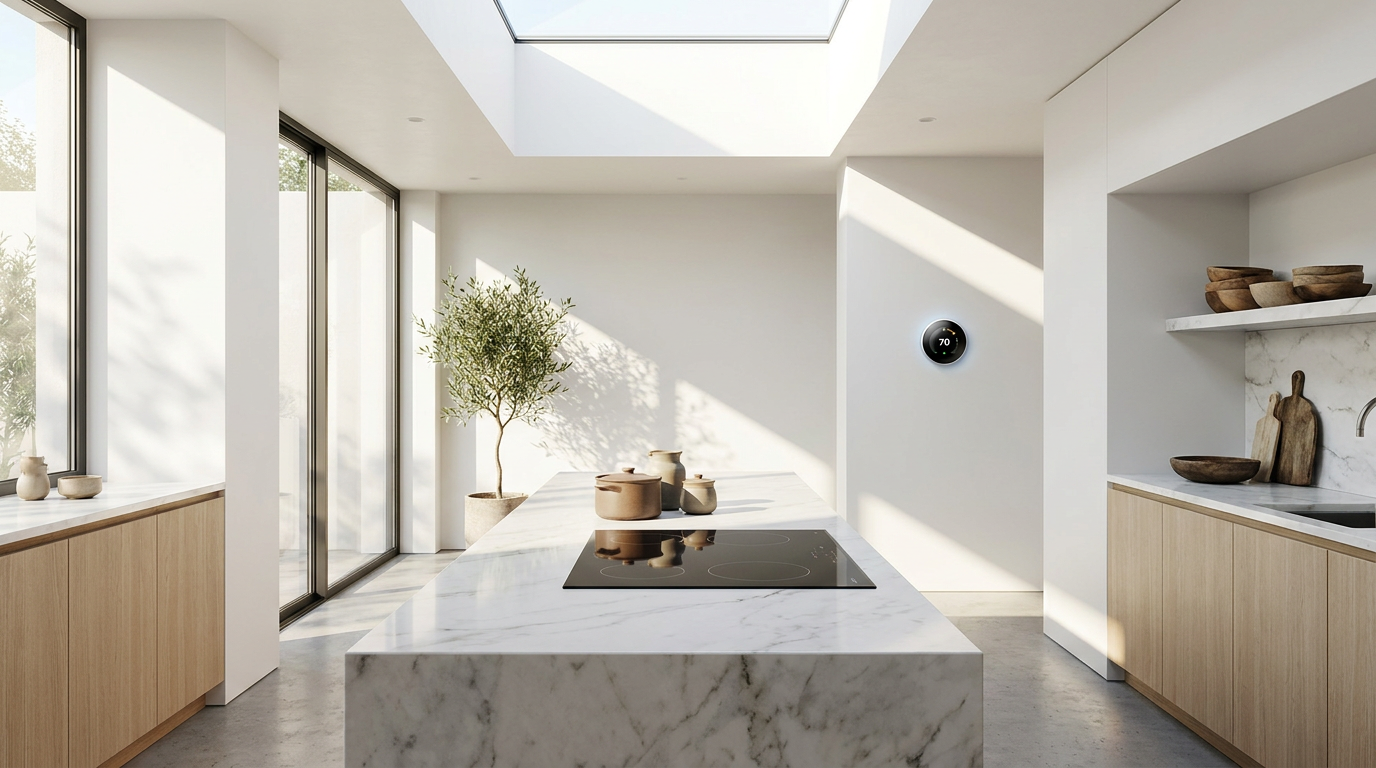
Inside the kitchen, the conversation has shifted rapidly toward induction cooking. Once considered a niche alternative, induction ranges have crossed into the mainstream for 2026 remodels. They use electromagnetic fields to heat pots directly, offering faster boil times and more precise temperature control than gas.[4][7]
Beyond performance, the move away from gas stoves is heavily motivated by health and safety. Gas-fired appliances release combustion byproducts, including nitrogen dioxide, into the home. Removing this infrastructure eliminates the risk of carbon monoxide leaks and significantly improves indoor air quality.[3][7]
Managing these new electric loads requires a "brain" for the home. Smart electrical panels and battery storage systems are becoming standard inclusions in high-spec renovations. These systems link appliances, solar arrays, and EV chargers into an intelligent ecosystem that optimizes energy use based on real-time grid prices.[4][7]

The economics of this transition are compelling, though the upfront sticker shock remains a hurdle. A full whole-home electrification retrofit—including HVAC, panel upgrades, appliances, and solar—can range from $10,000 to over $40,000 depending on the size and age of the property.[4][7]
However, a 2026 policy blueprint from Rewiring America highlights that treating homes as energy infrastructure yields massive dividends. With the right mix of state policies and federal incentives, whole-home electrification could deliver an average of $26,000 in lifetime savings per home, while creating over a million local installation jobs.[1][7]

Public sentiment is already shifting to match the technology. Recent survey data indicates that a majority of Americans now prefer homes where all or most major appliances are powered by electricity, provided upfront costs are comparable to traditional fossil fuel systems.[2][7]
The broader impact extends far beyond individual utility bills. As data centers and aging infrastructure strain the national power grid, aggregating millions of electrified, battery-equipped homes into Virtual Power Plants offers a faster, lower-cost way to meet rising electricity demand without building expensive new centralized power plants.[1][7]
Challenges certainly remain. The industry is currently grappling with a shortage of trained home performance contractors, and navigating the complex patchwork of federal, state, and utility rebates can be daunting for the average homeowner looking to upgrade.[1][6]
Nevertheless, the trajectory is clear. The learning curves for clean energy technology are evolving at a rapid clip, and costs continue to fall. In 2026, electrifying a home is no longer just an environmental statement; it is the most practical way to future-proof a property, secure energy independence, and build a more resilient living space.[1][4][7]
How we got here
August 2022
The Inflation Reduction Act (IRA) is signed into law, introducing billions in tax credits and rebates for residential heat pumps, electrical upgrades, and efficiency improvements.
Spring 2023
National surveys reveal that a majority of Americans now prefer homes with all or mostly electric appliances, signaling a shift in consumer sentiment.
January 2026
California's 2025 Energy Code takes full effect, mandating electric readiness and expanding heat pump adoption for new building permit applications.
May 2026
Policy reports highlight that whole-home electrification could now be affordable for 96% of eligible U.S. households with optimal state and federal policies.
Viewpoints in depth
Electrification Advocates
Policy groups and environmental organizations focused on the macroeconomic and climate benefits of transitioning away from fossil fuels.
Advocates argue that treating the American home as critical energy infrastructure is the most efficient way to combat climate change and stabilize the power grid. Organizations like Rewiring America emphasize that widespread adoption of heat pumps, solar, and battery storage can offset the massive energy demands of new data centers. By aggregating these homes into Virtual Power Plants (VPPs), they believe the U.S. can avoid billions in centralized infrastructure costs while delivering tangible financial savings directly to households.
Pragmatic Homeowners
Everyday consumers balancing the desire for modern, efficient homes with the realities of upfront costs and renovation disruptions.
For many homeowners, the decision to electrify is driven less by global emissions targets and more by practical concerns: indoor air quality, volatile gas bills, and property resale value. While surveys show a growing preference for all-electric appliances, these consumers are highly sensitive to the initial sticker shock, which can exceed $20,000 for a whole-home retrofit. Their willingness to adopt these technologies heavily depends on the availability of point-of-sale rebates, tax credits, and the assurance that new systems will reliably heat their homes during extreme weather.
Building & HVAC Industry
Contractors, manufacturers, and tradespeople tasked with implementing the electrification transition on the ground.
The construction and HVAC sectors recognize that electrification is the future of the industry, driven by shifting building codes and consumer demand. However, they caution that the transition is currently bottlenecked by logistical hurdles. Contractors frequently point to a severe shortage of trained technicians capable of installing complex heat pump systems and smart panels. Additionally, they highlight that older homes often require expensive electrical service upgrades before they can handle the increased load of an all-electric ecosystem, complicating the sales pitch to budget-conscious clients.
What we don't know
- Whether the current shortage of trained HVAC and electrical contractors will delay widespread adoption timelines.
- Exactly how future utility rate structures will evolve as more homes transition to high-efficiency electric loads.
- The long-term impact of potential changes to federal tax credits and rebates under shifting political administrations.
Key terms
- Deep Energy Retrofit (DER)
- A comprehensive, whole-house renovation approach aimed at reducing a home's energy consumption by 50% or more through insulation, air sealing, and high-efficiency electric systems.
- Heat Pump
- An advanced electric heating and cooling system that moves heat from one place to another—extracting heat from outside air to warm a home, and reversing the process to cool it.
- Induction Cooktop
- A highly efficient cooking surface that uses electromagnetic energy to directly heat pots and pans, rather than using a flame or radiant heating element.
- Virtual Power Plant (VPP)
- A network of decentralized, home-based energy resources—like solar panels and home batteries—that can be pooled together to supply power to the grid during times of peak demand.
- Smart Electrical Panel
- An upgraded circuit breaker box that allows homeowners to monitor, control, and optimize the electricity usage of individual appliances and systems in real-time.
Frequently asked
Do I need to upgrade my electrical panel to electrify my home?
Often, yes. Older homes with 100-amp service usually require an upgrade to a 200-amp panel to safely handle the increased load of a heat pump, induction stove, and EV charger, which can add $2,000 to $4,000 to the project cost.
Do heat pumps work effectively in very cold climates?
Yes. Modern 'cold-climate' inverter heat pumps are designed to operate efficiently even in sub-zero temperatures, though they may use slightly more electricity during extreme cold snaps compared to mild weather.
Is induction cooking the same as a traditional electric glass-top stove?
No. Traditional electric stoves use radiant heat coils under the glass, which are slow to heat and cool. Induction uses electromagnetic fields to heat the cookware directly, offering speed and precision that rivals or beats gas.
How much does a full home electrification retrofit cost?
A comprehensive whole-home retrofit—including a new heat pump HVAC system, heat pump water heater, induction range, panel upgrade, and basic solar—typically ranges from $10,000 to over $40,000 before tax credits and rebates are applied.
Sources
Source coverage
7 outlets
3 viewpoints surfaced







[1]Rewiring AmericaElectrification Advocates
Homegrown Energy: A policy blueprint for energy affordability
Read on Rewiring America →[2]Yale Program on Climate Change CommunicationPragmatic Homeowners
Do Americans prefer homes with electric or fossil fuel appliances?
Read on Yale Program on Climate Change Communication →[3]CleanPowerSFElectrification Advocates
Home Electrification: Heat Pumps and Bill Credits
Read on CleanPowerSF →[4]EcoFlowBuilding & HVAC Industry
Master Home Electrification: The Ultimate Guide to Eco-Friendly Living
Read on EcoFlow →[5]5J Building GroupBuilding & HVAC Industry
Home Renovation Trends 2026: What's Actually Trending in Our Backyards?
Read on 5J Building Group →[6]Fox & EssellBuilding & HVAC Industry
Heat Pump vs Traditional HVAC in 2026: The $10,000 Decision
Read on Fox & Essell →[7]Factlen Editorial TeamPragmatic Homeowners
Synthesis by Factlen editorial team
Read on Factlen Editorial Team →
Every angle. Every day.
Get home stories with full source coverage and perspective breakdowns delivered to your inbox.