
The Science of Tangzhong and Yudane: How Water Roux Transforms Bread
By pre-cooking a small portion of flour and water, bakers can trigger starch gelatinization to create ultra-soft, long-lasting bread. Here is the science behind the tangzhong and yudane methods.
By Factlen Editorial Team
- Culinary Scientists
- Focus on the chemistry of starch gelatinization and moisture retention.
- Home Bakers
- Value the practical ease and foolproof results of the technique.
- Commercial Bakeries
- Prioritize scalability and clean-label shelf stability.
What's not represented
- · Gluten-Free Bakers
- · Industrial Dough Conditioner Manufacturers
Why this matters
Staling is the enemy of fresh bread, often turning a beautiful loaf dry and crumbly within 24 hours. Understanding water roux methods allows home bakers to achieve bakery-level softness and extend shelf life by days without using artificial dough conditioners.
Key points
- Tangzhong and yudane are Asian baking techniques that pre-cook a portion of a recipe's flour and liquid.
- Heating the mixture gelatinizes the flour's starches, allowing them to absorb up to five times their weight in water.
- Tangzhong uses a 1:5 flour-to-liquid ratio cooked on a stove, yielding a fluffy, airy crumb.
- Yudane uses a 1:1 ratio mixed with boiling water, resulting in a chewier, more resilient texture.
- Both methods trap moisture in the dough, making it easier to handle despite high hydration levels.
- The pre-gelatinized starches delay retrogradation, keeping bread soft for days longer than standard methods.
For generations, bakers have chased the elusive goal of baking a loaf of bread that is impossibly soft, feathery light, and resistant to staling. While European traditions often relied on heavy enrichments like butter and eggs to achieve a tender crumb—think of a rich brioche or a dense challah—Asian baking traditions developed a radically different approach. By pre-cooking a small fraction of the recipe's flour and water before mixing the final dough, bakers discovered they could fundamentally alter the dough's chemistry and moisture retention [7].[7]
This technique, known broadly as a water roux, comes in two primary forms: the Chinese tangzhong and the Japanese yudane. Both methods achieve the exact same underlying scientific goal, which is to gelatinize the starches in the flour before they ever touch the main dough [3][4]. The result is a loaf that can hold significantly more moisture, rising higher in the oven, developing a remarkably tender crumb, and remaining soft for days on the counter without the need for artificial preservatives [1].[1][3][4]
To understand why a water roux works so effectively, one must look at the behavior of starch in the presence of heat and moisture. Raw flour can only absorb a limited amount of cold or room-temperature liquid. If a baker tries to force too much water into a standard dough, it becomes a slack, sticky mess that is impossible to knead or shape [2]. However, when flour is heated with liquid to approximately 65°C (150°F), the starch granules undergo a thermoirreversible transformation called gelatinization [3][6].[2][3][6]

During this gelatinization process, the starch granules swell and burst, absorbing up to five times their weight in liquid [3]. This creates a thick, viscous paste that binds the water tightly. When this paste is cooled and added back into the main bread dough, it brings all that trapped water with it [1]. Because the water is securely bound within the gelatinized starch matrix, the dough remains supple, elastic, and easy to handle by hand or machine, despite having a much higher overall hydration level [6].[1][3][6]
The tangzhong method, which was popularized across Asia in the early 2000s by Taiwanese cookbook author Yvonne Chen, is the most common water roux technique used by home bakers today [1][3]. It involves whisking flour and liquid—usually water or whole milk—in a 1:5 ratio by weight [4]. The mixture is cooked gently on the stovetop, or in short bursts in the microwave, whisking constantly until it thickens into a glossy, pudding-like slurry that leaves distinct lines when stirred [2].[1][2][3][4]

It involves whisking flour and liquid—usually water or whole milk—in a 1:5 ratio by weight [4].
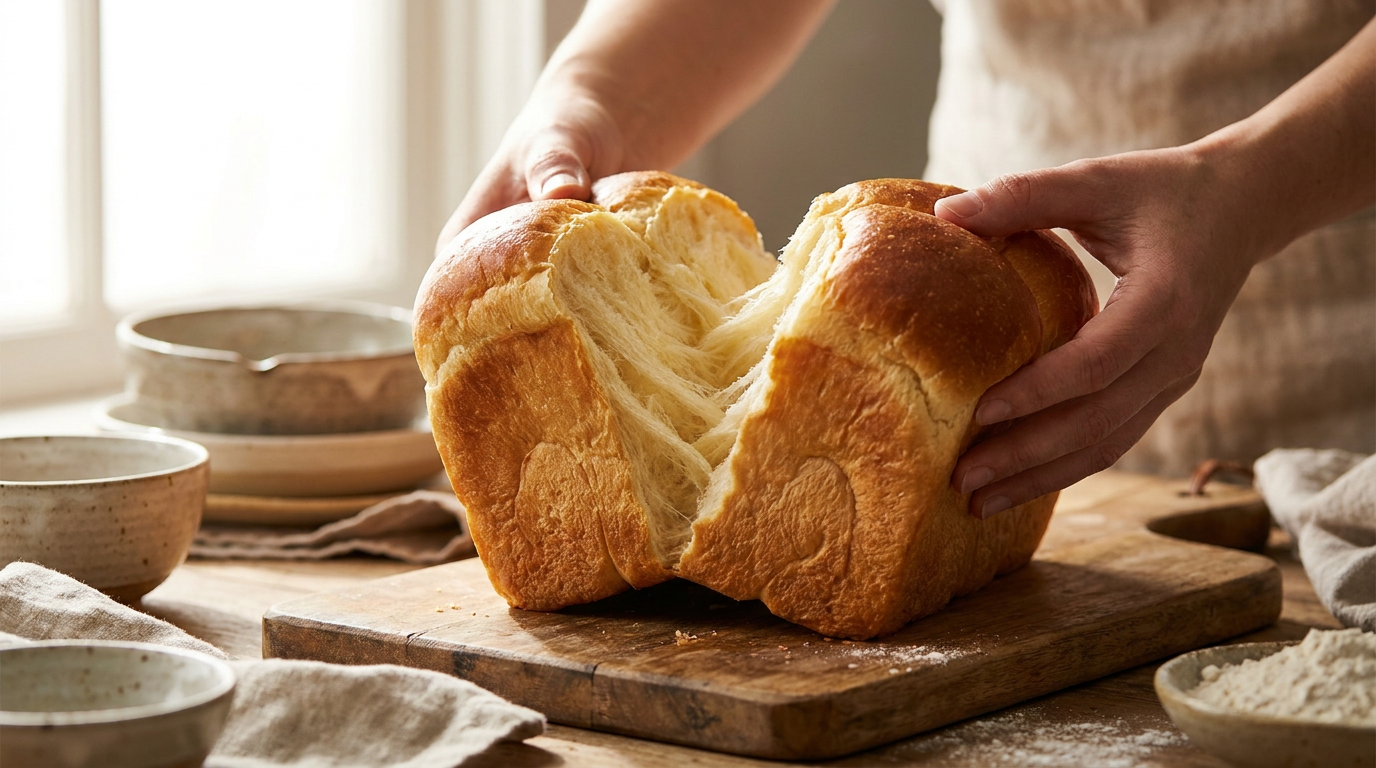
Typically, a tangzhong utilizes between 5% and 10% of the total flour called for in a recipe [2]. Because the starches are fully cooked and the paste is incredibly smooth, tangzhong integrates seamlessly into enriched doughs, yielding a crumb that is delicate, fluffy, and shreds into feathery strands [5]. This is the foundational technique behind Japanese milk bread, or shokupan, which has gained immense popularity in bakeries worldwide for its cloud-like texture and slightly sweet flavor profile [1][6].[1][2][5][6]
Yudane, the older Japanese predecessor to tangzhong, achieves starch gelatinization through a slightly different mechanism [3]. Instead of cooking the mixture over sustained heat on a stove, the baker pours rapidly boiling water directly over the flour in a 1:1 ratio by weight [4]. The intense heat of the boiling water instantly gelatinizes the starch, forming a thick, pliable dough-like mass rather than a wet, whiskable paste [5]. Because the water cools quickly upon contact with the room-temperature flour, the gelatinization is slightly less uniform than a stovetop tangzhong, but the structural benefits to the final bread are nearly identical.[3][4][5]
Because yudane uses significantly less water than tangzhong, it often constitutes a larger percentage of the recipe's total flour—typically 15% to 20%, and sometimes up to 30% [5]. The yudane must be covered tightly to prevent evaporation and left to cool completely, often resting in the refrigerator overnight to allow for maximum hydration and enzymatic activity [3]. Breads made with yudane tend to have a slightly chewier, more resilient texture, often described by bakers as having a "mochi-like" bite, compared to the airy, delicate fluffiness of tangzhong [5].[3][5]

Beyond the immediate improvements to texture and dough handling, the most significant benefit of both water roux methods is the delay of retrogradation, the scientific term for bread staling [6]. Staling is not merely the evaporation of moisture; it is the chemical process by which starch molecules recrystallize and harden over time [3]. Because the starches in a water roux are pre-gelatinized and thoroughly saturated with water, they recrystallize at a much slower rate than raw starches [7].[3][6][7]
This delayed retrogradation means a batch of cinnamon rolls, dinner rolls, or sandwich buns made with a water roux will remain soft, tender, and fresh-tasting for four to six days at room temperature, whereas a standard batch might dry out and become crumbly within 24 hours [1][6]. For home bakers who do not use commercial dough conditioners or artificial preservatives, this technique is a revelation, allowing homemade bread to rival the extended shelf life of store-bought loaves [2].[1][2][6]
Converting a standard bread recipe to use a water roux requires a bit of basic baker's math. To maximize the benefits, the total hydration of the dough should ideally be pushed to around 75% to account for the water trapped in the roux [1]. A baker simply subtracts the flour and liquid used to create the roux from the recipe's total ingredient list, ensuring the overall ratios remain balanced while the dough structure is transformed [2].[1][2]
While tangzhong and yudane are most famous for their use in white breads, milk breads, and sweet rolls, the underlying technique is highly versatile. It can be successfully applied to whole wheat flour, rye blends, and even gluten-free baking, where moisture retention and crumb structure are notoriously difficult to achieve [2]. By mastering the simple science of starch gelatinization, any baker can elevate their dough from good to extraordinary, ensuring every loaf emerges from the oven perfectly soft [7].[2][7]
How we got here
Early 20th Century
European bakers utilize 'scalding' techniques for rye breads to improve moisture and reduce enzymatic degradation.
Post-WWII
Japanese bakers develop the yudane method, pouring boiling water over flour to create ultra-soft shokupan (milk bread).
2007
Taiwanese pastry chef Yvonne Chen publishes '65°C Bread Doctor', popularizing the tangzhong method across Asia.
2010s
The tangzhong technique goes viral among Western home bakers and food bloggers seeking the secret to perfect cinnamon rolls and milk bread.
Viewpoints in depth
Culinary Scientists
Focus on the chemistry of starch gelatinization and moisture retention.
Food scientists view water roux methods primarily through the lens of starch behavior. When flour is heated in the presence of water, the crystalline structure of the starch granules breaks down, allowing them to absorb massive amounts of liquid. This thermoirreversible process not only increases the dough's effective hydration without compromising its structural integrity, but it also fundamentally alters the retrogradation timeline. By pre-saturating the starches, the bread's crumb remains physically soft long after a standard loaf would have crystallized and staled.
Home Bakers
Value the practical ease and foolproof results of the technique.
For the home baker, the appeal of tangzhong and yudane lies in their accessibility. Unlike complex sourdough fermentations or the use of commercial dough conditioners, a water roux requires only flour, water, and five minutes of prep time. The technique is highly forgiving and transforms standard recipes for cinnamon rolls, burger buns, and sandwich loaves into bakery-quality products that survive on the kitchen counter for nearly a week without drying out.
Commercial Bakeries
Prioritize scalability and clean-label shelf stability.
In commercial settings, extending shelf life is a primary economic driver. Traditional mass-market breads achieve this through chemical preservatives and artificial dough conditioners. However, as consumer demand shifts toward 'clean label' products with recognizable ingredients, commercial bakeries have increasingly adopted automated scalding and roux techniques. This allows them to produce soft, long-lasting breads using only natural ingredients, though it requires specialized equipment to handle the highly hydrated, sticky pre-ferments at scale.
What we don't know
- While tangzhong is widely credited to Taiwanese author Yvonne Chen, the exact historical origins and the timeline of how the technique migrated from Japanese yudane to Chinese tangzhong remain debated among food historians.
- The precise upper limit of how much flour can be pre-gelatinized before the dough loses its structural integrity varies wildly depending on the specific protein content of the flour used.
Key terms
- Starch Gelatinization
- The process where starch granules swell and absorb liquid when heated, creating a thick, viscous paste.
- Retrogradation
- The scientific term for staling; the process where gelatinized starches cool and slowly recrystallize, causing bread to become hard and crumbly.
- Hydration
- The ratio of liquid to flour in a bread dough, expressed as a percentage. Higher hydration generally leads to softer bread.
- Shokupan
- A Japanese style of white milk bread famous for its incredibly soft, feathery, and tear-apart texture.
- Water Roux
- A general term for a mixture of flour and liquid that has been cooked to a paste, encompassing both tangzhong and yudane.
Frequently asked
Can I use whole wheat flour for a tangzhong?
Yes. Any flour that contains sufficient starch, including whole wheat, rye, and all-purpose flour, can be used to make a water roux.
Can I make tangzhong in the microwave?
Yes. You can whisk the flour and liquid in a bowl and microwave it in 20-second intervals, stirring in between, until it forms a thick paste.
Does a water roux make the dough sticky and hard to knead?
No. Because the water is securely trapped inside the gelatinized starch, the dough actually feels less sticky and is easier to handle than a standard dough with the same hydration level.
How long can I store tangzhong before using it?
A prepared tangzhong can be covered and stored in the refrigerator for up to three days. It should be brought to room temperature before mixing into a dough.
Sources
Source coverage
7 outlets
3 viewpoints surfaced







[1]King Arthur BakingCommercial Bakeries
Introduction to tangzhong
Read on King Arthur Baking →[2]The Perfect LoafCommercial Bakeries
How to Make Tangzhong (Water Roux)
Read on The Perfect Loaf →[3]GrokipediaCulinary Scientists
Tangzhong
Read on Grokipedia →[4]ChainBakerHome Bakers
Tangzhong vs Yudane: What is the difference?
Read on ChainBaker →[5]Carter's BakeshopHome Bakers
Tangzhong vs. Yudane: The Ultimate Guide to Water Roux
Read on Carter's Bakeshop →[6]JayArr BreadHome Bakers
Tangzhong Method Explained: The Water Roux for Softer Bread
Read on JayArr Bread →[7]Factlen Editorial TeamCulinary Scientists
Synthesis by Factlen editorial team
Read on Factlen Editorial Team →
Every angle. Every day.
Get food drink stories with full source coverage and perspective breakdowns delivered to your inbox.