
How the Human Brain Builds Sentences, Neuron by Neuron
A landmark study has recorded the real-time electrical activity of single neurons during conversation, revealing that individual brain cells specialize in specific grammatical rules and word meanings.
By Factlen Editorial Team
- Cognitive Neuroscientists
- Focus on the biological mechanism of language generation and brain architecture.
- Computational Linguists
- Focus on the convergence of biological and artificial neural networks.
- Clinical Neurologists
- Focus on restoring speech for patients with severe paralysis or communication disorders.
- Factlen Synthesis
- Focus on synthesizing the cross-disciplinary impact of the discovery.
What's not represented
- · Evolutionary Biologists
- · Neuroethics Scholars
Why this matters
By decoding how individual brain cells construct grammar and meaning, scientists are paving the way for next-generation brain-computer interfaces that could restore fluid, real-time speech for paralyzed patients, while also providing a biological blueprint to improve artificial intelligence.
Key points
- Scientists successfully tracked the electrical activity of single neurons during natural human conversation.
- Individual brain cells specialize in specific linguistic tasks, acting as grammatical gatekeepers for nouns, verbs, and phrase endings.
- Neurons typically process either semantics (meaning) or syntax (grammar), rarely handling both simultaneously.
- Both human neurons and artificial language models track up to five preceding words to determine context.
- The findings could lead to vastly improved brain-computer interfaces for patients with paralysis or speech disorders.
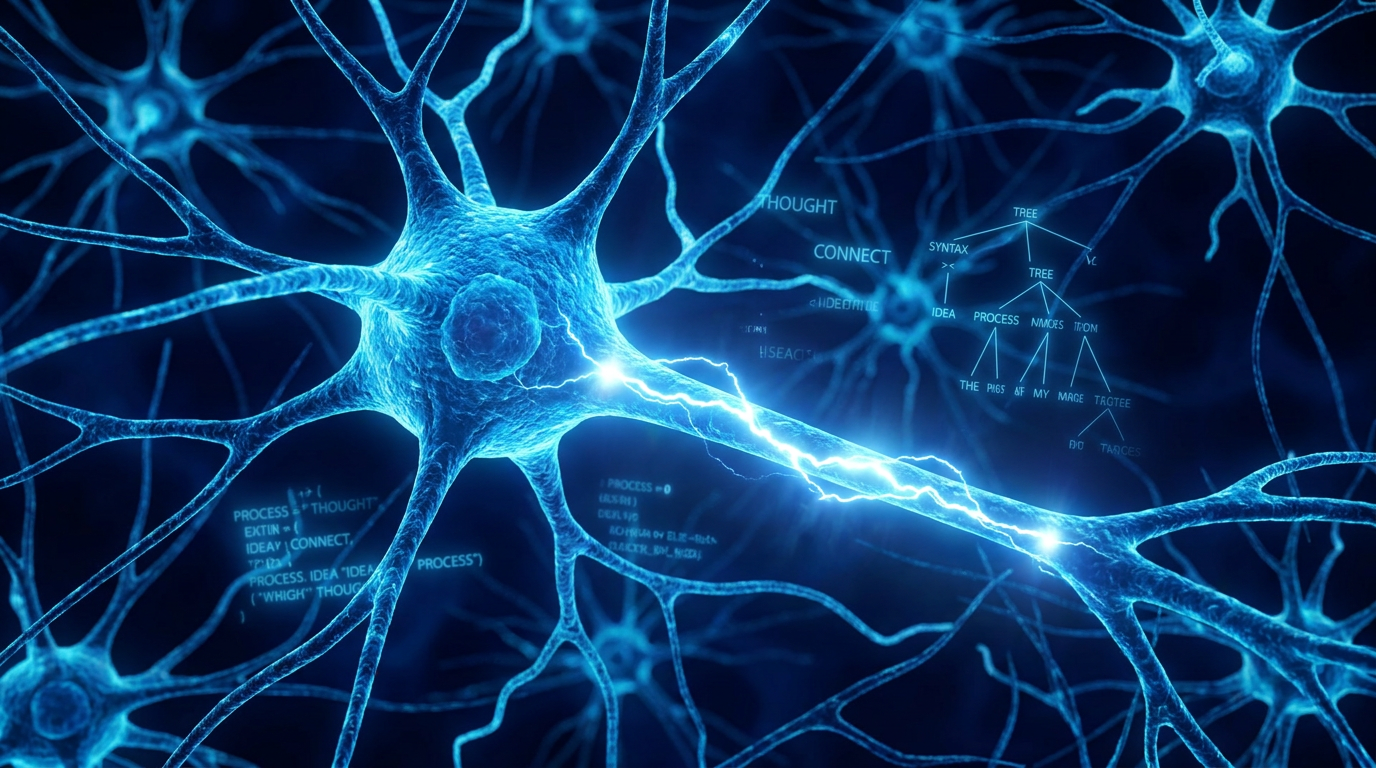
The speed of human conversation is a biological marvel. In the fraction of a second before a person speaks, the brain weaves together complex grammar, precise vocabulary, and underlying meaning into a seamless stream of sound.[3]
For decades, neuroscientists have mapped this process to broad regions of the brain, such as the frontotemporal cortex. But the exact cellular mechanics—how individual neurons construct a sentence piece by piece—remained a black box, obscured by the limitations of traditional imaging technology.[1][7]
Now, a landmark study published in Nature has cracked that box open. By recording the electrical activity of single neurons in real time, researchers have successfully mapped the cellular building blocks of human language.[1][3]
The findings reveal a highly specialized division of labor at the microscopic level. Some neurons act as grammatical gatekeepers, firing only when a word functions as a specific part of speech, such as a noun or a verb.[1][2]

Other neurons track the higher-order syntactic structure of a sentence, monitoring phrase transitions and the sequence of words to ensure the intended output makes logical and grammatical sense.[1][4]
To capture this unprecedented data, a team led by researchers at Massachusetts General Hospital and Harvard Medical School utilized microelectrode arrays temporarily implanted in eight patients undergoing neurosurgery for epilepsy.[2][3]
Because these patients were awake and speaking freely during the recordings, scientists could "listen" directly to the cellular processes underlying natural, unscripted conversation—a level of granularity that is physically impossible to achieve with non-invasive fMRI scans.[2][5]
"For the first time we're describing processes not only at the regional but cellular scale that produce speech," noted Dr. Jing Cai, the study's lead author, emphasizing that identifying these fundamental building blocks sets the stage for answering profound questions about human cognition.[2]

"For the first time we're describing processes not only at the regional but cellular scale that produce speech," noted Dr.
The research team then applied advanced natural language processing models—the same architectural foundation behind modern AI chatbots—to decode the neuronal firing patterns and predict the grammar, meaning, and context of the spoken sentences.[1][2]
The comparison yielded a striking convergence between biological and artificial intelligence. Both human neurons and large language models (LLMs) rely heavily on contextual memory, tracking up to five preceding words to predict and shape the meaning of the next.[3][7]
"We used to think language was this diffuse, whole-network phenomenon," explained Dr. Ziv Williams, a neurosurgeon and co-author of the study. "But it turns out you have specific neurons that only care if a word is a noun, or only care if a phrase is ending."[3]
The data also confirmed a long-held hypothesis about the brain's lateralization, but proved it at the cellular level. While language-responsive neurons are distributed across both hemispheres, the ability to encode complex linguistic information is heavily dominant in the left hemisphere.[1][4]

Interestingly, the study found a strict separation between semantics (meaning) and syntax (grammar). Individual neurons typically specialize in one or the other, rarely processing both simultaneously.[1][3]
This extreme specialization is unique to single cells. When researchers looked at local field potentials—the synchronized activity of thousands of neighboring cells—this fine-grained linguistic selectivity vanished, highlighting why single-neuron recording is so critical to understanding the brain.[1][8]
The implications for clinical neurology are profound. By understanding exactly how neurons encode speech before it is vocalized, engineers can design vastly more accurate brain-computer interfaces (BCIs).[2][5]
Current BCIs, which help patients with ALS or stroke communicate, often struggle with natural conversational speed. Tapping directly into the brain's cellular grammar engine could enable real-time, machine-generated speech that perfectly matches the user's intent.[2][7]

Beyond medicine, the research provides a new lens for computational linguistics. As AI models increasingly mirror the human brain's approach to language, these biological insights could inspire more efficient, context-aware artificial neural networks.[4][6]
While the study marks a monumental leap, questions remain. It is not yet clear how these single-neuron mechanisms adapt across different languages, or how the brain resolves linguistic ambiguity in real-time.[7]
How we got here
1860s
Paul Broca and Carl Wernicke identify broad, regional areas of the brain responsible for language production and comprehension.
1990s-2000s
Functional MRI (fMRI) technology allows scientists to observe blood flow in the brain during speech, confirming regional language networks but lacking cellular resolution.
2021-2023
High-density microelectrode arrays begin allowing researchers to record hundreds of individual neurons simultaneously in human patients.
June 2026
Researchers publish a landmark Nature study mapping the specific linguistic functions of single neurons during natural conversation.
Viewpoints in depth
Cognitive Neuroscientists
Focus on the biological mechanism of language generation.
This camp views the discovery as a fundamental shift in understanding brain architecture. For decades, language was viewed as a regional phenomenon, mapped to broad areas like Broca's and Wernicke's areas. The revelation that single neurons act as grammatical gatekeepers—firing specifically for nouns or phrase endings—proves that the brain's computational power is highly localized. They argue this cellular-level mapping is essential for truly understanding human cognition.
Computational Linguists & AI Researchers
Focus on the convergence of biological and artificial neural networks.
AI researchers are particularly interested in the striking similarities between human neuronal activity and Large Language Models (LLMs). The finding that both biological cells and artificial nodes use a similar 'look-back' window of about five words to determine context suggests a convergent evolution of intelligence. This camp believes that studying the brain's cellular language engine could provide blueprints for more efficient, context-aware AI architectures that require less computing power.
Clinical Neurologists
Focus on restoring speech for patients with severe paralysis or communication disorders.
For neurologists and neurosurgeons, the clinical stakes are paramount. Current Brain-Computer Interfaces (BCIs) for patients with ALS or stroke often rely on broad motor cortex signals or slow spelling mechanisms. By tapping directly into the frontotemporal cortex's 'grammar neurons,' clinicians hope to develop next-generation implants that can decode intended speech in real-time, translating thoughts into fluid, machine-generated conversation with unprecedented accuracy.
What we don't know
- How these single-neuron mechanisms adapt and function across different languages, particularly tonal languages.
- How the brain resolves linguistic ambiguity and double meanings in real-time at the cellular level.
- Whether these highly specialized language neurons are present from birth or develop dynamically as a child learns to speak.
Key terms
- Single-neuron recording
- A highly precise neuro-monitoring technique that uses microelectrodes to track the electrical firing of individual brain cells, rather than broad regions.
- Frontotemporal cortex
- A large area of the brain encompassing the frontal and temporal lobes, known to be heavily involved in language production and comprehension.
- Semantics
- The branch of linguistics and logic concerned with meaning—how words and phrases represent concepts.
- Syntax
- The set of rules, principles, and processes that govern the structure of sentences and the grammatical arrangement of words.
- Large Language Model (LLM)
- A type of artificial intelligence algorithm trained on vast amounts of text to understand, predict, and generate human language.
- Brain-Computer Interface (BCI)
- A direct communication pathway between the brain's electrical activity and an external device, often used to restore function for paralyzed patients.
Frequently asked
How did researchers record individual neurons?
They used high-density microelectrode arrays temporarily implanted in the brains of eight patients undergoing neurosurgery for epilepsy, allowing them to monitor single cells while the patients spoke naturally.
What is the difference between semantics and syntax in the brain?
Semantics refers to the meaning of words, while syntax refers to the grammatical rules that structure them. The study found that individual neurons typically specialize in processing either semantics or syntax, but rarely both.
Can this technology read people's minds?
No. The current technology requires invasive surgical implants and is focused on decoding the mechanical construction of intended speech, not extracting private, unvocalized thoughts from the general public.
How does this help patients with paralysis?
By understanding exactly how neurons encode words and grammar before a person speaks, engineers can build better brain-computer interfaces that translate the neural signals of paralyzed patients into fluid, real-time synthetic speech.
Sources
Source coverage
8 outlets
4 viewpoints surfaced







[1]NatureCognitive Neuroscientists
Mapping the neuronal building blocks of human language with language models
Read on Nature →[2]National Institutes of HealthClinical Neurologists
With neuronal data, AI models predicted grammar, meaning, and context of spoken sentences
Read on National Institutes of Health →How the brain builds sentences, neuron by neuron
Read on Nature News →[4]BioengineerComputational Linguists
Decoding Human Language Neurons with AI
Read on Bioengineer →[5]The TransmitterClinical Neurologists
Novel implants provide new insight into the neural coding of speech
Read on The Transmitter →[6]arXivComputational Linguists
Can neurons speak? Semantic narration of vision at single-cell resolution
Read on arXiv →[7]Factlen Editorial TeamFactlen Synthesis
Synthesis by Factlen editorial team
Read on Factlen Editorial Team →[8]bioRxivCognitive Neuroscientists
Single-neuron representations of semantic and phonological features in right-hemispheric association cortex
Read on bioRxiv →

More in science
See all 5 stories →Stem Cell Therapy
Stem Cell Transplant Banishes Severe Autoimmune Disease for 15 Years in Landmark Study
8 sources
Gravitational Waves
How Astronomers Turned the Milky Way Into a Giant Gravitational Wave Detector
6 sources

Stem Cell Tech
Stem Cells Banish Severe Autoimmune Disease for 15 Years in Landmark Study
8 sources
Every angle. Every day.
Get science stories with full source coverage and perspective breakdowns delivered to your inbox.