
How Astronomers Turned the Milky Way Into a Giant Gravitational Wave Detector
By tracking the precise ticking of dead stars across the galaxy, scientists have detected the deep, low-frequency hum of supermassive black holes merging across the universe.
By Factlen Editorial Team
- Astrophysicists & Cosmologists
- Focuses on how the gravitational wave background reveals the history of galaxy mergers and solves the final parsec problem.
- Fundamental Physicists
- Views the discovery as a potential window into exotic early-universe phenomena like cosmic strings or inflation.
- Observational Astronomers
- Emphasizes the engineering marvel of the array, the data analysis challenges, and the need for next-generation radio telescopes.
What's not represented
- · Software engineers developing the complex algorithms required to filter out solar system noise from the pulsar data.
Why this matters
This breakthrough opens an entirely new window into the cosmos, allowing humanity to 'hear' the slow, massive collisions that shape galaxies and the fundamental structure of the universe.
Key points
- Astronomers have detected a continuous background hum of low-frequency gravitational waves.
- The discovery was made by tracking the precise radio pulses of 68 dead stars over 15 years.
- The waves stretch and squeeze spacetime, altering the arrival time of the pulsar signals.
- The primary source is believed to be supermassive black holes orbiting each other in merging galaxies.
- The finding helps solve the 'final parsec problem' regarding how massive black holes eventually collide.
For decades, humanity could only look at the universe. Then, in 2015, we learned to listen. The Laser Interferometer Gravitational-Wave Observatory (LIGO) detected the sharp, high-frequency "chirp" of stellar-mass black holes colliding. But astrophysicists knew that was only the treble of the cosmic symphony. The universe is also filled with a deep, continuous bass—a low-frequency hum of gravitational waves rippling through spacetime.[2][5]
These low-frequency waves are so vast that a single crest can take years or even decades to pass through Earth. Detecting waves this massive required a detector larger than our planet. It required a detector the size of the Milky Way galaxy itself. Enter the Pulsar Timing Array (PTA), a triumph of patience, precision, and international collaboration that has fundamentally transformed modern astrophysics.[3][6]
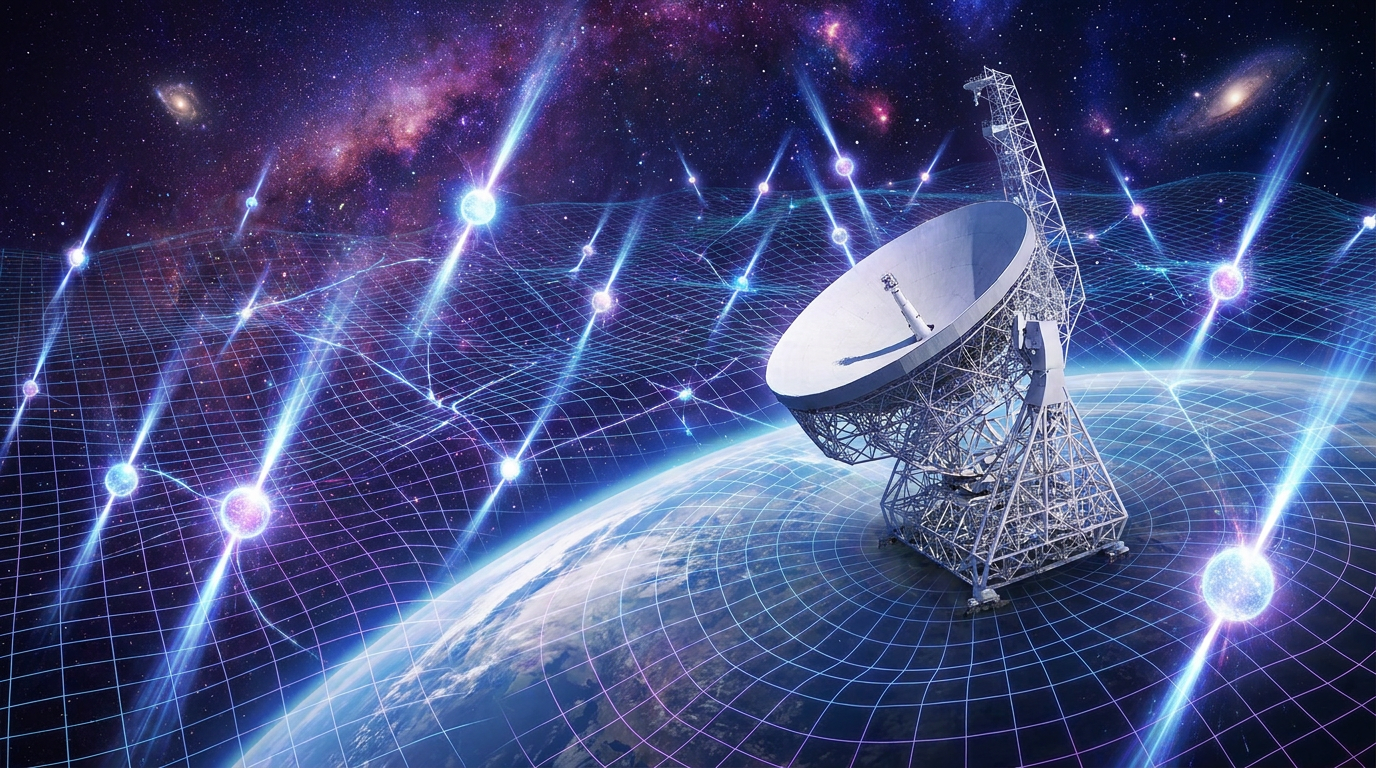
To understand how a Pulsar Timing Array works, one must first understand its core component: the pulsar. When a massive star goes supernova at the end of its life, its core collapses into a neutron star. This is an object so dense that a single teaspoon of its material weighs billions of tons. Some of these neutron stars spin incredibly fast, sweeping beams of intense radio waves across the cosmos like a lighthouse.[2][6]
When these radio beams sweep past Earth, our telescopes detect them as regular, repeating pulses. The fastest of these objects, known as millisecond pulsars, rotate hundreds of times per second. They are the most precise clocks in nature. Their rotation is so stable that astronomers can predict the arrival time of a pulse years in advance, down to the nanosecond.[1][3]

This extreme predictability is the foundation of the galaxy-sized detector. Albert Einstein’s General Theory of Relativity predicts that as gravitational waves pass through space, they stretch and squeeze the very fabric of spacetime. If a gravitational wave passes between Earth and a distant pulsar, the physical distance between them slightly changes.[5][6]
This stretching and squeezing means the pulsar's radio signals have to travel a slightly longer or shorter distance to reach our telescopes. Consequently, the pulses arrive just a tiny fraction of a second earlier or later than predicted. However, a single pulsar isn't enough to prove the existence of gravitational waves. A delayed pulse could be caused by interstellar plasma, a glitch in the star's rotation, or errors in our own atomic clocks on Earth.[3][4]
The solution is an array. By monitoring dozens of pulsars scattered across the sky simultaneously, astronomers can look for a correlated pattern of delays. As spacetime stretches in one direction, it compresses in another. This specific pattern of correlation—where pulsars close together in the sky show similar timing shifts, while those at 90-degree angles show opposite shifts—is known as the Hellings-Downs curve.[1][5]
By monitoring dozens of pulsars scattered across the sky simultaneously, astronomers can look for a correlated pattern of delays.
The Hellings-Downs curve is the smoking gun signature of a gravitational wave background. Finding this signature required immense patience. Collaborations like the North American Nanohertz Observatory for Gravitational Waves (NANOGrav), the European Pulsar Timing Array, and the Parkes Pulsar Timing Array in Australia spent over 15 years meticulously recording the ticks of 68 different pulsars.[1][4]

The data analysis involved filtering out the noise of the solar system, the interstellar medium, and the Earth's own orbit. It was a monumental computational challenge, requiring the synthesis of thousands of terabytes of radio telescope data. The precision required is akin to measuring the distance to the Moon to the width of a human hair, sustained over a decade and a half.[3][6]
The source of this cosmic hum is believed to be supermassive black hole binaries. At the center of nearly every large galaxy lies a supermassive black hole, millions or billions of times the mass of our Sun. When two galaxies collide and merge, their central black holes sink to the center of the newly formed galaxy.[2][5]
These behemoths begin to orbit each other, spiraling closer and closer over millions of years. As they dance, they churn spacetime, radiating immense amounts of energy in the form of low-frequency gravitational waves. Because there are millions of these merging galaxies across the universe, their combined waves overlap, creating a continuous background roar.[1][6]
This discovery helps address the "final parsec problem" in astrophysics. Theoretical models previously struggled to explain how two supermassive black holes could bridge the final three light-years (one parsec) to actually merge, rather than just orbiting indefinitely. The detection of these waves proves that the binaries do indeed get close enough to emit strong gravitational radiation, shedding orbital energy and eventually colliding.[2][4]

While supermassive black holes are the most likely source, physicists remain open to exotic alternatives. The background hum could contain echoes from the Big Bang itself. Some theories suggest the waves could be generated by cosmic strings—hypothetical one-dimensional defects in spacetime—or by the rapid expansion of the early universe known as inflation.[1][5]
Distinguishing between a background made of merging black holes and one made of early-universe physics will require even more data. Astronomers are currently combining the datasets from all international pulsar timing arrays into a massive global consortium, which will sharpen the resolution of the gravitational wave signal.[3][6]

How we got here
1916
Albert Einstein predicts the existence of gravitational waves in his General Theory of Relativity.
1967
Jocelyn Bell Burnell discovers the first pulsar, initially dubbed LGM-1.
1983
Physicists Ron Hellings and George Downs publish the mathematical curve that would prove a gravitational wave background.
2015
LIGO makes the first direct detection of high-frequency gravitational waves from stellar-mass black holes.
2023
NANOGrav and international partners announce the first compelling evidence for the low-frequency gravitational wave background.
Viewpoints in depth
Astrophysicists & Cosmologists
Focuses on how the gravitational wave background reveals the history of galaxy mergers and solves the final parsec problem.
For astrophysicists, the gravitational wave background is a fossil record of galaxy evolution. Every time two galaxies merge, their central supermassive black holes eventually find each other. However, models previously suggested these black holes would stall at a distance of one parsec (about three light-years), unable to shed enough energy to actually collide. The detection of this background hum proves that nature finds a way to bridge that gap, allowing the black holes to emit massive amounts of gravitational radiation and eventually merge.
Fundamental Physicists
Views the discovery as a potential window into exotic early-universe phenomena like cosmic strings or inflation.
While supermassive black holes are the most conservative explanation for the cosmic hum, fundamental physicists are looking for anomalies in the data. If the spectrum of the gravitational waves doesn't perfectly match the predictions for black hole binaries, it could point to entirely new physics. Some theorists hope the background contains the signature of cosmic strings—infinitely thin, incredibly dense fractures in spacetime left over from the Big Bang—or echoes from the rapid inflationary period of the early universe.
Observational Astronomers
Emphasizes the engineering marvel of the array, the data analysis challenges, and the need for next-generation radio telescopes.
For the astronomers operating the telescopes, the triumph is one of extreme precision and patience. Measuring nanosecond deviations in signals that have traveled for thousands of years requires accounting for the Earth's exact position in the solar system, the gravitational pull of Jupiter, and the shifting plasma of the interstellar medium. This camp is highly focused on the future, advocating for the completion of the Square Kilometre Array, which will exponentially increase the number of pulsars we can track and turn the current 'hum' into a detailed map of the gravitational wave sky.
What we don't know
- Whether the background hum is composed entirely of supermassive black holes, or if it contains signals from the Big Bang.
- The exact location of the individual black hole binaries contributing to the loudest parts of the background noise.
- How exactly the supermassive black holes overcome the 'final parsec problem' to get close enough to emit these waves.
Key terms
- Pulsar
- A highly magnetized, rotating neutron star that emits beams of electromagnetic radiation out of its magnetic poles.
- Gravitational Wave Background
- A continuous, low-frequency hum of spacetime ripples created by millions of supermassive black hole mergers across the universe.
- Spacetime
- The four-dimensional continuum in which all events in the universe occur, combining the three dimensions of space with time.
- Hellings-Downs Curve
- A specific mathematical pattern of timing delays between pulsars that serves as the definitive proof of a gravitational wave background.
- Parsec
- A unit of distance used in astronomy, equal to about 3.26 light-years.
Frequently asked
Can humans actually hear these gravitational waves?
No. Gravitational waves stretch and squeeze spacetime, not air. However, scientists often convert the frequency of these waves into audio files so we can 'listen' to the data.
Will these waves affect Earth or our solar system?
The waves pass through Earth constantly, but the stretching and squeezing effect is incredibly tiny—smaller than the nucleus of an atom over the distance of the entire planet.
How is this different from what LIGO discovered in 2015?
LIGO detects high-frequency waves from small black holes colliding over a few seconds. Pulsar Timing Arrays detect low-frequency waves from supermassive black holes orbiting each other over millions of years.
Sources
Source coverage
6 outlets
3 viewpoints surfaced






[1]arXiv / NANOGrav CollaborationFundamental Physicists
The NANOGrav 15-year Data Set: Evidence for a Gravitational-Wave Background
Read on arXiv / NANOGrav Collaboration →[2]NASA Jet Propulsion LaboratoryAstrophysicists & Cosmologists
Astronomers Hear the Cosmic Hum of the Universe
Read on NASA Jet Propulsion Laboratory →[3]Max Planck Institute for Radio AstronomyObservational Astronomers
Listening to the gravitational wave universe with pulsars
Read on Max Planck Institute for Radio Astronomy →[4]National Science FoundationObservational Astronomers
NSF-supported NANOGrav team discovers low-frequency gravitational waves
Read on National Science Foundation →[5]NatureAstrophysicists & Cosmologists
Gravitational-wave background discovered: what it means for astrophysics
Read on Nature →[6]Factlen Editorial TeamAstrophysicists & Cosmologists
Synthesis by Factlen editorial team
Read on Factlen Editorial Team →

Every angle. Every day.
Get science stories with full source coverage and perspective breakdowns delivered to your inbox.