
How Solid-State Batteries Work—and Why They Are Finally Hitting the Road
By replacing flammable liquid electrolytes with solid materials, next-generation batteries promise to double EV range, slash charging times, and eliminate fire risks. After decades in the lab, the technology is entering commercial production in 2026.
By Factlen Editorial Team
- Automotive Manufacturers
- View solid-state batteries as the ultimate competitive advantage to eliminate consumer range anxiety and reduce vehicle weight.
- Battery Researchers
- Focus on the immense materials science challenges of scaling up production, particularly regarding moisture sensitivity and interface resistance.
- Market Analysts
- Track the billions in capital flowing into the sector, projecting a massive shift in supply chains as the technology matures.
What's not represented
- · Lithium Mining Communities
- · Legacy Auto Mechanics
Why this matters
Solid-state batteries solve the three biggest hurdles to mass electric vehicle adoption: range anxiety, long charging times, and fire safety. This breakthrough will make EVs lighter, cheaper, and capable of traveling over 1,000 kilometers on a single 10-minute charge.
Key points
- Solid-state batteries replace flammable liquid electrolytes with solid ceramics, glasses, or polymers.
- The solid barrier prevents short circuits, allowing the use of energy-dense lithium-metal anodes.
- Energy density is expected to double, pushing EV ranges past 1,000 kilometers.
- Fire risks are virtually eliminated, as the solid materials do not easily ignite under stress.
- Major automakers and battery suppliers are targeting 2026-2028 for early commercial production.
For the past three decades, the lithium-ion battery has been the undisputed engine of the portable world. It powers everything from the smartphone in your pocket to the electric vehicle in your driveway. But despite relentless optimization, traditional lithium-ion technology is hitting a hard physical wall. Consumers want electric vehicles that can drive further, charge faster, and operate safely in extreme weather, but extracting more performance from current battery chemistry yields diminishing returns.[8]
That paradigm is finally shifting. After years of being dismissed as a perpetual "five years away" lab experiment, solid-state batteries (SSBs) are entering commercial production in 2026. Major automakers and battery giants are transitioning from prototypes to small-batch manufacturing lines, racing to commercialize what industry analysts consider the most significant leap in energy storage since the 1990s.[2][5]
To understand why this breakthrough matters, you have to look inside a conventional battery. Every battery relies on three primary components to function: an anode (the negative side), a cathode (the positive side), and an electrolyte (the medium sitting between them). When you power a device, lithium ions travel from the anode, through the electrolyte, to the cathode, creating an electrical current. When you plug the device into a wall, the process runs in reverse.[3][7]
In the lithium-ion batteries used today, that crucial electrolyte is a liquid—specifically, a lithium salt dissolved in an organic solvent. While effective at transporting ions, this liquid is highly volatile and flammable. If a battery is punctured in a crash, overcharged, or exposed to extreme heat, the liquid electrolyte can ignite, triggering a dangerous chain reaction known as thermal runaway.[1][7]

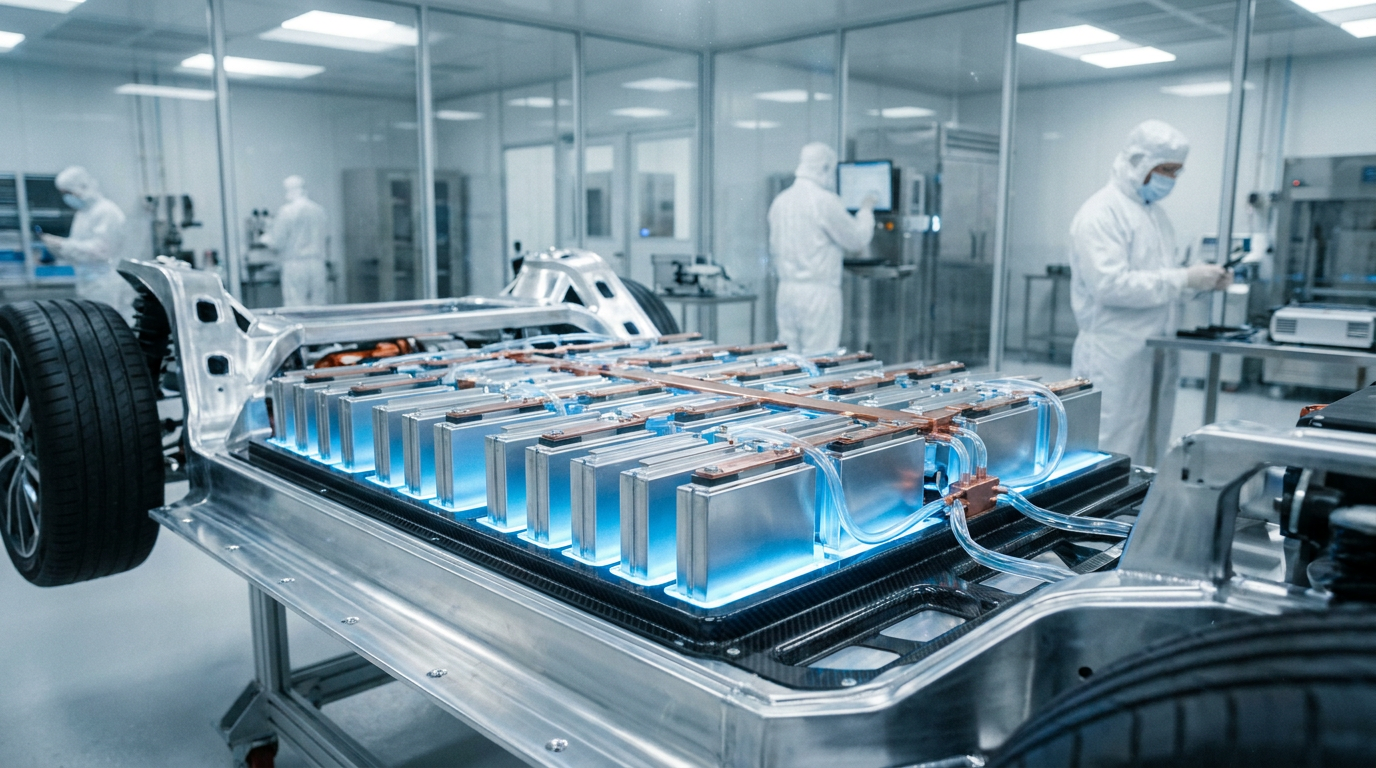
A solid-state battery solves this vulnerability with one elegant swap: it replaces the flammable liquid electrolyte with a solid material. Depending on the manufacturer, this solid separator is typically made from advanced ceramics, glass, polymers, or sulfide compounds. This single architectural change fundamentally alters the battery's physical limits and safety profile.[3][8]
The immediate benefit is a massive upgrade in safety. Because there is no combustible liquid inside the cell, the risk of fire drops to near zero. Comparative testing shows that thermal events in solid-state systems do not even begin until temperatures reach roughly 247°C, compared to just 90°C for conventional lithium-ion batteries. This intrinsic stability means automakers can strip out the heavy, expensive cooling systems and protective armor currently required to keep EV batteries safe.[1][7]
But safety is only half the story; the real prize is energy density. In a traditional battery, the anode is made of bulky graphite, which acts as a sponge to safely hold lithium ions. If you try to use pure lithium metal instead of graphite, the liquid electrolyte allows microscopic, needle-like structures called dendrites to grow. These dendrites eventually pierce the separator, causing a catastrophic short circuit.[4]
But safety is only half the story; the real prize is energy density.
A solid electrolyte acts as a physical brick wall. It is mechanically strong enough to suppress dendrite growth, which finally allows engineers to ditch the heavy graphite and use a pure lithium-metal anode. By removing the "dead weight" of graphite, the battery becomes significantly lighter and more compact while holding vastly more energy.[4][7]

The numbers represent a generational leap. Today's best lithium-ion batteries deliver an energy density of roughly 200 to 300 watt-hours per kilogram (Wh/kg). The first wave of commercial solid-state batteries targeting the 2026 market are hitting 400 to 500 Wh/kg. For the average driver, this translates to an electric vehicle that can travel over 1,000 kilometers (620 miles) on a single charge.[1][2]
Charging speeds are poised for a similar revolution. Because solid electrolytes are highly stable and resistant to heat, they can accept a massive influx of electricity without degrading. Automakers anticipate that next-generation solid-state packs will be able to charge from 10% to 80% capacity in under 10 minutes, making a highway pit stop for an EV virtually identical to filling up a gas tank.[2][5]
If the science is so clear, why has it taken decades to reach the market? The bottleneck has always been manufacturing at scale. Creating a solid electrolyte that perfectly contacts the electrodes without cracking as the battery expands and contracts is incredibly difficult. Sulfide-based solid electrolytes offer excellent conductivity but are highly sensitive to moisture, requiring expensive dry-room manufacturing. Oxide-based ceramics are stable but require extreme heat to process.[1][4]

Those manufacturing hurdles are finally being cleared. In China, the government is releasing its first official standard for solid-state EV batteries in July 2026, signaling a shift from experimental tech to regulated mass production. Automakers like GAC and Dongfeng have already completed small-batch production lines, integrating early solid-state cells into test vehicles capable of operating flawlessly in -30°C weather.[2]
Meanwhile, legacy giants are finalizing their timelines. Toyota, which holds over 1,000 patents in solid-state technology, is targeting mass production for its vehicles by 2027 to 2028. Their prototypes have already demonstrated a 50% increase in driving range over their upcoming high-performance lithium-ion models, cementing the technology as the cornerstone of their future fleet.[2][5]

The impact of this transition will extend far beyond passenger cars. Because solid-state batteries can be miniaturized without losing power, they are set to revolutionize medical implants, wearable electronics, and e-bikes. In the long term, the dramatic reduction in battery weight could finally make electric aviation and heavy-duty electric trucking commercially viable.[8]
We are witnessing the twilight of the liquid battery era. As gigafactories retool to produce solid-state cells over the next five years, the compromises that have defined early electric vehicles—range anxiety, heavy chassis, and long charging stops—will fade away. The holy grail of battery chemistry is no longer a theory; it is rolling off the assembly line.[4][8]
How we got here
1991
Sony commercializes the first rechargeable lithium-ion battery, revolutionizing portable electronics.
2010s
Automakers adopt lithium-ion technology for mass-market electric vehicles, but face range and safety limitations.
Early 2020s
Billions in venture capital flow into solid-state battery startups to solve manufacturing bottlenecks.
July 2026
China is scheduled to release its first official standard for solid-state EV batteries.
2027–2028
Toyota and other legacy automakers plan to launch their first mass-produced solid-state vehicles.
Viewpoints in depth
Automotive Manufacturers
Automakers view solid-state batteries as the ultimate competitive advantage to eliminate consumer range anxiety.
For legacy automakers, the transition to electric vehicles has been hampered by consumer hesitation over range and charging times. Solid-state technology is viewed as the silver bullet that makes an EV functionally identical to a gas-powered car in terms of convenience. By doubling energy density, manufacturers can either offer massive 1,000-kilometer ranges or drastically shrink the battery pack, making the vehicle lighter, more agile, and cheaper to produce. Companies like Toyota are betting their entire next-generation fleet architecture on this chemistry.
Battery Researchers
Materials scientists focus on the immense challenges of scaling up production and ensuring long-term durability.
While the chemistry works perfectly in a lab, researchers emphasize that mass manufacturing is incredibly difficult. Solid electrolytes must maintain perfect physical contact with the electrodes as the battery naturally swells and shrinks during charging. If microscopic gaps form, the battery loses capacity. Furthermore, different solid materials present unique hurdles: sulfide-based electrolytes are highly conductive but react poorly to moisture, requiring expensive dry-room manufacturing, while oxide-based ceramics require extreme heat to process.
Market Analysts
Financial analysts track the billions in capital flowing into the sector, projecting a massive shift in global supply chains.
Market watchers note that the commercialization of solid-state batteries will trigger a massive realignment in the global supply chain. The IDTechEx report projects the solid-state market will reach $10 billion by 2036. Because these batteries eliminate the need for heavy graphite anodes and complex liquid cooling systems, the raw material demands will shift heavily toward pure lithium metal. Analysts warn that whichever region scales solid-state manufacturing first will hold a dominant monopoly over the next decade of transportation.
What we don't know
- How quickly manufacturing costs will drop to make solid-state batteries competitive with cheap lithium-iron-phosphate (LFP) cells.
- Whether the solid electrolytes will maintain their structural integrity over 10 to 15 years of daily driving.
- Which specific solid material (sulfide, polymer, or oxide) will ultimately dominate the global market.
Key terms
- Electrolyte
- The medium inside a battery that allows charged ions to flow between the anode and the cathode.
- Anode
- The negative electrode of a battery, where lithium ions are stored when the battery is fully charged.
- Cathode
- The positive electrode of a battery, which receives lithium ions as the battery discharges power.
- Dendrites
- Microscopic, needle-like metallic structures that can grow inside a battery, potentially piercing the separator and causing a short circuit.
- Energy Density
- A measure of how much energy a battery can hold relative to its weight, typically expressed in watt-hours per kilogram (Wh/kg).
Frequently asked
What makes a solid-state battery different?
It replaces the flammable liquid electrolyte found in standard lithium-ion batteries with a solid material, like ceramic or glass, to transport ions.
Why are solid-state batteries safer?
Because they lack a volatile liquid electrolyte, they are highly resistant to catching fire, even if punctured or exposed to extreme heat.
How much further can an EV drive with one?
Solid-state batteries target an energy density of 400-500 Wh/kg, which could allow electric vehicles to travel over 1,000 kilometers (620 miles) on a single charge.
When will they be available in cars?
Early integrations are beginning in 2026, with major automakers like Toyota targeting mass production for passenger vehicles between 2027 and 2028.
Sources
Source coverage
8 outlets
3 viewpoints surfaced








[1]IDTechExMarket Analysts
Solid-State and Polymer Batteries 2026-2036: Technology, Forecasts, Players
Read on IDTechEx →[2]EV Infrastructure NewsAutomotive Manufacturers
The Race to Commercialize Solid-State EV Batteries
Read on EV Infrastructure News →[3]Built InBattery Researchers
What Is a Solid-State Battery? How Does It Work?
Read on Built In →[4]Volta FoundationBattery Researchers
The Holy Grail of Batteries: Solid-State Electrolytes
Read on Volta Foundation →[5]EVTech NewsAutomotive Manufacturers
Solid-State Batteries Are Coming Soon
Read on EVTech News →[6]Flash BatteryBattery Researchers
What are solid-state batteries and how do they work
Read on Flash Battery →[7]QuratorBattery Researchers
How Do Solid-State Batteries Work?
Read on Qurator →[8]Factlen Editorial TeamMarket Analysts
Synthesis by Factlen editorial team
Read on Factlen Editorial Team →
Every angle. Every day.
Get guides stories with full source coverage and perspective breakdowns delivered to your inbox.