
The 2026 E-Bike Buying Guide: How to Choose the Right Electric Bicycle
Electric bikes have transformed urban commuting and outdoor recreation, but navigating motor types, battery ranges, and class regulations can be overwhelming. This comprehensive guide breaks down everything you need to know to find the perfect e-bike for your lifestyle and budget.
By Factlen Editorial Team
- Urban Commuters
- Prioritizes reliability, cargo capacity, and replacing car trips with sustainable transit.
- Recreational Cyclists
- Focuses on natural ride feel, motor torque, and technical capability for trails.
- Safety & Regulatory Advocates
- Emphasizes battery certification, trail etiquette, and strict adherence to speed limits.
What's not represented
- · Traditional Acoustic Cyclists
- · City Infrastructure Planners
Why this matters
An e-bike is a major investment that can replace car trips, improve your cardiovascular health, and lower your daily carbon footprint. However, choosing the wrong model can result in costly maintenance issues, inadequate battery range, or a bike that doesn't legally comply with your local trail regulations.
Key points
- E-bikes are categorized into three classes based on their top speed and whether they feature a throttle.
- Mid-drive motors offer better balance and hill-climbing efficiency, while hub motors are more budget-friendly.
- Real-world battery range is often 30% to 40% lower than advertised maximums due to terrain and assist levels.
- Purchasing from a reputable brand ensures access to UL-certified batteries and long-term repair support.
- Test riding an e-bike at a local shop is crucial to ensure the frame geometry and motor feel match your needs.
Electric bicycles have evolved from a niche novelty into a dominant force in modern transportation, fundamentally reshaping how people navigate their daily lives. In 2026, e-bikes are no longer just heavy, clunky alternatives to traditional cycling; they are highly sophisticated machines designed to replace daily car commutes, conquer steep mountain trails, and make cycling accessible to a vastly broader demographic. Whether you are a seasoned cyclist looking to extend your weekend touring range or a daily commuter hoping to arrive at the office without breaking a sweat, the electric bike market now offers a highly specialized tool for almost every conceivable mission. However, this explosion of variety has also introduced a steep learning curve for first-time buyers. Navigating the complex landscape of motor types, battery capacities, sensor technologies, and localized legal classifications can quickly become overwhelming. Making an informed decision requires looking past flashy marketing claims and understanding the underlying mechanics of how these bicycles actually operate in the real world.[1]
At its core, an electric bike is simply a standard bicycle integrated with an electric motor, a rechargeable battery pack, and a controller system. However, the specific way that power is delivered to the wheels fundamentally changes the entire riding experience. Most modern e-bikes rely on a "pedal-assist" system, meaning the electric motor only engages when the rider is actively turning the pedals. This design seamlessly amplifies the rider's natural physical effort, creating a sensation akin to having a constant, powerful tailwind pushing you forward. Because the rider must still engage in the physical act of pedaling, these bikes preserve the cardiovascular benefits of traditional cycling while eliminating the exhausting strain of steep inclines or heavy headwinds. The level of assistance is entirely customizable; riders can typically toggle between low-power "eco" modes to maximize battery range or high-power "turbo" modes to effortlessly scale daunting hills.[7]
Before comparing technical specifications or frame geometries, prospective buyers must first understand the three-class regulatory system that governs where and how electric bikes can be legally ridden. This classification framework has been widely adopted across North America and dictates the maximum speed and operational mechanics of the motor. Class 1 e-bikes are strictly pedal-assist only, meaning the motor provides no power unless the rider is pedaling, and the assistance automatically cuts off when the bicycle reaches a speed of 20 miles per hour. Because they most closely mimic the behavior and speed profile of traditional acoustic bicycles, Class 1 models enjoy the broadest legal access. They are generally permitted on shared multi-use paths, dedicated bike lanes, and most municipal park trails, making them the safest and most versatile choice for the average recreational rider or suburban commuter.[2][6]

Class 2 e-bikes share the same 20-mile-per-hour maximum assisted speed limit as their Class 1 counterparts, but they introduce a crucial mechanical difference: the inclusion of a throttle. Usually mounted on the handlebar as a twist-grip or thumb-lever, the throttle allows the rider to propel the bicycle forward entirely on battery power, without needing to pedal at all. This feature is particularly popular among urban commuters who frequently navigate stop-and-go traffic, as it allows them to accelerate quickly and safely from a dead stop at an intersection. It also provides a welcome respite for riders who may need to rest their legs during a long commute. However, because they can operate like low-speed mopeds, Class 2 e-bikes are sometimes restricted from certain unpaved mountain bike trails or highly congested pedestrian paths, requiring riders to verify local ordinances before purchasing.[5][6]
Class 3 e-bikes are engineered specifically for speed, efficiency, and long-distance commuting, providing pedal assistance up to a brisk 28 miles per hour. To achieve this higher speed threshold, Class 3 models are typically required to be pedal-assist only, meaning they do not feature a throttle mechanism. These bicycles are the ultimate car-replacement vehicles, allowing riders to comfortably keep pace with urban vehicular traffic and significantly reduce their overall commute times. Because of their elevated speeds, Class 3 e-bikes are subject to much stricter safety regulations. They are frequently banned from shared pedestrian paths and dedicated bike trails, restricting them primarily to road use and designated commuter bike lanes. Furthermore, many jurisdictions require Class 3 riders to wear a certified helmet at all times and impose minimum age requirements, making them less suitable for casual family recreation.[2][6]
Once the appropriate legal class is determined, the next major mechanical decision revolves around the type of motor powering the bicycle. Hub-drive motors, which are housed entirely inside the center of either the rear or front wheel, represent the most common and budget-friendly option on the market. Because they operate independently of the bicycle's standard chain and gearing system, hub motors provide a very straightforward, linear push that is excellent for cruising along flat city streets or gently rolling suburban paths. They are also relatively low-maintenance, as they do not place additional stress on the bike's drivetrain. However, this design does have notable drawbacks; housing a heavy motor inside the rear wheel can make the bicycle feel somewhat back-heavy and cumbersome to maneuver, and they are generally less efficient at tackling long, steep gradients compared to alternative motor designs.[3][7]

Mid-drive motors, conversely, are positioned directly at the bicycle's bottom bracket, nestled between the rider's pedals. This centralized placement keeps the bike's center of gravity remarkably low and perfectly balanced, resulting in handling characteristics that closely mirror a high-end traditional bicycle. More importantly, because mid-drive motors transfer their power directly through the bicycle's existing chain and rear cassette, they can leverage the bike's mechanical gears. This allows the motor to operate at its optimal efficiency regardless of the terrain, making mid-drive systems vastly superior for climbing steep hills, hauling heavy cargo, or navigating technical off-road trails. While mid-drive e-bikes command a higher premium and require more frequent drivetrain maintenance due to the increased torque on the chain, the incredibly natural, intuitive riding feel they provide makes them the gold standard for serious cyclists and mountain bikers.[3][4]
Mid-drive motors, conversely, are positioned directly at the bicycle's bottom bracket, nestled between the rider's pedals.
The sensation of power delivery is also heavily dictated by the type of internal sensor the electric bike utilizes to measure the rider's effort. Basic cadence sensors act somewhat like an electronic on/off switch; they simply detect whether the pedals are turning and deliver a predetermined, flat amount of motor power based on the selected assist level. While functional, this can sometimes result in a jerky, unnatural surge of acceleration. Premium e-bikes, particularly those equipped with mid-drive motors, utilize sophisticated torque sensors instead. A torque sensor physically measures exactly how hard the rider is pushing down on the pedals and delivers motor assistance proportionally in real-time. If you pedal lightly, the motor provides a gentle nudge; if you stand up and mash the pedals to conquer a hill, the motor instantly surges with maximum power, creating a beautifully seamless and responsive riding experience.[1]
Battery capacity is arguably the most heavily scrutinized specification on any electric bike, as it directly dictates how far you can travel before needing to find a power outlet. Capacity is typically measured in watt-hours (Wh), which provides a reliable indication of the battery's total energy storage—essentially the size of the bicycle's "gas tank." Most standard commuter and recreational e-bikes feature batteries ranging from 400Wh to 750Wh, which is generally sufficient for daily urban use. However, specialized electric touring bicycles and heavy-duty cargo haulers often require significantly more energy to move their mass over long distances. These specialized machines frequently utilize dual-battery setups that push the total onboard capacity well beyond 1,000Wh, ensuring that riders can embark on multi-day adventures or complete extensive delivery routes without suffering from range anxiety.[8]
While comparing watt-hours is straightforward, prospective buyers must be highly skeptical of the "maximum range" claims prominently plastered across manufacturer marketing materials. These impressive figures are almost always calculated under the most ideal, unrealistic conditions possible: a lightweight rider, pedaling on perfectly flat, smoothly paved terrain, with no wind, using the absolute lowest level of motor assistance. In the real world, battery drain is highly variable. Factors such as steep, sustained climbs, strong headwinds, heavier rider weights, under-inflated tires, and a reliance on high-power "turbo" modes can drastically reduce efficiency. For practical daily planning, industry experts recommend assuming you will only achieve roughly 60 to 70 percent of the manufacturer's advertised maximum range. If a bike claims it can travel 50 miles on a single charge, a commuter should safely plan for a realistic round-trip range of 30 to 35 miles.[5]

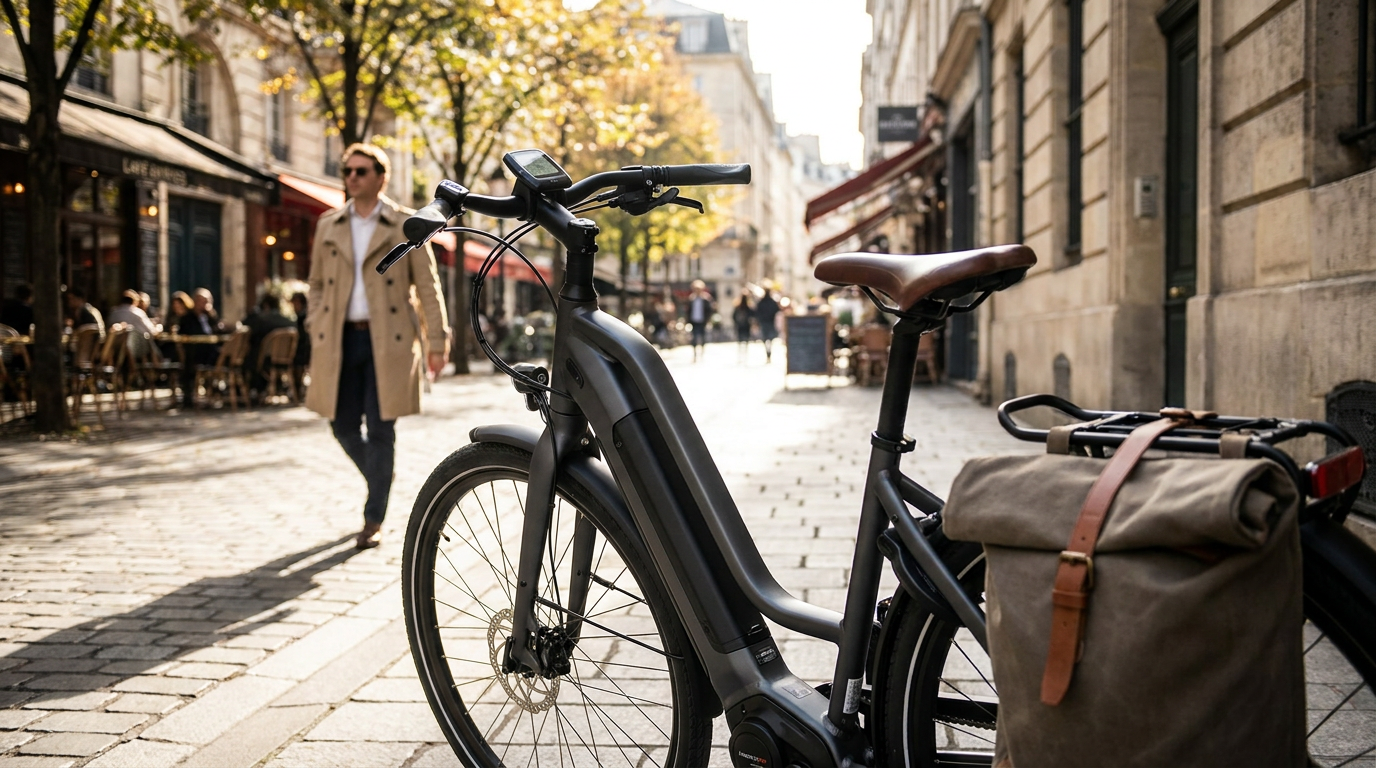
Beyond the electronics, the physical design and geometry of the frame must perfectly match the rider's intended mission. Commuter and city e-bikes are engineered for practicality and comfort in urban environments. They typically feature an upright riding posture that keeps the rider's eyes focused on surrounding traffic, integrated LED lighting systems powered directly by the main battery, and built-in rear racks for carrying pannier bags or briefcases. Furthermore, step-through frames—once relegated solely to traditional "Dutch-style" city bikes—have become incredibly popular across all age groups and genders in the e-bike market. By removing the high top tube, step-through frames allow riders to easily mount and dismount the heavy bicycle without needing to awkwardly swing a leg over the saddle, a feature that is especially valuable when the bike is loaded with groceries or when riding in restrictive work attire.[5][7]
For those looking to venture far beyond the pavement, electric mountain bikes (e-MTBs) offer a completely different set of specialized features. These rugged machines are equipped with robust front and rear suspension systems to absorb heavy impacts, wide knobby tires for maximum traction on loose dirt, and incredibly powerful mid-drive motors specifically tuned to deliver massive torque for conquering technical, root-covered ascents. On the opposite end of the utility spectrum, electric cargo bikes have emerged as the ultimate suburban car replacements. Boasting elongated, reinforced frames, heavy-duty kickstands, and modular seating arrangements, these utilitarian workhorses are capable of hauling a week's worth of groceries, transporting multiple children to school, or carrying heavy professional equipment, all while easily bypassing gridlocked morning traffic.[4][8]

One universal truth that applies to almost every electric bicycle on the market is their substantial weight. A typical, fully equipped e-bike tips the scales at anywhere between 45 and 70 pounds (20 to 32 kilograms)—which is significantly heavier than a standard, unpowered acoustic bicycle that typically weighs around 30 pounds. While the powerful electric motor entirely masks this extra mass while you are actively riding down the street, the weight becomes a very real logistical factor the moment you dismount. Buyers must carefully consider their daily storage and transportation realities. If your daily routine involves carrying the bicycle up three flights of narrow apartment stairs, lifting it onto a high vehicle roof rack, or maneuvering it into a cramped basement storage unit, a 65-pound e-bike may quickly become an unmanageable burden regardless of how beautifully it rides.[3][4]
To help mitigate the inherent challenges of maneuvering such a heavy piece of machinery while dismounted, many modern e-bikes now come equipped with a highly practical feature known as "Walk Mode." Usually activated by pressing and holding a dedicated button on the handlebar control pad, Walk Mode engages the electric motor to provide a very gentle, low-speed assist—typically capping out at around 3 miles per hour. This feature is an absolute lifesaver when you need to push a fully loaded cargo bike up a steep driveway, navigate a heavy commuter bike up a specialized staircase ramp at a train station, or walk an e-MTB through an unrideable, rocky section of a mountain trail. It ensures that the motor remains useful even when you aren't in the saddle.[3]
As the e-bike market has exploded, safety and electrical reliability have rightfully become paramount concerns for consumers and regulators alike in 2026. The proliferation of cheap, uncertified lithium-ion batteries has led to a well-documented rise in dangerous thermal runaway events and battery fires. Consequently, buyers are now strongly advised to exclusively purchase e-bikes whose batteries and entire electrical systems have been rigorously tested and certified to strict international safety standards, such as UL 2849 or EN 15194. These independent certifications guarantee that the battery cells, the motor controller, and the charging equipment have been engineered with proper fail-safes to prevent overheating, overcharging, and short circuits. Purchasing a certified bike from a reputable brand is the single most important step a buyer can take to protect their home and family.[2]
Establishing a realistic budget for an electric bicycle requires taking a long-term perspective on ownership and maintenance. While the internet is flooded with ultra-cheap, direct-to-consumer e-bikes priced under $1,000, these models almost universally rely on proprietary, low-quality electrical components and generic batteries. When these cheap parts inevitably fail, local bike shops are often unable to source replacements or safely perform repairs, turning the bike into expensive electronic waste. Investing in a solid mid-range model—typically priced between $1,700 and $3,000—ensures that the bicycle is built with standardized, serviceable components. In this price bracket, buyers gain access to highly reliable, UL-certified motor systems from established industry giants like Bosch, Shimano, or Yamaha, guaranteeing that replacement parts, software updates, and professional mechanic support will remain widely available for years to come.[3][4]

Ultimately, while extensive online research and specification comparisons are valuable, the absolute best way to choose the perfect electric bicycle is to visit a local, specialized bike shop and test ride multiple different models. A specification sheet simply cannot convey the nuanced differences in motor responsiveness between a cadence and a torque sensor, the subtle variations in frame geometry that dictate your riding posture, or the overall balance and comfort of the machine. A proper test ride allows you to physically feel how the bike handles under your own weight and riding style. Furthermore, purchasing through a local dealer ensures that the complex electrical and mechanical systems are professionally assembled, safely tuned, and backed by accessible warranty support, guaranteeing that your new e-bike remains a reliable, joyful part of your daily routine.[5]
How we got here
Early 2000s
Early e-bikes enter the market, often characterized by heavy lead-acid batteries and clunky hub motors.
2015
The three-class e-bike regulatory system is introduced in the United States to standardize trail access and safety rules.
2020
The global pandemic triggers a massive surge in e-bike adoption as consumers seek socially distanced transportation and outdoor recreation.
2024
Stricter safety standards, such as UL 2849, become widely adopted following concerns over uncertified lithium-ion battery fires.
2026
E-bikes solidify their position as mainstream utility vehicles, with cargo and commuter models frequently replacing secondary family cars.
Viewpoints in depth
The Urban Commuter's View
Prioritizes reliability, cargo capacity, and replacing car trips.
For daily commuters, an e-bike is a utility vehicle rather than a piece of sporting equipment. This camp values integrated lighting, robust fenders, and step-through frames that accommodate work attire. They often favor Class 2 or Class 3 bikes to keep pace with city traffic and utilize throttles to accelerate quickly from intersections without breaking a sweat. To this group, the initial investment is easily offset by savings on fuel, parking, and public transit passes.
The Off-Road Enthusiast's View
Focuses on natural ride feel, torque, and technical capability.
Recreational trail riders and mountain bikers prioritize mid-drive motors equipped with torque sensors. They argue that hub motors disrupt the natural balance of the bike and fail to provide the nuanced power delivery required for technical climbs. For this group, the e-bike is an extension of traditional mountain biking, allowing them to ride further and tackle steeper ascents without relying on shuttles or ski lifts, maximizing their time spent actually riding.
The Safety Regulator's View
Emphasizes battery certification, trail etiquette, and speed limits.
As e-bikes surge in popularity, safety advocates and land managers are focused on mitigating risks. This perspective strongly advocates for strict adherence to UL 2849 battery certifications to prevent lithium-ion fires. Furthermore, they emphasize the importance of the three-class system to ensure high-speed Class 3 bikes do not create hazardous conditions on shared pedestrian paths and multi-use trails, advocating for clear signage and rider education.
What we don't know
- How future local legislation might further restrict or expand trail access for Class 2 and Class 3 e-bikes.
- Whether solid-state batteries will replace current lithium-ion technology in the near future, potentially reducing bike weight.
- How the secondary market for used e-bikes will evolve as older proprietary batteries degrade and require replacement.
Key terms
- Pedal-Assist
- A system where the electric motor only provides power while the rider is actively pedaling.
- Throttle
- A mechanism, usually on the handlebar, that allows the rider to engage the motor and propel the bike forward without pedaling.
- Mid-Drive Motor
- An electric motor located at the center of the bike between the pedals, which leverages the bike's gears for efficient hill climbing.
- Hub Motor
- An electric motor housed inside the center of the front or rear wheel, offering straightforward propulsion independent of the bike's gears.
- Watt-hour (Wh)
- A measurement of battery capacity. A higher Wh rating indicates a larger battery that can provide a longer riding range.
- Torque Sensor
- A sensor that measures how hard the rider is pedaling and delivers motor assistance proportionally, creating a smooth and natural riding feel.
Frequently asked
How far can an e-bike go on a single charge?
Most standard e-bikes offer a real-world range of 30 to 50 miles per charge. However, this varies heavily based on battery capacity, the level of motor assistance used, rider weight, and terrain.
Do I still get a workout on an electric bike?
Yes. Because most e-bikes rely on pedal-assist, the rider must still pedal to engage the motor. You can adjust the assistance level to dictate how much effort you want to exert.
Are e-bikes heavier than regular bicycles?
Significantly. A typical e-bike weighs between 45 and 70 pounds, compared to 25 to 35 pounds for a standard bike. While the motor compensates for the weight while riding, it can be challenging to lift onto car racks.
What does a UL certification mean for an e-bike?
A UL 2849 or EN 15194 certification means the e-bike's battery and electrical system have been rigorously tested by an independent laboratory to ensure they are safe from thermal runaway and fire risks.
Sources
Source coverage
8 outlets
3 viewpoints surfaced








[1]Factlen Editorial TeamUrban Commuters
Synthesis by Factlen editorial team
Read on Factlen Editorial Team →[2]Bicycle ColoradoSafety & Regulatory Advocates
E-Bike Buying Guide and Classifications
Read on Bicycle Colorado →[3]Bike LineSafety & Regulatory Advocates
E-Bike Buying Guide for Beginners
Read on Bike Line →[4]Bike24Recreational Cyclists
How to Choose an E-Bike: 5 Tips
Read on Bike24 →[5]Riding 5Urban Commuters
Everything You Need to Know Before Buying an E-Bike
Read on Riding 5 →[6]Polygon BikesSafety & Regulatory Advocates
Electric Bike Buying Guide: Navigating the Essentials
Read on Polygon Bikes →[7]CanyonRecreational Cyclists
What to look for when buying an electric bike
Read on Canyon →[8]Epic Road RidesRecreational Cyclists
E-bike buying guide: what to know before buying
Read on Epic Road Rides →



Every angle. Every day.
Get shopping stories with full source coverage and perspective breakdowns delivered to your inbox.