
How Oil and Gas Drilling Techniques Are Unlocking a Geothermal Energy Boom
By repurposing the horizontal drilling and hydraulic fracturing techniques that fueled the shale boom, engineers are turning deep, hot rock into a near-limitless source of 24/7 clean electricity.
By Factlen Editorial Team
- Geothermal Developers
- Focus on the rapid technological iteration and the potential for EGS to provide scalable, 24/7 clean power anywhere in the world.
- Energy Policy Analysts
- Emphasize the macroeconomic potential of the technology while warning that regulatory bottlenecks and permitting delays could stifle growth.
- Clean Energy Media
- Highlight the irony and optimism of the fossil fuel industry's tools being used to solve the climate crisis they helped create.
What's not represented
- · Local communities near proposed EGS sites
- · Traditional fossil fuel executives
Why this matters
The global transition to clean energy has been bottlenecked by the intermittent nature of wind and solar power. If next-generation geothermal can scale globally, it provides the missing piece of the climate puzzle: a reliable, carbon-free baseload power source that runs 24 hours a day, regardless of the weather.
Key points
- Enhanced Geothermal Systems (EGS) use oil and gas drilling techniques to tap heat from deep, dry rock.
- The technology solves the intermittency problem of wind and solar by providing 24/7 baseload power.
- Advanced rigs and drill bits have slashed the time required to drill deep geothermal wells by 70 percent.
- The transition to EGS allows the fossil fuel workforce to pivot directly into the clean energy sector.
- Despite technological breakthroughs, EGS deployment is currently slowed by lengthy federal permitting reviews.
The global push for clean energy faces a stubborn mathematical reality: modern electrical grids require constant, unwavering power, but the wind does not always blow and the sun sets every evening. To replace fossil fuels entirely, the world desperately needs "baseload" power—energy sources that can run 24 hours a day, seven days a week, without interruption.[7]
Historically, geothermal energy provided exactly this kind of reliable power, but it was severely limited by geography. Traditional geothermal plants could only be built in rare locations where natural underground aquifers met highly permeable, volcanic rock—such as in Iceland or parts of California. Because of these strict geological requirements, geothermal currently supplies less than 1 percent of the world's electricity.[3][7]
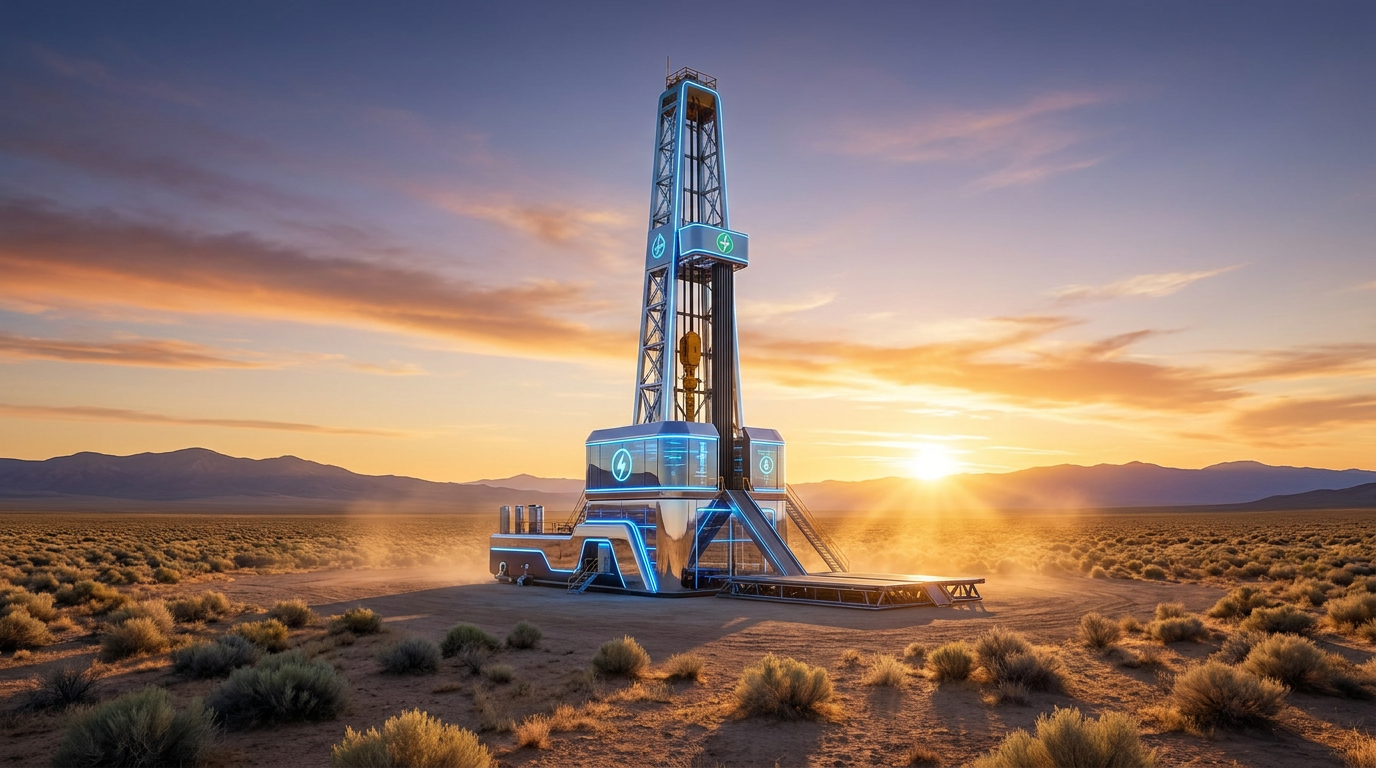
Now, a surprising savior has emerged to break those geographical constraints: the oil and gas industry. The very technologies that fueled the fossil fuel shale boom over the last two decades—specifically precision horizontal drilling and hydraulic fracturing—are being aggressively repurposed to unlock near-limitless clean energy beneath our feet.[2][4]
This new approach is known as Enhanced Geothermal Systems (EGS). Instead of hunting for rare, naturally occurring underground hot springs, EGS allows engineers to essentially manufacture their own geothermal reservoirs anywhere the subterranean rock is sufficiently hot.[2][3]
The mechanism is an engineering marvel. Drillers bore a vertical well 10,000 feet or more into solid, hot, dry granite. Once they reach the target depth, they use specialized directional steering to turn the drill bit 90 degrees, continuing to drill horizontally for another mile or more through the superheated rock.[2][8]
A second "sister" well is then drilled parallel to the first. Using hydraulic stimulation—the same high-pressure fluid injection technique known as fracking—engineers create a vast network of tiny, interconnected fractures in the solid rock between the two horizontal wells, effectively building a subterranean radiator.[2][5]

Cold water is pumped down the injection well and forced through this artificial fracture network. As the water travels through the cracks, it absorbs immense heat from the surrounding rock. The superheated fluid is then pushed up the production well to the surface, where it drives a turbine to generate electricity before being cooled and reinjected in a continuous, zero-emission closed loop.[5][8]
The U.S. Department of Energy's Utah FORGE project has served as the critical proving ground for this technology. Operating as a massive field laboratory, researchers at FORGE proved that utilizing modern polycrystalline diamond compact (PDC) drill bits—honed in the oilfields—could dramatically cut costs and improve durability when chewing through abrasive granite.[4]
Department of Energy's Utah FORGE project has served as the critical proving ground for this technology.
Private startups have rapidly commercialized these government-backed breakthroughs. Fervo Energy, the current industry leader, proved the commercial viability of EGS at its Project Red site in Nevada, which successfully began supplying round-the-clock, carbon-free electricity to Google's local data centers.[2][5][7]
Now, the industry is scaling up at a blistering pace. Fervo is currently constructing Cape Station in Utah, a massive 400-megawatt EGS project. Phase 1 of the facility is on track to begin delivering 100 megawatts of power to the grid by 2026, with the remainder coming online by 2028.[1][2]
The efficiency gains driving this scale-up are staggering. Just a few years ago, drilling a 12,000-foot geothermal well through hard rock took an average of 150 days. Today, by deploying state-of-the-art oil and gas rigs, Fervo completes wells of that length in just 15 days.[1]

This 70 percent reduction in drilling time fundamentally alters the economics of geothermal energy. Historically, the sector was crippled by astronomical upfront capital costs, with drilling accounting for more than half of a project's total price tag. Slashing those timelines brings EGS much closer to price parity with fossil fuels and subsidized renewables.[1][2]
Beyond raw drilling speed, EGS operators are deploying fiber-optic cables downhole to gather real-time, high-resolution data. This allows engineers to monitor temperatures and optimize fluid flow through the fracture network, ensuring the reservoir does not prematurely cool down and maximizing the lifespan of the well.[5]
The implications for the global workforce are equally profound. Unlike the transition to solar or wind, which requires entirely new manufacturing supply chains, the transition to EGS employs the exact same rigs, roughnecks, and petroleum engineers that currently extract carbon. It offers a direct, highly paid pivot for the fossil fuel workforce into the green economy.[7][8]

If the technology continues its current trajectory, the macroeconomic impact will be massive. Analysts at Wood Mackenzie and the International Energy Agency project that with the right policy support, next-generation geothermal could attract a trillion dollars in investment by 2035 and supply up to 15 percent of global power by 2050.[3][6]
However, significant uncertainties remain. Despite the rapid drop in drilling costs, EGS still relies heavily on federal subsidies, clean energy mandates, and corporate buyers willing to pay a premium for 24/7 green power to compete with cheap natural gas.[2]
Permitting is another massive bottleneck. Drilling deep wells on federal lands requires navigating a labyrinth of environmental reviews. Currently, geothermal exploration often faces stricter and lengthier National Environmental Policy Act (NEPA) reviews than equivalent oil and gas projects, delaying deployments by years.[2][3]

Furthermore, while closed-loop EGS plants do not release greenhouse gases, the use of hydraulic fracturing raises familiar concerns among local communities regarding induced seismicity (minor earthquakes) and water usage. Operators emphasize that EGS fracturing uses far less water than shale gas and is strictly monitored to avoid seismic hazards, but public perception remains a hurdle.[8]
Despite these challenges, the momentum behind next-generation geothermal is undeniable. By marrying the brute-force engineering of the oil and gas industry with the urgent mandate for zero-carbon electricity, Enhanced Geothermal Systems represent one of the most promising and pragmatic climate breakthroughs of the decade.[8]
How we got here
2021
The DOE's Utah FORGE project demonstrates massive efficiency gains using modern oil and gas drilling techniques in hard granite.
2023
Fervo Energy's Project Red in Nevada successfully supplies carbon-free electricity to Google data centers, proving commercial viability.
2025
Drilling times for 12,000-foot EGS wells drop from a historical average of 150 days to just 15 days.
2026
Phase 1 of Fervo's massive Cape Station project in Utah is scheduled to begin commercial operations.
Viewpoints in depth
Geothermal Developers
Focus on the rapid technological iteration and the ability to provide 24/7 clean power anywhere.
For the startups and engineers building these systems, the narrative is one of exponential technological progress. They point to the 70 percent reduction in drilling times and the successful deployment of fiber-optic monitoring as proof that EGS is no longer a science experiment, but a commercially viable product. Their primary argument is that by treating geothermal development like a manufacturing process—where costs fall predictably as more wells are drilled—EGS can eventually be deployed anywhere in the world, completely decoupling clean energy from geographic luck.
Energy Policy Analysts
Focus on the macroeconomic potential and the urgent need for regulatory reform.
Policy analysts view EGS as the missing puzzle piece for a fully decarbonized grid, noting that batteries alone cannot cost-effectively back up wind and solar during multi-day weather lulls. However, they are deeply concerned about the regulatory environment. They argue that the current federal permitting process, particularly the National Environmental Policy Act (NEPA), treats geothermal exploration more harshly than legacy oil and gas drilling. Without congressional action to streamline these approvals, they warn that the trillion-dollar investment potential of EGS will be choked off by red tape.
Clean Energy Media
Highlight the irony and optimism of the fossil fuel industry's tools being used to solve the climate crisis.
Climate journalists and clean energy advocates emphasize the poetic justice of the EGS boom: the exact same hydraulic fracturing and horizontal drilling techniques that unlocked vast reserves of carbon-heavy shale gas are now being used to render fossil fuels obsolete. They also highlight the socio-economic benefits, noting that EGS offers a "just transition" for oilfield workers. A roughneck in Texas doesn't need to learn how to code or build solar panels; they can use their existing skills to drill for clean heat instead of dirty oil.
What we don't know
- Whether Congress will streamline the federal permitting process for geothermal leases, which currently face longer environmental reviews than oil and gas.
- How quickly the supply chain for specialized high-temperature drilling components can scale to meet a sudden boom in EGS projects.
- The exact localized risk of induced seismicity (minor earthquakes) as these massive hydraulic stimulation projects move closer to populated areas.
Key terms
- Baseload power
- The minimum level of electricity demand on a grid over a 24-hour period, requiring power plants that can run continuously without interruption.
- Enhanced Geothermal Systems (EGS)
- Man-made underground reservoirs created by fracturing hot, dry rock to circulate water and extract heat for electricity generation.
- Hydraulic stimulation
- The process of injecting high-pressure fluid into subterranean rock to create a network of fractures; commonly known as fracking.
- Closed-loop system
- An engineering design where the geothermal fluid is continuously recirculated between the underground reservoir and the surface power plant without being released into the environment.
- Polycrystalline diamond compact (PDC) bit
- An advanced, highly durable drill bit used in the oil and gas industry that is now being utilized to cut through hard geothermal granite.
Frequently asked
What is an Enhanced Geothermal System (EGS)?
EGS is a technology that creates artificial geothermal reservoirs by drilling deep into hot, dry rock and injecting fluid to create fractures. This allows operators to extract heat for electricity in areas without natural hot springs.
Does EGS use fracking?
Yes, EGS uses hydraulic stimulation (fracking) to create tiny cracks in the deep rock so water can circulate. However, it uses a closed-loop system and generally requires less water than shale gas extraction.
How is EGS different from traditional geothermal energy?
Traditional geothermal relies on finding naturally occurring underground aquifers of hot water or steam. EGS engineers their own reservoirs in dry rock, meaning plants can theoretically be built almost anywhere the rock is hot enough.
Can EGS completely replace fossil fuels?
While it has massive potential to provide the 24/7 baseload power that wind and solar cannot, EGS is still in its early commercial stages and faces significant regulatory and cost hurdles before it can scale globally.
Sources
Source coverage
8 outlets
3 viewpoints surfaced








[1]Columbia University SIPAEnergy Policy Analysts
The Potential Contribution of Enhanced Geothermal Systems to Future Power Supply
Read on Columbia University SIPA →[2]Information Technology and Innovation FoundationEnergy Policy Analysts
Three advanced geothermal technologies—Enhanced Geothermal Systems (EGS), Advanced Geothermal Systems (AGS), and Superhot Rock Geothermal (SHR)
Read on Information Technology and Innovation Foundation →[3]Wood MackenzieEnergy Policy Analysts
Next-generation geothermal power: 5 key questions answered
Read on Wood Mackenzie →[4]Utah FORGEGeothermal Developers
Utah FORGE: Advancing Enhanced Geothermal Systems
Read on Utah FORGE →[5]MHI GroupGeothermal Developers
How to harness and enhance geothermal power in the US
Read on MHI Group →[6]The Energy PioneerClean Energy Media
Geothermal energy breakthroughs and oil and gas technology
Read on The Energy Pioneer →[7]The EconomistClean Energy Media
Could geothermal soon overtake nuclear power?
Read on The Economist →[8]Factlen Editorial TeamClean Energy Media
Synthesis by Factlen editorial team
Read on Factlen Editorial Team →
Every angle. Every day.
Get energy stories with full source coverage and perspective breakdowns delivered to your inbox.