
The Evidence for Agrivoltaics: How Dual-Use Solar Farms Impact Crop Yields, Water, and Grid Efficiency
A growing body of peer-reviewed evidence suggests that co-locating solar panels with agriculture can simultaneously boost photovoltaic efficiency, reduce irrigation needs, and increase certain crop yields in arid climates.
By Factlen Editorial Team
- Agricultural Economists
- Focusing on crop yields, Land Equivalent Ratio (LER), and farm profitability.
- Renewable Energy Developers
- Viewing agrivoltaics as a strategy to unlock land access and boost panel efficiency.
- Hydrologists & Climatologists
- Focusing on the microclimate benefits and water conservation potential in arid regions.
- Rural Communities
- Focusing on land preservation, aesthetics, and local economic impact.
What's not represented
- · Heavy Agricultural Machinery Manufacturers
- · Traditional Solar Purists
Why this matters
As the transition to renewable energy accelerates, land-use conflicts between solar developers and farming communities have intensified. Agrivoltaics offers a data-backed solution that could secure the global food supply while meeting clean energy targets.
Key points
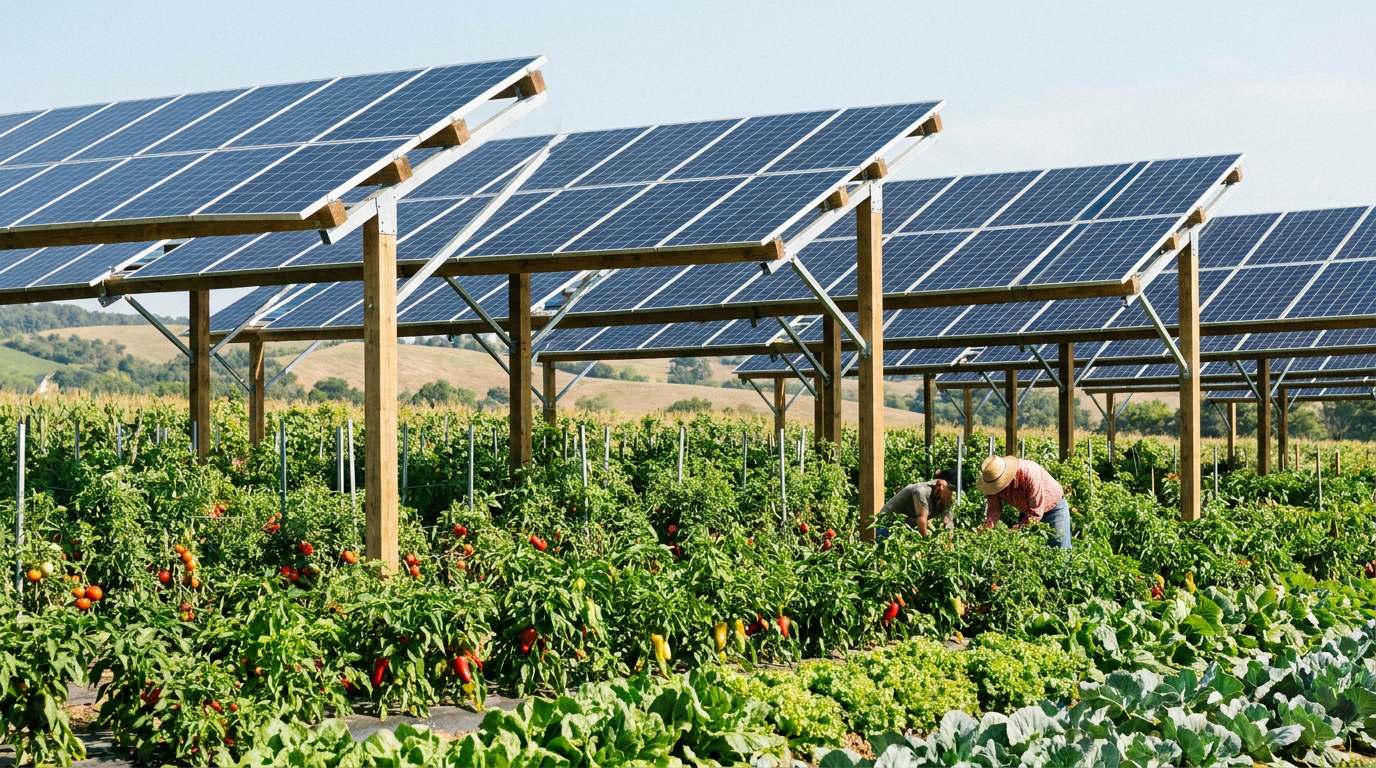
- Agrivoltaics involves co-locating elevated solar panels with active agricultural production.
- Crops cool the solar panels above them through evapotranspiration, increasing electrical efficiency.
- The partial shade reduces soil evaporation, cutting irrigation water requirements by 20% to 30%.
- Crop yield impacts vary by climate: shade boosts certain yields in arid regions but reduces them in humid areas.
- The elevated steel structures required for agrivoltaics increase initial installation costs by 10% to 20%.
The transition to renewable energy faces a fundamental geographic bottleneck: land. The National Renewable Energy Laboratory (NREL) projects that utility-scale solar installations in the United States could require up to 10 million acres of land by 2050. Because solar arrays require flat, sun-exposed terrain, developers frequently target existing farmland, sparking intense local opposition and zero-sum debates over whether land should be used to feed communities or power the grid.[1][4]
But a rapidly expanding body of empirical research suggests this trade-off may be a false dichotomy. "Agrivoltaics"—the practice of co-locating elevated solar panels with active agricultural production—is shifting from a niche experiment to a validated, utility-scale deployment model. By early 2025, the NREL had identified nearly 600 agrivoltaic sites across the U.S., covering roughly 65,000 acres and generating over 10 gigawatts of electricity.[1][7]
As the sector scales, peer-reviewed data is replacing theoretical models. The evidence points to a complex but highly synergistic relationship between photovoltaic modules and the crops growing beneath them. Rather than simply sharing space, the two systems actively alter each other's microclimates, creating measurable benefits for water retention, panel efficiency, and, under the right conditions, crop yields.[5][6]
The most immediate biophysical benefit of agrivoltaics flows upward, from the plants to the panels. Solar photovoltaics are inherently sensitive to heat; standard modules lose approximately 0.5% of their conversion efficiency for every degree Celsius they heat up beyond 25°C. In traditional solar farms built over bare dirt or gravel, the ambient temperature directly degrades power output during peak summer irradiance.[3]
Introducing vegetation beneath the arrays fundamentally changes this thermal dynamic. A comprehensive microclimate model validated by field data and published in Applied Energy found that mounting solar panels four meters above a soybean crop reduced the surface temperature of the modules by up to 10°C compared to panels mounted half a meter over bare soil.[3]

This profound cooling effect is driven by two factors. First, crops like soybeans have a much higher surface albedo, or reflectivity, than bare ground, reducing the amount of heat absorbed and radiated back up at the panels. Second, the plants act as a natural air conditioning system through evapotranspiration, releasing water vapor that cools the underside of the solar arrays.[3][6]
Conversely, the panels provide a protective canopy that drastically alters the hydrological cycle of the soil below. By casting partial shade, the arrays reduce direct solar radiation and lower the atmospheric demand for water. A landmark study published in Nature Sustainability analyzing dryland agrivoltaics found that soil moisture remained 15% higher in shaded plots compared to open-sky control plots, even when irrigated on the exact same schedule.[6]
Conversely, the panels provide a protective canopy that drastically alters the hydrological cycle of the soil below.
This reduction in evaporative loss translates directly into agricultural resilience. Multiple field trials indicate that agrivoltaic systems can reduce overall irrigation water requirements by 20% to 30%, depending on the crop and the local climate. In water-stressed regions like the American Southwest and California's Central Valley, this efficiency gain allows farmers to maintain production levels while drawing significantly less from depleted aquifers.[4]
However, the impact of solar shading on actual crop yields is not universally positive; it is highly dependent on both the regional climate and the specific photosynthetic pathways of the plants. A rigorous spatial analysis published in the Proceedings of the National Academy of Sciences (PNAS) mapped these divergent biophysical feedbacks across the United States.[2]
The PNAS study revealed that in semiarid regions—such as the western Dakotas, Kansas, and Nebraska—the shade from solar panels alleviated severe heat and water stress. In these dry environments, soybean yields actually increased by 6% under the panels, while the expected yield penalty for maize was moderated to a 12% decline. The panels effectively protected the crops from the harshest afternoon sun, allowing them to continue photosynthesizing rather than shutting down to conserve water.[2][6]
In contrast, the same study found that in the humid, cooler regions of the eastern Midwest, the shading effect became a liability. Without the threat of extreme heat stress, the reduction in sunlight directly limited photosynthesis, leading to a 24% drop in maize yields and a 16% drop in soybean yields compared to conventional open-field agriculture.[2]

The choice of crop is equally critical. Plants utilize different metabolic pathways to fix carbon. C3 crops, such as soybeans, tomatoes, leafy greens, and root vegetables, are generally more shade-tolerant and thrive in the cooler microclimates created by agrivoltaics. C4 crops, like maize and wheat, are adapted for high-efficiency growth under intense, direct sunlight and suffer significant yield penalties when shaded.[2][6]
Despite these regional and biological constraints, the global macroeconomic potential of dual-use farming is staggering. A 2026 systematic review published in Renewable and Sustainable Energy Reviews synthesized data from global trials and concluded that deploying agrivoltaics across compatible crops in a maximum-potential scenario could add 1,800 million tonnes to global food yields annually.[5]
The financial architecture of farming also shifts under an agrivoltaic model. According to a 2025 report by the Institute for Energy Economics and Financial Analysis (IEEFA), integrating solar provides landowners with a steady, weather-independent revenue stream that insulates them from the volatility of commodity markets and climate extremes.[4]

Yet, transparent uncertainties remain regarding the capital expenditures required to scale these systems. Elevating solar panels to 3.5 or 4 meters to allow standard agricultural machinery to operate underneath requires significantly more structural steel and engineering than traditional low-mount arrays. This can increase the initial installation costs by 10% to 20%, requiring adaptive financial models and longer-term power purchase agreements to justify the upfront investment.[3][4][7]
Furthermore, the operational complexity of managing a dual-use site requires unprecedented coordination between energy developers and agricultural operators. Panel spacing, tilt angles, and tracking algorithms must be optimized not just for maximum electricity generation, but to ensure adequate light penetration for the specific crop rotation below.[5][7]

Ultimately, the evidence suggests that agrivoltaics is not a blanket replacement for all conventional farming, but rather a highly effective, climate-specific tool. By matching the right crops to the right regions, policymakers and developers can transform solar expansion from a threat to agricultural land into a symbiotic system that bolsters both food and energy security.[4][5]
How we got here
Early 1980s
The concept of co-locating solar power systems and agriculture is first proposed to maximize land-use efficiency.
2019
A landmark study in Nature Sustainability demonstrates the mutual benefits of agrivoltaics across the food-energy-water nexus in drylands.
2023
Microclimate modeling confirms that crops can cool overhead solar panels by up to 10°C, significantly boosting their electrical efficiency.
Early 2025
The U.S. National Renewable Energy Laboratory tracks nearly 600 active agrivoltaic sites generating over 10 gigawatts of power.
2026
Global systematic reviews project that scaling agrivoltaics could add 1,800 million tonnes to global crop yields annually.
Viewpoints in depth
Agricultural Economists
Evaluating the financial viability and crop yield trade-offs of dual-use land.
For agricultural economists, the primary metric of success is the Land Equivalent Ratio (LER)—a measure of how much land would be required to produce the same amount of food and energy separately. They emphasize that while agrivoltaics provides a stable secondary income stream via electricity generation, the capital costs of elevated racking systems are non-trivial. They argue that the model is most viable when paired with high-value, shade-tolerant specialty crops (like leafy greens or berries) rather than low-margin commodity crops that require massive, unobstructed acreage.
Renewable Energy Developers
Viewing agrivoltaics as a strategy to unlock land access and boost panel efficiency.
Energy developers face mounting local opposition to utility-scale solar projects that take farmland out of production. For this camp, agrivoltaics is a crucial permitting strategy. By keeping the land agriculturally active, developers can bypass 'solar sprawl' pushback and secure leases more easily. Furthermore, developers are increasingly focused on the engineering data showing that the evaporative cooling from crops can lower panel temperatures by up to 10°C, directly boosting the photovoltaic conversion efficiency during peak summer demand.
Hydrologists & Climatologists
Focusing on the microclimate benefits and water conservation potential in arid regions.
Climate scientists and hydrologists view agrivoltaics primarily as a climate adaptation tool for water-stressed regions. Their research highlights how the partial shade from solar arrays fundamentally alters the local hydrological cycle, reducing soil evaporation and plant transpiration. In areas facing severe aquifer depletion, this camp advocates for agrivoltaics not just for clean energy, but as a mechanism to reduce agricultural water demand by 20% to 30% while maintaining food production.
What we don't know
- How the long-term degradation rates of solar panels are affected by the localized humidity generated by crop evapotranspiration.
- The exact economic tipping point where the 10-20% higher capital costs of elevated racking are fully offset by increased panel efficiency and crop yields.
- How future climate change and shifting aridity zones will alter the geographic boundaries of where agrivoltaics is most effective.
Key terms
- Agrivoltaics
- The simultaneous use of areas of land for both solar photovoltaic power generation and agriculture.
- Evapotranspiration
- The process by which water is transferred from the land to the atmosphere by evaporation from the soil and by transpiration from plants.
- Albedo
- The proportion of the incident light or radiation that is reflected by a surface, such as the ground or a crop canopy.
- Land Equivalent Ratio (LER)
- A metric used to assess the productivity of growing two things together (like crops and solar energy) compared to growing them separately.
- C3 and C4 Crops
- Categories of plants based on their photosynthetic pathways; C3 plants (like soybeans) are generally more shade-tolerant than C4 plants (like corn).
Frequently asked
Do solar panels block too much sun for plants to grow?
It depends on the plant. Shade-tolerant crops like leafy greens and tomatoes thrive, while sun-intensive crops like corn suffer yield reductions.
How do tractors fit under the solar panels?
Agrivoltaic systems are engineered with elevated racking—often 3 to 4 meters high—and spaced widely enough to allow standard agricultural machinery to navigate the rows.
Does agrivoltaics save water?
Yes. The partial shade reduces evaporation and lowers the temperature, allowing soil to retain up to 15% more moisture and reducing irrigation needs by 20% to 30%.
Are agrivoltaic farms more expensive to build?
Yes. The taller steel structures and specialized engineering required to elevate the panels increase the initial capital expenditures by roughly 10% to 20%.
Sources
Source coverage
7 outlets
4 viewpoints surfaced






[1]National Renewable Energy Laboratory (NREL)Renewable Energy Developers
Agrivoltaics Research and Development
Read on National Renewable Energy Laboratory (NREL) →[2]Proceedings of the National Academy of Sciences (PNAS)Agricultural Economists
Climate-driven divergence in biophysical and economic impacts of agrivoltaics
Read on Proceedings of the National Academy of Sciences (PNAS) →[3]Applied EnergyRenewable Energy Developers
The potential for agrivoltaics to enhance solar farm cooling
Read on Applied Energy →[4]Institute for Energy Economics and Financial Analysis (IEEFA)Rural Communities
Agrivoltaics increases yields, reduces water usage, and boosts rural participation in the renewable energy transition
Read on Institute for Energy Economics and Financial Analysis (IEEFA) →Agrivoltaics as a systems innovation: multi-dimensional benefits from global studies across climate, agriculture, energy, and ecosystems
Read on Renewable and Sustainable Energy Reviews →[6]Nature SustainabilityHydrologists & Climatologists
Agrivoltaics provide mutually beneficial outcomes across the food–energy–water nexus
Read on Nature Sustainability →[7]Factlen Editorial TeamRural Communities
Synthesis by Factlen editorial team
Read on Factlen Editorial Team →
Every angle. Every day.
Get energy stories with full source coverage and perspective breakdowns delivered to your inbox.