
The Rise of 'Self-Driving Labs': How Agentic AI is Automating Scientific Discovery
Autonomous laboratories combining AI agents with robotic hardware are compressing decades of chemical and materials research into days.
By Factlen Editorial Team
- Automation Advocates
- Believe fully autonomous, closed-loop systems are essential to overcome the slow pace of human-driven research.
- Clinical Pragmatists
- Focus on integrating AI into existing pipelines to solve immediate bottlenecks, emphasizing data quality over pure autonomy.
- Human-in-the-Loop Proponents
- Argue that AI should augment rather than replace scientists, keeping humans in control of hypothesis generation and ethics.
What's not represented
- · Laboratory Technicians
- · Regulatory Agencies
Why this matters
By removing the manual bottlenecks of traditional research, self-driving labs are poised to drastically accelerate the development of life-saving drugs, sustainable materials, and clean energy technologies.
Key points
- Self-driving labs (SDLs) combine AI and robotics to automate the entire scientific method, from hypothesis to physical execution.
- By operating in continuous, closed-loop cycles, these systems can accelerate materials discovery by up to 100 times.
- The shift is driven by 'agentic AI,' which moves beyond passive text generation to actively execute multi-step physical workflows.
- Major institutions, including Oak Ridge National Laboratory and NC State University, are deploying SDLs to tackle complex challenges in energy and medicine.
- A primary hurdle remains data quality, as AI models require highly structured data and precise records of failed experiments to learn effectively.
The traditional image of scientific discovery involves a brilliant researcher hunched over a lab bench, manually pipetting fluids and monitoring temperature profiles. For over a century, this human-dependent, trial-and-error process has been the gold standard of chemical and materials research.[8]
But as the scientific community advances through 2026, a quiet revolution is maturing on the laboratory floor. Driven by the convergence of cloud computing, advanced robotics, and specialized artificial intelligence, "self-driving labs" (SDLs) are transitioning from experimental academic concepts into foundational industrial infrastructure.[3][8]
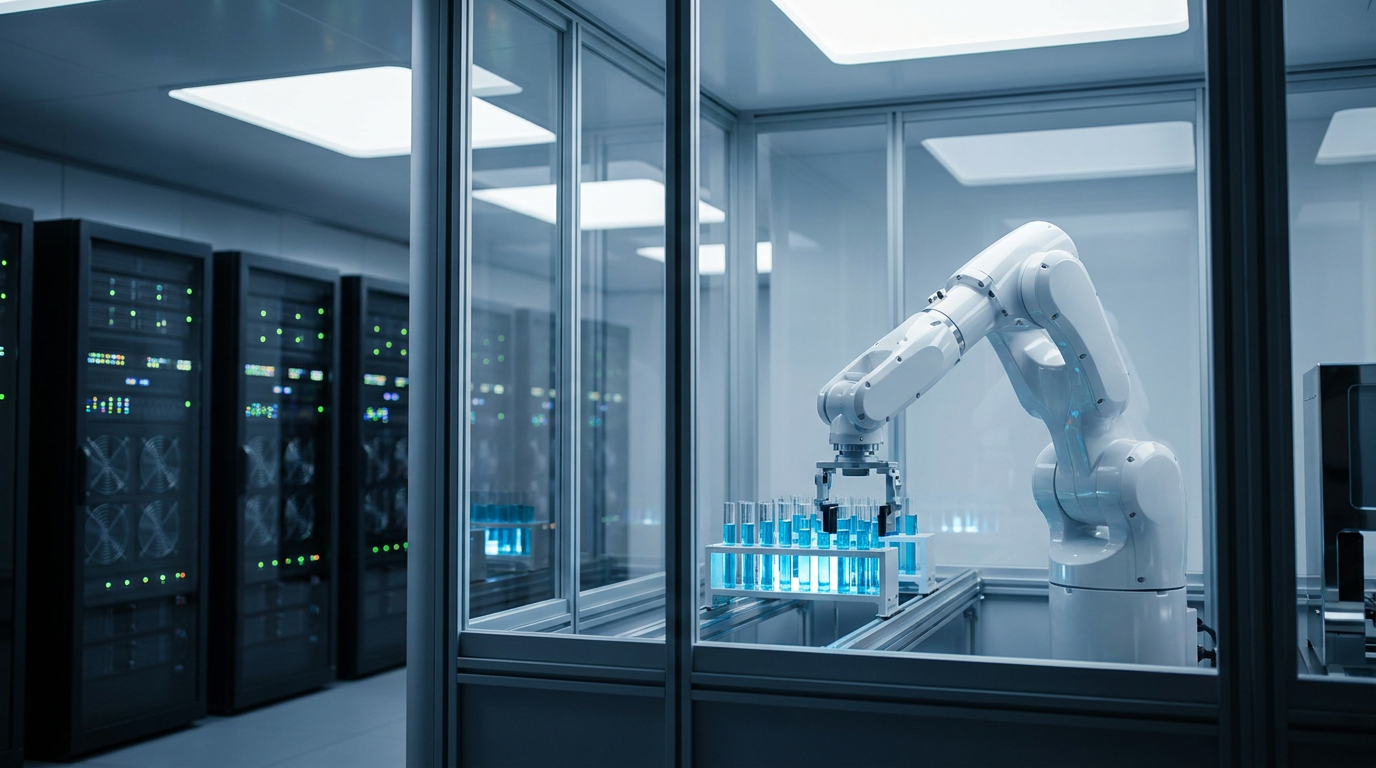
A self-driving lab is not merely a conventional laboratory equipped with robotic arms. It is a fully closed-loop, autonomous ecosystem. In these systems, an AI model proposes a hypothesis or experimental condition, automated instruments synthesize the materials, and characterization tools immediately measure the results.[2][3]
The resulting data is then fed back into the machine learning algorithm, which analyzes the outcome and determines the most promising next experiment. This continuous design-build-test-learn cycle operates without human intervention, allowing the system to run round-the-clock experiments at a breakneck pace.[2][3]

At North Carolina State University, home to the largest system of automated labs at any U.S. academic institution, researchers are witnessing the sheer scale of this acceleration. Chemical engineering professor Milad Abolhasani notes that SDLs can accelerate discovery up to 100 times faster than conventional chemical and materials science methods.[1]
The goal is a massive compression of both time and capital. At the University of Toronto, the Aspuru-Guzik research group aims to use SDLs to reduce the resources required to discover a new functional material by a factor of ten—shrinking the process from an estimated ten years and $10 million down to just one year and $1 million.[4]

This leap in capability is largely powered by a shift in software architecture: the rise of "agentic workflows." For the past few years, AI in research primarily functioned as a "copilot"—a sophisticated search engine and summarizer that could retrieve literature and draft reports, but lacked the ability to execute physical tasks.[7][8]
Agentic AI changes that paradigm. Instead of just answering questions, agentic systems act proactively to achieve objectives by dynamically adjusting their behavior based on changing environments. They can plan experimental designs, generate the necessary robotic code, and execute the chemical reactions autonomously.[7]
Instead of just answering questions, agentic systems act proactively to achieve objectives by dynamically adjusting their behavior based on changing environments.
Innovators like b12 labs are bridging the gap between computational planning and real-world execution. By utilizing natural-language workflows, a scientist can simply describe a goal, and the AI agents will translate that intent into a complex synthesis workflow, compressing weeks of iterative optimization into mere days.[6]
The impact is already being felt in the pharmaceutical industry, where traditional drug discovery is notoriously slow, expensive, and burdened by a failure rate exceeding 90 percent. According to the 2026 Biotech AI Report from Benchling, the sector has entered a phase where AI is actively reshaping research and development pipelines.[5]
By tightly coupling AI design systems with physical laboratory execution, drug developers are effectively shrinking discovery timelines from years to months. The report notes that half of the organizations adopting AI in biotech are already seeing faster time-to-target, with significant uplifts in accuracy and hit rates.[5]

Beyond commercial pharmaceuticals, national research institutions are investing heavily in the technology. At Oak Ridge National Laboratory (ORNL), researchers are developing interconnected platforms that combine leadership-class computing with cutting-edge instrumentation to create prototype "Labs of the Future."[2]
These efforts are part of broader initiatives, such as the Department of Energy's Genesis Mission, which aims to accelerate scientific discovery nationwide. By integrating AI and automated instrumentation into a shared ecosystem, ORNL hopes to tackle complex challenges in energy, materials, and environmental science.[2]
Despite the rapid progress, the transition to fully autonomous science faces significant hurdles. The primary bottleneck is no longer the AI models themselves, but the underlying data infrastructure. Biology and chemistry data is often messy, incomplete, or siloed across dozens of incompatible systems.[5][8]
Furthermore, AI models require high-quality "negative data" to learn effectively. In traditional labs, when a manual experiment fails, the human chemist often discards the sample and logs minimal details. SDLs, however, capture every anomaly and failed run with perfect precision, mapping out the boundaries of what does not work—the so-called "dark data" of science.[3][8]

There are also understandable concerns about the role of the human scientist in an increasingly automated landscape. Experts emphasize that SDLs are not designed to replace human ingenuity. Instead, they elevate the scientist's role from manual laborer to high-level architect.[1][7]
As researchers at NC State and ORNL point out, human researchers still define the overarching goals, set the safety constraints, and interpret the broader meaning of the results. The AI and robots simply navigate the vast, unmapped chemical universe to get to those results faster.[1][2]
As 2026 unfolds, the scientific method itself is being rewritten. By delegating the repetitive execution of experiments to tireless agentic systems, researchers are freeing themselves to focus on the creative and strategic leaps that machines cannot yet make, ushering in a new era of accelerated discovery.[8]
How we got here
Early 2020s
AI models like AlphaFold revolutionize digital biology by predicting protein structures, but physical lab work remains largely manual.
2023–2024
Generative AI 'copilots' enter research environments, assisting scientists with literature reviews and data summarization.
2025
Early self-driving lab prototypes demonstrate the ability to autonomously synthesize and optimize novel chemical compounds.
2026
Agentic workflows mature, allowing AI to reliably control robotic lab hardware and shrinking drug discovery timelines from years to months.
Viewpoints in depth
The Automation Advocates
Pushing for fully closed-loop systems to maximize the speed of discovery.
Researchers building self-driving labs view human intervention as a fundamental bottleneck. They argue that the sheer size of the undiscovered chemical universe—comprising billions of potential molecular combinations—makes traditional trial-and-error physically impossible to scale. By removing the 'human latency' of manual pipetting and data transcription, they believe science can compress decades of optimization into days, unlocking rapid solutions for climate change and novel diseases.
The Clinical Pragmatists
Focused on data infrastructure and integrating AI into existing commercial pipelines.
Industry analysts and biotech leaders caution that a robotic arm is only as smart as the data feeding its AI. This camp emphasizes that the current barrier to autonomous science isn't a lack of advanced hardware, but the messy, siloed nature of biological data. They advocate for a 'builder phase' focused on standardizing data formats, capturing the 'dark data' of failed experiments, and ensuring that AI models have clean, structured environments to learn from before trusting them with full autonomy.
The Human-in-the-Loop Proponents
Emphasizing that AI should augment human intuition, not replace the scientist.
Academic ethicists and veteran researchers stress that while AI excels at high-throughput optimization, it lacks genuine scientific intuition and contextual understanding. This perspective argues that self-driving labs should be viewed as powerful navigational tools—a 'GPS for the chemical universe'—rather than independent scientists. They insist that humans must remain the architects of the research, defining the ethical boundaries, setting the overarching goals, and interpreting the real-world implications of the AI's findings.
What we don't know
- It remains unclear how regulatory bodies like the FDA will adapt their approval frameworks for drugs discovered and optimized entirely by autonomous systems.
- The long-term impact on the scientific workforce, particularly for entry-level lab technicians whose primary roles are being automated, is still unfolding.
- Whether self-driving labs can successfully scale beyond highly structured chemical synthesis into the messier, more unpredictable realm of live biological testing is yet to be proven.
Key terms
- Self-Driving Lab (SDL)
- An automated laboratory ecosystem where AI models and robotic instruments work together in a closed loop to conduct experiments autonomously.
- Agentic AI
- Artificial intelligence systems designed to take proactive actions, use tools, and execute complex, multi-step workflows rather than just generating text.
- Closed-Loop System
- A process where the output of an experiment is automatically fed back into the AI model to inform and optimize the very next experiment.
- Dark Data
- The unrecorded or discarded information from failed experiments, which is highly valuable for training AI models on what not to do.
Frequently asked
What is a self-driving lab?
A self-driving lab (SDL) is an autonomous system that combines artificial intelligence with robotic hardware to design, execute, and analyze scientific experiments in a continuous loop without human intervention.
How much faster are autonomous labs?
Researchers at NC State University estimate that self-driving labs can accelerate the discovery of new molecules and materials up to 100 times faster than conventional manual methods.
What is an agentic workflow?
Unlike an AI 'copilot' that simply answers questions or summarizes text, an agentic workflow is an AI system that proactively plans and executes multi-step actions, such as writing robotic code and running chemical reactions.
Will AI replace human scientists?
Experts agree that AI will not replace scientists. Instead, it will automate repetitive manual labor, allowing researchers to focus on high-level strategy, hypothesis generation, and interpreting complex results.
Sources
Source coverage
8 outlets
3 viewpoints surfaced








[1]NC State UniversityAutomation Advocates
Self-driving labs are accelerating the discovery of new molecules and materials
Read on NC State University →[2]Oak Ridge National LaboratoryAutomation Advocates
Autonomous Laboratories at Oak Ridge National Laboratory
Read on Oak Ridge National Laboratory →[3]Royal Society PublishingHuman-in-the-Loop Proponents
Autonomous, 'self-driving' laboratories
Read on Royal Society Publishing →[4]University of TorontoAutomation Advocates
AI for Discovery and Self-Driving Labs
Read on University of Toronto →[5]Drug Discovery NewsClinical Pragmatists
2026 Biotech AI Report: A new discovery model
Read on Drug Discovery News →[6]AIChEClinical Pragmatists
Translating AI's potential into practical, lab-ready applications
Read on AIChE →[7]ElsevierHuman-in-the-Loop Proponents
Evolution of AI in Education: Agentic Workflows
Read on Elsevier →[8]Factlen Editorial TeamHuman-in-the-Loop Proponents
Synthesis by Factlen editorial team
Read on Factlen Editorial Team →

More in ai
See all 6 stories →AI Drug Discovery
Open-Source AI Discovers Three New Classes of Antibiotics to Combat Drug-Resistant Superbugs
6 sources
Edge AI
How Local AI Models Work on Consumer Hardware in 2026
8 sources

Scientific Discovery
The Rise of Self-Driving Labs: How AI and Robotics Are Automating Scientific Discovery
8 sources
Medical AI
Autonomous AI Agents Match Human Physicians in End-to-End Patient Care Simulations
7 sources

Every angle. Every day.
Get ai stories with full source coverage and perspective breakdowns delivered to your inbox.