
SpaceX Executes Largest IPO in History, Reaching $2.1 Trillion Valuation
Elon Musk's aerospace company raised a record-shattering $75 billion in its Nasdaq debut, instantly becoming the sixth-largest public company in the United States and making Musk the world's first trillionaire.
By Factlen Editorial Team
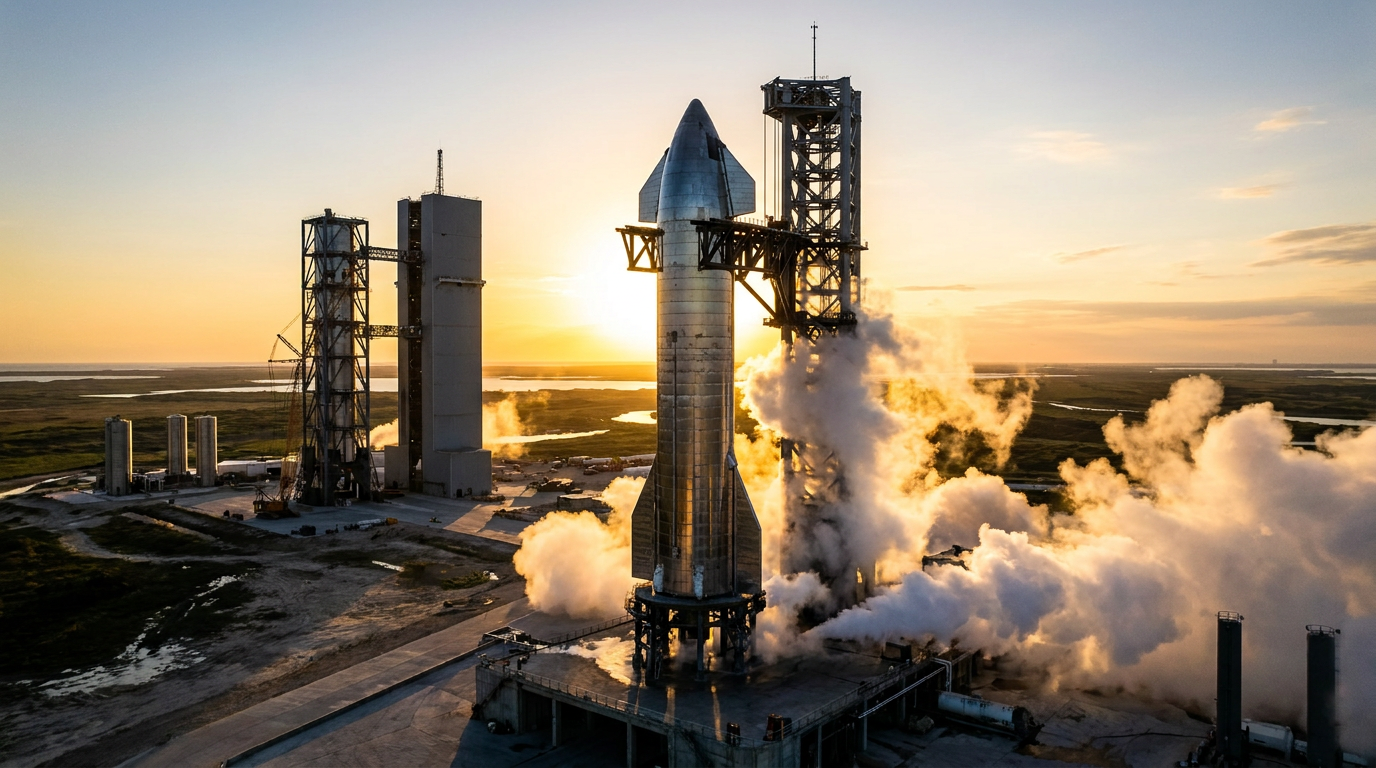
- Tech Bulls & Space Advocates
- Argue that the unprecedented valuation is justified by SpaceX's monopoly on launch services and its transformative potential.
- Value Skeptics
- Warn that the $2.1 trillion market capitalization is dangerously disconnected from the company's current financial realities.
- Market Structure Analysts
- Focus on how the sheer size of the IPO forces passive funds to buy the stock regardless of its fundamental valuation.
What's not represented
- · Retail investors priced out of early allocations
- · Competitors in the legacy aerospace sector
Why this matters
The sheer scale of SpaceX's $75 billion public debut fundamentally reshapes global equity markets and provides unprecedented capital to accelerate humanity's expansion into space. For everyday investors, it introduces a massive new heavyweight that will instantly influence the performance of major index funds and retirement portfolios.
Key points
- SpaceX raised $75 billion in the largest initial public offering in global market history.
- The stock surged 19.2% on its first day, pushing the company's valuation to $2.1 trillion.
- The massive valuation officially made founder Elon Musk the world's first trillionaire.
- While Starlink is highly profitable, the broader company posted a $4.9 billion net loss in 2025.
- Major index providers are fast-tracking the stock's inclusion, forcing massive passive fund buying.
On June 12, 2026, Elon Musk’s Space Exploration Technologies Corporation rewrote the financial record books, executing the largest initial public offering in global market history. Debuting on the Nasdaq under the ticker symbol SPCX, SpaceX priced its shares at a fixed $135, raising an unprecedented $75 billion in fresh capital. The offering instantly valued the aerospace juggernaut at $1.77 trillion, vaulting it past the previous IPO record set by Saudi Aramco in 2019 and immediately cementing its status as the sixth-largest public company in the United States. The sheer scale of the debut marks a watershed moment not just for the commercial space industry, but for global equity markets, signaling a massive influx of capital into next-generation infrastructure.[2][3][7]
The market’s appetite for the stock proved insatiable from the opening bell. Shares opened at $150 and climbed steadily throughout the session, reaching an intraday high of $176.52 before settling at $160.95. That 19.2 percent first-day gain pushed SpaceX’s closing market capitalization past the $2.1 trillion threshold, placing it in the rarefied air previously occupied only by tech giants like Apple, Microsoft, and Nvidia. The proceeds from the offering, which involved no secondary share sales by existing insiders, will flow directly into the company’s coffers to fund its aggressive growth initiatives.[1][2][3]
The historic listing also triggered a monumental shift in global wealth distribution. By retaining his 42 percent equity stake through Class B shares, Elon Musk saw his personal net worth surge past the thirteen-figure mark during the first twenty minutes of trading, officially making him the world’s first trillionaire. The milestone was celebrated in New York City with a massive projection of SpaceX’s Starship rocket illuminating the side of a Times Square skyscraper. Speaking at the Nasdaq podium, Musk reflected on the company’s origins in an El Segundo warehouse, noting that he initially gave the venture less than a ten percent chance of survival.[3][5]

Beneath the celebratory atmosphere and staggering top-line numbers, Wall Street analysts are grappling with a complex financial reality. SpaceX posted an impressive $18.7 billion in revenue for 2025, but simultaneously reported a $4.9 billion net loss. At its IPO price, the stock traded at roughly 94 times trailing revenue—a multiple that expanded further as the share price climbed. For tech bulls, this premium is entirely justified by the company’s near-monopoly on commercial launch services and its transformative potential. For value-focused skeptics, however, the $2.1 trillion valuation suggests that decades of flawless future execution have already been priced into the stock.[2]
The company’s current financial viability rests almost entirely on Starlink, its satellite internet division. Starlink generated $11.4 billion of SpaceX’s total 2025 revenue and posted a $1.19 billion profit in its most recent quarter alone. The constellation of low-Earth orbit satellites has established a formidable recurring revenue stream, providing high-speed internet to remote regions, maritime vessels, and aviation fleets. However, the rest of the company’s portfolio—including its core rocket manufacturing, the xAI integration, and ambitious plans for orbital data centers—currently operates at a massive deficit, bleeding billions as the company pushes the boundaries of aerospace engineering.[2]
The company’s current financial viability rests almost entirely on Starlink, its satellite internet division.
The primary driver of that cash burn is Starship, the massive, fully reusable launch vehicle designed to carry unprecedented payloads into orbit and eventually transport humans to Mars. Analysts note that SpaceX’s entire growth thesis depends on Starship achieving rapid, aircraft-like reusability to drastically lower the cost of access to space. CFRA initiated coverage with a "Sell" rating and a $115 price target, warning that any technical setbacks or delays with Starship could create a severe execution bottleneck that ripples across all of the company’s future revenue initiatives.[2]

Independent research firm Morningstar issued an even more cautious assessment, valuing the company at just $63 per share—a 53 percent discount to the IPO price. The firm’s analysts emphasized that their bearish stance is rooted in mathematics rather than skepticism, noting that neither the engineering challenges of rapid Starship reusability nor the commercial viability of orbital data centers have been fully solved. Even in Morningstar’s most optimistic "moonshot" scenario, which assumes flawless execution on both fronts by 2028, the firm estimates the company’s intrinsic value at $154 per share, a figure that still falls short of the stock’s first-day closing price.[6]
Despite these fundamental concerns, the sheer gravity of SpaceX’s market capitalization is forcing the hands of institutional investors and index providers. The company’s $1.77 trillion debut valuation makes it too large for passive funds to ignore, compelling major index providers to rewrite their inclusion rules. Nasdaq deployed its "Fast Entry" methodology and eliminated minimum float requirements, allowing the stock to be fast-tracked into headline benchmarks. This accelerated timeline is expected to create intense liquidity demand as passive funds scramble to replicate what will instantly become a sizable weight in major indices.[4]
Market structure analysts warn that this dynamic could fundamentally alter the stock’s price discovery process in the crucial early weeks of trading. Because passive funds are mandated to buy the stock regardless of its valuation multiples, SpaceX’s near-term trading price may be driven more by structural supply-and-demand imbalances than by traditional financial metrics. The elimination of the 10 percent minimum float requirement allows low-float mega-caps to receive a weighting multiplier, further amplifying the mandatory buying pressure from index-tracking exchange-traded funds and mutual funds that must mirror the benchmark.[4]

For the broader financial ecosystem, the SpaceX offering signals a revitalization of the global IPO market. Goldman Sachs, which served as the lead left bookrunner for the transaction, noted that the $75 billion raise nearly doubles the year-to-date global IPO volume, which had been hovering around $95 billion. The successful debut of such a capital-intensive, forward-looking enterprise suggests that institutional investors remain willing to underwrite massive technological ambitions, provided the company has a proven track record of disrupting entrenched industries.[7]
Ultimately, the $75 billion capital injection provides SpaceX with an unparalleled financial runway to pursue its most audacious goals. Musk has recently outlined plans to deploy up to one million AI-enabled satellites into Earth orbit and to send fleets of 1,000 Starships to Mars every 26 months. While traditional financial models struggle to quantify the value of interplanetary colonization or orbital computing infrastructure, the market has delivered its verdict. Investors have overwhelmingly chosen to fund the frontier, betting that the company that revolutionized spaceflight can defy the skeptics once again.[2][5]
How we got here
2002
Elon Musk founds Space Exploration Technologies Corporation with the goal of reducing space transportation costs.
December 2019
Saudi Aramco sets the previous global IPO record, raising $29.4 billion.
May 2026
SpaceX files its S-1 prospectus with the SEC, signaling its intent to go public on the Nasdaq.
June 12, 2026
SpaceX makes its historic market debut, pricing shares at $135 and raising $75 billion.
Viewpoints in depth
Tech Bulls & Space Advocates
Argue that the unprecedented valuation is justified by SpaceX's monopoly on launch services and its transformative potential.
This camp views traditional financial metrics as inadequate for evaluating a company that is fundamentally altering human access to space. They point to Starlink's rapid path to profitability—generating $1.19 billion in a single quarter—as proof that SpaceX can successfully monetize its engineering breakthroughs. For these investors, the $75 billion capital injection is not a liability, but the necessary fuel to unlock multi-trillion-dollar markets in orbital data centers and interplanetary logistics.
Value Skeptics
Warn that the $2.1 trillion market capitalization is dangerously disconnected from the company's current financial realities.
Financial analysts in this camp emphasize that SpaceX is still bleeding money, posting a $4.9 billion net loss in 2025. They argue that the current stock price requires flawless execution on unproven technologies, specifically the rapid reusability of the Starship rocket. Firms like Morningstar and CFRA caution that any technical delays could create severe bottlenecks, suggesting the stock is priced for a "moonshot" scenario that has a low probability of materializing in the near term.
Market Structure Analysts
Focus on how the sheer size of the IPO forces passive funds to buy the stock regardless of its fundamental valuation.
This perspective highlights the mechanical realities of modern equity markets. Because SpaceX debuted at a $1.77 trillion valuation, major index providers like Nasdaq have fast-tracked its inclusion into headline benchmarks. Market structure experts warn that this forces passive index funds and ETFs to blindly purchase billions of dollars of the stock to match their target weights. Consequently, they argue that SpaceX's near-term price action will be driven more by mandatory institutional buying and supply-demand imbalances than by rational price discovery.
What we don't know
- Whether SpaceX can successfully achieve rapid, aircraft-like reusability for its Starship rocket.
- How the massive influx of passive index buying will affect the stock's long-term volatility.
- If the company can successfully commercialize its planned orbital data centers.
Key terms
- Initial Public Offering (IPO)
- The process by which a private company offers its shares to the public for the first time, raising capital from public market investors.
- Market Capitalization
- The total dollar value of a company's outstanding shares of stock, calculated by multiplying the current share price by the total number of shares.
- Passive Funds
- Investment vehicles, such as index funds or ETFs, that automatically buy and hold a basket of stocks to track the performance of a specific market index.
- Price Discovery
- The process by which the open market determines the fair price of an asset through the continuous interactions of buyers and sellers.
- Float
- The number of a corporation's shares that are freely available for trading by the public, excluding closely held insider shares.
Frequently asked
How much did SpaceX raise in its IPO?
SpaceX raised $75 billion by offering shares at a fixed price of $135, making it the largest initial public offering in history.
What is SpaceX's total market valuation?
The company debuted with a $1.77 trillion valuation, but a 19.2% surge on its first day of trading pushed its market capitalization to $2.1 trillion.
Is SpaceX currently a profitable company?
No. While its Starlink satellite internet division is highly profitable, the overall company posted a $4.9 billion net loss in 2025 due to heavy investments in rocket development.
How did the IPO affect Elon Musk's net worth?
By retaining a 42% equity stake, the massive valuation pushed Elon Musk's personal net worth past the $1 trillion mark, making him the world's first trillionaire.
Sources
Source coverage
7 outlets
3 viewpoints surfaced







[1]CNBCTech Bulls & Space Advocates
Musk's SpaceX stake is worth over $1 trillion. Here are the other billionaire shareholders
Read on CNBC →[2]BoardroomValue Skeptics
SpaceX just pulled off the largest IPO in market history. Now Wall Street has to figure out if any of it makes sense.
Read on Boardroom →[3]ClearTaxMarket Structure Analysts
SpaceX IPO Details, Share Price, Valuation & Review
Read on ClearTax →[4]CME GroupMarket Structure Analysts
The SpaceX Mega-IPO: Why Index Choice Matters
Read on CME Group →[5]Space.comTech Bulls & Space Advocates
The IPO made Elon Musk the world's first trillionaire.
Read on Space.com →[6]MorningstarValue Skeptics
Why Is Morningstar So Bearish on SpaceX's IPO?
Read on Morningstar →[7]BloombergMarket Structure Analysts
SpaceX makes history with the biggest ever IPO raising $75 billion
Read on Bloomberg →

More in business
See all 5 stories →


Every angle. Every day.
Get business stories with full source coverage and perspective breakdowns delivered to your inbox.